Muon Spin Rotation/Relaxation Studies of Niobium for SRF Applications - - PowerPoint PPT Presentation

muon spin rotation relaxation studies of
SMART_READER_LITE
LIVE PREVIEW

Muon Spin Rotation/Relaxation Studies of Niobium for SRF Applications - - PowerPoint PPT Presentation

CANADAS NATIONAL LABORATORY FOR PARTICLE AND NUCLEAR PHYSICS Owned and operated as a joint venture by a consortium of Canadian universities via a contribution through the National Research Council Canada P ( B ) B Muon Spin


slide-1
SLIDE 1

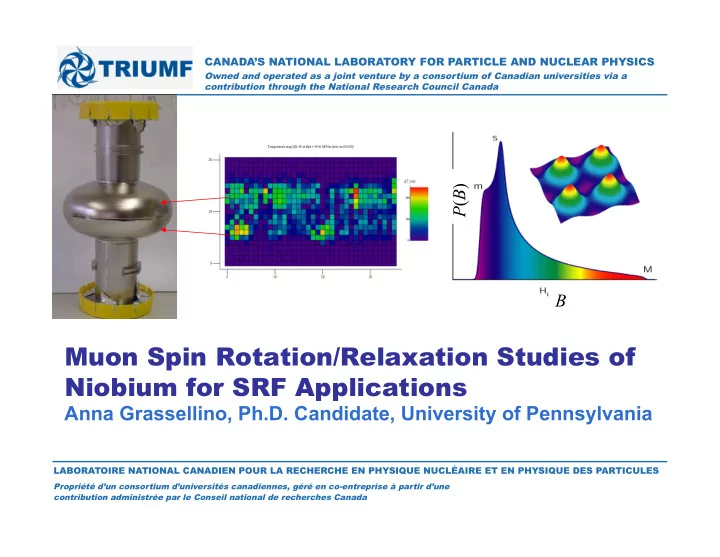
Muon Spin Rotation/Relaxation Studies of Niobium for SRF Applications

Anna Grassellino, Ph.D. Candidate, University of Pennsylvania

CANADA’S NATIONAL LABORATORY FOR PARTICLE AND NUCLEAR PHYSICS

Owned and operated as a joint venture by a consortium of Canadian universities via a contribution through the National Research Council Canada LABORATOIRE NATIONAL CANADIEN POUR LA RECHERCHE EN PHYSIQUE NUCLÉAIRE ET EN PHYSIQUE DES PARTICULES

Propriété d’un consortium d’universités canadiennes, géré en co-entreprise à partir d’une contribution administrée par le Conseil national de recherches Canada

B P(B)

slide-2
SLIDE 2

Superconductivity

7/22/11 Muon Spin Rotation/Relaxation Studies of Niobium for SRF Applications 2

Nb: (marginal) type 2

slide-3
SLIDE 3

Q-slope in Nb cavities

  • Degradation of quality factor with the applied RF field
  • Medium field Q-slope: gradual decrease in range Hpk~20-100 mT
  • Problem we want to study: High field Q-drop: sharp losses

above peak field ~80-100 mT

  • HFQS signature: 120C bake 48 hrs UHV improves/removes HFQS
  • Huge number of models in the history of SRF to explain HFQS
  • None so far unconfutably proves causes or mechanisms

7/22/11 3 Muon Spin Rotation/Relaxation Studies of Niobium for SRF Applications

slide-4
SLIDE 4

HFQS: early magnetic flux entry?

  • ‘Weaker’ superconducting regions allow ‘premature’ magnetic flux entry

in the Nb surface

  • Model never proved, but there are experimental hints towards it, eg:
  • Magnetization measurements of Nb samples with different treatments (Roy, Myneni):

field of entry varies in agreement with RF cavity performance

  • Cutout samples studies (Romanenko, Padamsee): decrease in average dislocation density
  • bserved by EBSD after 120C baking -working hypothesis – surface dislocations provide

sites for early flux penetration (below bulk Hc1)

7/22/11 4 Muon Spin Rotation/Relaxation Studies of Niobium for SRF Applications

P.Bauer, Review of Q-drop models Roy et al, Supercond. Sci. Technol. 22 (2009) 105014

slide-5
SLIDE 5

HFQS: how to prove if it’s early flux penetration?

  • GOAL: Design an experiment to prove magnetic flux entry as

the right or wrong mechanism behind HFQS

  • We study for the first time the field of first flux entry in RF

characterized samples  HFQS limited cutout samples: – Hot vs cold – Baked vs unbaked

  • Look for correlation field of flux entry – onset of HFQS (as per

thermometry characterization and after surface treatments like 120C baking and BCP)

  • Need of local, sensitive magnetic field probe: Muon Spin Rotation
  • We will see that the probe is able to measure with extreme

precision what fraction of the sample contains magnetic flux

7/22/11 Muon Spin Rotation/Relaxation Studies of Niobium for SRF Applications 5

slide-6
SLIDE 6

6

Samples used: cutouts from large/small grain BCP 1.5 GHz cavities (courtesy of Cornell)

RF Side Outer Side

  • A. Romanenko Ph.D. thesis

7/22/11 Muon Spin Rotation/Relaxation Studies of Niobium for SRF Applications

slide-7
SLIDE 7

7/22/11 7 Muon Spin Rotation/Relaxation Studies of Niobium for SRF Applications

slide-8
SLIDE 8

The muon is sensitive to the vector sum of the local

magnetic fields at its stopping site. The local fields consist of:

  • those from nuclear magnetic moments
  • those from electronic moments

(100-1000 times larger than from nuclear moments)

  • external magnetic fields
  • As a local probe, µSR can be used to deduce

Magnetic volume fractions

  • So we will be able to measure what fraction of the sample is

penetrated by magnetic flux as function of the field, and look for correlation with the RF performances

7/22/11 8 Muon Spin Rotation/Relaxation Studies of Niobium for SRF Applications

slide-9
SLIDE 9

Field of first entry measurement: Transverse-Field µSR

The information on local fields is contained in the time evolution of the muon spin Polarization which is described by: where G(t) is a relaxation function describing the envelope of the TF-µSR signal that is sensitive to the width of the static field distribution or temporal fluctuations.

7/22/11 9 Muon Spin Rotation/Relaxation Studies of Niobium for SRF Applications

slide-10
SLIDE 10

Forming the B-F count rate ratio:

µSR asymmetry spectrum

The count rates for opposing e+ detectors:

7/22/11 10 Muon Spin Rotation/Relaxation Studies of Niobium for SRF Applications

  • Frequency of oscillation  amplitude of local field
  • Amplitude of asymmetry  magnetic volume

fraction

Signal obtained: asymmetry spectrum

slide-11
SLIDE 11

7/22/11 Muon Spin Rotation/Relaxation Studies of Niobium for SRF Applications 11

TF-muSR setup for cutout samples studies

  • DC magnetic field perpendicular to sample, T=2.3K (and

measurements at 4.5K up to 8K), full scan in field 0-270mT

0.8 cm

H ~ kG

µ+

Samples:

  • 3 mm thick
  • 2cm diameter
  • Field at the

center ~ applied field (in the field range of interest -above 70mT, By(0,0) ~ 15mT behind Bappl)

Ag Mask Spin

Muon stopping depth ~300µm

Nb sample

slide-12
SLIDE 12

Zero Field muSR results

7/22/11 Muon Spin Rotation/Relaxation Studies of Niobium for SRF Applications 12

  • Representative ZF-µSR spectra of sample H1 at different temperatures, which

depends on lattice properties and impurity content

  • Temperature dependence of the muon hop rate in sample H1 before and after baking
  • Results consistent with what observed in previous µSR experiments on nitrogen

doped Nb

  • Measurement very interesting to be done in the surface layer to study hydrogen

trapping at the surface before/after baking

slide-13
SLIDE 13

Example of asymmetry signals, 30 and 120mT, 2.3K

7/22/11 Muon Spin Rotation/Relaxation Studies of Niobium for SRF Applications 13

H1 after 48 hours UHV 120C baking C1- cold spot large grain cutout, H1 – hot spot large grain cutout H1 after 48 hours UHV 120C baking plus 5µm BCP

slide-14
SLIDE 14

Fast Fourier Transform: internal field distribution

7/22/11 Muon Spin Rotation/Relaxation Studies of Niobium for SRF Applications 14

Fast Fourier transforms for sample H1 at 2.3K and respectively field levels: zero, 30mT, 120mT (peak of flux appearing at ~50mT), 270mT (peak of flux ~260mT)

 Suggests an inhomogeneous surface with preferential sites for flux entry Zero field 30mT 120mT 270mT

slide-15
SLIDE 15

7/22/11 Muon Spin Rotation/Relaxation Studies of Niobium for SRF Applications 15

Strong correlation fraction of sample NOT containing flux vs RF cavity performance

  • Onset of flux entry measured with muSR strongly correlates with onset of RF HF

losses as for thermometry characterization

  • Measurements consistent among all 6 samples tested
slide-16
SLIDE 16

Bent 115 123 108 106 122 83 66 95

Results - all samples

slide-17
SLIDE 17

Hot vs Cold sample before/after bake

7/22/11 Muon Spin Rotation/Relaxation Studies of Niobium for SRF Applications 17

slide-18
SLIDE 18

In conclusion

  • Muon spin rotation used @ TRIUMF for SRF

applications for the first time

  • Experiment results strongly suggest early magnetic

flux entry at ‘weaker spots’ as high field Q-slope losses mechanism in SRF Nb cavities

  • Invaluable tool for studying superconducting

parameters (λ, ξ, Hc1, Hc2…) and their temperature/field dependence

7/22/11 Muon Spin Rotation/Relaxation Studies of Niobium for SRF Applications 18

slide-19
SLIDE 19

Future direction

  • First establish baseline: study ultrapure Nb single crystal (field
  • f entry, superconducting parameters)
  • Understand which step of Nb processing for cavities causes

early flux entry  systematic study of field of entry for niobium with different treatments, degree of cold work, RRR…

  • Q0 and medium field losses studies: design apparatus for

parallel field measurements

  • Study quench and post baking losses spots (Romanenko,

FNAL)

  • Thin films and multilayer: accurate tool for field of entry
  • Beamtime already approved for these studies, to be scheduled

in fall

  • LEM for penetration depth and role of hydrogen in surface

7/22/11 Muon Spin Rotation/Relaxation Studies of Niobium for SRF Applications 19

slide-20
SLIDE 20

Thanks for your attention!

7/22/11 Muon Spin Rotation/Relaxation Studies of Niobium for SRF Applications 20

slide-21
SLIDE 21

Back up slides

7/22/11 Muon Spin Rotation/Relaxation Studies of Niobium for SRF Applications 21

slide-22
SLIDE 22

Pion Decay:

Conservation of Linear Momentum: µ+ emitted with momentum equal and opposite to that of the νµ

π+ → µ+ + νµ

Conservation of Angular Momentum: µ+ and the νµ have equal and opposite spin A pion resting on the downstream side of the primary production target has zero linear momentum and zero angular momentum. Weak Interaction: only “left-handed” νµ are created. Therefore the emerging µ+ has its spin pointing antiparallel to its momentum direction  100% spin polarized!

7/22/11 22 Muon Spin Rotation/Relaxation Studies of Niobium for SRF Applications

slide-23
SLIDE 23

µ+-Decay Asymmetry

Angular distribution of positrons from the µ+-decay. The asymmetry is a = 1/3 when all positron energies are sampled with equal probability.

7/22/11 23 Muon Spin Rotation/Relaxation Studies of Niobium for SRF Applications

slide-24
SLIDE 24

7/22/11 Muon Spin Rotation/Relaxation Studies of Niobium for SRF Applications 24

Courtesy of Jess Brewer, TRIUMF

slide-25
SLIDE 25

Thermometry characterization of losses

Fine grain Large grain

Thermometry maps, courtesy of Cornell

7/22/11 25 Muon Spin Rotation/Relaxation Studies of Niobium for SRF Applications

Example of T-map system, G.Ciovati Ph.D. thesis

slide-26
SLIDE 26

RF characterization of samples studied (A.Romanenko)

7/22/11 Muon Spin Rotation/Relaxation Studies of Niobium for SRF Applications 26

slide-27
SLIDE 27

Brandt – demagnetization

7/22/11 Muon Spin Rotation/Relaxation Studies of Niobium for SRF Applications 27

slide-28
SLIDE 28

Slope 1 Slope 2 H-int 0.003 1.7 132 Slope 1 Slope 2 H-int 0.12 32 124 Slope 1 Slope 2 H-int 0.27 52 123 Slope 1 Slope 2 H-int H6 0.1 5 111

slide-29
SLIDE 29

Knee points (RF heating vs field entry)

H1 H1 C1 H6 ΔB=16mT±1.5mT

slide-30
SLIDE 30

Processing

slide-31
SLIDE 31

Center vs Annular mask

7/22/11 Muon Spin Rotation/Relaxation Studies of Niobium for SRF Applications 31

slide-32
SLIDE 32

All samples results

7/22/11 Muon Spin Rotation/Relaxation Studies of Niobium for SRF Applications 32

slide-33
SLIDE 33

The count rates for opposing e+ detectors:

Zero-Field µSR: internal field distribution, magnetic impurities, trapped flux

The corresponding µ+ spin relaxation function is known as the Kubo-Toyabe function

7/22/11 33 Muon Spin Rotation/Relaxation Studies of Niobium for SRF Applications

slide-34
SLIDE 34

Upper critical field measurement

7/22/11 Muon Spin Rotation/Relaxation Studies of Niobium for SRF Applications 34

FFTs for sample H10 respectively for temperature and fields: (2.3K, 130mT), (4.5K, 200mT), (7.5K, 100mT), (7.5K, 140mT), (7.5K, 170mT), (7.5K, 200mT)

slide-35
SLIDE 35

Coexistence of different ‘superconducting’ regions?

7/22/11 Muon Spin Rotation/Relaxation Studies of Niobium for SRF Applications 35

slide-36
SLIDE 36

Coexistence of different ‘superconducting’ regions?

7/22/11 Muon Spin Rotation/Relaxation Studies of Niobium for SRF Applications 36

slide-37
SLIDE 37

(i = x, y, z) Nuclei with electric quadrupole moments (such as Cu and Y in YBa2Cu3O6+x) exert an effective dipolar field Bdip on the µ+. The static (in the µ+SR time window) internal fields are Gaussian distributed in their values and randomly oriented The corresponding µ+ spin relaxation function is known as the Kubo-Toyabe function

Nuclear Dipolar Relaxation

where Δ2/γµ

2 is the second moment of the field distribution.

7/22/11 37 Muon Spin Rotation/Relaxation Studies of Niobium for SRF Applications

slide-38
SLIDE 38

B P(B) Magnetic field distribution of a vortex lattice

Fourier transform Asymmetry spectrum plotted in a rotating reference frame

A(t)

7/22/11 38 Muon Spin Rotation/Relaxation Studies of Niobium for SRF Applications

slide-39
SLIDE 39

“Effective” Magnetic Penetration Depth: Magnetic Field Dependence

  • V3Si fully gapped
  • LuNi2B2C anisotropic gap
  • YBa2Cu3O6.95 dx

2

  • y

2-wave gap

  • NbSe2 multiband

JES, Rep. Prog. Phys. 70, 1717 (2007)

7/22/11 39 Muon Spin Rotation/Relaxation Studies of Niobium for SRF Applications

slide-40
SLIDE 40

Light guide Veto cup Sample

Detection in a cryogenic environment

7/22/11 40 Muon Spin Rotation/Relaxation Studies of Niobium for SRF Applications