Mutations What is a mutation? ANY change in the genetic material - PowerPoint PPT Presentation
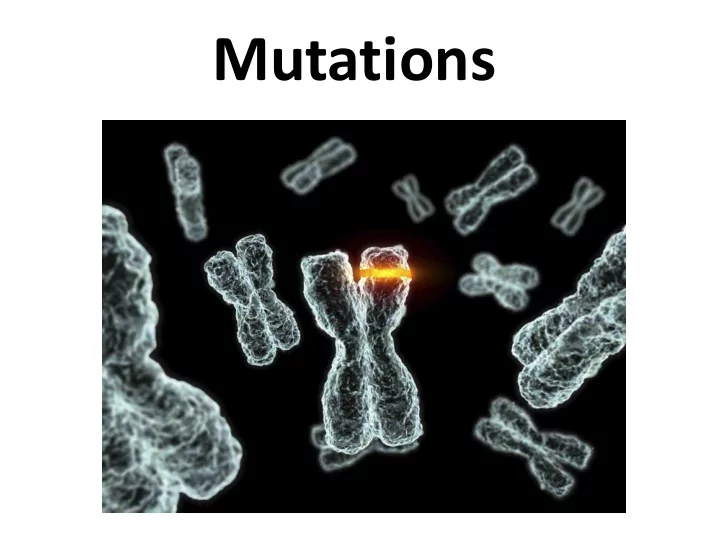
Mutations What is a mutation? ANY change in the genetic material (DNA) Mutations may be spontaneous or caused by mutagens (physical and chemical agents) Mutations are the primary source of genetic variation (not all are harmful)
Mutations
What is a mutation? • ANY change in the genetic material (DNA) • Mutations may be spontaneous or caused by mutagens (physical and chemical agents) • Mutations are the primary source of genetic variation (not all are harmful) • Mutations may provide an organism with a selective advantage (evolution)
Types of Mutations A. Chromosomal Mutations - large-scale mutations - affect many genes on a chromosome B. Gene Mutations - small-scale mutations - affect only one gene and therefore one protein
Types of Mutations Chromosomal Gene Mutations Mutations • Point Mutations • Silent • Inversion • Missense • Duplication • Nonsense • Deletion • Translocation • Frameshift Mutations • Nondisjunction • Insertion • Deletion
Chromosomal Mutations
Chromosomal Mutations • Mutations result from errors in mitosis or meiosis • Changes in chromosome number often result in new phenotypes, including sterility caused by triploidy and increased vigor of other polyploids • Changes in chromosomes number often result in human disorders with developmental limitations
Polyploid Plants • Multiple copies of each chromosome instead of only 2 copies of each chromosome (2n)
Human Disorders • Trisomy 21 (Down Syndrome) – three copies of chromosome 21 instead of two • Turner Syndrome (XO) – female with one X chromosome instead of two • Both disorders result from nondisjunction of chromosomes during Meiosis
Chromosomal Mutation: Nondisjunction
Other Chromosomal Mutations
Gene Mutations
Gene Mutations
Nucleotide-Pair Substitutions • Replacement of one nucleotide and its partner with another pair of nucleotides • Results in a silent, missense or nonsense mutation
Silent Mutation • Mutation has no effect on the encoded protein due to the redundancy of the genetic code
Missense Mutation • Changes one amino acid to another • May have little effect on the protein or drastically change the proteins function
Sickle Cell Anemia • Example of a missense mutation • Mutation affects a crucial area of the hemoglobin protein
Nonsense Mutation • Changes an amino acid into a stop codon • Translation terminated prematurely
Nucleotide-Pair Insertions and Deletions • Additions or losses of nucleotide pairs in a gene • Result in frameshift mutations
Frameshift Mutations • Usually affect the resulting protein more dramatically than other gene mutations
Effects of Mutations • DNA mutations can be positive, negative or neutral based on the effect or lack of effect they have on the resulting nucleic acid or protein • Example: Heterozygote Advantage – Tropical Africa where Malaria is common
Heterozygote Advantage
Effects of Mutations • Changes in genotype may affect phenotypes that are subject to natural selection • Genetic changes that enhance survival and reproduction can be selected by environmental conditions • Example: Antibiotic resistance and pesticide resistance mutations
Antibiotic Resistance
Pesticide Resistance
Recommend
More recommend
Explore More Topics
Stay informed with curated content and fresh updates.