MVDC Power System L. J. Rashkinl, J. C. Neely", D. G. - - PowerPoint PPT Presentation

mvdc
SMART_READER_LITE
LIVE PREVIEW

MVDC Power System L. J. Rashkinl, J. C. Neely", D. G. - - PowerPoint PPT Presentation

This paper describes objective technical results and analysis. Any subjective views or opinions that might be expressed in the paper do not necessarily represent the views of the U.S. Department of Energy or the United States Government.


slide-1
SLIDE 1

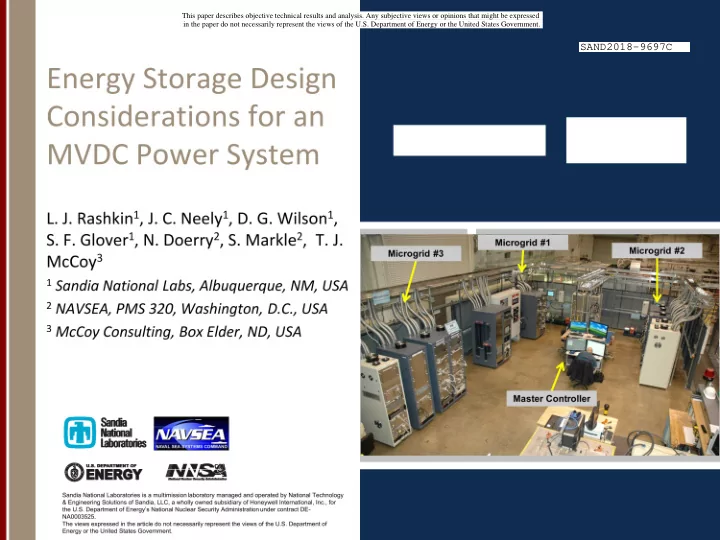
Energy Storage

Design Considerations for

an

MVDC

Power

System

L.

  • J. Rashkinl,

J.

C. Neely", D.

G.

Wilson',

S.

F.

Glover',

N. Doerry2

,

S.

Markle2

,

T.

J.

McCoy3

Sandia National

Labs, Albuquerque,

NM,

USA

2

NAVSEA,

PMS

320, Washington,

D.C.,

USA

3

McCoy

Consulting,

Box

Elder,

ND, USA

Sandia

National Laboratories

U.S.

DEPARTMENT OF

ENERGY

VAL SEA

S COMMAND

Iw mArqkv,9

A

k4

V

Sandia National Laboratories

is a multimission laboratory

managed and

  • perated by

National Technology

&

Engineering Solutions

  • f

Sandia, LLC,

a

wholly

  • wned

subsidiary

  • f

Honeywell

International, Mc., for the U.S.

Department

  • f

Energys

National Nuclear Security Administration under contract

DE- NA0003525. The views expressed

in the article

do

not necessarily represent the views

  • f

the U.S. Department

  • f

Energy

  • r

the United States Government.

SAND2018-9697C

This paper describes objective technical results and analysis. Any subjective views or opinions that might be expressed in the paper do not necessarily represent the views of the U.S. Department of Energy or the United States Government.

slide-2
SLIDE 2

Outline

Introduction

Model Development

■ System Layout ■ Control

Algorithm

Load

Profiles

■ Simulation Results

Energy Storage Requirements

■ Power

and Energy Requirements

■ Frequency

Analysis

■ Conclusions

Sandia National

Laboratories

2

slide-3
SLIDE 3

Introduction

Sandia National

Laboratories

■ Controls

are recognized as a primary challenge to

fielding

a

medium

voltage

DC

(MVDC)

power

system

for future Navy ships

■ The

service power

demands

  • f

these

future naval warships

may

include

advanced mission systems which need

large

amounts

  • f

power

in short

pulses

Energy storage

is a key

component

  • f

shipboard MVDC

architecture

■ Minimum

sizing

■ Trade

  • ffs between

performance and

size

3

slide-4
SLIDE 4

Scaled notional model

  • f

ship power

system

was

developed

  • An

electric

ship

is emulated

using

the Secure

Scalable Microgrid

Testbed

(SSMTB)

hardware

at

Sandia National Laboratories

(SNL)

3

networked

microgricls

PM

Gene

Pulsed

d En

1.7

kW d

Microgrid 3

DC Bus

  • Power

electronics interfaces

  • Agent

based

control

  • Repeatable

experiment

profiles

  • Simulink

model

library

Vdc rd

PM

Gene

23

Vdc 200 Vdc

Sandia National

Laboratories

M

rid

DC

Bus

E

ridl

2

DC

Bus

4

slide-5
SLIDE 5

Optimization

control

determines

set-points

based

  • n

system

status

  • Based
  • n

guidance

control algorithm

  • Reads

terminal voltages,

  • utput

currents,

and

state

  • f

charge

(SOC)

for

all sources

  • Estimates

load

  • Determines

power

demands

  • Sets
  • perational

set points for

sources

  • Filter used

to

determine

power

balance

between

energy

storage

and

generator resources

Guidance

Control Sandia

National Laboratories

Load Estimator IDC-DC Power

Command

Filter Compute

:

iload (V;

yor,o,

pf0,-

Pload ITES•

2V;

¡Li = •

rl iV b

pp )1

s

2

I 4rLiaikProf

v

:

A A

.

0* .*

A1,1L1

Diesel Generator 1 Programmable

.*

11

2,1L'

Vb,2,1b,2,Vs2

Loads

Diesel Generator

2

cnr

,

Pulsed

vb53

5 lb,

3

5 +,71-11

.,-.Esl

Load Storage

1

ir

Energy

***

5

slide-6
SLIDE 6

Load

vignettes

were

  • btained

for

different

types

  • f

loads

Mission Load

#1

80 40 80

  • 2

40

a)

  • a_
  • 80

40

e•

  • "•••

2

Propulsion

Load

200 400 600

Service

Load

Mission Load

#2

,80

2

a)

  • 11111111

11111111 11 0

  • 200 400 600

Time (sec)+

200 400 600

Time (sec)

80

2

4

a)

Sandia National

Laboratories

200 400 600

,Time

(sec)

200 400 600

Time (sec) Total

Load

6

A.M. Cramer,

X.

Liu, Y.

Zhang,

  • J. D.

Stevens and

E.

L. Zivi,

"Early-stage shipboard power

system simulation

  • f
  • perational

vignettes

for dependability

assessment

"

2015

IEEE Electric

Ship Technologies

Symposium

(ESTS), Alexandria,

VA,

201

S_ pp.

382-387_

slide-7
SLIDE 7

Potential

shipboard

load profiles are

identified and

positioned on

power

system

Propulsion load

60

MW

variable load

■ Split between

Microgrid

1

and

2

■ Service

load

20

MW

variable load

■ Microgrid

3

Mission Load

1

10

MW

pulsed load

■ Microgrid

3

Mission Load

2

700

kW

pulsed load

■ Microgrid

3

Sandia National

Laboratories

slide-8
SLIDE 8

Vignettes

were

scaled

to

hardware

capabilities

  • Original

system

  • 82

MW

  • 20

kV

  • SSMTB

system

  • 5

kW

  • 200

V

  • Four

load cases considered

  • No

pulsed loads

  • Mission

load 1

  • nly
  • Mission

load

2

  • nly
  • All Mission loads

Total

Power

for

200

V

DC

bus

4.5

4

  • ,

3.5

S 3

,_ 2.5

I

a)

, 2

1.5

1

0.5

,.,-,..,-,..,

Sandia National

Laboratories

100 200 300 400 500 600 Time

(sec)

  • Five

filter

constants considered

  • 0.1356

sec

  • 0.5299

sec

  • 2.0049

sec

  • 7.5117

sec

  • 28.5643

sec

8

slide-9
SLIDE 9

Load Responses

were

simulated

for

each

controller

time

constant

Sandia National

Laboratories

  • Faster

time

constants

result

in more

pulse delivery

from

generators

  • Slower

time

constants

result

in more

pulse delivery

from

storage

Controller

time constant

  • f

0.1356 sec

15 10

5

  • 5
  • 10
  • 15
  • 20

11111111-

  • Pulsed

Load

Bow

Storage

Starboard Storage

— — —

Port Storage

Starboard Generator

— — —

Port Generator

220 260

t

(sec)

,

200 400

Time (sec)

15 10

5

  • 5
  • 10
  • 15

600

  • 20

Controller

time constant

  • f

28.56

sec

— Pulsed

Load

— Bow

Storage

Starboard Storage

— — Port

Storage

Starboard Generator

— — Port

Generator

11111111

220

t (sec),

260

200 400

Time (sec)

600

9

slide-10
SLIDE 10

Speed

(RPM)

Load Responses

were

simulated

for

each

controller

time

constant

  • Inertia and

rate

  • f

power

extraction

govern speed

variation

  • Faster

time

constant

results

in more

spikes

in speed

Comparison

  • f

Generator

Speeds

1000 980 960 940 920

Reference

Speed

Generator

Speed

Experiment

1

Generator

Speed

Experiment

5

900

Sandia National

Laboratories

100 200 300 400 500 600

t

(sec)

10

slide-11
SLIDE 11

Control

effort

is considered by

a set

  • f

cost functions

Cost

is determined

by the

functions:

If NG„,

J

1 =

I

j

(ib,(r)—ib,

)

dr

to i ) t f

(

N ES

, 2

J

2

=

f I(iEsi(r)—iESI)

lo A 1

)

dr

Sandia National

Laboratories

where

ibi(t)

are

the

currents delivered

to the

respective busses

by the

starboard

and

port

generator converters as a

function

  • f

time,

N

G ens is the

number

  • f

generators,

and

iEsi(t)

are

the bus

currents

from

the

NEs

energy

storage systems.

A

1

t

r

ib,

=

ib,(T)ch

t—T

ia

A

1

1ESi =

.i. i

ESi

(r)dt

T

fa t—T

f

where

T

fa is

the

period

  • f

the

fast

average.

11

slide-12
SLIDE 12

System behavior

is dependent

  • n

load and control

filter

120

8

cc

  • No

Mission Loads

  • Mission 1 Only

Mission

2

Only

0 All Mission Loads

Greater

Filtering

  • f

Generator

Power Cornmand

50 100 150

J 1

(Generator

Control

Effort Fast

Average) 200

Sandia National

Laboratories

12

slide-13
SLIDE 13

Energy

storage

power

and

energy requirements

are

determined

from

simulations

10

10 4 105 Energy

(Wh)

No

Mission

Loads

Mission

Load

2

—Mission Load

1

  • All

Mission

Loads

Sandia National

Laboratories

13

slide-14
SLIDE 14

Energy Storage

technologies vary

in specific

power

/

specific

energy and frequency response

Energy

storage

strategies

vary

in the

technology used;

each

technology

has

different

size/weight

and

performance

capabilities,

examples

include:

  • Flywheel

energy

storage

  • Electrochemical

Cells/Batteries

(i.e. Lithium lon)

  • Super

Capacitor

Capabilities

are

usually

identified over

a

range

  • f

values

based

  • n

demonstrated

systems

[1]

Technology Energy Density

(Wh/L) Power

Density

(W/L)

Specific

Energy

(Wh/kg)

Specific

Power (W/kg)

Approx. Bandwidth (Hz) Flywheel 20-90 1000-5000 5-100 400-1500

20

Lithium-lon 150-500 1500-10000 75-200 150-2000

80

Super Cap 10-30 >100000

2.5-15

500-10000

80

Sandia National

Laboratories

[1] Xing Luo, Jihong Wang,

Mark Dooner, Jonathan

Clarke,

Overview

  • f

current

development

in electrical energy

storage technologies

and

the application potential

in power

system

  • peration,

Applied Energy, Vol 137,

2015, pgs 511-536,

14

slide-15
SLIDE 15

Storage technology

and

system

size

are

determined

from

a Ragone

plot

106

bA

P-4

102

rz1-1

100

Elastic

Element

100,000

kg

Fneumat,c

101.g

, Flywheco 100 kg 1nternal

Combust

  • n

1000 kg *

10,000

kg

Fuel

Cell

Batte

100 102

Specific

Energy

(Wh/kg)

104

Sandia National

Laboratories

15

slide-16
SLIDE 16

Energy

storage

frequency requirements determined

from

chirp

response

  • f

the system

  • Applied

a

log-sine chirp

to the

load

  • n

microgrid

3

  • A

sin

(2n

  • f

(!

  • cii

/ti t)

  • Where

f

  • is the

initial

frequency

in Hz

and

f

i is the

frequency

at

time

t1 in Hz

  • System

input

is load power

  • n

microgrid

3

  • System
  • utput

is the

  • utput

power

  • f

the generators and energy

storage

systems

  • Frequency

domain

behavior

  • f

inputs

and

  • utputs

are

found

using a fast Fourier

transform

(MATLAB

fft

function)

Sandia National

Laboratories

16

slide-17
SLIDE 17

Frequency Response

  • f

diesel

generators

show

they

are most

effective

at

low

frequencies

= 0.1356

  • 7

=

0.529g

7

  • 2.

UU4 r

7

=

28.5643

20

  • 60
  • BO

20

  • 200
  • °

101

102 103

10-1

1

1

........

10 Frequency (Hz)

.1

Sandia National

Laboratories

17

slide-18
SLIDE 18

Results

show

that

the energy

storage

is

most

needed

at

frequencies

above

10

Hz

Microgrid

1&2

r

=

0.1356

.

0.5299

I =

2.

0049

=

7.5117

7

  • 28.5643

20

a 0

  • 20
  • 40-
  • 60-
  • 80

10-2 10-1 10° 101 102 200

Microgrid

3

Sandia National

Laboratories

=

0.1356

T

.

0.5299

T

=

2.

0049

r=

7.5117

=

28.5643

20

a 0

  • 0 -20-

cy) -40-

1

1 .3 -60-

103

  • 80

10-2 200

&D.-- 100 cy)

1007

j

  • 103

200

10-2

C100

(73

I-100

  • 200

10-2 10-1 10° 101

Frequency

(Hz) 102 10-1 10° 101 102 103 10-1 10° 101 102 103

Frequency

(Hz)

18

slide-19
SLIDE 19

Summary

and

Conclusions

Analysis

  • f

notional ship microgrid was

performed

■ Requirements

for

the energy storage system

in terms

  • f

the

specific

energy and

power

densities

  • f

the system

were found

■ Requirements

were

applied

to

a Ragone

plot

Flywheel storage technology

would meet the energy and power requirements

■ Frequency

behaviour

  • f

the system

shows

that

this

technological solution may

not be

able

to supply the necessary frequency content

■ This

result

calls

for a hybrid energy storage solution that could

combine

the advantages

  • f

multiple different

technologies

Future

work

■ Optimisation of

a hybrid

energy

storage design to

meet

the

power demands

  • f

such a system.

Sandia National

Laboratories

19

slide-20
SLIDE 20

For

more

information

■ "Deriving

specifications

for coupling

through

dual-wound

generators"

■ "Nonlinear

power

flow

control design

methodology

for

navy

electric

ship microgrid

energy

storage

requirements"

Sandia National

Laboratories