SLIDE 1
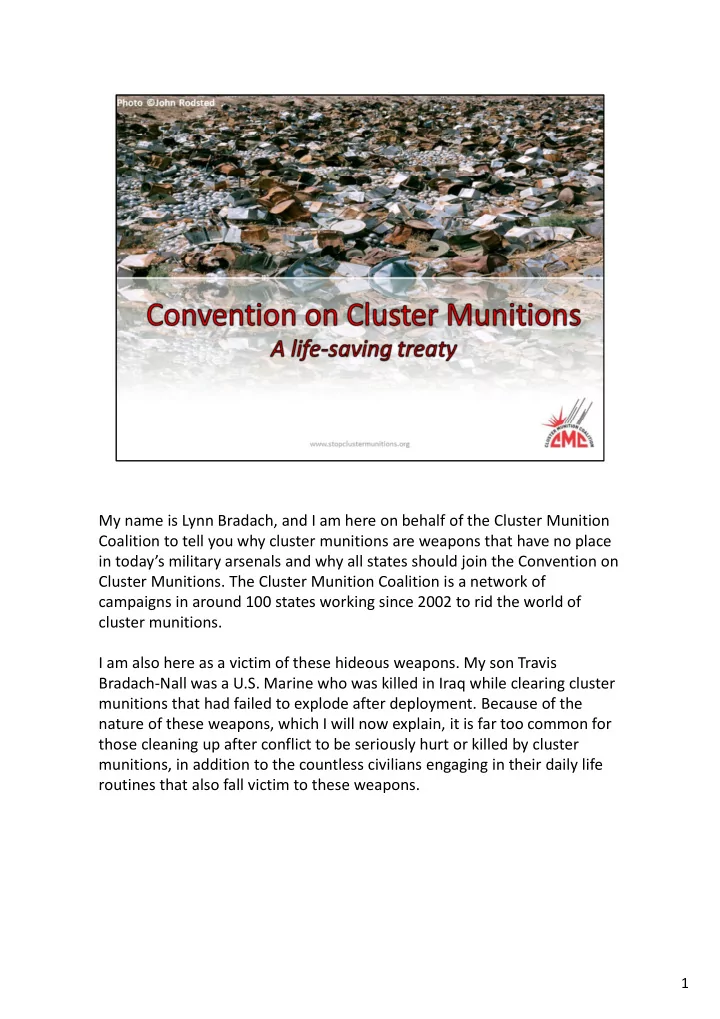
My name is Lynn Bradach, and I am here on behalf of the Cluster Munition Coalition to tell you why cluster munitions are weapons that have no place in today’s military arsenals and why all states should join the Convention on Cluster Munitions. The Cluster Munition Coalition is a network of campaigns in around 100 states working since 2002 to rid the world of cluster munitions. I am also here as a victim of these hideous weapons. My son Travis Bradach-Nall was a U.S. Marine who was killed in Iraq while clearing cluster munitions that had failed to explode after deployment. Because of the nature of these weapons, which I will now explain, it is far too common for those cleaning up after conflict to be seriously hurt or killed by cluster munitions, in addition to the countless civilians engaging in their daily life routines that also fall victim to these weapons.
1
SLIDE 2
I will start by explaining what cluster munitions are for those not familiar with the weapon. A cluster munition, or cluster bomb , is a weapon containing multiple – often hundreds – of small explosive submunitions, or bomblets. Cluster bombs are dropped from the air or fired from the ground and are designed to break open in mid-air, releasing the submunitions and saturating an area that can be the size of several football fields. Cluster Munitions were designed for wide-area targets such as columns of tanks or airfields, but are now used more often in populated areas. In other words, cluster bombs are what is called “area effect” weapons. This means that their impact is not limited to one precise target, such as an individual tank, but is meant to spread explosives and shrapnel across a wide area. At least 20 government armed forces have used cluster munitions during conflicts in 36 countries and four disputed territories since the end of World War II. During the 1970s, the USA used massive numbers of cluster bombs in Cambodia, Laos and Vietnam. More recently, cluster bombs were used in the Gulf War, Chechnya, the former Yugoslavia, Afghanistan, Iraq, Lebanon, Georgia, Libya, Syria, South Sudan and Ukraine. 2
SLIDE 3
It has been well established that cluster munitions have a devastating impact on the lives of civilians, both at the time of use and long afterwards. Given their wide area footprint of destruction, it is very difficult and often impossible to use cluster munitions in a manner that can discriminate between a civilian or a military target, which is a requirement of international humanitarian law. Cluster Munitions were designed for wide- area targets such as columns of tanks or airfields, but given the nature of modern warfare are now used more often in populated areas. Their wide area of destruction means that the weapon causes massive harm when deployed, anyone within each strike area is likely to be injured or killed. In addition, cluster munitions are recognized to have a significant failure rate, which mean unexploded submunitions remain after use and threaten lives long after a conflict has ended. Failure rates in Lebanon (2006) for example were around 25%. Land becomes uninhabitable and economically desolate - hampering subsistence and leaving a severe risk to children and their families, impacting their daily lives.
3
SLIDE 4
4
This slide illustrates what a cluster strike would look like on downtown Geneva. The red area is the area the strike is expected to cover if all goes as intended – approximately 90,000m2. As you can see, it would be impossible to differentiate between military targets and civilian buildings in such an attack. Therefore when cluster bombs are used in or near populated areas civilian casualties will almost always result.
SLIDE 5 5
Cluster munitions are notoriously unreliable, leaving very dangerous unexploded submunitions after conflicts end We have also seen over decades of use that from 2 to 25% or more of the submunitions dispersed from cluster munitions fail to explode after deployment. As a result, large numbers of the small, but highly powerful, bomblets are left on the ground, lying like landmines waiting to kill or injure anyone that might come into contact with them, even long after a conflict has ended. And though they are small, their explosive force is much stronger than landmines, resulting more often in death or severe injuries from shrapnel including loss of limbs and blindness. As you can see in these pictures, the submunitions aren’t necessarily just on the ground, but can get stuck in vegetation, or on roofs. Clearly such contamination prevents people from rebuilding their livelihoods after
- conflicts. The explosive contamination hampers post-conflict development, access to
schools and hospitals, and renders agricultural land inaccessible. Farmers working their land can cause bomblets to explode. Children are often attracted by the curious shape, colour and small size of the bomblets and have mistaken them for toys, killing and injuring themselves and others from picking them up or playing with them.
SLIDE 6 Ten of thousands of civilians worldwide have been killed or injured by cluster bombs. The Cluster Munition Monitor reports that where the status was recorded, civilians accounted for the majority of casualties (94%). Most civilian casualties were male (82%) and a significant proportion were children (in fact 40%). The small size and curious shapes of the bomblets dispersed by cluster bombs, are easily mistaken for a toy or a ball to play with, making them particularly interesting to children. 60% of cluster bomb casualties are injured while carrying out normal daily, livelihood activities in usual and accustomed places. Like this man in the center
- f the picture injured while fishing, people continue to fall victim to the
submunitions decades later. Because of the lethal charge of cluster bomblets, often it is not just one person injured or killed in a blast but two or three. Countries with the highest number of casualties include Lao, Iraq, Vietnam, Afghanistan and Lebanon. Most recently over two thousand people have already fallen victim to the widespread and ongoing cluster munition use in Syria. Of those killed in Syria from cluster munitions in 2012 and 2013, 97% were civilians 6
SLIDE 7 In response to the growing awareness about the problem of cluster munitions, especially in light
- f massive use and subsequent contamination in Lebanon in 2006, there was growing pressure
for a ban on cluster munitions. The goal was to prevent further harm to civilians given the large number of stockpiled cluster munitions with the potential for being used by states worldwide. When attempts to address the problem through the consensus-based Convention on Conventional Weapons failed to produce results, Norway launched an initiative in February 2007, known as the Oslo Process, which set out to create an international treaty by the end of 2008. The treaty, called the Convention on Cluster Munitions (CCM), was negotiated and formally adopted by 107 countries at the Dublin Diplomatic Conference in May 2008. The Convention on Cluster Munitions is designed to put an end for all time to the problem of cluster munitions. It completely bans the use, production, stockpiling, and transfer of cluster munitions; requires destruction of stockpiled cluster munitions, clearance of contaminated land, protects the rights of victims of these weapons, and entitles affected states to international assistance to meet their legal obligations. In other words, the convention aims to prevent further harm from cluster munitions and to redress the impact of past use. The Convention was signed by 94 states at a conference in Oslo, Norway on 3 – 4 December
- 2008. It entered into force on 1 August 2010, a very swift pace for a disarmament treaty.
As of September 2014, a total of 114 government have joined the Convention on Cluster Munitions including stockpilers, former users and producers of the weapon as well as the majority of affected countries
7
SLIDE 8 The CCM, like the mine ban treaty, has both disarmament and humanitarian
- bjectives – it bans a weapon and calls for its complete destruction, while
seeking to redress past use of the weapon The use, production, stockpiling, and transfer of cluster bombs are forbidden in all circumstances. States must not assist, encourage or persuade anyone to engage in any activity banned by the Convention. Other requirements are listed on the screen and in your handouts :
- States must destroy all cluster bomb stockpiles within eight years of joining
the Convention. Until they are destroyed they can not be used or transferred.
- States must clear all known cluster bomb contaminated areas within 10 years
- f joining the Convention. States must educate people to the risks of cluster
- bombs. States that have used cluster bombs are ‘strongly encouraged’ to help
clear and destroy them, including providing detailed information on when and where they were used.
- Victim assistance: States must respect the human rights of all cluster bomb
victims, including those directly injured, their families and communities, by providing medical care, rehabilitation, psychological and financial support.
- International cooperation and assistance: All States able to do so must assist
states affected to clear the land, destroy stocks, provide risk education and VA
- States must engage with states not parties to push them to join the
Convention and to refrain from using cluster munitions.
- There are other requirements on reporting and national implementation
measures, plus an article on compliance based on open consultation and cooperative among states 8
SLIDE 9
114 countries have already joined the 2008 Convention on Cluster Munitions, of which 86 are States Parties and the remaining 28 states are signatories and have yet to ratify the convention. 83 states are still outside the convention and will need to join by accession (a one-step process instead of signature and ratification). The lists are on the slide and on handouts if you are not sure about your country’s status 9
SLIDE 10 Historically, a total of 34 states have developed or produced more than 200 types of cluster munitions. Eighteen of these states have now ceased the production of cluster munitions. 22 States Parties have destroyed 1.16 million cluster munitions and nearly 140 million
- submunitions. This represents the destruction of 80% of cluster munitions and 78% of
submunitions declared as stockpiled by States Parties. Major stockpilers such as Belgium, and Denmark, the Netherlands, and the United Kingdom have already finished destroying all their stocks. The stigma against cluster munitions is strong as a result of the ban. Military powers that haven’t joined the Convention yet, haven’t used cluster munitions since the introduction
- f the Convention. Use of cluster munitions has only occurred in a few states in recent
years, with the most significant use taking place in Syria, a state that has shown complete disregard for international humanitarian law across the board. Each incident of use has been followed by strong international condemnation and usually denial or contrition by the state in question. To-date, a total of 157 countries have condemned use of cluster munitions in the context of ongoing use in Syria, most through two UN General Assembly resolutions. Yet ongoing use of cluster munitions in Syria and Ukraine, and with stockpiles of cluster munitions still remaining and some countries still producing, we must continue to stand up globally against the weapon. To prevent future use , more countries need to join and ratify the Convention. With every new country that becomes a state party, the global norm rejecting these weapons is reinforced.
10
SLIDE 11 There are many reasons why states should join the Convention banning cluster munitions:
- First, cluster munitions are outdated weapons. They were designed for Cold War-era operations
with large formations of tanks or troops. Today’s combat often takes place in urban environments, however, where there are a high number of civilians present. The weapons are therefore less effective, and the humanitarian impact is magnified.
- Second, using cluster munitions is often counterproductive for modern warfare. They interfere
with military operations, as contaminated areas reduce the mobility of the forces that use them and endanger friendly troops. After the 2003 war in Iraq, US army forces described cluster
munitions as “battlefield losers” because they were often forced to advance through areas contaminated with unexploded duds. The harm caused to civilians also means continued use of
the weapons would increase hostility among the local population towards the users.
- Third, cluster munitions are poor defensive weapons. Some states say they would only use them
defensively, meaning to fight off an attack on their own territory. But if used inside their own borders, they will leave behind large numbers of explosive submunitions that would endanger a state’s own population.
- Fourth, there is now a strong international stigma against the use of cluster munitions.
After each of the small number of incidents of recent use, a large number of states have condemned such use, including states still outside the convention. In addition, responsible state almost always has strongly denied such use knowing the shame associated with the
- weapon. Even some arms manufacturers are starting to show reluctance to be associated
with cluster munition production. Finally, these weapons are now banned under international humanitarian law, meaning they should no longer be part of the arsenal of any state that wants to operate in full respect of IHL. In other words, it is no longer strategically sensible or politically acceptable to use cluster munitions, and therefore there is no point in keeping them. 11
SLIDE 12 The reasons I’ve just laid out apply mainly to those states that have stockpiles or
- therwise might plan to use cluster munitions. But it is important that all nations
prioritise joining or ratifying the treaty, no matter whether or not they have ever used, produced, or stockpiled cluster munitions. By joining the Convention states will help: Prevent further harm and end indiscriminate killing – cluster munitions are being used in Syria and Ukraine, right now. We must stop use of this horrific weapon and prevent civilians in other countries suffering from it in future conflicts. The only sure way is through the Convention on Cluster Munitions. Show solidarity with those that are, or have, suffered from cluster munition use Shows states’ solidarity with people and communities affected by cluster munitions worldwide, including the people of Syria Show leadership & be among a diverse group of states: States from every region of the world have joined the Convention, showing that a wide variety of states with different political, economic, and security perspectives all support the cluster munitions ban. At least 43 countries that have stockpiled, produced, and/or used cluster munitions have joined the Convention, including key international and regional military powers. Several
- f the world’s most affected states have joined the Convention, including Lao PDR,
Afghanistan, Iraq and Lebanon. Strengthen the global stigma: The stigma on cluster munitions is strong, but to make it even stronger, we need more countries to join the treaty Promote human security & address armed violence: Some countries suffer from cluster munitions, some suffer more from other explosive remnants of war or other threats to the security of civilians. By joining international instruments to protect civilians, states help to reinforce each other’s efforts to promote peace and security for all. Finally, as my colleague from the CMC in Zambia always says, make your children proud. This is the feel good part of international diplomacy. Be part of a life-saving convention that every day is saving lives!
12
SLIDE 13 Finally, there are specific benefits of joining for those states that are affected by cluster munitions or stockpile them. As I previously mentioned, the Convention has a specific provision that requires all states in a position to do so do provide technical, financial or material support to help them destroy stocks, clear their land, or provide support to victims. Countries would benefit from clearing their contaminated land that could be used again, hence boosting local economies and benefitting people who were for years denied the right to use their land or source of survival. Most
- f the affected areas are poor, agricultural land.
Many states are already in the process of destroying cluster munitions past their shelf life as part of a normal stockpile management process, or of supporting victims of cluster munitions as part of health, education or social systems. By joining the convention, such states would have access to additional resources to do so.
13
SLIDE 14 I hope that this presentation has convinced you of the urgent need to take action against cluster munitions, and I ask you on behalf of victims worldwide to make the fight against cluster munitions your personal cause. You can be the difference that pushes your ratification or accession through. When you go home, we ask you to work with fellow members of parliament to ensure the Convention is ratified and acceded to in the coming months. Most signatory states have had six years to ratify – that is far too much
- time. Fix a maximum deadline to ratify or accede, such as by the Convention’s First
Review Conference, which will take place in Dubrovnik, Croatia in September 2015. And in the meantime, you can still be a champion against cluster munitions! Promote the treaty and the norm by actively discouraging any use by states in conflict, condemning any new use that might take place, and bringing your state closer to the convention through a national moratorium on production, transfer and use. We have given out memos about three cases of ongoing or recent use. We urge you to publicly condemn this use and call for it to stop immediately in Syria and Ukraine, where use is
- ngoing. Even if your country has already spoken out, we urge you to keep doing so
until the use ends. The Cluster Munition Coalition would be pleased to support you in your efforts to work towards ratification or accession. We have materials about the nature of the problem, about the Convention, and other reports and policy documents that can help you promote the Convention. We also have member organizations present in dozens of states that would be available to work with you more directly on technical or political
- issues. We look forward to hearing from you.
14
SLIDE 15
Thank you!
14