N-Gram Model Formulas Estimating Probabilities N-gram conditional - - PowerPoint PPT Presentation

n gram model formulas estimating probabilities
SMART_READER_LITE
LIVE PREVIEW

N-Gram Model Formulas Estimating Probabilities N-gram conditional - - PowerPoint PPT Presentation

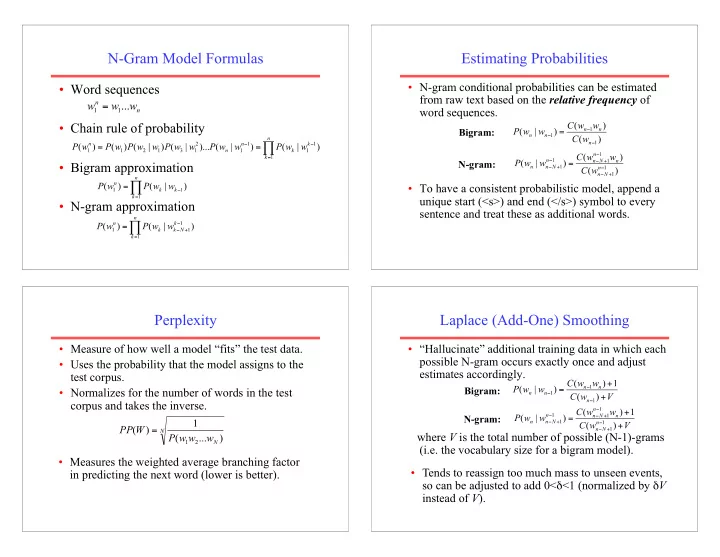
N-Gram Model Formulas Estimating Probabilities N-gram conditional probabilities can be estimated Word sequences from raw text based on the relative frequency of word sequences. Chain rule of probability Bigram: N-gram: Bigram


slide-1
SLIDE 1

N-Gram Model Formulas

  • Word sequences
  • Chain rule of probability
  • Bigram approximation
  • N-gram approximation

Estimating Probabilities

  • N-gram conditional probabilities can be estimated

from raw text based on the relative frequency of word sequences.

  • To have a consistent probabilistic model, append a

unique start (<s>) and end (</s>) symbol to every sentence and treat these as additional words.

Bigram: N-gram:

Perplexity

  • Measure of how well a model “fits” the test data.
  • Uses the probability that the model assigns to the

test corpus.

  • Normalizes for the number of words in the test

corpus and takes the inverse.

  • Measures the weighted average branching factor

in predicting the next word (lower is better).

Laplace (Add-One) Smoothing

  • “Hallucinate” additional training data in which each

possible N-gram occurs exactly once and adjust estimates accordingly. where V is the total number of possible (N-1)-grams (i.e. the vocabulary size for a bigram model).

Bigram: N-gram:

  • Tends to reassign too much mass to unseen events,

so can be adjusted to add 0<!<1 (normalized by !V instead of V).

slide-2
SLIDE 2

Interpolation

  • Linearly combine estimates of N-gram

models of increasing order.

  • Learn proper values for "i by training to

(approximately) maximize the likelihood of an independent development (a.k.a. tuning) corpus.

Interpolated Trigram Model: Where:

6

Formal Definition of an HMM

  • A set of N +2 states S={s0,s1,s2, … sN, sF}

– Distinguished start state: s0 – Distinguished final state: sF

  • A set of M possible observations V={v1,v2…vM}
  • A state transition probability distribution A={aij}
  • Observation probability distribution for each state j

B={bj(k)}

  • Total parameter set !={A,B}

Forward Probabilities

  • Let #t(j) be the probability of being in state j

after seeing the first t observations (by summing over all initial paths leading to j).

7

Computing the Forward Probabilities

  • Initialization
  • Recursion
  • Termination

8

slide-3
SLIDE 3

Viterbi Scores

  • Recursively compute the probability of the most

likely subsequence of states that accounts for the first t observations and ends in state sj.

9

  • Also record “backpointers” that subsequently allow

backtracing the most probable state sequence.

! btt(j) stores the state at time t-1 that maximizes the probability that system was in state sj at time t (given the observed sequence).

Computing the Viterbi Scores

  • Initialization
  • Recursion
  • Termination

10

Analogous to Forward algorithm except take max instead of sum

Computing the Viterbi Backpointers

  • Initialization
  • Recursion
  • Termination

11

Final state in the most probable state sequence. Follow backpointers to initial state to construct full sequence.

Supervised Parameter Estimation

  • Estimate state transition probabilities based on tag

bigram and unigram statistics in the labeled data.

  • Estimate the observation probabilities based on tag/

word co-occurrence statistics in the labeled data.

  • Use appropriate smoothing if training data is sparse.

12

slide-4
SLIDE 4

Context Free Grammars (CFG)

  • N a set of non-terminal symbols (or variables)
  • $ a set of terminal symbols (disjoint from N)
  • R a set of productions or rules of the form

A"%, where A is a non-terminal and % is a string of symbols from ($& N)*

  • S, a designated non-terminal called the start

symbol

Estimating Production Probabilities

  • Set of production rules can be taken directly

from the set of rewrites in the treebank.

  • Parameters can be directly estimated from

frequency counts in the treebank.

14