N O F I N A N C I A L D I S C LO S U R E S OBJECTIVES I recommend - - PowerPoint PPT Presentation

n o f i n a n c i a l d i s c lo s u r e s
SMART_READER_LITE
LIVE PREVIEW

N O F I N A N C I A L D I S C LO S U R E S OBJECTIVES I recommend - - PowerPoint PPT Presentation

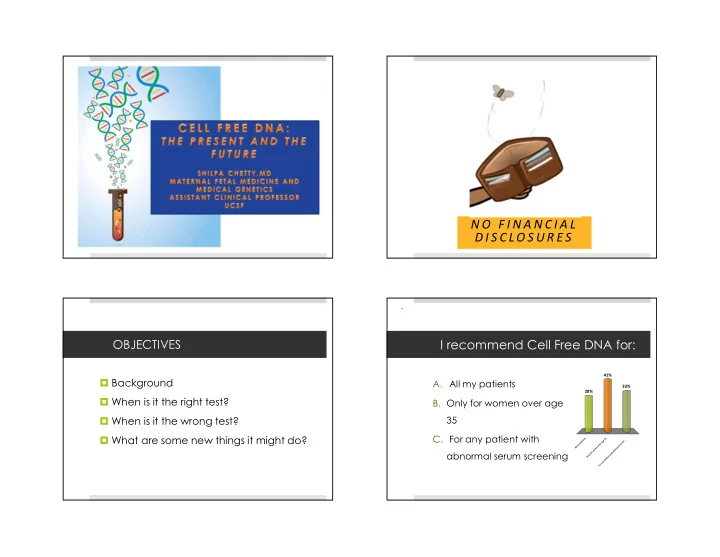
6/13/2019 N O F I N A N C I A L D I S C LO S U R E S OBJECTIVES I recommend Cell Free DNA for: 41% Background A. All my patients 32% 28% When is it the right test? B. Only for women over age When is it the wrong test? 35


slide-1
SLIDE 1

6/13/2019 1

N O F I N A N C I A L D I S C LO S U R E S

OBJECTIVES

 Background  When is it the right test?  When is it the wrong test?  What are some new things it might do?

I recommend Cell Free DNA for:

  • A. All my patients
  • B. Only for women over age

35

  • C. For any patient with

abnormal serum screening

A l l m y p a t i e n t s O n l y f

  • r

w

  • m

e n

  • v

e r a g e 3 5 F

  • r

a n y p a t i e n t w i t h a b n

  • r

m a l s e r u m . . .

28% 32% 41%

slide-2
SLIDE 2

6/13/2019 2

  • 37-year-old G5P4004 at 12 weeks gestation
  • 3 healthy children
  • 1 son with Wolf-Hirschorn syndrome
  • Parental testing performed
  • Father is a carrier of a balanced translocation

**25% recurrence risk

C a s e # 1 : P a t i e n t W N

What testing options should be

  • ffered?
  • A. Cell free DNA
  • B. Invasive testing with CVS
  • C. Cell free DNA followed by CVS
  • nly if abnormal

Cell free DNA Invasive testing with CVS Cell free DNA followed by CVS only if ...

5% 52% 43%

C e l l F r e e D N A - wh a t i s i t ?

  • Made up of short

segments of fetal DNA (<200 bp)

  • Origin is primarily

placental

  • Results from apoptosis
  • Circulate in maternal

plasma

cfDNA: Common Clinical Applications

  • Aneuploidy
  • Sex determination
  • Fetal RH status
slide-3
SLIDE 3

6/13/2019 3

Cell Free DNA: Characteristics

cfDNA represents ~10-15% of total DNA in maternal plasma1 Reliably detected after 7 wks gestation2 Higher concentrations late in gestation Short half life (16 min), undetectable by 2 hrs postpartum3

  • JAMA. 2018;320(6):591-592. doi:10.1001/jama.2018.9418

T e c h n i q u e s

  • Massively parallel shotgun sequencing (MPSS)
  • Targeted sequencing
  • Single nucleotide polymorphisms (SNP) analysis

Why does the technique matter? MPSS Targeted SNP

  • Amplification and

sequencing of all cfDNA

  • Benefit: Broad,

looks at cfDNA from all chromosomes

  • Limitations: Cost,

requires minimum fetal fraction of 4%

  • Sequencing of

regions of interest

  • nly
  • Benefit: less

expensive

  • Comparison of

SNPs of maternal

  • rigin to fetal
  • Benefit: accuracy

is equal across chromosomes

  • May allow

differentiation between triploidy, uniparental disomy, maternal mosaicism

slide-4
SLIDE 4

6/13/2019 4

Fetal Fraction

Taglauer, WES, Wilkins-Haug L, Bianchi DW Review: cell-free fetal DNA in maternal circulation as an indicatation of placental health and disease

F e t a l F r a c t i o n

Prenatal Diagnosis 2012; 32(13) p 1233-41

Why does fetal fraction matter?

The less fetal DNA, the harder to tell normal from abnormal Factors that impact fetal fraction

Maternal BMI- increased BMI associated with

decreased FF  Failed to provide a result in 20% of women >250 lb and 50% of women >350 lb.

Gestational age

 Increases after 21 weeks

Aneuploidy

 Increased FF with infants with T21  Decreased FF with infants with T18

Twins

slide-5
SLIDE 5

6/13/2019 5

Cell free DNA screening: Biologic Challenges

False Positives

  • Unrecognized or “vanishing”twin
  • Placental Mosaicism
  • Low level maternal mosaicism, esp. sex

chromosomes

  • Maternal Malignancy

False negatives

  • Low level of fetal DNA
  • Placental mosaicism
  • Maternal genetic variation (copy

number variants)

Cell free DNA screening: Biologic Challenges

Cell free DNA screening: Biologic Challenges

Failed Results

  • Increased BMI
  • Low level of fetal DNA
  • Fetal Aneuploidy

C F D N A a n d a n e u p l o i d y : P e r f o r m a n c e o f c f d n a

slide-6
SLIDE 6

6/13/2019 6

 It is important to counsel patients about the positive predictive value (PPV) of the test  PPV is influenced by prevalence of a disease  An individual PPV can be calculated using maternal age or risk generated from prior screening test  https://www.perinatalquality.org/vendors/ nsgc/nipt/

C F D N A a n d a n e u p l o i d y : P e r f o r m a n c e o f c f d n a

PPV calculator

Cell Free DNA for Aneuploidy in Twins

 Unaffected twin may mask an affected twin  Although initial studies are reassuring regarding use of cfDNA for T21 in twins, the overall data are limited  Not currently recommended by ACOG/SMFM  For higher order multiples Maternal age and nuchal translucency measurement for aneuploidy estimation

Cell Free DNA for fetal sex?

False positive rate is high for monosomy X Patients may learn about possible sex chromosome aneuploidy even when they are primarily interested in fetal sex In some cases, may be abnormal if the mother has an undiagnosed sex chromosome aneuploidy

slide-7
SLIDE 7

6/13/2019 7

Cell free DNA for ultrasound abnormalities?

 Negative cfDNA and isolated ‘soft marker’ Diagnostic testing is not recommended solely for this indication  Structural abnormality on ultrasound Offer diagnostic testing using microarray  The majority of congenital structural abnormalities are due to microdeletions or single gene disorders that cannot reliably be detected by cell free DNA  Invasive testing is recommended

Cell Free DNA Vs. Serum screening

What if CF DNA is normal followed by abnormal serum screening Raises concern for other chromosomal abnormality In a study by Norton et al. the residual risk

was 2%

The lowest detection rate for cfDNA in women who were <25 years old

Cell free DNA for Rh blood typing?

Lo and colleagues accurately assess fetal Rh status using cfDNA using PCR Negative predictive value as high as 98% Moise and colleagues (2016) reported false negative in 1 in 520 cases and inconclusive results in 5-6% of cases

Cell Free DNA for Microdeletions?

 Chromosomal microdeletions account for many syndromes  May have developmental delay and medical issues  There are approximately 40 well described microdeletions  Low baseline prevalence of each microdeletion syndrome  PPV is signficantly impacted

slide-8
SLIDE 8

6/13/2019 8

Microdeletions are rare

Microdeletions are More Common Than Down Syndrome for Women Under 40

Adapted from: Snijders, et al. Ultrasound Obstet Gynecol 1999;13:167–170

S h o u l d a l l w o m e n b e

  • f f e r e d s c r e e n i n g f o r

m i c r o d e l e t i o n s ?

Microdeletions can be detected by cfDNA, but….

 Difficult to validate  Low positive predictive value  In a recent study, investigators examined 8141 single pregnancies with NIPT  51 positive cases for chromosomal microdeletions or microduplications  only 13 (36%) true-positive cases

slide-9
SLIDE 9

6/13/2019 9

Back to case #1…

 Our patient underwent cell free DNA testing with micro deletions  Her results were normal so she declined any further testing  Level II ultrasound was notable for unilateral cleft lip and palate and abnormal profile  Amniocentesis confirmed deletion of 8.9 MB deletion on 4p consistent with Wolf-Hirshorn

Prevalence of many microdeletion syndromes is unknown

May be caused by different molecular mechanisms

Smaller deletions more difficult to detect

22q syndrome (~1/4000)

85% have 3Mb deletion, 15% smaller “97% detection” refers to only 3Mb deletion

Screening for these microdeletions has not been validated in clinical studies. Routine cell-free DNA screening for microdeletion syndromes should not be performed.

C e l l f r e e D N A t e s t i n g f o r s i n g l e g e n e d i s o r d e r s

 Disorders that are a result of DNA changes in a single gene  May affect up to 1% of all pregnancies  Requires identifying fetal DNA that is unique from maternal  Current clinically available for limited conditions

Achondroplasia  Thanatophoric dysplasia  Apert syndrome  Cystic fibrosis

slide-10
SLIDE 10

6/13/2019 10

T h e F u t u r e : N o n i n v a s i v e W h o l e G e n o m e S e q u e n c i n g

  • Coding and non coding

portions

  • Single nucleotide variants
  • Deletions and Duplications
  • Copy number variants

I s m o r e a l w a y s b e t t e r ?

  • OBTAI N INFORMATION

ABOUT THE ENTI RE FETAL GENOME

  • RAI SES BOTH

PRACTI CAL AND ETHICAL I SSUES

  • MAY GIVE

I NFORMATI ON REGARDI NG RISK FOR ADULT ONSET CONDITI ONS THAT ARE NOT RELEVANT

Current guidelines ACOG/SMFM guidelines

Conventional screening is most appropriate first line screen for most patients Ethically any patient may choose cfDNA screening, but should be counseled regarding limitations and benefits Diagnostic testing is required to confirm abnormal results before irreversible decisions Not recommended in twin pregnancies Microdeletion/expanded panels for cell free DNA are not recommended

slide-11
SLIDE 11

6/13/2019 11

What do we do at UCSF?

 Serum integrated screening  First trimester screening with Nuchal Translucency  Screen positive patients are counseled to undergo invasive testing  If a patient declines invasive testing, cell free DNA is offered as an

  • ption that is paid for by California in this setting

 We do occasionally recommend cell free DNA for specific single gene disorders  Concern for achondroplasia  RH disease

Thank you!

Thank you!