NamibRand Nature Reserve NamibRand Nature Reserve www.namibrand.org - - PowerPoint PPT Presentation

namibrand nature reserve namibrand nature reserve
SMART_READER_LITE
LIVE PREVIEW

NamibRand Nature Reserve NamibRand Nature Reserve www.namibrand.org - - PowerPoint PPT Presentation

NamibRand Nature Reserve NamibRand Nature Reserve www.namibrand.org Private Nature Reserves NamibRand NamibRand is one of the largest private nature reserves in Southern Africa 172,200 ha Shares 100 km border with the


slide-1
SLIDE 1

NamibRand Nature Reserve NamibRand Nature Reserve

www.namibrand.org
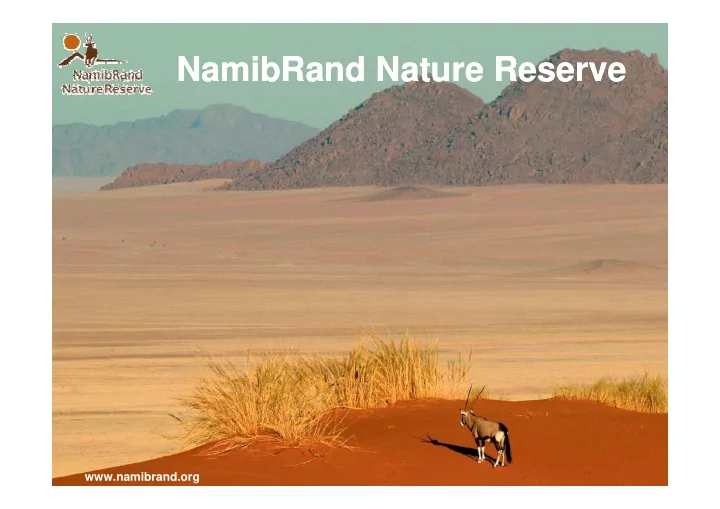
slide-2
SLIDE 2

Private Nature Reserves

slide-3
SLIDE 3

NamibRand

  • NamibRand is one of the largest

private nature reserves in Southern Africa – 172,200 ha

  • Shares 100 km border with the

Namib-Naukluft Park

  • All facets of the Namib Desert

are represented on the Reserve

slide-4
SLIDE 4

Main areas of focus

  • Conservation of indigenous biodiversity and landscapes
  • f the Pro-Namib area:
  • Transitional area between the true Namib Desert (the

‘sand-sea’) and the plateau in the interior.

  • This area is critical for migrating plains game that move

between the Namib and the interior on a seasonal basis in between the Namib and the interior on a seasonal basis in search of food and water.

  • Sustainable utilization of indigenous biodiversity:
  • Mainly through non-consumptive utilization such as

eco-tourism.

slide-5
SLIDE 5

The objectives are to:

  • Promote conservation

For the benefit of present & future generations To protect the sensitive and fragile environment and its rich biodiversity

  • Create a nature reserve

Healthy and functioning ecosystem Sanctuary for flora and fauna Sanctuary for flora and fauna Facilitate seasonal migratory routes in partnership with neighbours (National Parks, etc.)

  • Promote sustainable utilization

Ecologically sustainable and high-quality tourism products

  • Achieve a commercially viable
  • peration

Ensure continuance and financial independence

slide-6
SLIDE 6

Main achievements/

successes

  • 13 former livestock farms have joined together to form the NamibRand Nature

Reserve:

  • Landowners have signed articles of association that bring them and their land into the

NamibRand Nature Reserve association

  • Not for gain – a section 21 company.
  • Not for gain – a section 21 company.
  • Conservation is financially self-sufficient and funded though funds raised from

tourism:

  • Tourism concessions on the Reserve collect a daily

per person park fee from guests that is used to fund the conservation work on NamibRand entirely.

  • Area is holistically managed - all resource and

conservation management is done by dedicated staff:

  • Management plan, tourism and economic

development plan, zonation plan and EIA checklist.

slide-7
SLIDE 7

Main achievements/

successes

  • Successfully reintroduced historically occurring wildlife into the area:
  • Hartebeest, giraffe, cheetah.
  • Rehabilitated 13 former sheep farms into one contiguous landscape:
  • Taken down 1 500 km of fences
  • Removed old pipelines, unused or surplus water reservoirs (according to water
  • Removed old pipelines, unused or surplus water reservoirs (according to water

management plan), livestock camps, closed surplus roads and removing invasive alien plants

  • Entering into partnerships and taking down

fences with neighbours:

  • Extending the larger landscape for

conservation in increasing the area available for wildlife.

  • Namib Desert Environmental Education

Trust (NaDEET)

  • NamibRand Conservation Foundation
slide-8
SLIDE 8

Main challenges

  • Registering as a private nature reserve:
  • Advised to wait for new Wildlife Act to register.
  • Private nature reserve on land that is zoned as agricultural land:
  • Could benefit from extra status and legal rights if officially
  • Could benefit from extra status and legal rights if officially

registered as a private conservation area.

  • Veterinary restrictions:
  • e.g. double fences to keep wildebeest.
  • Removal of road corridor fences and shifting of motor gates.
slide-9
SLIDE 9

Main opportunities

for the future

  • Co-operative management of area with

neighbours to realize large open landscape conservation that is beneficial to the ecosystem to the ecosystem

  • Establishment of an association for the

co-management and development of the Greater Sossusvlei - Namib Complex

  • Work with MET in helping to manage the

neighbouring park e.g. game count, patrols, joint research

  • Development of an integrated, holistic

research programme with neighbours/ partners