Nanticoke River Action Plan(NAP) By: Tyler McCauley, Eric Hipple, - - PowerPoint PPT Presentation

nanticoke river action plan nap
SMART_READER_LITE
LIVE PREVIEW

Nanticoke River Action Plan(NAP) By: Tyler McCauley, Eric Hipple, - - PowerPoint PPT Presentation

Nanticoke River Action Plan(NAP) By: Tyler McCauley, Eric Hipple, Mike Kimball, and Ben Aghajanian Mission Statement NAPs mission is to protect and develop the health of the Nanticoke river in the form of water quality and habitat

slide-1
SLIDE 1

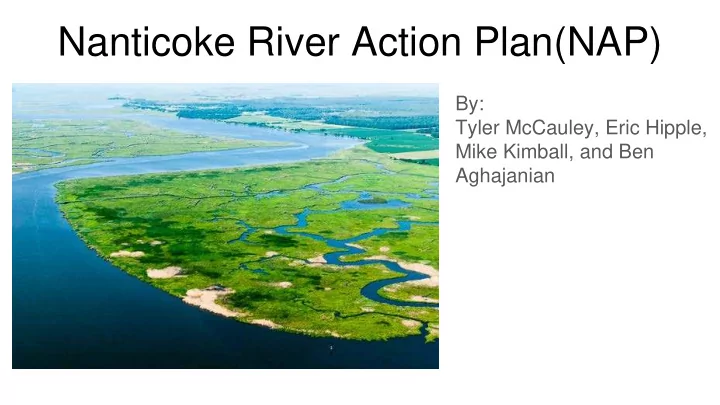
Nanticoke River Action Plan(NAP)

By: Tyler McCauley, Eric Hipple, Mike Kimball, and Ben Aghajanian

slide-2
SLIDE 2
slide-3
SLIDE 3

Mission Statement

NAP’s mission is to protect and develop the health of the Nanticoke river in the form of water quality and habitat

  • rejuvenation. By the year of 2027, all Nanticoke River waters

will be swimmable for people, livable for fish, and sustainable for future use by reducing sediment, bacteria, and chemical pollution.

slide-4
SLIDE 4

Background and History

  • Nanticoke watershed was first settled by the Nanticoke Indian Tribe.
  • Land was very marshy, so instead of farming, the tribe turned to hunting and

fishing.

○ Oyster, fish, crab, shrimp, and eel ○ Weir fishing technique ○ Hunted for food and clothing

  • Nanticoke indians were skillful canoeist, which helped with fishing and trade

along the Nanticoke River, and was In accordance with origination of their name “People of the tide water.”

○ Best merchants of all tribes in the region ○ Used river to trade commodities such as pelts and beads

  • First white man to make contact with the tribe was John Smith of England in

1608.

  • By 1748, the Nanticoke Indians were relocated up the Susquehanna to the

Iroquois

slide-5
SLIDE 5

Background and History(cont.)

slide-6
SLIDE 6

Background and History(cont.)

  • Today, Nanticoke River is largest tributary to the Chesapeake Bay.

○ Meanders through farmland, marshland, and forest ○ 64 miles long from headwaters in Southern Delaware to Tangier Sound in Maryland ○ 530,000 acre watershed ○ Home to the highest concentration of bald eagles in the northeastern United States

  • River has always played an important role in trade and commerce.

○ Critical navigable waterway from the Chesapeake Bay

  • Primary uses for the river are…

○ Primary recreation, secondary recreation, fishing, aquatic life & wildlife, industrial water supply, and agricultural water supply

  • Although the Nanticoke River has generally been a healthy river throughout

history, it is facing some problems that NAP plans to confront.

slide-7
SLIDE 7

Background and History(cont.)

slide-8
SLIDE 8

Policies and Mandates in Place

  • The Nature Conservancy has implemented a 50-mile corridor along the

western shoreline of the Nanticoke River that is permanently protected from intensive development.

  • DNREC’s acceptable levels for total N and total P are 3.0 mg/L and 0.1 mg/L.
  • The TDMLs for the Seaford, Bridgeville, and Laurel Sewage Treatment Plants

are 100 kg/day N and 25 kg/day P

  • The remaining treatment plants in the watershed have TDML of 586 kg/d N

and 1kg/day P

  • Nonpoint source N and P loads are to be reduced to 1723 kg/day and 36

kg/day, respectively, by 2025

slide-9
SLIDE 9

Problem 1: Sediment Pollution

Issue:

  • Overload of sediment or presence or foreign sediment in waterways
  • Decreases of health and mobility of bottom dwelling creatures
  • Makes hunting more difficult for predators
  • Kills underwater plants due to lack of nutrients

Solution:

  • Enforce existing regulations for development near waterways
  • Create robust buffer zones with native plant species
slide-10
SLIDE 10

Problem 2: Bacteria and Chemical Pollution

Issue:

  • The pollution of nitrogen, phosphorus, bacteria, and nitrate are continuous and harmful to the river:

Can cause water to be unswimmable for people and unlivable for fish.

  • Issues Stem From: Sewage Plants, Poultry and Crop Farms, Septic Systems, Groundwater

Solution:

  • Plant deep rooted plants along the ditches and

streams that lead to larger bodies of water

  • Residents can use no phosphorus fertilizer
  • Implementing controlled drainage systems
  • Stricter biological nutrient removal for treatment

plants

slide-11
SLIDE 11

Problem 3: Habitat Loss and Overfishing

Issue:

  • Loss of key populations
  • Atlantic sturgeon almost nonexistent in Nanticoke
  • Only two oyster patches left in Chesapeake Bay

Solution:

  • Stop fishing sturgeon and collecting oysters
  • Create better buffer zones for sturgeon
  • Enforce existing regulations on releasing waste, toxins, and sediment into the

Bay for oysters

slide-12
SLIDE 12

NAP Goals

  • Rebuild the buffer zone using native plants and trees
  • Plant deep rooted plants to try to reduce runoff from agricultural fields
  • Implementing controlled drainage systems to reduce runoff and allow more

water to be absorbed by crops and plants

  • Using non-phosphorus fertilizer
  • Enforcing stricter biological nutrient removal processes for treatment plants
  • Regulations on waste and toxins entering waterways
  • Reduce sediment, nutrient, and bacteria concentrations to healthy levels by

2027

  • Restore the habitats and help wildlife such as oysters and sturgeon rebound

by 2027

slide-13
SLIDE 13