SLIDE 1
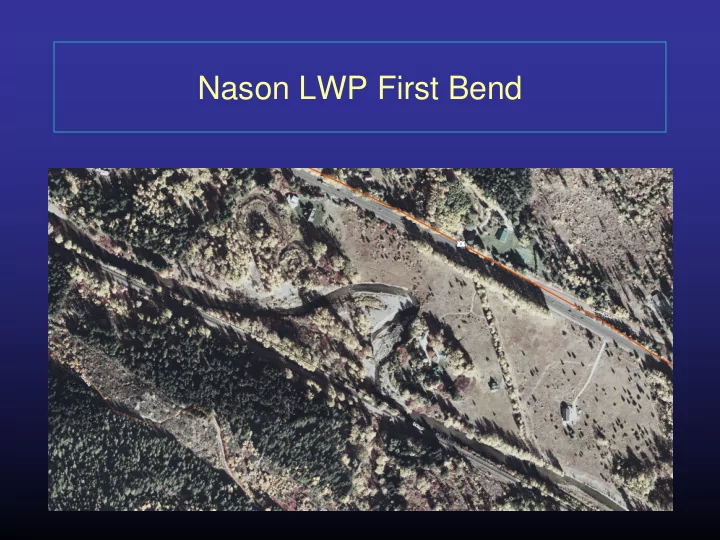
Nason LWP First Bend
SLIDE 2
Nason LWP First Bend
SLIDE 3 Nason LWP First Bend
Reach geomorphology
– Straightening and confinement – Legacy incision – Sediment transport conditions – Riparian vegetation – Accelerated meander scrolling
SLIDE 4
Nason LWP First Bend
Site conditions
– Accelerated bank erosion – No woody streambank or riparian vegetation – Low floodplain roughness (in oxbow and on field) – Log jam at downstream end of bend – Poor margin habitat along bank
SLIDE 5
Nason LWP First Bend
Site conditions
SLIDE 6
Nason LWP First Bend
Planform geometry analysis
SLIDE 7
Nason LWP First Bend
Other indicators of imminent avulsion
– Headcut along railway embankment
SLIDE 8
Nason LWP First Bend
Other indicators of imminent avulsion
– Large bar deposits
SLIDE 9
Nason LWP First Bend
Hydraulic modeling
Depth 50-year event
SLIDE 10 Nason LWP First Bend
Existing avulsion risk
- Created by human disturbance
– Denuded streambank vegetation (root strength) – Denuded floodplain roughness (across oxbow) – Legacy incision – Sediment imbalance
– Additional straightening of reach – Loss of pool-riffle habitat – Probable stranding of existing log jam
SLIDE 11
No Action Alternative
SLIDE 12 No Action Alternative
Benefits
- Low cost and effort
- Wait and see approach
Risks/Constraints
- Does not decrease avulsion risk
- Avulsion likely to decrease habitat quantity and
quality
- Potential abandonment of pool-riffle habitat, and
existing log jam, due to avulsion
- Uncertain human actions may result from flood
damage
SLIDE 13
Alternative 1
LW and riparian enhancement of existing alignment
SLIDE 14 Alternative 1
LW and riparian enhancement of existing alignment
Benefits
- Reduce the human-caused accelerated erosion rate
- Limit the likely future increase in avulsion risk
- Restore long-term riparian health and LW recruitment
- Provide salmonid cover and complexity until riparian recovery
Risks/Constraints
- Does not decrease avulsion risk
- Avulsion likely to decrease habitat quantity and quality
- Potential abandonment of project, and log jam, due to avulsion
- Nearby private property and infrastructure
SLIDE 15
Alternative 2
Re-alignment and creation of off-channel habitat
SLIDE 16 Alternative 2
Re-alignment and creation of off-channel habitat
Benefits
- Reduce the human-caused accelerated
erosion rate
- Significantly reduce avulsion risk
- Restore long-term riparian health and LW
recruitment
- Create connected off-channel habitats
- Provide salmonid cover and complexity until
riparian recovery Risks/Constraints
- Nearby private property and infrastructure
SLIDE 17
Alternative 3
Enhance existing off-channel habitat
SLIDE 18 Alternative 3
Enhance existing off-channel habitat
Benefits
- Establish year-round connected off-channel
habitat
- Add LW cover and complexity to existing off-
channel areas
- Compatible with other alternatives
Risks/Constraints
- Areas are connected now except at very low
flows
- Potential to lower water levels and decrease
rearing capacity
- Private property and infrastructure
- Both channels could potentially be
abandoned if an avulsion