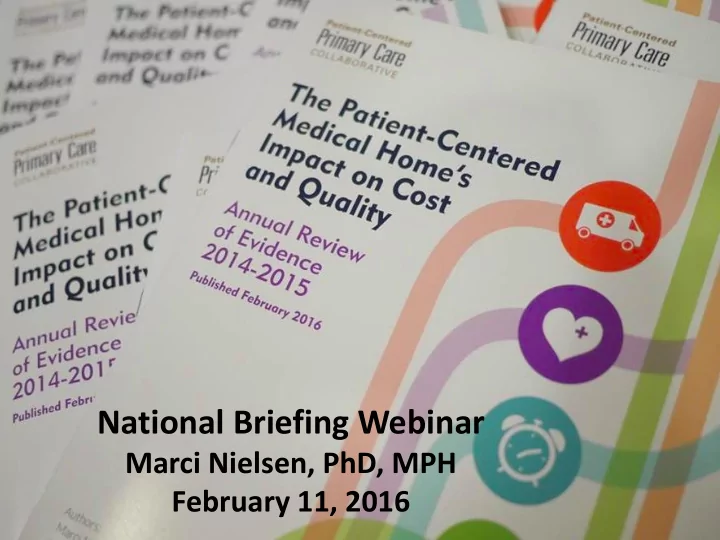
National Briefing Webinar Marci Nielsen, PhD, MPH February 11, 2016 - - PowerPoint PPT Presentation

national briefing webinar
SMART_READER_LITE
LIVE PREVIEW

National Briefing Webinar Marci Nielsen, PhD, MPH February 11, 2016 - - PowerPoint PPT Presentation

National Briefing Webinar Marci Nielsen, PhD, MPH February 11, 2016 1 AGENDA PCPCC: Who we are & what we do 2015 Annual Evidence Report: What we studied & what we learned Paying for Value Where delivery reform


slide-1
SLIDE 1

1

National Briefing Webinar

Marci Nielsen, PhD, MPH February 11, 2016

slide-2
SLIDE 2

AGENDA

  • PCPCC:

– Who we are & what we do

  • 2015 Annual Evidence

Report:

– What we studied & what we learned

  • Paying for Value

– Where delivery reform meets payment reform – What’s Next?

  • Q & A

2

slide-3
SLIDE 3

Patient-Centered Primary Care (PCPCC)

Unifying for a better health system - by better investing in patient- centered primary care

PAYERS:

Employees, Employers, Health plans, Government, Policymakers

PUBLIC:

Patients, Families, Caregivers, Consumers Communities

PROVIDERS: Primary care team, medical neighborhood, ACOs, integrated care

3

slide-4
SLIDE 4

4

Co-Chairs Honorable Joe Courtney (D-CT) Honorable David Rouzer (R-NC) Capitol Hill Briefing hosted by: The Primary Care Caucus

slide-5
SLIDE 5

Section One:

A CHANGING POLICY LANDSCAPE

5

#PCMHEvidence

slide-6
SLIDE 6

AUTHORS

Marci Nielsen, PhD, MPH

  • Chief Executive Officer, PCPCC

Lisabeth Buelt, MPH

  • Policy and Research Manager,

PCPCC Kavita Patel, MD, MS

  • Nonresident Senior Fellow,

Economic Studies, The Brookings Institution Len M. Nichols, PhD, MS, MA

  • Director, Center for Health Policy

Research and Ethics, George Mason University

REVIEWERS

Christine Bechtel, MA Bechtel Health; National Partnership for Women & Families Asaf Bitton, MD, MPH Brigham and Women's Hospital & Harvard Medical School Jean Malouin, MD, MPH University of Michigan Mary Minniti, BS, CPHQ Institute for Patient- and Family-Centered Care Bob Phillips, MD, MP American Board of Family Medicine Sarah Hudson Scholle, DrPH, MPH National Committee for Quality Assurance Lisa Dulsky Watkins, MD Milbank Memorial Fund Multi-State Collaborative

slide-7
SLIDE 7

PCMH MODEL/FRAMEWORK

U.S. Department of Health and Human Services, Agency for Healthcare Research and Quality (AHRQ). Patient-centered medical home resource center, defining the PCMH. Retrieved from http://pcmh.ahrq.gov/page/defining-pcmh

7

slide-8
SLIDE 8

PCMH EXPANDING RAPIDLY: BUT STILL AN EARLY INNOVATION

8

slide-9
SLIDE 9

PAYING NOW… OR… PAYING LATER

9

slide-10
SLIDE 10

PAYMENT REFORM AND MEDICARE

Health & Human Services

  • Shift 30% of Medicare FFS

payments to value through APMs by 2016, 50% by 2018

  • Created of Health Care

Payment Learning & Action Network

  • Investment in Multi-payer

Efforts Congress

  • Passage of Medicare Access

and CHIP Reauthorization Act (MACRA)

  • Merit-based Incentive

Payment System (MIPS)

  • Alternative Payment

Models (APMs)

10 http://doctorwhostories.wikia.com/wiki/The_Macra_Terror_(TS)

https://hcp-lan.org/

slide-11
SLIDE 11

PAYMENT REFORM & PCMH

11

  • Fee-for service fails to compensate for PCMH scope of

services – esp for small and independent practices

  • Numerous Alternative Payment Models (APMs) can support PCMH
  • Evidence does not point to single payment model that best supports

PCMH

slide-12
SLIDE 12

Section Two:

NEW EVIDENCE FOR PCMH AND INNOVATIONS IN PRIMARY CARE

12

#PCMHEvidence

slide-13
SLIDE 13

METHODS

INCLUSION CRITERIA

  • Predictor variable:

– “Medical home” – “PCMH” – “Advanced primary care”

  • Outcome variable:

– “Cost” or – “Utilization”

  • Date published:

– Between Oct 2014 and Nov 2015

13

slide-14
SLIDE 14

LIMITATIONS

  • Several reports published this year fall outside

the scope of our inclusion criteria

– We track these studies on our PCMH Map

  • Does not include studies focused on disease-

specific, non-primary care medical homes

  • Generally include only the measures that reach

statistical significance

  • Studies included vary significantly
  • DEFINING & MEASURING PCMH REMAINS A

CHALLENGE

14

slide-15
SLIDE 15

RESULTS: TRENDS

(n1 = Improvement in measure/n2 = Measure assessed by study)

15

#PCMHEvidence

slide-16
SLIDE 16

DETAILS: Utilization

MEASURES OF UTILIZATION

  • Emergency department (ED) use

– All cause ED visits – Ambulatory care sensitive condition (ASCS) ED visits – Non-urgent, avoidable, or preventable ED visits – ED utilization

  • Hospitalization

– All cause hospitalizations – ACSC in-patient admissions – In-patient days

  • Urgent care visits
  • Readmission rate
  • Specialist visits

– Ambulatory visits for specialists

“ED USE” (Peer reviewed studies n=17)

  • Studies below reported on “ED use”

– 13 measures were ED use reductions, 1 measure was ED use increase – California Health Care Coverage Initiative – CHIPRA Illinois study – Colorado Multi-payer PCMH pilot – Medicare Fee-For-Service NCQA study – Pennsylvania Chronic Care Initiative – Rochester Medical Home study – UCLA Health System study – Texas Children’s Health Plan – Veterans Affairs PACT study (AJMC)

  • Reported higher ED use for one measure,

and ACSC hospitalizations per patient

16

slide-17
SLIDE 17

DETAILS: Cost

MEASURES OF COST

  • Total cost of care

– Net or overall costs – Total PMPM spend – Total PMPM for pediatric patients – Total PMPM for adult patients

  • Total Rx spending
  • ED payments per beneficiary
  • ED costs for patients with 2 or more

comorbidities

  • PMPM spending on inpatient
  • Inpatient expenditures (PMPY)
  • Outpatient expenditures (PMPY)
  • Expenditures for dental, social, and

community based supports

“TOTAL COST” (Peer reviewed, n=17)

  • Studies below reported “Total cost of care”

– 10 measures were total cost of care savings, one measure was no net savings – Geisinger Health System PCMH – Blue Cross Blue Shield of Michigan Physician Group Incentive Program (Health Affairs) – Blue Cross Blue Shield of Michigan Physician Group Incentive Program (Medical Care Research & Review) – Colorado Multi-payer PCMH pilot

  • No net savings over 2 year study

– Pennsylvania Chronic Care Initiative (American Journal of Managed Care) – UCLA Health System study – Vermont Blueprint for Health

17

slide-18
SLIDE 18

REFERENCE: Rosenthal, M.B., Alidina, S., Friedberg, M.W., Singer, S.J., Eastman, D., Li, Z., & Schneider, E.C. (2015). A difference-in-difference analysis of changes in quality, utilization and cost following the Colorado Multi-Payer Patient-Centered Medical Home Pilot. Journal of General Internal Medicine. DESCRIPTION: Authors conducted difference-in-difference analyses evaluating 15 small and medium- sized practices participating in a multi-payer PCMH pilot. The authors examined the post-intervention period two years and three years after the initiation of the pilot.

DETAILS BY STUDY

18

slide-19
SLIDE 19

Section Three:

DISCUSSION OF FINDINGS AND IMPLICATIONS

19

#PCMHEvidence

slide-20
SLIDE 20

20

slide-21
SLIDE 21

KEY FINDING

  • CONTROLLING COSTS BY PROVIDING THE RIGHT CARE

– POSITIVE CONSISTENT TRENDS:

  • By providing the right primary care “upstream,” we

change how care is used “downstream”

  • Consistent reductions in high-cost (and many times

avoidable) care, such as: emergency department (ED) use and hospitalization, etc

  • Cost savings evident – but assessment of total cost of

care required (while assessing quality, health outcomes, patient engagement, & provider satisfaction)

21

#PCMHEvidence

slide-22
SLIDE 22

WHY DO SOME MEDICAL HOMES WORK WHILE OTHERS DON’T?

slide-23
SLIDE 23

KEY FINDING

  • ALIGNING PAYMENT AND PERFORMANCE

– BEST OUTCOMES FOR MULTI-PAYER EFFORTS:

  • Most impressive cost & utilization outcomes among

multi-payer collaboratives with incentives/performance measures linked to quality, utilization, patient engagement, or cost savings … more mature PCMHs had better outcomes

  • No single best payment model emerged, but extended

beyond fee-for-service

23

slide-24
SLIDE 24

Trajectory to Value-based Purchasing: PCMH part of a larger framework

HIT Infrastructure: EHRs and population health management tools Primary Care Capacity: PCMH or advanced primary care Care Coordination: Coordination

  • f care across

medical neighborhood & community supports for patient, families, & caregivers Value/ Outcome Measurement Reporting of quality, utilization and patient engagement & population health measures Value-Based Purchasing: Reimbursement tied to performance on value

Source: THINC - Taconic Health Information Network and Community

Alternative Payment Models (APMs): Supporting ACOs, PCMH, & other value based arrangements

24

slide-25
SLIDE 25

APM FRAMEWORK WORK GROUP

25

C ategory 1 Fee for Service – No Link to Q uality & Value C ategory 2 Fee for Service – Link to Q uality & Value C ategory 3 APMs Built on Fee-for-Service Architecture C ategory 4 Population-Based Payment A

Foundational Payments for Infrastructure & O perations

B

Pay for R eporting

C

R ewards for Performance

D

R ewards and Penalties for Performance

A

APMs with U pside G ainsharing

B

APMs with U pside G ainsharing/D

  • wnside R

isk

A

C

  • ndition-Specific

Population-BasedPayment

B

C

  • mprehensive

Population-Based Payment

Population-B ased A ccountable A PMs

  • The LAN’s Alternative

Payment Model Framework and Progress Tracking (APM FPT) Work Group was successful in developing a Framework for categorizing APMs.

  • Within the APM

framework, population- based-payment models fall into categories some

  • f 3 and 4.
slide-26
SLIDE 26

MACRA – MIPS & APMS

Providers Must Choose FFS + PFP1 or Accountable Care

Source: Medicare Access and CHIP Reauthorization Act

  • f 2015; Advisory Board research and analysis.

PATEL, KAVITA, APA Presentation, November 2015

  • 1. Pay for performance.
  • 2. Value-based payment modifier.
  • 3. Positive adjustments for professionals with scores above the benchmark may be scaled by a factor of up to 3 times the negative adjustment

limit to ensure budget neutrality. In addition, top performers may earn additional adjustments of up to 10 percent.

  • 4. APM participants who are close to but fall short of APM bonus requirements will not qualify for bonus but can report MIPS measures and

receive incentives or can decline to participate in MIPS.

Merit-Based Incentive Payment System (MIPS) Advanced Alternative Payment Models3

2020: -5% to +15%2 at risk 2019: Combine PQRS, MU & VBPM programs: -4% to +12%2 at risk 2022 and on: -9% to +27%2 at risk 2021: -7% to +21%2 at risk 2018: Last year of separate MU, PQRS, and VBPM2 penalties 2015:H2 – 2019: 0.5% annual update 2026 and on: 0.25% annual update 2020 – 2025: Frozen payment rates 2019 - 2024: 5% participation bonus 2019 - 2020: 25% Medicare revenue requirement 2021 and on: Ramped up Medicare or all-payer revenue requirements 2026 and on: 0.75% annual update 2015:H2 – 2019: 0.5% annual update 2020 – 2025: Frozen payment rates

4

slide-27
SLIDE 27

MULTI-PAYER COLLABORATIVES: Beyond early evaluations

COMPREHENSIVE PRIMARY CARE INITIATIVE (CPC)

  • 5 out of 7 regions reported

cost and/or utilization improvements

  • Arkansas
  • Colorado
  • Hudson Valley New York
  • New Jersey
  • Oregon

MULTI-PAYER ADVANCED PRIMARY CARE DEMONSTRATION (MAPCP) 6 out of 8 MAPCP states found cost and/or utilization improvements

  • Michigan
  • Pennsylvania
  • New York
  • North Caroline
  • Rhode Island
  • Vermont

27

slide-28
SLIDE 28

KEY FINDING

ASSESSING AND PROMOTING VALUE

– BETTER MEASURES & DEFINITIONS:

  • Variation across study measures -- and PCMH

initiatives – make for challenging evaluations and expectations (patients, providers, payers)

slide-29
SLIDE 29

TRANSFORMING CLINICAL PRACTICE INITIATIVE GOALS

slide-30
SLIDE 30

SELECT PCPCC TCPI GOALS

– Define and support patient-practice partnerships – Promote clinic-to-community linkages

30

slide-31
SLIDE 31

SAVE THE DATES

– Safety Net Medical Home Grantee Symposium (CareFirst

BlueCross BlueShield of Maryland, co-hosted by PCPCC)

  • March 15, 2016; 9:00am – 3:00pm
  • The Newseum, 555 Pennsylvania Ave NW, Washington, DC 20001

– PCPCC’s March National Briefing webinar

  • Thursday, March 31st at 1:00pm ET
  • “The Primary Care Imperative: New Evidence Shows Importance of

Investment in Patient-Centered Medical Homes” (Authored by National Business Group Health and the PCPCC)

– National Medical Home Summit (Co-hosted by the PCPCC)

  • June 6 & 7th
  • Grand Hyatt, Washington DC

– Celebrate the PCPCC’S 10 year Anniversary – Annual Meeting & Awards Dinner

  • November 9th and 10th, Grand Hyatt, Washington DC

31

slide-32
SLIDE 32

32

Please download the report, sign up for our free monthly newsletter and alerts, or support our efforts as by becoming executive member at:

www.pcpcc.org