National Environmental Policy Act, the Endangered Species Act, and - - PowerPoint PPT Presentation

national environmental policy act the endangered species
SMART_READER_LITE
LIVE PREVIEW

National Environmental Policy Act, the Endangered Species Act, and - - PowerPoint PPT Presentation

National Environmental Policy Act, the Endangered Species Act, and Habitat Conservation Plans National Environmental Policy Act, the Endangered Species Act, and Habitat Conservation Plans Why are we here? The DBBC and the City of


slide-1
SLIDE 1

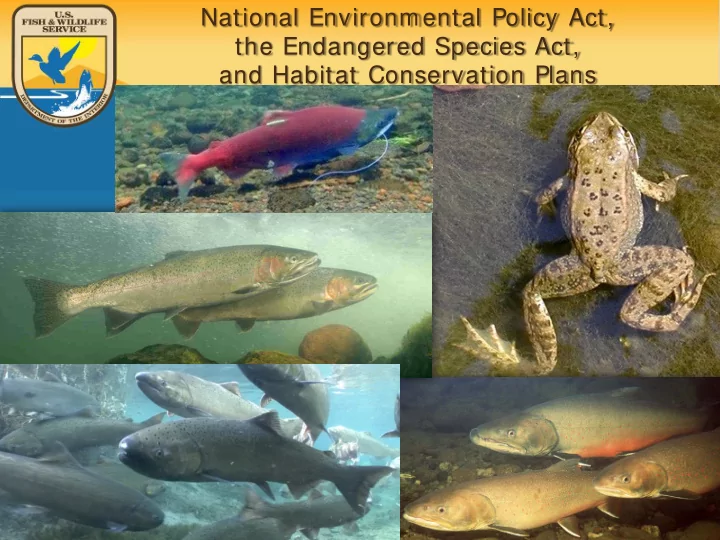
National Environmental Policy Act, the Endangered Species Act, and Habitat Conservation Plans

slide-2
SLIDE 2

National Environmental Policy Act, the Endangered Species Act, and Habitat Conservation Plans

Why are we here?

  • The DBBC and the City of Prineville are preparing a

Habitat Conservation Plan (HCP) for several Deschutes River-dependent species.

  • In response, USFWS will prepare an Environmental

Impact Statement (EIS) under the National Environmental Policy Act (NEPA) for the HCP.

  • Preparation of an EIS, triggers scoping.
slide-3
SLIDE 3

ESA/ NEPA Processes

slide-4
SLIDE 4

Why do Scoping?

  • Scoping engages the public and asks for input
  • The process identifies significant environmental

issues for further analysis

  • Other, less significant environmental issues, are

identified but further analysis may not be necessary.

Scoping

slide-5
SLIDE 5
  • Get involved to help us identify important

issues

  • Give us your comments

the public comment period goes through September 22, 2017

Scoping

slide-6
SLIDE 6

NEPA Options

slide-7
SLIDE 7

We want comments on: – Alternatives to the proposed action – Measures to avoid, mitigate, or minimize effects – Existing environmental conditions in the basin – Permit duration – Covered species and activities – Biological goals and objectives of the HCP – Any other significant issues

Scoping

slide-8
SLIDE 8

The NEPA process:

  • Is required for the Service to approve an Applicants’

HCP.

  • Helps the Service make decisions based on our

understanding of the environmental consequences of approving the HCP.

  • Is used to identify and take actions that protect, restore,

and enhance the environment.

  • Analyzes the effects of all the alternatives considered.

National Environmental Policy Act

slide-9
SLIDE 9

NEPA considers the impacts of a federal action on elements of the human environment such as:

  • water quality
  • wetlands
  • air quality
  • socio-economic and cultural resources
  • fish and wildlife species including ESA-listed

National Environmental Policy Act

slide-10
SLIDE 10

Environmental Impact Statement and Habitat Conservation Plans The Service will prepare an EIS because the HCP is likely to: – Cover a significant portion of the basin – Cover multiple species and multiple activities – Cover water management activities in the basin – Affect the human environment and listed species

slide-11
SLIDE 11

Environmental Impact Statement

What does an EIS include?

 Purpose and need for the action  Alternatives (no action, proposed action, others)  Affected environment  Environmental effects of the alternatives  Cumulative effects

slide-12
SLIDE 12

Endangered Species Act

slide-13
SLIDE 13

Endangered Species Act

Purpose

  • To protect and recover imperiled species and the

ecosystems upon which they depend.

slide-14
SLIDE 14

Species listed as endangered or threatened:

  • ‘Threatened’ means a species is likely to

become endangered within the foreseeable future throughout all or a significant portion

  • f its range.
  • ‘Endangered’ means a species is in danger of

extinction throughout all or a significant portion of its range.

Endangered Species Act

slide-15
SLIDE 15

ESA protects endangered and threatened species and their habitats by prohibiting “take”

  • Take means “to harass, harm, pursue,

hunt, shoot, wound, kill, trap, capture,

  • r collect or to attempt to engage in any

such conduct.” Endangered Species Act (ESA)

slide-16
SLIDE 16
  • Section 9 of the ESA states it is unlawful for

anyone to take endangered or threatened species. However….

  • Section 10 of the ESA allows incidental take of

threatened and endangered species, if take

  • ccurs under an approved habitat conservation

plan.

Endangered Species Act (ESA)

slide-17
SLIDE 17
  • Incidental Take refers to take that results from

carrying out an otherwise lawful activity (for example, residential and commercial development,

  • r road construction)
  • A Habitat Conservation Plan is a voluntary plan

developed by a non-Federal applicant in order to receive an incidental take permit.

Habitat Conservation Plans

slide-18
SLIDE 18

The Applicant’s HCP must describe and include:

  • Impacts likely to result from the taking of the species
  • Measures the applicants will take to minimize and

mitigate impacts

  • Adequate funding to perform those measures
  • Alternative actions that would not result in take and

reasons those alternatives are not being used

  • Additional measures as required by the Service

Habitat Conservation Plans

slide-19
SLIDE 19

To approve the Applicant’s HCP and issue an incidental take permit, the Service must determine:

  • Taking is incidental
  • The Applicants will, to the maximum extent practicable,

minimize and mitigate the impacts of the taking

  • The Applicants ensure adequate funding for the plan
  • The taking will not appreciably reduce the likelihood of the

survival and recovery of the species in the wild

  • Any measures required by the Service will be met

Habitat Conservation Plans

slide-20
SLIDE 20
  • NEPA Scoping
  • Public comment period ends 9/22/2017
  • Draft EIS and draft HCP

– Public comment period (2018)

  • Final EIS and final HCP

– Public comment period (2019)

  • HCP Implementation

Next Steps/ Timeline

slide-21
SLIDE 21

Contact Us

Send comments to: Peter Lickwar peter_lickwar@fws.gov More information: http://bit.ly/DeschutesHCP

August 14-15, 2017