
SLIDE 1
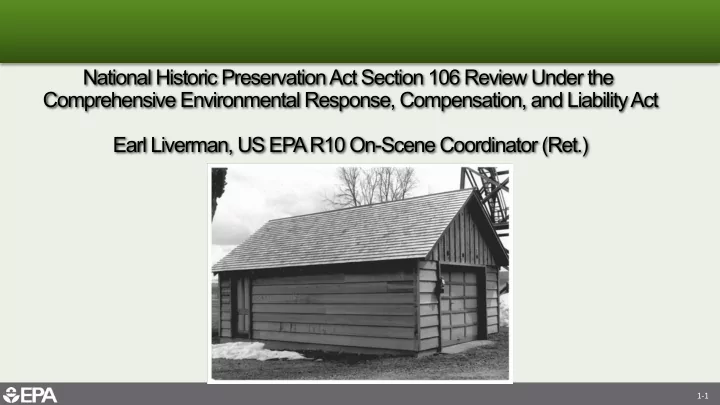
National Historic Preservation Act Section 106 Review Under the Comprehensive Environmental Response, Compensation, and Liability Act Earl Liverman, US EPA R10 On-Scene Coordinator (Ret.)
1-1
National Historic Preservation Act Section 106 Review Under the - - PowerPoint PPT Presentation
National Historic Preservation Act Section 106 Review Under the Comprehensive Environmental Response, Compensation, and Liability Act Earl Liverman, US EPA R10 On-Scene Coordinator (Ret.) 1-1 Overview Course provides participants with an
1-1
1-2
1-3
♦ Environmental review process initiated with passage
as amended (P.L. 89-665; 80 Stat. 915; 16 U.S.C. 470) ♦ Section 106 requires federal agencies to:
» Take into account effects of undertakings on historic properties » Provide the Advisory Council on Historic Preservation (ACHP) with a reasonable opportunity to comment » Consult with State Historic Preservation and Tribal Historic Preservation Offices, Indian tribes, and Native Hawaiian Organizations
1-4
Initiation of Section 106 Process 36 CFR § 800.3 Identification of Historic Properties 36 CFR § 800.4 Assessment
36 CFR § 800.5 Resolution of Adverse Effects 36 CFR § 800.6
1-5
1-6
7
1-8
1-9
Crystal Lake Cemetery Barlow Road
1-10
[36 CFR § 60.4]
1-11
Avery Depot
1-12
1-13
Sumpter Valley Gold Dredge
1-14
♦ Section 106 places particular emphasis on consultation with THPOs, Tribes, and Native Hawaiian organizations (NHOs ♦ Federal agencies must consult THPOs, Tribes, and NHOs about undertakings when they may affect historic properties to which a Tribe or NHO attach religious or cultural significance ♦ Applies regardless of whether the property is located on or off tribal lands [36 CFR §§ 800.2(c)(2)]
1-15
1-16
1-17
♦ Geographic area or areas within which an undertaking may directly or indirectly cause alterations in the character or use of historic properties, if any such properties exist ♦ APE is influenced by the scale and nature of an undertaking and may be different for different kinds of effects caused by the undertaking [36 CFR §§ 800.4(a)(1), 800.16(d)] Site APE
1-18
1-19
1-20
1-21
1-22
1-23
1-24
1-25
1-26
1-27
1-28
1-29
♦ NCP requires only those state standards that are promulgated, are identified by the state in a timely manner, and are more stringent than federal requirements may be applicable or relevant and appropriate (ARARs) [§ 300.400(g)(4)] ♦ NCP requires removal actions to attain ARARs of Federal and State laws to the extent practicable considering the exigencies of the situation [§ 300.415(j)] ♦ NCP requires remedial actions to meet ARARs at the completion of an action (or justify a waiver) [§ 300.435.(b)(1)]
1-30
1-31
1-32
1-33
1-34
1-35
1-36
» ACPs [§ 300.210(c)] have been developed as a reference document for use of all agencies engaged in responding to environmental emergencies in a defined geographic area » ACPs adopt national Programmatic Agreement
1-37
Identify historic properties that have been listed in or determined eligible for inclusion in the NRHP that might be affected by response to a release or a spill Identify specific geographic areas or types of areas where categorical exclusions may apply Develop a list of parties to be notified in the event of an incident in a non-excluded area
reasonably anticipated to protect historic properties
1-38
Lochsa River, ID
1-39
1-40
1-41
1-42
» Placement of physical barriers to deter the spread of released or spilled substances » Excavation of trenches to stop the spread of the released or spilled substances » Ground disturbing shoreline clean up methods » Establishment of field camps for personnel » Creation of staging areas for materials or equipment » Excavation of borrow pits for fill materials » Construction of access roads
1-43
1-44
1-45
1-46
1-47
Initiate Section 106 Programmatic Agreement Process Incident is categorically excluded from Section 106 compliance Monitor for discovery of previously unidentified historic properties or SHPO categorically excluded release or spill may have potential to affect a significant historic property
1-48
Spills/releases onto (which stay on):
including undeveloped right-of-way)
runways (improved gravel strips and/or paved runways) Spills/releases into (that stay in):
: reach land/submerged land; and include any emergency response activities with land/submerged land-disturbing components
area Spills/releases of:
1-49
Initiate Section 106 Programmatic Agreement Process Determine if emergency is categorically excluded from Section 106 Notify SHPO/THPO for consultation because of
determines there are historic properties or cultural resources that need to be considered
develop protective measures for historic properties or cultural resources if determined by consultation Assess potential adverse effects of response actions
emergency response has formally concluded
1-50
1-51
1-52
1-53
P
Initiate Section 106 Process; establish undertaking; undertaking might affect historic properties No undertaking; no potential to cause effects
r
c
n s
Identify area that might be affected by undertaking; historic properties are affected No historic properties affected
s s u l t
Assess adverse effects; historic properties are adversely affected No historic properties adversely affected
C a
m i p
n e t e
ACHP Comment ____36 CFR 800.6(b)___ Section 104(a) of CERCLA ____________Resolve adverse effects________ Resolve adverse effects to the extent practicable considering the exigencies of the situation Failure to Agree
1-54
Roles of Participants Involving the Public Consultation Documentation
1-55
1-56
1-57
1-58
1-59
1-60
1-61
1-62
1-63
1-64
1-65
» PRP-prepared Cultural Resources Assessment » EPA-prepared Cultural Resources Survey (CRS); recommends pedestrian survey and archaeological field study of Site and finding of no adverse effect
1-66
» CRS is “well done and meets the Secretary of the Interior’s Standard’s.” » “In the future, EPA should have final comments in hand prior to any ground-disturbing activities associated with the project. Without final comments, EPA is not meeting the requirements of Section 106.”
1-67
1-68
1-69
1-70
1-71
1-72
♦ 06/03/2014 – 09/30/2014. Initiated and completed substantive requirements of Section 106 Process under CERCLA, including
» Consultation with OR SHPO (throughout 106 Process) and interested Tribes » Completion of a Cultural Resources Survey (CRS) » EPA determined that the TCRA had no potential to have an adverse effect on historic properties because no such properties remained at the Site » CRS forwarded to OR SHPO, interested Tribes, and Douglas County Historical Society » SHPO concurred with no effect determination
♦ State OSC played an influential consultation role throughout the 106 Process
1-73
1-74
1-75
1-76
1-77
1-78
1-79
1-80
1-81
1-82
1-83
» Identified three features likely to be adversely affected by removal action (JM-1, JM-2, JM-3) » Recommended development of an Memorandum of Agreement (MOA) between State of Washington Department of Archaeology and Historic Preservation (DAHP) and EPA, and preliminary excavation at these three features be monitored by qualified archaeologist
» DAHP agreed to allow removal action to proceed with preliminary excavation into three features being monitored by a qualified archaeologist
1-84
JM-1 JM-3
1-85
JM-2
1-86
1-87
1-88
♦ NCP requires removal actions to attain ARARs of Federal and State laws to the extent practicable considering the exigencies of the situation [40 CFR § 300.415(j)]
» Need for prompt and thorough response to contamination which presents an ongoing risk to public health and environment, short work season and need to conserve limited work resources
♦ NCP requires only those state standards that are promulgated, are identified by the state in a timely manner, and are more stringent than federal requirements may be ARARs [§ 300.400(g)(4)]
» No comments were received from SHPO (or anyone else) about historic preservation laws during early planning, review of the CRE and engineering evaluation/cost analysis (EE/CA) (both produced in March 2010), or in response to listing NHPA as an ARAR in the Action Memorandum (produced 08/26/10) » Comments were received from SHPO about State historic preservation laws on 09/14/2010 › SHPO did not provide a satisfactory explanation as to why the historic preservation laws were substantively more stringent than NHPA
1-89
1-90
1-91
1-92
1-93
1-94
1-95
» 8/25 Yes; 6/25 No; 11/25 Other
» Determinations of Eligibility: Poorer 4/13; Typical 8/13; Better 1/13 » Determinations of Effect: 4/11; Typical 6/11; Better 1/11 » Considerations of Alternatives: Poorer 7/11; Typical 4/11; Better 0/11 » Mitigation of Adverse Effect: Poorer 4/11; Typical 4/11; Better 3/11
1-96
1-97
1-98
1-99
1-100