National Hydrology Project National Hydrology Project National - - PDF document

national hydrology project national hydrology project
SMART_READER_LITE
LIVE PREVIEW

National Hydrology Project National Hydrology Project National - - PDF document

National Hydrology Project National Hydrology Project National Hydrology Project National Hydrology Project BY D. S. CHASKAR DIRECTOR, NWA NATIONAL HYDROLOGY PROJECT NATIONAL HYDROLOGY PROJECT HP HP-I (1995 I (1995-2003) 2003) HP-II


slide-1
SLIDE 1

National Hydrology Project National Hydrology Project National Hydrology Project National Hydrology Project

BY

  • D. S. CHASKAR

DIRECTOR, NWA

2

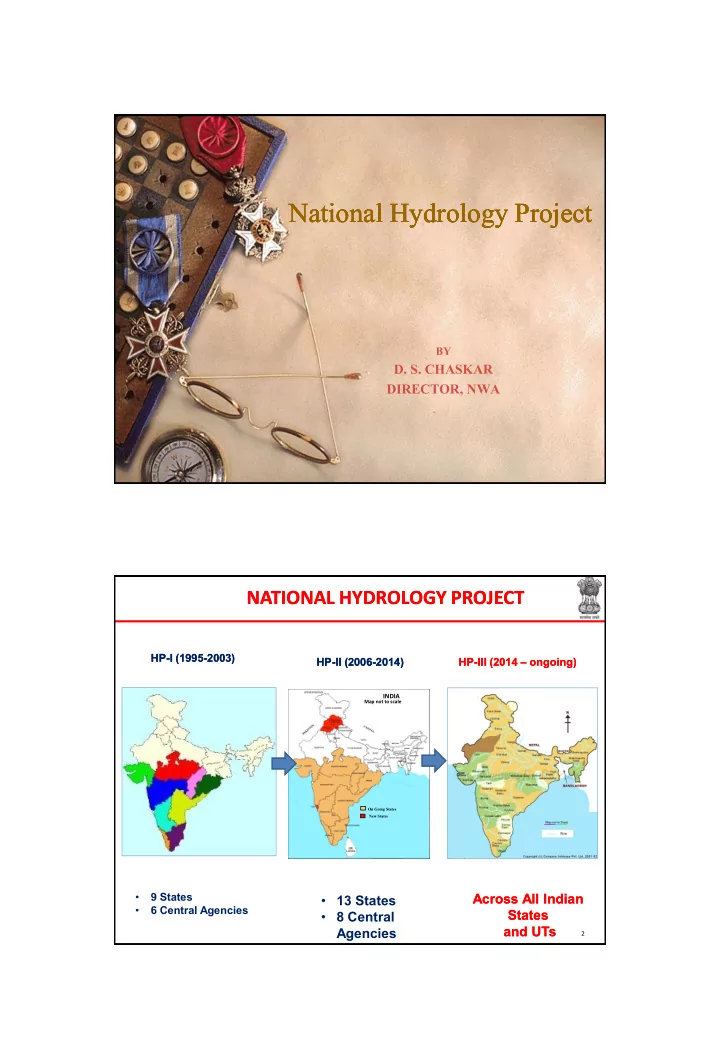
  • 9 States
  • 6 Central Agencies

HP HP-I (1995 I (1995-2003) 2003)

INDIA

On Going States New States

Map not to scale

  • 13 States
  • 8 Central

Agencies

HP HP-II (2006 II (2006-2014) 2014) HP HP-III (2014 III (2014 – ongoing)

  • ngoing)

Across All Indian Across All Indian States States and UTs and UTs

NATIONAL HYDROLOGY PROJECT NATIONAL HYDROLOGY PROJECT

slide-2
SLIDE 2

3

  • 9 States
  • 6 Central Agencies

HP HP-I (1995 I (1995-2003) 2003)

NATIONAL HYDROLOGY PROJECT NATIONAL HYDROLOGY PROJECT

Establishment of Hydrological Information System (HIS)

WB IDA credit of SDR 75.1 million (US $ 101 million) Total Revised cost : Rs.616.22 crore

4 INDIA

On Going States New States

Map not to scale

  • 13 States
  • 8 Central

Agencies

HP HP-II (2006 II (2006-2014) 2014)

NATIONAL HYDROLOGY PROJECT NATIONAL HYDROLOGY PROJECT

 To extend and promote the sustained and effective use of HIS by all implementing agencies  To extend HIS to the four new state agencies  Strengthening the capabilities for efficient water resource planning and management; DSS, HDA., PDS etc.

Estimated Cost : Rs. 631.83 Crore (US $ 135.01 million) - World Bank funding US $ 104.98 million in the form of IBRD loan

slide-3
SLIDE 3

5 INDIA

On Going States New States

Map not to scale

  • 13 States
  • 8 Central

Agencies

HP HP-II (2006 II (2006-2014) 2014)

NATIONAL HYDROLOGY PROJECT NATIONAL HYDROLOGY PROJECT

Achievements :

  • Moved From Manual Data Collection to Real

Time Data Acquisition System

  • From Desktop Data Management to Web-

based Data Management

  • Collating Data into Analyzed Information for

Decision Making through Decision Support System (DSS) Planning, Hydrological Design Aids (HDA), Purpose Driven Studies (PDS) etc.

  • Up gradation to real time flood forecasting

and reservoir operation systems through development of Real Time DSS (RTDSS), Real- Time Stream Flow (RTSF) & Reservoir Operation System (ROS).

  • National web based applications, like e-GEMS

(Ground Water Estimation & Management System), e-SWIS (Surface Water Information System), e-WQIS (Water Quality Information System) etc.

6

HP HP-III (2015 III (2015 – 2023 ) 2023 )

Across All Indian States Across All Indian States and UTs and UTs

NATIONAL HYDROLOGY PROJECT NATIONAL HYDROLOGY PROJECT

slide-4
SLIDE 4

Hydrologic Cycle Hydrologic Cycle

What is HIS? What is HIS?

 Hydrol

  • log
  • gical

– Hydrology is the science of water in the Hydrological cycle and is concerned with its states, storages and fluxes in location, time and phase. Hydrometry is the sister science, concerned with the measurement of these states, storages and fluxes

 Infor

  • rma

mati tion

  • n

– Information is data which has been manipulated and processed to give them meaning and purpose (reliability, availability and presentation)

 System

– It is a logical and structured system to collect, convert, process, check, store and disseminate in a form suitable to users.

slide-5
SLIDE 5

NEED OF HIS NEED OF HIS

 Water Is A Vital Natural Resource  Occurrence Of Water Not Uniform In Space And Time Domain  Planning, Design & Operation Of Water Resource Systems Requires

  • Knowledge of Occurrence & Behavior of

Movement of Water

  • Not Only Quantity but Quality Is Also Equally

Important  Fast Growing Population And Rapid Urbanisation

  • Ever Increasing Demand for Water Related

Information HYDROLOGICAL INFORMATION SYSTEM (HIS) HYDROLOGICAL INFORMATION SYSTEM (HIS)

 One of the pre-requisite for WRD&M

– Reliable, comprehensive and timely hydrological

data

  • + info. on economical, social and environmental

dimensions

 Realizes part of our National Water Policy (MoWR 1987)

– a well-developed Water Information System

(WIS) and

– free exchange of data among various agencies

  • “ … as the prime requisites for water resources

planning”

slide-6
SLIDE 6

DATA NEEDS AND DATA DATA NEEDS AND DATA USERS...(I) USERS...(I)

 Potential Hydrological Data Users

– Government Organisations: State Surface Water Departments Central Water Commission State Ground Water Departments Central Ground Water Board India Meteorological Department State Pollution Control Boards Water Supply And Sewage Boards Geology And Mines Departments Urban Water Supply And Drainage Boards Public Health Departments Hydropower Corporations Thermal Power Corporations Industries And Commerce Departments

DATA NEEDS AND DATA DATA NEEDS AND DATA USERS...(II) USERS...(II)

  • Agricultural Departments
  • Fisheries Departments
  • Forestry Departments
  • Development Authorities
  • Road Departments
  • Railways Departments
  • Drought Monitoring Cells
  • Tourist Boards
  • Universities & Research Institutes
  • Remote Sensing Agencies
  • Ministry Of Transport (For Navigation)
  • Ministry Of Environment And Forest
  • Ministry of Defence
slide-7
SLIDE 7

DATA NEEDS AND DATA DATA NEEDS AND DATA USERS...(III) USERS...(III)

Non-governmental Organisations:

  • Chambers Of Commerce
  • Water Users Associations
  • Farmers Development Agencies
  • Environmental Protection Organisations
  • Tourist Organisations

Private Sector:

  • Industries: E.G. Paper Mills, Fibre Industries, Cotton

Mills, Etc.

  • Engineering Consultants
  • Contractors

Most Commonly Required Data Most Commonly Required Data

 Water level in a river  Discharge/Flow  Rainfall  Climate( Sunshine, Humidity, Temp. Wind, Evaporation etc.)  Water Quality  Sedimentation

slide-8
SLIDE 8
  • DECISION MAKERS
  • POLICY MAKERS
  • DESIGNERS
  • RESEARCHERS
  • OPERATORS
  • USERS AGENCIES

USERS

HIS STORAGE PROCESSING VALIDATION RECORDING

DATA SENSING ACTIONS / STUDIES /USE

WATER RESOURCES / WATER USE SYSTEM

OBJECT SYSTEM TEM ADDITIONAL INFORMATION

ROLE OF AN HIS

G&D data on web G&D data on web

 http://water.bom.gov.au/waterstorage/awris/  http://www.timeanddate.com/  National Water Portal for Canada http://www.wateroffice.ec.gc.ca/  National Water Portal for the USA http://water.usgs.gov/nwis  State Water Portal of California http://cdec.water.ca.gov/  Water Portal for Regional Water Authority http://hydromet.lcra.org/  India

 www.india-wris.nrsc.gov.in/

slide-9
SLIDE 9

HIS design HIS design

 Number of stations  Type of instrumentation  Type of telemetry  Data collection  Data processing  Data dissemination  Decision support

Network Design Network Design

A complete network design addresses the following questions that pertain to the collection of hydrological data  What hydrological variables need to be

  • bserved?

 Where do hydrological observations need to be

  • bserved?

 What is the duration of the observation program?  How accurate should the observations be?

slide-10
SLIDE 10

Technology Related Components Technology Related Components

Hydrology Project Hydrology Project-I&II I&II

 Strengthening HIS in 9+4 states with the assistance from the WB

the first concerted effort at this scale for improving HIS in the country HP-I STATES  PHASE-I : PROJECT DURATION 6 YEARS (1996 - 2002)  PHASE-II : PROJECT DURATION 6 YEARS (2006 - 2012)

slide-11
SLIDE 11

PARTICIPATING AGENCIES-I&II CENTRAL STATES

CENTRAL WATER COMMISSION NATIONAL INSTITUTE OF HYDROLOGY CENTRAL GROUNDWATER BOARD INDIA METEOROLOGICAL DEPTT. CENTRAL WATER & POWER RESEARCH STATION

ANDHRA PRADESH ORISSA TAMIL NADU KERALA MADHYA PRADESH MAHARASTRA CHHATTISGARH GUJARAT KARNATAKA PUDUCHERRY

BHAKRA-BEAS MGMT. BOARD CENTRAL POLLUTION CONTROL BRD

GOA PUNJAB HIMACHAL PRADESH

INFRASTRUCTURAL PROFILE INFRASTRUCTURAL PROFILE

6500 digital water level recorders 7900 dedicated piezometers 920 river gauging stations 1800 rainfall stations 150 full climatic stations 80 water quality laboratories 1600 offices and site buildings 580 vehicles 1500 computer systems with dedicated software 390 data entry and processing centres 31 data storage centres 27000 staff training units organised

slide-12
SLIDE 12

HIS Components HIS Components

 AN HIS COMPRISES

– INFRASTRUCTURE OF PHYSICAL & HUMAN RESOURCES TO

  • COLLECT, PROCESS, STORE & DISSEMINATE (GEO-)

HYDROLOGICAL, HYDRO-METEOROLOGICAL DATA

 PHYSICAL INFRASTRUCTURE INCLUDES

– OBSERVATION NETWORKS – LABORATORIES – HARDWARE – SOFTWARE – DATA COMMUNICATION SYSTEM – DATA CENTRES HAVING DATA PROCESSING & DATABASE TOOLS

 HUMAN RESOURCES - WELL TRAINED STAFF

SOFTWARES FOR HIS SOFTWARES FOR HIS

 SWDES : Surface Water Data Entry System  HYMOS : Hydrological data processing System  WISDOM : Hydrological Data Storage System

slide-13
SLIDE 13

HYDROLOGICAL HYDROLOGICAL DATA PROCESSING SOFTWARE (HYMOS)

DATA ENTRY DATA ENTRY & EDITING DATA DATA STORAGE DATA CORRECTION DATA CORRECTION DATA COMPILATION DATA COMPILATION DATA DATA VALIDATION DATA DATA ANALYSIS

USERS USERS

HYDROLOGICAL HYDROLOGICAL DATA ENTRY SOFTWARE (SWDES)

EXPORT TO EXPORT TO HYMOS

HYDROLOGICAL HYDROLOGICAL DATA STORAGE SOFTWARE (WISDOM)

DATA STORAGE EXPORT TO DATA STORAGE SOFTWARE WISDOM

slide-14
SLIDE 14

INDIA INDIA-WRIS WRIS

slide-15
SLIDE 15

India Water Resources Management Programme – Hydrology Project (Phase – III)

RELIAB ABLE, E, TIMELY , QUALITY TY , CONSIST STEN ENT, PUBLIC C DATA

30

  • 9 States
  • 6 Central Agencies

HP HP-I (1995 I (1995-2003) 2003)

INDIA

On Going States New States

Map not to scale

  • 13 States
  • 8 Central

Agencies

HP HP-II (2006 II (2006-2014) 2014) HP HP-III (2015 III (2015 – ongoing)

  • ngoing)

Across All Indian Across All Indian States States and UTs and UTs

HYDROLOGY PROJECT HYDROLOGY PROJECT – Journey Ahead Journey Ahead

slide-16
SLIDE 16

31

Concepts of Hydrology Project Concepts of Hydrology Project –Phase III Phase III

  • Standardizing Water Resources Monitoring and

Information System for the country with uniform procedures and database.

  • Enhancing collaboration between Centre & States.
  • Improving access to information in the public-

domain.

  • Introducing country wide generic solutions for flood

forecasting and water resources management.

  • Developing site specific solutions for water resources

planning and management including used of remote sensing based techniques.

Data Repositories

to store and serve both raw feed and processed data (on Cloud Platform) Telemetry Dissemination Platforms Crowd-sourced / Community Surveillance Data Earth observation data access via suitable mechanisms (e.g. Internet, GeoNetCast)

Web Portals

(e.g. integrated

  • hydromet. visualization

platforms)

Stakeholder Alerts

Soils Canals Wetlands
  • Rivers

GIS and other data sets Data Rescue Data Management & Modeling (for weather, hydrological, inundation & other forecasts – short- term and seasonal)

Operational Control Rooms

“Bottom-up” Data Acquisition System

Manual Monitoring Automated Monitoring Radars

Interaction with other Knowledge Base and Analytical Systems

“Top-Down” Data Acquisition System

Satellite Earth Observation

slide-17
SLIDE 17

Project Project Design Design

Project Objective: Improve the data, information and knowledge systems to strengthen water resources planning, operation and management across India. Project Components: A. Improving Water Resources Monitoring system (WRMS) B. Improving Water Resources Information Systems (WRIS) C. Water Resources Management Applications (WRMA) D. Strengthening Institutions and Capacity Building Budget Outlay: 3000 Crores INR Timeline: 8 years Moving towards a programmatic approach

Project Project Design Design

Implementation arrangements Budget Outlay: 3000 Crores INR (2000 Crore World Bank, 1000 GoI)

  • As per EFC : WB 1820, Center 1226, States 594.5, Total 3640

Duration: 8 years Implementing agencies include:

  • 29 States
  • Central agencies: CWC, CGWB, NIH, IMD, CPCB, SoI, NRSC,

CWPRS, and BBMB

slide-18
SLIDE 18

Project Project Timeline Timeline

  • S. No.

Activity Due by 1 Itemized Cost estimate by IAs October 15, 2014 2 First draft of PIP November 15, 2014 3 Finalization of PIP by MoWR Dec 15, 2014 4 Submission for EFC clearance Jan 2015 5 EFC Clearance March 2015 6 Project Appraisal May 2015 7 Negotiation July 2015 8 Submission to World Bank Board for clearance August 2015 9 Effectiveness September, 2015

Project Project Design Design – Output components Output components

  • A. Improving Water Resources Monitoring system

(WRMS): India’s Water Resources Monitoring System (WRMS) has been upgraded, established and/or expanded nation-wide, and transparent and easy access for all data users is provided

  • B. Improving Water Resources Information

Systems (WRIS): A centralized Water Resources Information System is established and public domain information services are provided

slide-19
SLIDE 19

Project Project Design Design – Output components Output components

  • A. Water Resources Management Applications

(WRMA): All concerned agencies have applied tools for water resources planning and management activities, Flood Forecasting and Drought Management Systems have reduced annual flooding and drought losses, and studies have contributed to knowledge advances in India’s water sector

  • B. Strengthening Institutions and Capacity Building:

Integrated water resources knowledge centers are established and Implementing Agencies are strengthened

Component Component A : Improving A : Improving Water Resources Monitoring System Water Resources Monitoring System

  • A1. Water Resources Monitoring Systems
  • Improve and expand water resources monitoring

(including real-time) systems including:

‒ Weather ‒ Rivers ‒ Groundwater ‒ Reservoirs/tanks/lakes ‒ Water uses/ demands ‒ Sediment ‒ Coastal monitoring

  • Set monitoring standards: water

quantity/quality, AQC methods

  • Develop data sharing and data validation protocols

across state agencies

  • Pilot community based monitoring and water

management;

  • Introduce community based mobile monitoring

system for small streams, groundwater, water bodies, flooding and drought.

slide-20
SLIDE 20
  • A2. Database Population and Maintenance
  • Digitization, categorization and integration of paper data

and documents (e.g. documents, books, maps)

  • Develop spatial river basin information
  • Upgrade centralized and web-based data entry, storage

management and dissemination systems: E-SWIS, E- GEMS and E-WQIS

  • A3. Targeted Surveys in Selected Areas
  • Reservoir sedimentation surveys
  • Bathymetric river surveys in critical areas
  • Water quality/waste loads assessment
  • Groundwater exploration and aquifer mapping for

selected areas (complementary or in parallel to NAQUIM efforts)

Soils Canals Wetlands

  • Rivers

Component A: Improving Water Resources Monitoring System

40

Component B : Improving Water Resources Information Systems

B1: Centralized Spatial Dataset

  • Development of Digital Elevation Model (DEM) for the entire

country for improved flood mapping and other planning purposes.

  • High resolution surveys such as LIDAR for flood prone areas

for flood risk mapping.

  • Temporal Earth Observation/Remote Sensed products for the

entire country.

  • Temporal land use/land cover for entire country.
  • Weather forecast.
  • Climate change projections.
slide-21
SLIDE 21
  • B2. Water Resources Information System
  • Strengthening India’s National WRIS web-based portal for water

resources information

  • Introduce State Chapters to India WRIS
  • B3. Public-Domain Services
  • Provide public-domain information services (incl. online open

data and map services, digital online libraries)

  • Provide information products (e.g. online yearbooks, online

interactive atlases, customizable interactive visualization dashboards, benchmarking products) Component B : Improving Water Resources Information Systems

Component C : Water Resources Management Tools and Applications

  • C1. Water Resources Management Tools
  • Planning and Decision Support Systems for river basin

planning, introduction of community based groundwater management, climate risk assessment, water quality management, watershed planning, scenario analysis for investment planning

  • Flow/Flood Forecasting Systems for short-term and

seasonal forecasts for floods, flows, inundation, drought

  • Operational Management Systems for reservoirs,

irrigation systems operations, flood preparedness, spill management, and other water infrastructure

  • Design Tools: improve design tools such as Hydrologic

Design Aids (HDA) to improve design practices of water resource infrastructure – web-based
slide-22
SLIDE 22
  • C2. Water Knowledge Products
  • River Basin Management Plans (with stakeholder

involvement).

  • Customizable knowledge portals and mobile Apps;

Bulletins (e.g. flood forecasting).

  • Special Issue Based Reports (e.g. on climate change

and basin performance).

  • Flagship Knowledge Products (e.g. State of India’s

Water Resources).

Component C : Water Resources Management Tools and Applications

Component D: Improving Institutions and Capacity Building

  • D1. Integrated Water Resources Knowledge Centers
  • Establishment of the National Water Informatics Center

(integrated Center of Excellence for water resources knowledge and analysis, including use of modern modeling tools etc.)

  • State/basin Level (similar downscaled centers at basin,

regional or state levels based on requirements)

  • Institutional Modernization Support
  • Office Furnishing including laboratory and information

management tools

  • D2. Water Resources Capacity-Building
  • Policy Support
  • Strengthened Partnerships with other knowledge

providers, open data initiatives, academia, CSOs, internships/visiting experts, international exchange program

slide-23
SLIDE 23
  • D3. Training & Outreach
  • Annual Water Resources Knowledge Forum (showcasing the best of what

India has to offer and facilitate knowledge exchange).

  • Training (including curriculum development, technical courses, refresher

courses).

  • Multi-media: distance learning (e.g. using videoconferencing), e-learning

(e.g. self-paced courses, webinars), vendor fairs, regular video & audio podcasts, documentaries.

  • Competitions (e.g. Online Tools, Appathons, Hackathons)
  • D4. Project Management and Technical Assistance
  • Establishment of a permanent WRIS Coordination Secretariat in MoWR
  • Support to Project Management Units at IA level
  • Project Implementation Facilitation (e.g. technical assistance and support

for procurement, financial management, safeguards, training and sustainability) at central and state levels

  • Project Monitoring (M&E, FMR, progress reporting)

Component D: Improving Institutions and Capacity Building Expected Benefits

  • Standardized country-wide water resources database and India is

brought under one water resources information framework.

  • Enhanced collaboration between Centre and States.
  • Improved access to information in the public-domain
  • Centers of excellence providing modern water resources

knowledge services and partnerships.

  • Availability of country wide generic solutions for flood forecasting

and water resources management.

  • Focus on use of water resources information for addressing critical

water challenges in the country

  • Improved learning and knowledge exchange
slide-24
SLIDE 24

Thank you