
SLIDE 1
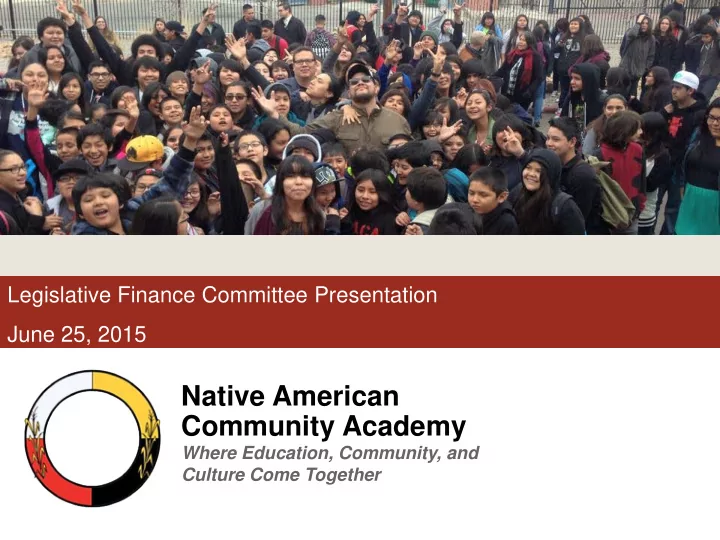
Native American Community Academy Where Education, Community, and - - PowerPoint PPT Presentation
Legislative Finance Committee Presentation June 25, 2015 Native American Community Academy Where Education, Community, and Culture Come Together NACA Mission and History To engage students, educators, families, and community in creating a
2
NACA Mission and History
3
Respect – Having concern for harmonious relationships; honoring yourself, your peers, your family, your elders, your ancestors, your teachers, your school, your community, your tribe/nation. Having courteous regard for
Responsibility – We are responsible to our People; past, present and future, as well as our environment and
conduct in all that you do. Community/Service – We belong to the NACA community as well as the communities of our neighborhoods, cities, pueblos, reservations and nations. This means that, along with rights, we have the responsibility to provide service to make our community a better place for all. Culture – We honor and value our own cultures and those of others. We recognize we are influenced by many cultures, including Indigenous, youth, and contemporary western cultures and are mindful in how this impacts the development of identity. Perseverance – Indigenous people have endured because of the perseverance and determination of those that came before. We make our ancestors proud by remaining constant to a purpose, idea or task in spite of
full potential. Reflection – Indigenous thinking and learning is a reflective process involving a deliberate looking inward, self- awareness and contemplation of deeper meanings. We support this reflective practice to encourage thoughtfulness, personal growth, profound learning and meaningful change.
NACA Core Values
4
Companionship
Community
Fulfillment
NACA Wellness Wheel
5
Integrated Curriculum CCSS Culture and Language Context Wellness Philosophy
Commitment to Community and Service
culturally based education, holistic wellness philosophy, and community/ based education – to guide the development of school programs, wellness, and academic curriculum
curriculum and vigorous testing (students complete at least 6 hours of dual enrollment credit prior to graduation)
language, and culture as the framework for rigorous, college-prep curriculum
storytelling, oral traditions, cultural history, Native languages, community presentations, and Native American literature
providing free, school-based, culturally-sensitive, high quality mental health services open to all students and families
focused on students overall wellness; part of required Personal Wellness class for all students
healthcare, nutrition, and social services at the on-site school based health center
Time program
houses, guest speakers, cultural events, and mentoring
include: First Nations, Americans for Indian Opportunity, NM Forum for Youth & Community, CNM, Southwest Youth Services, UNM School Based Health, UNM Tribal Service Corps, Teach for America and many more… NACA Curriculum and Instruction Framework
6/25/2015 5
NACA GOALS
Integrated curriculum Cultural relevancy Community Relations Wellness Philosophy Language Revitalization Enrichment & College-Preparatory Focus
6
7
10 20 30 40 50 60 6th Reading 2012 8th Reading 2014 6th Math 2012 8th Math 2014
Class of 2018 Scores as 6th Grade versus 8th Grade NACA Students (percent of students scoring in each area)
Beginning Nearing Proficient Advanced
Students coming to NACA in 6th grade frequently score in the beginning step on state mandated assessments. By 8th grade, we are able to see a great deal of growth in the number of students who have moved up 1 or more categories and into the proficient range.
8
10 20 30 40 50 60 70 80 90 All Students Female Male Hispanic American Indian Economically Disadvantaged English Language Learners
Graduation Rates NACA vs. State vs. District (by percentage)
State Rate District Rate NACA Rate
9
NISN and NACA Mission and History
10
NACA Element What it looks like Integration of Academic Excellence & Cultural Relevance
and practices, with data-backed evaluation of outcomes
through Indigenous teaching practices (e.g. integrating geology curriculum with Native creation stories, impact of policy on tribes, impact of Ind.Ed) Focus on holistic wellness
to assess growth and set goals
Spiritual, Physical, and Emotional Health
impact of boarding schools in Native communities due to colonization Community Transformation
creating and leading partnerships with organizations like the Indian Pueblo Cultural Center, UNM’s NAS, SYS, Inc., AIO
wow and 1491s NACA Mission and History
11
Indigenous perspectives are integrated throughout the teaching and learning framework, ensuring a high level of consonance and meaning. Curriculum: Encompasses
Common Core State Standard skills with culturally relevant content and real-world application as a means to achieve Indigenous Perspectives.
Instruction: Teachers use the
Understanding by Design (UbD) framework, eemphasizing student
Professional development:
Based on collaborative critique model emphasizing transparency, availability, and vulnerability in teachers’ curriculum, assessments, and instruction.
Assessment: Student outcomes
are judged at the end of each unit, and ultimately used to inform decisions about the future units of study.
NACA Professional Development Framework
12
NISN Guiding Philosophy
Each NISN school will be a leader in Indigenous education, integrating personal health, cultural identity, and academic excellence so that every student is holistically well (intellectual, physical, social / emotional, relationships / community) and prepared to lead in and contribute to their communities
Expressed through the Six Community Commitments
Academic Excellence & Relevance
Student excellence in college, career, and community through culturally relevant curriculum and instructional practices
Community Transformation
Community designed and led schools that transform the lives of their students, families, and stakeholders
NISN Core Values & Culture
Embodiment of the NISN core values, reflecting and supporting the cultural diversity and perspectives of their communities
Reflection and Continuous Improvement
Continual deliberate reflection on, and improvement in, practices in service of their communities and mission
Operating Effectiveness & Efficiency
Creation of long-lasting impact through effective and sustainable practices and use of resources
Leadership in Indigenous Education
Contributions to the creation and sustaining of a national movement for excellence in Indigenous education
NISN Operating Model and Strategic Plan