
SLIDE 1
Native Plants in your Yard and Garden. Edible Native Landscape - - PowerPoint PPT Presentation
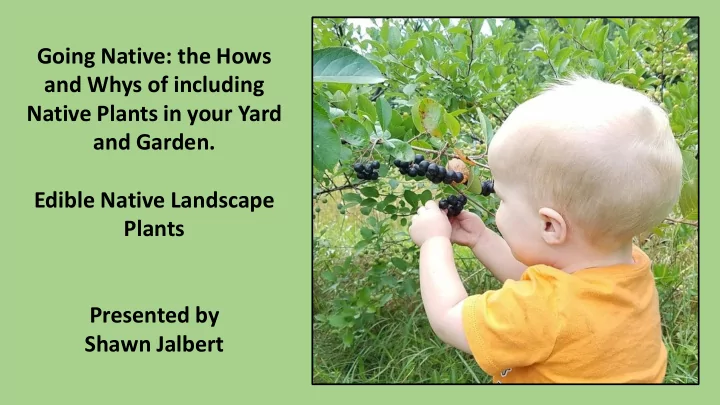
Going Native: the Hows and Whys of including Native Plants in your Yard and Garden. Edible Native Landscape Plants Presented by Shawn Jalbert Acer rubrum & A. saccharum , Red & Sugar Maple Both red and sugar maples can be tapped
Old school maple sap collection techniques using a sumac spile and a trough made from a hollowed
1 gallon of syrup. Both red and sugar maples can be tapped for their sap, but sugar maples have a higher sugar content.
Wild leeks are much revered for their distinctively flavored roots. Rare in Maine, wild populations are being sacked, prompting conservation concerns.
Shadbush fruit has a pleasantly sweet taste; it’s a good food source for humans and wildlife. Lots of flowers means lots of food for pollinators, as well as being pleasing to the human eye.
Chokeberry is a wonderfully adaptable plant--it can grow in inundated wetlands and bone dry fields and everywhere in between
The Soviets took interest in the fruit as a way to ensure a domestic supply of vitamin c. Chokeberries have some of the highest antioxidant levels found in any fruit, thanks to that beautiful dark purple pigment. Chokeberries have been grown commercially in the former USSR region and eastern Europe since the late 1800’s Chokeberry orchards have been established in the eastern US over the last decade or so, but market success has not been particularly stellar.
White birch can be tapped like a maple tree and its sap boiled down into a tasty syrup. Birch syrup is not common around here, probably because
syrup, but is common in more northerly areas, like Alaska.
Nut meat tastes very similar to walnut. Squirrels go “nuts” for these nuts and maniacally harvest as many as they can for winter storage.
American hazelnut is the more prolific nut producer of the two species we have in Maine Does best in full sun conditions, accepting a variety of soil types.
Needs to be in at least part shade, nuts are fewer and smaller than those produced by American hazelnut.
Size doesn’t matter-even though the berries are small (about the size of your pinky fingernail), this strawberry made an important genetic contribution to modern strawberry cultivars. Fragaria virginiana was hybridized with
allowing today’s large tasty strawberries to be grown well into northern area.
It is arguable that huckleberries taste better than blueberries. Red tinged flowers are a conversation piece when they come out in the spring. Grows in a variety of contrasting habitats-rocky upland areas to soggy bogs.
Can be eaten right off the bush, but the plums are not as sweet as you would expect them to be. Fruit makes excellent jellies and jams, which it is perhaps best known for in modern times.
Elderberry is a rock star in every sense
centuries, and recently proven by modern science, as a having potent medicinal and nutritive value. The berries are high in beneficial antioxidants, vitamins, and minerals. Elderberry extracts provide relief from colds and the flu, thanks to its anti- viral and anti-bacterial properties. Berries can be made into wine and
purple color to food products.
This large handful of berries is from one of the many elderberry cultivars that have been developed over the last century. Taken at Longwood Gardens trial planting in PA. Laden with berries, this plant was growing in the wild.
Tolerant of poor sandy soils, lowbush blueberry can be used as a ground cover in sunny spots.
Sweet-tart berries; commercial highbush blueberry cultivars were selected from this native shrub and are now grown all over the world. Found growing in wetlands in the wild.
Cranberries aren’t so good picked right off the plant, they are very tart with not enough sweet. But we know how good they are when a bit of sugar is added…. In the wild they are a denizen of sphagnum moss bogs, but they do surprisingly well when planted in upland gardens.
Fox grape is the wild parent of the famous Concord grape, grown for its wonderful tasting juice.
This species bears many more, albeit smaller, grapes on each cluster then fox grape. Grapes are sour to the human palate, but many species of wildlife are nourished by the fruit. Leaves and tendrils are edible before they become fully mature and too woody.
Shawn Jalbert is the principle of Native Haunts Located in Alfred, Maine 207-604-8655 www.nativehaunts.com nativehaunts@gmail.com
Products
Native trees, shrubs and perennials of local provenance. Locally collected seed of native trees, shrubs and perennials.
Consultation services
Identification of native plants on your property. Integrating native plants into your landscape plan. Identification and control strategies for invasive plants.