Natural Language Processing Syntax Parsing I Dan Klein UC Berkeley - - PDF document

natural language processing syntax
SMART_READER_LITE
LIVE PREVIEW

Natural Language Processing Syntax Parsing I Dan Klein UC Berkeley - - PDF document

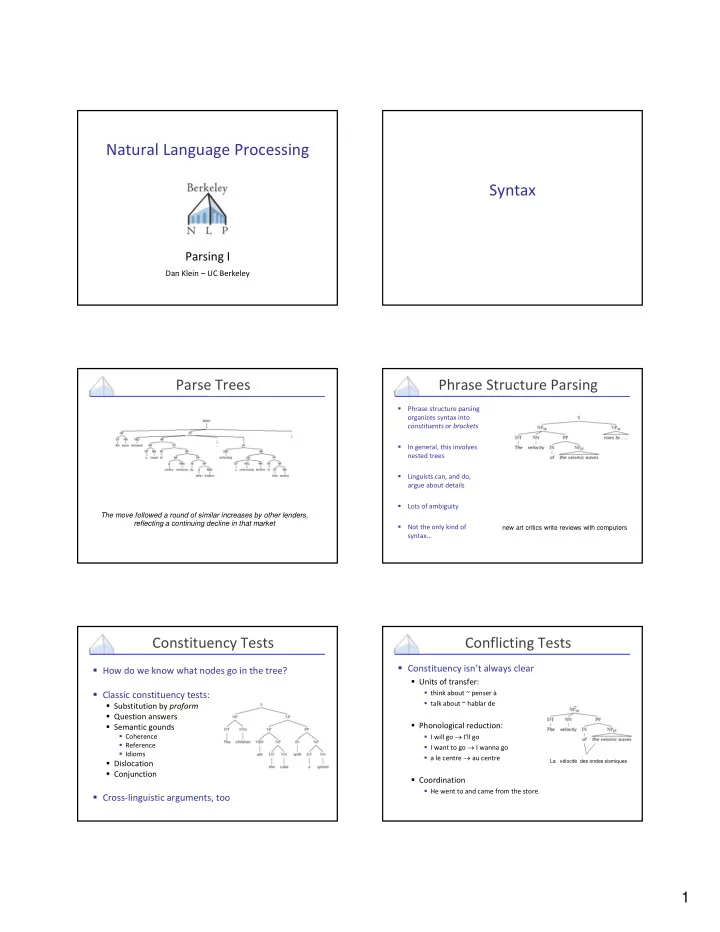
Natural Language Processing Syntax Parsing I Dan Klein UC Berkeley Parse Trees Phrase Structure Parsing Phrase structure parsing organizes syntax into constituents or brackets In general, this involves nested trees Linguists can,


slide-1
SLIDE 1

1

Natural Language Processing

Parsing I

Dan Klein – UC Berkeley

Syntax

Parse Trees

The move followed a round of similar increases by other lenders, reflecting a continuing decline in that market

Phrase Structure Parsing

  • Phrase structure parsing
  • rganizes syntax into

constituents or brackets

  • In general, this involves

nested trees

  • Linguists can, and do,

argue about details

  • Lots of ambiguity
  • Not the only kind of

syntax…

new art critics write reviews with computers

PP NP NP N’ NP VP S

Constituency Tests

  • How do we know what nodes go in the tree?
  • Classic constituency tests:
  • Substitution by proform
  • Question answers
  • Semantic gounds
  • Coherence
  • Reference
  • Idioms
  • Dislocation
  • Conjunction
  • Cross‐linguistic arguments, too

Conflicting Tests

  • Constituency isn’t always clear
  • Units of transfer:
  • think about ~ penser à
  • talk about ~ hablar de
  • Phonological reduction:
  • I will go  I’ll go
  • I want to go  I wanna go
  • a le centre  au centre
  • Coordination
  • He went to and came from the store.

La vélocité des ondes sismiques

slide-2
SLIDE 2

2

Classical NLP: Parsing

  • Write symbolic or logical rules:
  • Use deduction systems to prove parses from words
  • Minimal grammar on “Fed raises” sentence: 36 parses
  • Simple 10‐rule grammar: 592 parses
  • Real‐size grammar: many millions of parses
  • This scaled very badly, didn’t yield broad‐coverage tools

Grammar (CFG) Lexicon

ROOT  S S  NP VP NP  DT NN NP  NN NNS NN  interest NNS  raises VBP  interest VBZ  raises … NP  NP PP VP  VBP NP VP  VBP NP PP PP  IN NP

Ambiguities

Ambiguities: PP Attachment Attachments

  • I cleaned the dishes from dinner
  • I cleaned the dishes with detergent
  • I cleaned the dishes in my pajamas
  • I cleaned the dishes in the sink

Syntactic Ambiguities I

  • Prepositional phrases:

They cooked the beans in the pot on the stove with handles.

  • Particle vs. preposition:

The puppy tore up the staircase.

  • Complement structures

The tourists objected to the guide that they couldn’t hear. She knows you like the back of her hand.

  • Gerund vs. participial adjective

Visiting relatives can be boring. Changing schedules frequently confused passengers.

Syntactic Ambiguities II

  • Modifier scope within NPs

impractical design requirements plastic cup holder

  • Multiple gap constructions

The chicken is ready to eat. The contractors are rich enough to sue.

  • Coordination scope:

Small rats and mice can squeeze into holes or cracks in the wall.

slide-3
SLIDE 3

3

Dark Ambiguities

  • Dark ambiguities: most analyses are shockingly bad

(meaning, they don’t have an interpretation you can get your mind around)

  • Unknown words and new usages
  • Solution: We need mechanisms to focus attention on the

best ones, probabilistic techniques do this This analysis corresponds to the correct parse of “This will panic buyers ! ”

PCFGs

Probabilistic Context‐Free Grammars

  • A context‐free grammar is a tuple <N, T, S, R>
  • N : the set of non‐terminals
  • Phrasal categories: S, NP, VP, ADJP, etc.
  • Parts‐of‐speech (pre‐terminals): NN, JJ, DT, VB
  • T : the set of terminals (the words)
  • S : the start symbol
  • Often written as ROOT or TOP
  • Not usually the sentence non‐terminal S
  • R : the set of rules
  • Of the form X  Y1 Y2 … Yk, with X, Yi  N
  • Examples: S  NP VP, VP  VP CC VP
  • Also called rewrites, productions, or local trees
  • A PCFG adds:
  • A top‐down production probability per rule P(Y1 Y2 … Yk | X)

Treebank Sentences Treebank Grammars

  • Need a PCFG for broad coverage parsing.
  • Can take a grammar right off the trees (doesn’t work well):
  • Better results by enriching the grammar (e.g., lexicalization).
  • Can also get reasonable parsers without lexicalization.

ROOT  S 1 S  NP VP . 1 NP  PRP 1 VP  VBD ADJP 1 …..

PLURAL NOUN NOUN DET DET ADJ NOUN NP NP CONJ NP PP

Treebank Grammar Scale

  • Treebank grammars can be enormous
  • As FSAs, the raw grammar has ~10K states, excluding the lexicon
  • Better parsers usually make the grammars larger, not smaller

NP

slide-4
SLIDE 4

4

Chomsky Normal Form

  • Chomsky normal form:
  • All rules of the form X  Y Z or X  w
  • In principle, this is no limitation on the space of (P)CFGs
  • N‐ary rules introduce new non‐terminals
  • Unaries / empties are “promoted”
  • In practice it’s kind of a pain:
  • Reconstructing n‐aries is easy
  • Reconstructing unaries is trickier
  • The straightforward transformations don’t preserve tree scores
  • Makes parsing algorithms simpler!

VP [VP  VBD NP ] VBD NP PP PP [VP  VBD NP PP ] VBD NP PP PP VP

CKY Parsing

A Recursive Parser

  • Will this parser work?
  • Why or why not?
  • Memory requirements?

bestScore(X,i,j,s) if (j = i+1) return tagScore(X,s[i]) else return max score(X->YZ) * bestScore(Y,i,k) * bestScore(Z,k,j)

A Memoized Parser

  • One small change:

bestScore(X,i,j,s) if (scores[X][i][j] == null) if (j = i+1) score = tagScore(X,s[i]) else score = max score(X->YZ) * bestScore(Y,i,k) * bestScore(Z,k,j) scores[X][i][j] = score return scores[X][i][j]

  • Can also organize things bottom‐up

A Bottom‐Up Parser (CKY)

bestScore(s) for (i : [0,n-1]) for (X : tags[s[i]]) score[X][i][i+1] = tagScore(X,s[i]) for (diff : [2,n]) for (i : [0,n-diff]) j = i + diff for (X->YZ : rule) for (k : [i+1, j-1]) score[X][i][j] = max score[X][i][j], score(X->YZ) * score[Y][i][k] * score[Z][k][j] Y Z X i k j

Unary Rules

  • Unary rules?

bestScore(X,i,j,s) if (j = i+1) return tagScore(X,s[i]) else return max max score(X->YZ) * bestScore(Y,i,k) * bestScore(Z,k,j) max score(X->Y) * bestScore(Y,i,j)

slide-5
SLIDE 5

5

CNF + Unary Closure

  • We need unaries to be non‐cyclic
  • Can address by pre‐calculating the unary closure
  • Rather than having zero or more unaries, always have

exactly one

  • Alternate unary and binary layers
  • Reconstruct unary chains afterwards

NP DT NN VP VBD NP DT NN VP VBD NP VP S SBAR VP SBAR

Alternating Layers

bestScoreU(X,i,j,s) if (j = i+1) return tagScore(X,s[i]) else return max max score(X->Y) * bestScoreB(Y,i,j) bestScoreB(X,i,j,s) return max max score(X->YZ) * bestScoreU(Y,i,k) * bestScoreU(Z,k,j)

Analysis

Memory

  • How much memory does this require?
  • Have to store the score cache
  • Cache size: |symbols|*n2 doubles
  • For the plain treebank grammar:
  • X ~ 20K, n = 40, double ~ 8 bytes = ~ 256MB
  • Big, but workable.
  • Pruning: Beams
  • score[X][i][j] can get too large (when?)
  • Can keep beams (truncated maps score[i][j]) which only store the best few

scores for the span [i,j]

  • Pruning: Coarse‐to‐Fine
  • Use a smaller grammar to rule out most X[i,j]
  • Much more on this later…

Time: Theory

  • How much time will it take to parse?
  • For each diff (<= n)
  • For each i (<= n)
  • For each rule X  Y Z
  • For each split point k

Do constant work

  • Total time: |rules|*n3
  • Something like 5 sec for an unoptimized parse of a

20‐word sentences

Y Z X i k j

Time: Practice

  • Parsing with the vanilla treebank grammar:
  • Why’s it worse in practice?
  • Longer sentences “unlock” more of the grammar
  • All kinds of systems issues don’t scale

~ 20K Rules (not an

  • ptimized

parser!) Observed exponent:

3.6

slide-6
SLIDE 6

6

Same‐Span Reachability

ADJP ADVP FRAG INTJ NP PP PRN QP S SBAR UCP VP WHNP TOP LST CONJP WHADJP WHADVP WHPP NX NAC SBARQ SINV RRC SQ X PRT

Rule State Reachability

  • Many states are more likely to match larger spans!

Example: NP CC 

NP CC

n n-1 1 Alignment Example: NP CC NP 

NP CC

n n-k-1 n Alignments

NP

n-k

Efficient CKY

  • Lots of tricks to make CKY efficient
  • Some of them are little engineering details:
  • E.g., first choose k, then enumerate through the Y:[i,k] which are

non‐zero, then loop through rules by left child.

  • Optimal layout of the dynamic program depends on grammar,

input, even system details.

  • Another kind is more important (and interesting):
  • Many X:[i,j] can be suppressed on the basis of the input string
  • We’ll see this next class as figures‐of‐merit, A* heuristics, coarse‐

to‐fine, etc

Agenda‐Based Parsing

Agenda‐Based Parsing

  • Agenda‐based parsing is like graph search (but over a

hypergraph)

  • Concepts:
  • Numbering: we number fenceposts between words
  • “Edges” or items: spans with labels, e.g. PP[3,5], represent the sets of

trees over those words rooted at that label (cf. search states)

  • A chart: records edges we’ve expanded (cf. closed set)
  • An agenda: a queue which holds edges (cf. a fringe or open set)

1 2 3 4 5

critics write reviews with computers PP

Word Items

  • Building an item for the first time is called discovery. Items go

into the agenda on discovery.

  • To initialize, we discover all word items (with score 1.0).

critics write reviews with computers

critics[0,1], write[1,2], reviews[2,3], with[3,4], computers[4,5] 1 2 3 4 5

AGENDA CHART [EMPTY]

slide-7
SLIDE 7

7

Unary Projection

  • When we pop a word item, the lexicon tells us the tag item

successors (and scores) which go on the agenda critics write reviews with computers

1 2 3 4 5

critics write reviews with computers critics[0,1] write[1,2] NNS[0,1] reviews[2,3] with[3,4] computers[4,5] VBP[1,2] NNS[2,3] IN[3,4] NNS[4,5]

Item Successors

  • When we pop items off of the agenda:
  • Graph successors: unary projections (NNS  critics, NP  NNS)
  • Hypergraph successors: combine with items already in our chart
  • Enqueue / promote resulting items (if not in chart already)
  • Record backtraces as appropriate
  • Stick the popped edge in the chart (closed set)
  • Queries a chart must support:
  • Is edge X:[i,j] in the chart? (What score?)
  • What edges with label Y end at position j?
  • What edges with label Z start at position i?

Y[i,j] with X  Y forms X[i,j] Y[i,j] and Z[j,k] with X  Y Z form X[i,k]

Y Z X

An Example

1 2 3 4 5

critics write reviews with computers NNS VBP NNS IN NNS NNS[0,1] VBP[1,2] NNS[2,3] IN[3,4] NNS[3,4] NP[0,1] NP[2,3] NP[4,5] NP NP NP VP[1,2] S[0,2] VP PP[3,5] PP VP[1,3] VP ROOT[0,2] S ROOT S ROOT S[0,3] VP[1,5] VP NP[2,5] NP ROOT[0,3] S[0,5] ROOT[0,5] S ROOT

Empty Elements

  • Sometimes we want to posit nodes in a parse tree that don’t

contain any pronounced words:

  • These are easy to add to a chart parser!
  • For each position i, add the “word” edge :[i,i]
  • Add rules like NP   to the grammar
  • That’s it!

1 2 3 4 5

I like to parse empties       NP VP

I want you to parse this sentence I want [ ] to parse this sentence

UCS / A*

  • With weighted edges, order matters
  • Must expand optimal parse from

bottom up (subparses first)

  • CKY does this by processing smaller

spans before larger ones

  • UCS pops items off the agenda in
  • rder of decreasing Viterbi score
  • A* search also well defined
  • You can also speed up the search

without sacrificing optimality

  • Can select which items to process first
  • Can do with any “figure of merit”

[Charniak 98]

  • If your figure‐of‐merit is a valid A*

heuristic, no loss of optimiality [Klein and Manning 03]

X n i j

(Speech) Lattices

  • There was nothing magical about words spanning exactly
  • ne position.
  • When working with speech, we generally don’t know

how many words there are, or where they break.

  • We can represent the possibilities as a lattice and parse

these just as easily.

I awe

  • f

van eyes saw a ‘ve an Ivan