Naveen Bajaj DM (Neonatology) Seth GS & KEM Mumbai Neonatal - - - PowerPoint PPT Presentation

naveen bajaj
SMART_READER_LITE
LIVE PREVIEW

Naveen Bajaj DM (Neonatology) Seth GS & KEM Mumbai Neonatal - - - PowerPoint PPT Presentation

Naveen Bajaj DM (Neonatology) Seth GS & KEM Mumbai Neonatal - Perinatal Medicine Fellow (UWO, Canada) MD (Ped), GMC Patiala Presently working as Neonatologist In Charge Deep Hospital, Ludhiana, Punjab. Beating the bugs: what works and


slide-1
SLIDE 1

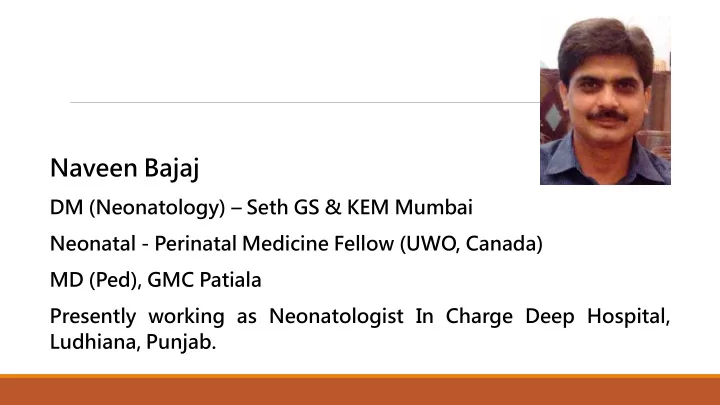
Naveen Bajaj

DM (Neonatology) – Seth GS & KEM Mumbai Neonatal - Perinatal Medicine Fellow (UWO, Canada) MD (Ped), GMC Patiala Presently working as Neonatologist In Charge Deep Hospital, Ludhiana, Punjab.
slide-2
SLIDE 2

Beating the bugs: what works and what

does not against nosocomial infections?

DR NAVEEN BAJAJ

DM (NEONAT ATOLOGY) NEONAT ATAL PERINAT ATAL MEDICINE FELLOW NEONAT ATOLOGIST, DEEP HOSPITAL, LUDHIANA, PUNJAB

slide-3
SLIDE 3

Nosocomial Infections in Neonates

  • Sepsis claims > 1 million neonatal deaths/year worldwide
  • Nosocomial sepsis 100 times more common than EO sepsis
  • 7-24 % of NICU patients
  • Blood stream infections 55%
  • Pneumonia 30%
  • Incidence varies inversely with gestational age
  • Huge burden of mortality, morbidity and cost
slide-4
SLIDE 4

Common Organisms

Developed world Developing world

  • Klebsiella
  • Staph Aureus
  • Acenatobacter
  • E coli
  • Fungal
  • Enterococci
  • Gram +ve
  • Gram +ve – 70%, mainly CONS
  • Gram –VE – 18%
  • Fungi – 15%
  • Staph Aureus
  • Enterococci
  • Viruses –RSV and Rotavirus
  • Fungal
slide-5
SLIDE 5

Hand Hygiene

  • Simplest Most effective method for reducing nosocomial infections
  • High compliance lowers rate of blood stream infection
  • Antiseptic Hand wash vs Alcohol hand rub (Larson et al 2005)

No significant differences

  • Any Neonatal infections (OR 0.98 95% CI 0.77-1.25)
  • Mea ioial outs o uses’ hads (3.21 and 3.11 log10 CFU for

handwashing and alcohol, respectively; P=.38)

Larson et al . Effect of antiseptic handwashing vs alcohol sanitizer on health care-associated infections in neonatal intensive care units. Arch Pediatr Adolesc Med. 2005 Apr;159(4):377-83.

slide-6
SLIDE 6

Hand Hygiene

  • AAP Perinatal Care Guidelines 6th ed (2007) recommends
  • Whe hads ae isil otaiated, the should fist e ashed

with soap and water

  • Antiseptic soap or an alcohol-based gel or foam for routine hand

sanitizing if hands are not visibly soiled

Antiseptic Hand Wash and Alcohol Hand Rub equally effective

slide-7
SLIDE 7

Gowning by Staff and visitors

  • No significant effects on (Cochrane review 2013)
  • Incidence of systemic nosocomial infection
  • Colonization
  • Length of hospital stay
  • Not euied outiel i NICU’s
  • Wear doing procedures or handling neonate for isolation

Webster J, Pritchard MA. Gowning by attendants and visitors in newborn nurseries for prevention

  • f neonatal morbidity and mortality. Cochrane Database of Systematic Reviews 2013
slide-8
SLIDE 8

Central Venous Catheter Related Infections

  • CRBSI - Most common nosocomial infection
  • Usually because of
  • Breach of asepsis during insertion
  • Poor insertion technique
  • Lack of Ongoing care of catheter
  • Hub manipulation and contamination
  • Afte 2 eeks odds of ifetio ↑ (Advani et al 2011)
  • Extraluminal – Ist week
  • Intraluminal and hub colonization - > Ist week
slide-9
SLIDE 9

Risk factors for CVC-associated bloodstream infections in NICU

  • ELBW (OR = 5.13, CI = 2.1 to 12.5)
  • Catheter hub colonization (OR = 44.1, 95% CI = 14.5 -134.4)
  • Exit site colonization (OR = 14.4, CI = 4.8-42.6)
  • Duration of parenteral nutrition (OR=1.04, CI=1.0-1.08)
  • Catheter insertion after Ist week of life (OR = 2.7, CI = 1.1-6.7)

Mahieu et al Risk factors for central vascular catheter-associated bloodstream infections among patients in a neonatal intensive care unit. J Hosp Infect. 2001 Jun;48(2):108-16.

slide-10
SLIDE 10

CVC Protocol

  • Maximal sterile barrier precautions during insertion (cap,

mask, glove, gown) reduce infection (Raad et al 1995)

  • Asepsis by Chlorhexidine vs Povidone –Iodine
  • Equally efficacious (Garland et al 1995)
  • Chlorhexidine impregnated dressing (Garland et al 2001)
  • In line filters (Jack et al 2012)
  • No impact on sepsis
slide-11
SLIDE 11

Antimicrobial-impregnated CVC for prevention of CRBI - Cochrane review 2015

  • 1 small trial(N=98)
  • Silverzeolite impregnated UVC reduced the incidence of

bloodstream infection in very preterm infants (RR 0.11, 95% CI

0.01 to 0.87; risk difference -0.17, 95% CI -0.30 to -0.04; NNT for benefit 6)

Balain M, Oddie SJ, McGuire W. Antimicrobial-impregnated central venous catheters for prevention of catheter-related bloodstream infection in newborn infants. Cochrane Database of Systematic Reviews 2015

Needs more data before Routine use

slide-12
SLIDE 12

Proactive Management of CVC

  • Dedicated task force for CVC management – 2/3rd reduction

in CRBSI (Golombek et al 2002)

  • Standardization of CVC placement and maintenance had

49% lower risk of CRBSI in patients who had a central line in place for more than 30 days (Taylor et al 2011)

Taylor e al Advances in Neonatal Care:. April 2011 - Volume 11 - Issue 2 - p 122–128

Dedicated CVC management team reduces CRBSI

slide-13
SLIDE 13

Antibiotic lock for prevention of catheter related infection - Cochrane Review 2015

  • 3 trials (271 infants)
  • ↓ ofied CRI’s (RR 0.15, 95% CI 0.06 - 0.40)
  • ↓ suspeted CRI’s (RR 0.65, 95% CI 0.22 to 1.92)
  • ↓ Coied Cofied and suspect infection rates (RR 0.25, 95%

CI 0.12 0.49)

  • ARR was 20.5% and the NNTB was 5
  • However, No difference for mortality due to sepsis

Taylor JE, Tan K, Lai NM, McDonald SJ. Antibiotic lock for the prevention of catheter-related infection in neonates. Cochrane Database of Systematic Reviews 2015

Appears to be effective but concern of antibiotic resistance Needs more data before routine recommendations

slide-14
SLIDE 14

Antibiotics Use and Misuse

  • Use is universal and Misuse is very common
  • Alteration of neonatal microflora
  • Development of antibiotics resistance
  • Use of 3 rd Gen cephalosporin as empirical therapy

increase drug resistance

  • Increase fungal infections
slide-15
SLIDE 15

Prophylactic Antibiotics

  • Central Catheters - ↓ rate of proven bacterial sepsis but no

effect on overall mortality (Cochrane Review 2008)

  • UVC – Insufficient evidence (Cochrane Review 2010)
  • UAC - Insufficient evidence (Cochrane Review 2010)
  • ICD - Insufficient evidence (Cochrane Review 2010)
  • Ventilation - Insufficient evidence (Cochrane Review 2010)
  • Proph Vancomycin - Not recommended (Cochrane Review 2010)

DON’T Use Pophlati Atiiotis

slide-16
SLIDE 16
slide-17
SLIDE 17

Probiotics for prevention of NEC in preterm infants - Cochrane Review 2014

  • Sigifiatl ↓ seee NEC (>stage II ) (RR 0.43, 95% CI 0.33 to 0.56)

and mortality (RR 0.65, 95% CI 0.52 to 0.81)

  • No evidence of significant reduction of nosocomial sepsis
  • Concerns
  • Most effective preparations
  • Timing, Dose and duration
  • Preparations available in India

AlFaleh K, Anabrees J. Probiotics for prevention of necrotizing enterocolitis in preterm infants.

Cochrane Database of Systematic Reviews 2014

Probiotics prevents Severe NEC and Mortality Recommended, if right preparation is available

slide-18
SLIDE 18

Weisman e al Pediatrics 2011;128:271–279

  • 80 patients received pagibaximab at 90 (n22) or 60 (n 20)

mg/kg or placebo (n 46)

  • 3 once-a-week 90 or 60 mg/kg pagibaximab infusions, in

high-risk neonates, seemed safe and well tolerated

  • No staphylococcal sepsis occurred in infants who received

90 mg/kg Not enough data for recommendation Promising Future

slide-19
SLIDE 19

Immunoprophylaxis

  • IVIG – No Role (INIS 2011)
  • Antistaph Immunoglobulin – No Role (Cochrane 2009)
  • Oral Imunoglobulins for Prevention of NEC – No role (Cochrane

2011)

  • G –CSF and GM – CSF – No role (Cairo et al 1999)
  • Glutamine Supplementation – No Role (Cochrane 2012)

Iuopophlais Does’t Wok

slide-20
SLIDE 20

Prophylactic Fluconazole in VLBW – Cochrane Review 2013

  • 7 trials involving 880 infants compared systemic antifungal

prophylaxis vs placebo or no drug

  • Sigifiat ↓ iidee of invasive fungal infection (RR- 0.41,

95% CI 0.27 - 0.61) Risk of death not different

  • High Incidence of Fungal infection in control
  • Concerns
  • Emergence of fluconazole resistant strains of Candida

Austin N, McGuire W. Prophylactic systemic antifungal agents to prevent mortality and morbidity in very low birth weightinfants. Cochrane Database of Systematic Reviews 2013,

Can be considered in settings of high incidence of fungal infections and In neonates with multiple risk facors

slide-21
SLIDE 21

Breast Milk

  • Anti-infective properties – Lactoferrin, lysozyme, IgA, IgG

cytokines interferons, bifidogenic factors, PAF

  • BM feeding associated with decreased gut permeability
  • Reduction of Late onset Sepsis and NEC (Schanler et al, Pedaitrics

1999)

  • Fresh Breast milk of > 50 ml/kg/day reduces sepsis by 0.27

(Furman 2003)

slide-22
SLIDE 22

Always Use Breast Milk – Fresh whenever possible

slide-23
SLIDE 23

Oral lactoferrin for prevention of sepsis and NEC in preterm infants – Cochrane 2015

  • ↓Late oset

Sepsis

  • ↓NEC > Stage II
  • ↓All Cause

mortality

PammiM, Abrams SA.Oral lactoferrin for the prevention of sepsis and necrotizing enterocolitis in preterm

  • infants. Cochrane Database of Systematic Reviews 2015

Low to Moderate quality evidence Favors its use Large Ongoing trials results and Long term outcome data awaited

slide-24
SLIDE 24

KMC and nosocomial infection – Cochrane Review 2014

  • ↓ Nosooial ifetio/sepsis (RR 0.45, 95% CI 0.27-0.76)
  • ↓ risk of mortality (RR 0.60, 95% CI 0.39 to 0.92)
  • ↓ Hpotheia (RR 0.34, 95% CI 0.17 to 0.67)
  • ↓ Legth of hospital stay (MD 2.2 days, 95% CI 0.6 to 3.7)
  • Better infant growth, breastfeeding, and mother-infant

attachment

Conde-Agudelo A, Díaz-Rossello JL. Kangaroo mother care to reduce morbidity and mortality in low birthweight infants. Cochrane Database of Systematic Reviews 2014

KMC should be encouraged

slide-25
SLIDE 25

Use of H2 Blockers

  • Impairs Acid gastric barrier
  • ↑Risk of infections
  • 7 times greater risk of LO Sepsis (Bianconi et al , J P Med 2007)
slide-26
SLIDE 26

H2 Blockers are Harmful

Terrin et al. Pediatrics Ranitidine is Associated With Infections, Necrotizing Enterocolitis, and Fatal Outcome in Newborns2012;129:e40–e45

slide-27
SLIDE 27

Ventilator Associated Pneumonia - VAP

  • Risk Factors ( Garland 2009)
  • <28 weeks/ELBW
  • Duration of venti
  • No of reintubations
  • ET Suction
  • Opiate use
  • Position (Torres 1992)
  • Lateral vs Supine – Lateral better
  • Suctioning systems
  • Closed vs suction – Equal
slide-28
SLIDE 28
  • Baseline infection rate was 8.5 /1000

hospital days

  • NI rate fell 26% (P=0.002) from baseline

in Ist year and 29% (P<0.001) in 2nd and 3rd years after the CIC intervention

  • CIC measures can reduce bacterial and

fungal NI rates. This effect has been sustained for 3 years following the intervention

Schelonka et al Journal of Perinatology (2006) 26, 176–179

slide-29
SLIDE 29

Landre-Peigne. J Hospital Infection . 2011

slide-30
SLIDE 30
  • Increase host

defence

  • Identify high risk
  • Reduce

exposure to pathogens

NICU CARE BUNDLES

slide-31
SLIDE 31

Potentially Best Practices – PBP’s

  • Hand Washing
  • Initial hand wash till elbows with soap and water
  • Follow 6 steps of Hand Washing
  • Soap and water/Alcohol hand rub for routine asepsis
  • Hand hygiene even touching the inanimate object or surface
  • Gloes do’t eplae the had hgiee eed
  • Ensure Compliance
  • Regular Education, Monitoring
slide-32
SLIDE 32

Potentially Best Practices – PBP’s

  • Gowning
  • Daily washed dress
  • Routine gowning not required
  • Gowning for Procedures
  • Prevent understaffing and Overcrowding
  • Routine Disinfection Policy
  • Decrease no of venipunctures and heel pricks
slide-33
SLIDE 33

Potentially Best Practices – PBP’s

  • CVC Bundles
  • Strict Asepsis during insertion
  • Topical antiseptic – Chlorhexidine/Povidone-Iodine
  • Sterile dressing –Transparent
  • Daily visual inspection
  • Minimum hub manipulation
  • Separate medication line for reducing repeated hub entry
  • Alcohol wipes rubbing of hub for 10 sec before entry
slide-34
SLIDE 34

Potentially Best Practices – PBP’s

  • CVC Bundles
  • Careful preparation of TPN and fluids
  • Change fluids and sets every 72 hours
  • Change lipids every 24 hours
  • Catheter removal at the earliest - 100 ml/kg feeds
  • Dedicated CVC team
slide-35
SLIDE 35

Potentially Best Practices – PBP’s

  • VAP Policy
  • Change position regularly – Lateral/Prone preferred
  • Sterile disposable circuits
  • Change circuits when visibly soiled
  • No routine suction
  • Strict asepsis during suction
  • Extubate at the earliest
  • Aggressive use of NIV - CPAP/HHHFNC
slide-36
SLIDE 36

Potentially Best Practices – PBP’s

  • Nutritional policy
  • Use Fresh Breast milk
  • Promote KMC
  • Promote enteral feeding
  • Probiotics can be used
  • NO H2 blockers
slide-37
SLIDE 37

Potentially Best Practices – PBP’s

  • Antibiotic stewardship
  • Make your own Antibiotic Policy
  • Develop Clinical Guidelines for Sepsis
  • Authorization for High end antibiotics
  • Limit antibiotics where infection is likely
  • Specific plans for Streamlining antibiotics – Braod spectrum to

narrow spectrum

  • Deescalating antibiotics
  • Treat for appropriate duration
slide-38
SLIDE 38

Potentially Best Practices – PBP’s

  • Antibiotic stewardship
  • Discontinue empirical treatment when infection not identified
  • No routine prophylaxis
  • No prophylaxis in invasive devices
  • No Immunoprophylaxis
  • Know your NICU cultures
  • Antifungal Policy
  • Consider Fluconazole prophylaxis only if incidence is high
slide-39
SLIDE 39
  • Participate in the surveillance program (NEOKISS 2007 Germany)
  • Quality improvement Program

Potentially Best Practices – PBP’s

Thank You

slide-40
SLIDE 40

Reducing neonatal nosocomial bloodstream infections through participation in a national surveillance system

  • NEO-KISS 2000 in Germany
  • 48 NICUs
  • Incidence density of BSIs decreased significantly by 24% from

8.3 BSIs per 1000 patient-days in the first year to 6.4 in the third year

  • Participation in ongoing surveillance of nosocomial infections

in NICUs, requiring individual units to feedback data, may lead to a reduction in BSI rates

slide-41
SLIDE 41
  • 113 hospitals in 9 countries, 3493 infants receiving

antibiotics for suspected or proven serious infection

  • Polyvalent IgG immunoglobulin-500 mg/kg 48 hours apart
  • No effect on the outcomes of suspected or proven neonatal

sepsis

INIS Collaborative group N Engl J Med 2011;365:1201-11.