SLIDE 1
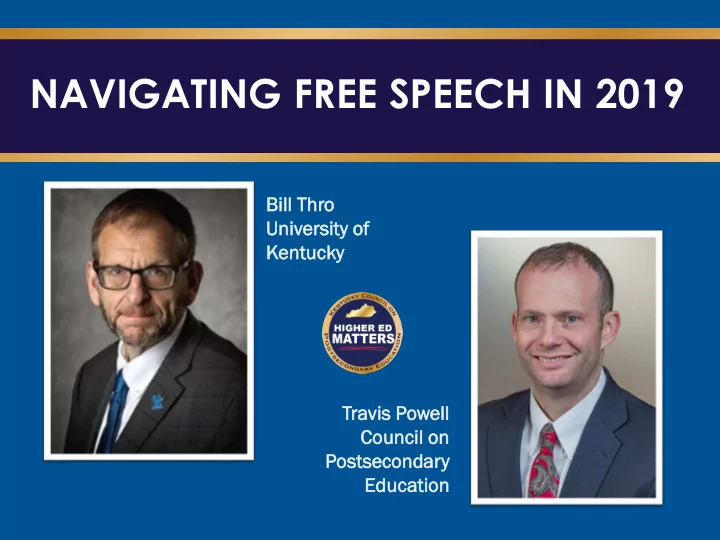
Bil ill l Thro University y of Kent ntuc ucky
NAVIGATING FREE SPEECH IN 2019
Tr Travis Powell Counc uncil l on Postsecondary y Educatio ion
SLIDE 2 Public Universities
- Are Constitutional Actors
- Are Subject To The Limitations Of The First
Amendment
- Do Not Have The Discretion To Regulate
Expression That The Private Sector Enjoys
SLIDE 3 Topics Covered
I. Freedom Of Speech Overview
- II. Employees
- III. Students
- IV. Open Spaces
- V. Board Obligations
SLIDE 4
- I. Freedom of Speech
- No “Hate Speech” Exception
- Narrow Categorical Exceptions
- Broad Protections For Employee Speech In
Personal Capacity
- Broad Protections For Student Speech
SLIDE 5 Cases Protecting “Hate Speech”
- Snyder v. Phelps—Protests At Military
Funerals
- Matal v. Tam—Trademark Of A Racial Slur
- Iancu v. Brunetti—Trademark Of “Immoral”
Or “Scandalous” Trademarks
SLIDE 6 Narrow Categorical Exceptions
- Incitement To Violence
- True Threat
- Harassment (By Inference)
- Fighting Words
SLIDE 7 Incitement to Lawless Action
- Advocacy Of The Use Of Force Or Of Law
Violation Where Such Advocacy Is Directed To Inciting Or Producing Imminent Lawless Action And Is Likely To Incite Or Produce Such Action
SLIDE 8
True Threat
“True Threats” Encompass Those Statements Where The Speaker Means To Communicate A Serious Expression Of An Intent To Commit An Act Of Unlawful Violence To A Particular Individual Or Group Of Individuals.
SLIDE 9 Threat Must Be Intended
- Fact Someone Feels Threatened Or A
“Reasonable Person” Would Feel Threatened Is Not Enough
- Speaker Must Intend The Threat Or Know
That It Would Be Perceived As A Threat
SLIDE 10 Harassment
- Supreme Court Has Held That Public Schools
And Universities Are Liable For Harassment.
- Therefore, We Can Infer That Harassment Is
Not Protected.
SLIDE 11
Harassment Definition
Conduct That Is So Severe, Pervasive, And Objectively Offensive That It Can Be Said To Deprive The Victims Of Access To The Educational Opportunities Or Benefits
SLIDE 12
Fighting Words
Those Personally Abusive Epithets Which, When Addressed To The Ordinary Citizen, Are, As A Matter Of Common Knowledge, Inherently Likely To Provoke Violent Reaction.
SLIDE 13 II. Employees
- Personal Capacity v. Employee Capacity
- Academic Freedom
SLIDE 14 Private Capacity v. Professional Capacity
- Private Capacity—All Public Employees
Have A First Amendment Right To Speak On Matters Of Public Concern.
- Employment Capacity—Public Employer Can
And Does Dictate Speech. Public Employee Can Be Disciplined For Speech Made In Their Employment Capacity.
SLIDE 15 Academic Freedom
- Faculty Like To Talk About Individual
Academic Freedom
- Supreme Court And Sixth Circuit Case Law
Says Faculty Have The Same Rights As Other Public Employees. No Greater And No Less.
- Institution May Choose To Give Greater
Academic Freedom To Faculty
SLIDE 16
- III. Student Groups
- Recognition
- Funding
- Right Of Association
- Religious Groups
SLIDE 17 Recognition
- Public University Must Recognize Student
Organizations Regardless Of The Viewpoint Advocated.
- No Establishment Clause Violation When
Public University Recognizes Religious Organization.
SLIDE 18 Funding
- If Public University Provides Funding, It Must
Provide Funding For All—Regardless Of Viewpoint Advocated.
- No Violation Of The Establishment Clause To
Fund Student Religious Organizations
- Distribution Of Fees Must Be Viewpoint
Neutral
SLIDE 19 Right of Association
- There Is A Right To Associate Together For
Expressive Purposes.
- There Is A Right For A Group To Exclude
Those Who Disagree With The Group’s Aim.
SLIDE 20 Religious Groups
- State Law Gives Religious Groups The Right
To Exclude Those Who Do Not Share The Faith.
- State Religious Freedom Restoration Act
- Campus Free Speech Act
SLIDE 21
- IV. Open Spaces
- State Law Says All Open Space On Campus Is
A “Traditional Public Forum” For Students And Faculty.
- State Law Prohibits Free Speech Zones
SLIDE 22 Time Place and Manner Restrictions
- Reasonable
- Justified Without Reference To The Content Of
The Regulated Speech
- Narrowly Tailored To Serve A Compelling
Governmental Interest, And
- Limited To Provide Ample Alternative Options
For The Communication Of The Information
SLIDE 23 Examples of Acceptable Restrictions
- No Amplification
- No Blocking Of Pedestrian Traffic
- No Open Flames
- No Demonstrations Between Certain Hours
- Some Areas May Be Reservation Only
SLIDE 24
V. Board Obligations
SLIDE 25 2019 Campus Free Speech Act
- Board Must Adopt Policies Guaranteeing First
Amendment Rights
- Private Right Of Action And Damages To
Enforce The Act (No Immunity)
- Policies Must Be Communicated To The
University Community
- Cannot Disrupt The Speech Of Others
SLIDE 26 Guidance
- Consult Your Campus Counsel
- Make Sure You Understand The Issues Before
You Act
- Make Sure Your Administrators Are
Knowledgeable About Free Speech
SLIDE 27
Questions?
SLIDE 28
The Scenarios