Ne New w Zea eala land nd Why is New Zealand's road safety - - PowerPoint PPT Presentation

ne new w zea eala land nd
SMART_READER_LITE
LIVE PREVIEW

Ne New w Zea eala land nd Why is New Zealand's road safety - - PowerPoint PPT Presentation

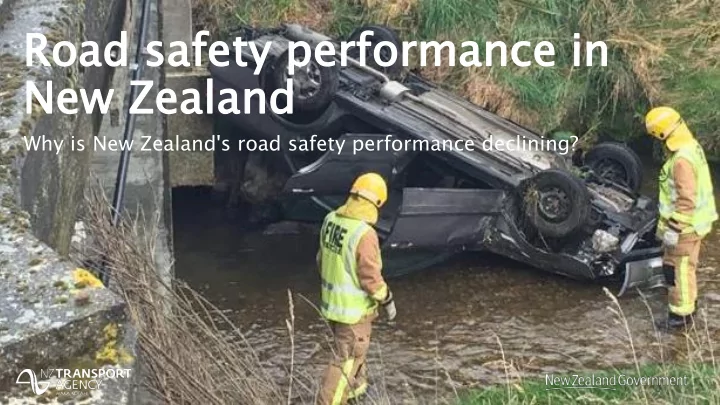
Roa oad sa safe fety ty per erform formanc ance e in in Ne New w Zea eala land nd Why is New Zealand's road safety performance declining? Is our sy syst stem em safe? fe? Ten years ago 95,000 km of roads 94,000 km of

slide-1
SLIDE 1

Roa

  • ad sa

safe fety ty per erform formanc ance e in in Ne New w Zea eala land nd

Why is New Zealand's road safety performance declining?

slide-2
SLIDE 2

Is our sy syst stem em safe? fe?

  • 95,000 km of roads
  • 3.5 million vehicles
  • 4.8 million people
  • 45.8 billion vehicle-kilometres

travelled

  • 3,200 deaths and serious injuries

Ten years ago

  • 94,000 km of roads
  • 2.9 million vehicles
  • 4.2 million people
  • 40.1 billion vehicle-kilometres

travelled

  • 3,100 deaths and serious injuries
slide-3
SLIDE 3

Fatalit lities ies in in la last 5 y years

  • 55% increase since 2014
  • highest total since 2009
  • today 394

100 200 300 400 500 Mar-14 Mar-15 Mar-16 Mar-17 Mar-18

slide-4
SLIDE 4

We w were doin ing g better er

  • 42% reduction from

2008 to 2013

  • lowest annual road toll

(253) in 2013

100 200 300 400 500 2008 2009 2010 2011 2012 2013 2014 2015 2016 2017 2018

slide-5
SLIDE 5

All ll ca casual ualty y measu asures es trendi ding ng upwar ards ds

  • fatalities

+55%

  • deaths and serious

injuries (DSIs) +40%

  • hospitalisations

+10%

  • ACC claims

+39%

1000 2000 3000 4000 5000 6000 Mar-14 Mar-15 Mar-16 Mar-17 Mar-18

persons killed in road crashes deaths and serious injuries hospitalised >1 day ACC entitlement claims

slide-6
SLIDE 6

Where are the in increase ases s - users

500 1000 1500

  • verseas

>75yrs 16-24yrs cyc/ped m/cycle passengers drivers 2017 2016 2015 Killed or seriously injured

slide-7
SLIDE 7

Where are the in increase ases s - regi gions

100 200 300 400 500 600 700 800 900 Nthland Auckland Waikato BayPlenty Gisborne HawkesBay Taranaki 2015/16 2016/17 2017/18

slide-8
SLIDE 8

Where are the in increase ases s - regi gions

20 40 60 80 100 120 140 Nthland Auckland Waikato BayPlenty Gisborne HawkesBay Taranaki 2015/16 2016/17 2017/18

Deaths and serious injuries, per 100,000 population

slide-9
SLIDE 9

Where are the in increase ases s - regi gions

20 40 60 80 100 120 140 160 180 Man-Wang Wellington Nel-Mar-Tas Canterbury WestCoast Otago Sthland 2015/16 2016/17 2017/18

Deaths and serious injuries, per 100,000 population

slide-10
SLIDE 10

More vehicl icles es and more travel

  • with increasing population, increasing

numbers of vehicles and increasing travel, the number of crashes on the network would be expected to increase*

  • however, fatalities and serious injuries are

increasing at a faster rate than can be explained by simple traffic growth

slide-11
SLIDE 11

More vehicl icles es and more travel

  • cars

+14%

  • all vehicles

+17%

  • vehicle kilometres

travelled +10%

  • population

+8%

900 1000 1100 1200 1300 1400 1500 Dec-13 Dec-14 Dec-15 Dec-16 Dec-17

Population and fleet trends, indexed to 2013=1000

persons killed in road crashes cars all vehicles veh kms travelled population deaths and serious injuries

  • fatalities

+55%

  • DSIs

+40%

900 1000 1100 1200 1300 1400 1500 Dec-13 Dec-14 Dec-15 Dec-16 Dec-17

Population and fleet trends, indexed to 2013=1000

persons killed in road crashes cars all vehicles veh kms travelled population deaths and serious injuries

slide-12
SLIDE 12

Crashes hes vs in injuries ries

  • it is important to reduce crash numbers, and we have a good understanding of the

factors which lead to crashes –

  • drivers impaired, by alcohol, drugs, fatigue
  • drivers distracted, by cellphones, passengers
  • too fast for conditions
  • the state of the road or the weather
  • inexperience, etc, etc
  • but, accepting that crashes are inevitable, we also need to understand the factors

which lead to fatal and serious injuries in those crashes

slide-13
SLIDE 13

Crashes hes vs in injuries ries

  • reducing injury severity is about mitigating energy exchange in a collision
  • within the vehicle – crumple zones, seatbelts, side airbags
  • with roadside features – vegetation, barriers, culverts, poles
  • speed of impact – less speed, less harm
  • vulnerability of user – collisions involving pedestrians, cyclists, motorcyclists
  • road user incompatibility – e.g. truck vs car, car vs bicycle

If there are severity-increasing influences, deaths and injuries will increase .

slide-14
SLIDE 14

Trends ds whic ich in increase ase in injur ury y sever erity ity

  • crashes involving trucks are more severe
  • crashes at higher speeds are more severe
  • crashes involving motorcycles are more severe
  • crashes involving older vehicles are more severe
  • injuries in crashes when not wearing seatbelts are more severe
slide-15
SLIDE 15

Ve Vehic icle le mass s makes es a d dif iffer ference ence

In 2013-2017

  • 26% of car vs truck crashes resulted in death or serious injury
  • 14% of car vs car crashes resulted in death or serious injury
  • 7% of car vs truck crashes resulted in death
  • 1.5% of car vs car crashes resulted in death
slide-16
SLIDE 16

Heavy y vehicl icles es

100 200 300 400 500 600 Dec-13 Jun-14 Dec-14 Jun-15 Dec-15 Jun-16 Dec-16 Jun-17

108,000 more trucks 215 million more SH vkt 12,000 more heavy trucks

129,000 458,000 2039 M

slide-17
SLIDE 17

Sp Speed d makes es a d dif iffer ferenc ence

In 50km/h zones, 16% of crashes were fatal/serious

slide-18
SLIDE 18

Sp Speed d trends ds

0% 2% 4% 6% 8% 10% 90 92 94 96 98 100 Sep-13 Sep-14 Sep-15 Sep-16 Sep-17 Speed on 100 km/h roads: behaviour and enforcement

average open road speed vehicles detected speeding in 100 km/h zones

slide-19
SLIDE 19

Motorcycles cles come wit ith ris isk

64000 68000 72000 76000 80000 84000 Sep-13 Sep-14 Sep-15 Sep-16 Sep-17

Licensed motorcycles and mopeds 8000 more motorcycles

slide-20
SLIDE 20

Ve Vehic icle le age ge m makes es a d dif iffe ference ence

0% 10% 20% 30% 40% 50% 60% 70% Sep-13 Sep-14 Sep-15 Sep-16 Sep-17

Percentage of occupant fatalities in older vehicles

half of all occupant fatalities in vehicles more than 15 years old

slide-21
SLIDE 21

Ve Vehic icle le crashwo worthiness thiness makes es a d dif iffer ferenc ence

0% 10% 20% 30% 40% 50% 60% 1 Star 2 Star 3 Star 4 Star 5 Star % fleet % driver DSI

slide-22
SLIDE 22

Influenc luences es on th the road toll ll

and the severity of crashes is influenced by

  • vehicle and roadside safety features
  • vehicle mismatch and user vulnerability
  • collision speed

crash numbers are influenced by

  • vehicle kilometres travelled, increased by 10%
  • licensed motorcycle numbers, increased by 11%
  • average open road speed, increased 0.4 km/h*
slide-23
SLIDE 23

Se Seatbel elts ts

20 40 60 80 100 120 Dec-12 Dec-13 Dec-14 Dec-15 Dec-16 Dec-17

Vehicle occupants killed not wearing seatbelts

slide-24
SLIDE 24

So …

To build a safe road system free of death and serious injury

  • reduce the opportunities for interactions between heavy and light vehicles,
  • r between vulnerable users and other users
  • improve the safety of motorcyclists (e.g. ABS, energy-absorbing roadside

features)

  • have speeds that ensure serious injuries are unlikely in a collision
  • every vehicle occupant wears their seatbelt, all the time
slide-25
SLIDE 25

A Sa Safe Sy System em

In a safe system, people should not be seriously injured or killed as a result of someone’s mistake. The four pillars: Safe Roads and roadsides, Safe Vehicles, Safe Users, Safe Speeds The principles: people make mistakes, people are vulnerable, all parts of the system are needed, shared responsibility