Nearest Common Ancestors (NCA) Org. [D. Harel, R.E. Tarjan, Fast - - PowerPoint PPT Presentation

nearest common ancestors nca
SMART_READER_LITE
LIVE PREVIEW

Nearest Common Ancestors (NCA) Org. [D. Harel, R.E. Tarjan, Fast - - PowerPoint PPT Presentation

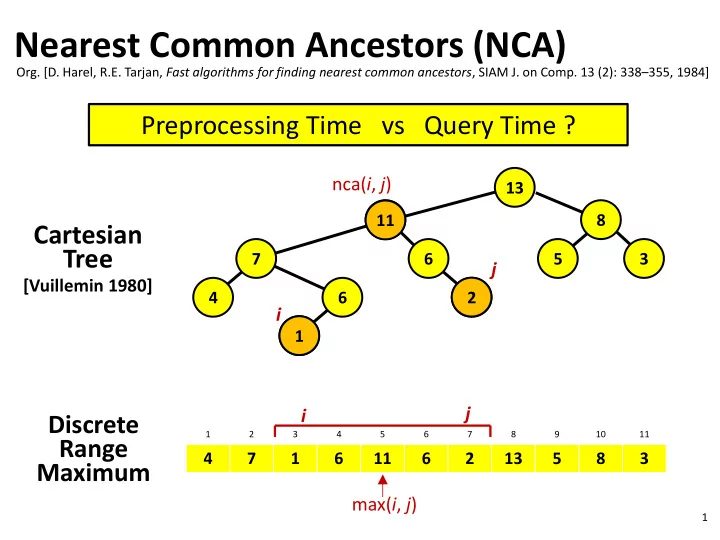
Nearest Common Ancestors (NCA) Org. [D. Harel, R.E. Tarjan, Fast algorithms for finding nearest common ancestors , SIAM J. on Comp. 13 (2): 338 355, 1984] Preprocessing Time vs Query Time ? nca( i , j ) 13 11 8 11 Cartesian Tree 7 6


slide-1
SLIDE 1

1

Nearest Common Ancestors (NCA)

Discrete Range Maximum

1 2 3 4 5 6 7 8 9 10 11

4 7 1 6 11 6 2 13 5 8 3 4 7 1 6

11

6 8 2 3 5

Cartesian Tree

[Vuillemin 1980]

i j max(i, j) i j nca(i, j)

1 2 11 13

Preprocessing Time vs Query Time ?

  • Org. [D. Harel, R.E. Tarjan, Fast algorithms for finding nearest common ancestors, SIAM J. on Comp. 13 (2): 338–355, 1984]
slide-2
SLIDE 2
  • Incremental construction left-to-right
  • O(n) time (Φ = #nodes on rightmost path)

2

Cartesian Tree Construction

18 ∙∙∙ 13 ∙∙∙ 8 ∙∙∙ 2 10

10 18 8 13 2 10

+

18 8 13 2

START HERE

slide-3
SLIDE 3

A B C D E F J G K I

3

Reduction: NCA  1 Discrete Range Maximum

Euler Tour

H E B A B D C D B E F G F E H J I J K J H 1 2 3 4 3 4 5 4 3 2 3 4 3 2 1 2 3 2 3 2 1

node depth

i j nca(i, j)

E G C

j i

2

minimum depth nca(i, j)

H

slide-4
SLIDE 4

4

NCA on Perfect Binary Trees

i 2i 2i+1 1 2 3 4 5 10 11 20 21 22 23 = nca(11,21)

11 = 10112 21 = 101012 nca(21,21) = 5 = 1012 = lcp( 10112 , 101012 )

longest common prefix

proc lcp(x, y) if y < x then swap (x, y) return x >> (msb(x XOR (y >> (msb(y)-msb(x)))

position of most significant bit ≠ 0

slide-5
SLIDE 5

5

Discrete Range Mimimum – Space O(n∙log n) words

2 3 4 3 4 5 4 3 2 2 1 1 2 3 4 3 1 1 2 3 3 2 3 4 1 1 1 1 1 2 3 1 2 3 4 3 4 5 4 3 2 3 4 3 2 1 2

1

3 3

2

3 3

3

3 3 d 3 2

5

1 1

j

0 1 i ∙ ∙ ∙

righti leftj drm(i, j) = min(righti(d), leftj(d)) d = msb(i XOR j)

nca(i, j)

slide-6
SLIDE 6

6

Blocked solution – Space O(n) words

1 2 3 4 3 4 5 4 1 4 3 4 3 2 3 2 1 2 1 2 block of O(log n) elements 1 1 1

5 4 3 2 1

j i Wj (One for each j)

Block query: j+1-msb(Wj AND ((1 << (j-i+1))-1)) General query: 1 top query + 2 bottom queries

Top structure O(n/log n) elements Space O(n) Query O(1)

O(n) Preprocessing Time O(1) Query Time

slide-7
SLIDE 7

7

Summary...

General Discrete Range Searching Cartesian Tree NCA Discrete Range Max on Depth Array ”O(n∙log n)” solution on O(n/log n) blocks O(log n) size blocks

1 2 3 4 5 6 7 8

4 7 1 6 8 6 2 9

i j

4 7 1 6 8 6 2 9

i j nca(i, j)

1 2 3 4 3 4 5 4 3 2 3 4 3 2 1

O(n) Preprocessing Time O(1) Query Time

slide-8
SLIDE 8

1d & 2D DRM Results

better upper or lower bound ?

Indexing Model (input accessible) Encoding Model (input not accessable) m = 1 1D

2n+o(n) bits, O(1) time [FH07] n/c bits  Ω(c) time [BDR10] n/c bits, O(c) time [BDR10] ≥ 2n - O(log n) bits 2n+o(n) bits, O(1) time [F10]

1 < m < n O(mnlog n) bits, O(1) time [AY10]

O(mn) bits, O(1) time [BDR10] mn/c bits  Ω(c) time [BDR10] O(clog2 c) time [BDR10] O(clog c(loglog c)2) time [BDLRR12] Ω(mnlog m) bits [BDR10] O(mnlog n) bits, O(1) time [BDR10] O(mnlog m) bits, O(mn) time [BBD13]

m = n

squared Ω(mnlog n) bits [DLW09] O(mnlog n) bits, O(1) time [AY10]

slide-9
SLIDE 9

A B C D E F J G K I

9

DRM encoding - O(n) bits

Euler Tour

H E B A B D C D B E F G F E H J I J K J H 1 2 3 4 3 4 5 4 3 2 3 4 3 2 1 2 3 2 3 2 1

node depth

i j nca(i, j)

E G C

2

minimum depth nca(i, j)

H

1 1 1 1 1 1 1 1 1 1 1 + + + +

  • +

+

  • +

+

  • +

+

  • +
  • A

1 B 2 C 3 D 4 E 5 F 6 G 7 H 8 I 9 J 10 K 11

4 7 1 6 11 6 2 13 5 8 3

Cartesian Tree

depth = #+ - #- = min-prefix-sum(pi,pj) j’th ”1” = select(j)

4n bits

rank(p) = drm(i,j) = #1 left of p

p

select(i) = i’th ”1” pi

pj

i j

slide-10
SLIDE 10

10

Succinct data structures for DRM, O(n) bits

1 1 1 1 1 1 1 1 1 1 1

i’th ”1” = select(i) rank(p) = R1[└p/α┘] + Trank[B[└p/α┘], p mod α]

p

B0 B1 B2

α = ½log n bits

α+log α bits

R1[i] = #1 in first i blocks (n/αlog n bits) Trank = rank inside block, table lookup (2α+log α log α bits)

B3 …

select(i) = αb + Tselect [B[b], i-rank(αb-1)] b = Rnonempty[rankleader(i)]

i is in block B[b] leader[i] = is the ith ”1” the first ”1” in its block? (n bits) rankleader(i) = rank structure for leader array (O(n) bits) Rnonempty = index of nonempty blocks (n/αlog n bits) Tselect = select inside block, table lookup (2α+log αlog α bits)

1 

min-prefix-sum(pi, pj) = α(bk-1)+dk b1 = └pi/α┘ b3 = └pj/α┘ b2 = drmPS(b1+1, b3-1) d1 = Tmps[B[b1], pi mod α, α-1] d2 = Tmps[B[b2], 0, α-1] d3 = Tmps[B[b3], 0, pj mod α] k = argmint=1..3 PS[bt-1]+Tps[B[bt], dt]

PS[b] = #+ - #- for blocks B0..Bb (n/αlog n bits) Tps = #+ - #- for block prefix, table lookup (2α+log α(1+log α) bits) Tmps = index of minimum prefix sum #+ - #- inside range in a block, table lookup (2α+2log αlog α bits) MPS[b] = PS[b-1]+ Tmps[B[b], 0, α-1] (n/αlog n bits) drmMPS = drmin structure for MPS, O(n/α) words (O(n) bits)

+ + + +

  • +

+

  • +

+

  • +

+

  • +
  • 1

3 2 1 2 1

Bb1 Bb3 Bb2

b2 pi pj b1 b3 d1=3 d2=2 d3=1

MPS