
SLIDE 1
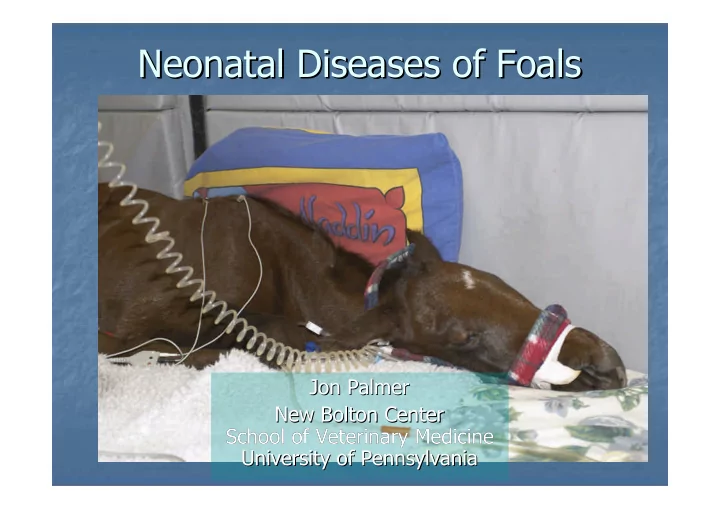
Neonatal Diseases of Foals Neonatal Diseases of Foals Jon Palmer - - PowerPoint PPT Presentation
Neonatal Diseases of Foals Neonatal Diseases of Foals Jon Palmer Jon Palmer New Bolton Center New Bolton Center School of Veterinary Medicine School of Veterinary Medicine University of Pennsylvania University of Pennsylvania Neonatal
Neonatal Encephalopathy
Neonatal Nephropathy
Neonatal Gastroenteropathy
Sepsis/septic shock
Prematurity
IUGR
Neonatal Maladjustment
“Dummy foal”
Barkers
Hypoxic Ischemic
Changes in behavior
Changes in responsiveness
Changes in muscle tone
Brain stem damage
Seizure
Changes in behavior
Loss of suckle response
Loss of tongue curl
Loss of tongue coordination
Disorientation especially relative to the udder
Aimless wandering
Blindness
Loss of affinity for the dam
Abnormal vocalization ("barker")
Changes in responsiveness
Hyperesthesia
Hyperresponsiveness
Hyperexcitability
Hyporesponsiveness
Periods of somnolence
Unresponsiveness
Changes in muscle tone
Extensor tonus
Hypotonia
Neurogenic myotonia
Failure to protract legs
Changes in respiratory patterns
Tachypnea, apneusis
Apnea, cluster breathing
Central hypercapnia
Loss of thermoregulation
Weakness
Hypotension
Vestibular signs
Facial nerve paresis
Loss of consciousness
Spectrum of disease
Incomplete fetal transition
Water/Na retention
Mild tubular dysfunction
Acute tubular necrosis
Usually transient
Occasionally
Irreversible acute damage
Chronic renal disease
Decreased GFR
Slow decrease birth Cr
Decrease
cr
Decreased H
2O excretion
Edema formation
Weight gain
Slow response to fluid challenges
Abnormal electrolyte handling
Na loss
Abnormal Na balance
Abnormal excretion of drugs
High amikacin trough levels
Oliguria/Anuria
Wide spectrum of disease
Mild indigestion
Dysmotility
Enema dependence
Moderate disease
Colic
Abdominal distension/ileus
Diapedesis of blood into the lumen
Mucosal edema
Severe
Epithelial necrosis
Intussusceptions
Structures
Hemorrhagic gastritis or enteritis/colitis
Pneumatosis intestinalis
Predisposition to sepsis
Translocation of bacteria
Neonatal Encephalopathy
Neonatal Nephropathy
Neonatal Gastroenteropathy
Neonatal Metabolic Maladaptation
Neonatal Cardiovascular Maladaptation
Neonatal
Neonatal
85
Prematurity
< 320 days
Dysmaturity
> 320 days
Looks premature
Prematurity
Not by calendar
Relative to mare’s normal gestation
Clinical appearance
IUGR
Clinical characteristics
May accompany prematurity
Precocious development
Definitions
Clinical diagnosis
1991, 2001
Infection
Bacteremia
Pulmonary
GIt
Umbilical
SIRS
Sepsis
Severe Sepsis
Septic shock
NEONATAL DISEASES OF FOALS Palmer JE Department of Clinical Studies, New Bolton Center, School of Veterinary Medicine, University of Pennsylvania, Kennett Square, PA, USA Disruption of the intrauterine environment will not only result in fetal distress, but may be a major cause of neonatal diseases recognized in foals. Conditions of neonatal foals which may be directly associated with placentitis include prematurity, IURG and precocious maturation. Other conditions that may be associated with placentitis include the complex of Neonatal Encephalopathy, Neonatal Nephropathy, Neonatal Gastroenteropathy and maladaptation of other systems. Prematurity in the foal has been defined as birth before 320 days gestation. The term 'dysmature' has been used to describe foals with physical characteristics of prematurity in a foal born after a gestation more than 320 days. These definitions are problematic because of the wide variation in normal gestational length in mares. This has lead to confusion in diagnosing prematurity, dysmaturity and IUGR. I feel it is more helpful to define prematurity based on the mare's normal gestational length, use IUGR for foals small for gestational age (which are not constitutionally small) and avoid using the term dysmaturity. There is a neonatal mutisystem maladaptation syndrome which includes neurologic, renal, gastrointestinal and other system malfunctions which may be secondary to placental disease. The most prominent signs are neurologic abnormalities traditionally referred to as Neonatal Maladjustment Syndrome (NMS). Research findings in other species early in the 1990's lead many equine neonatologists to speculate about a hypoxic ischemic or asphyxial origin for this syndrome. The term Hypoxic Ischemic Encephalopathy (HIE) largely replaced NMS. It is clear, however, that despite attractive experimental models showing many similarities, often this disease syndrome occurs in the absence of a detectable hypoxic ischemic insult. Because of this I prefer to use the terms, such as Neonatal Encephalopathy, that do not specify an etiology or pathogenesis but only the organ dysfunction and age group. Most recently there has been speculation that inflammatory mediators secondary to placentitis may (possibly by initiating a hypoxic ischemic insult) be responsible for the multiorgan dysfunction. Foals with Neonatal Encephalopathy (NE) may show changes in responsiveness, muscle tone, behavior, evidence of brain stem damage or seizure-like behavior. Changes in responsiveness include hyperesthesia, hyperresponsiveness, hyperexcitability, hyporesponsiveness, periods of somnolence or unresponsiveness. Often the foals go through a period of increased responsiveness followed by a period of decreased
Changes in behavior are very common and include loss of suckle response, loss of tongue curl, loss of tongue coordination, disorientation especially relative to the udder, aimless
wandering, loss of affinity for the dam and abnormal vocalization. Foal with NE commonly have changes in respiratory patterns with central tachypnea, apneusis, apnea, cluster breathing, ataxic breathing, Cheyne-Stokes breathing or central hypercapnia. Other signs of brain stem damage include loss of thermoregulatory control, generalized weakness, anisocoria, pupillary dilation, pinpoint pupils, central hypotension, decreased responsiveness, difficult to arouse, loss of consciousness, vestibular signs (circling, head tilt), facial nerve paresis and a variety of other signs. Foals with NE have a wide variety
days. Foals may also develop renal maladaptation referred to as Neonatal Nephropathy (NN). There is a wide spectrum of disease seen in cases of NN including incomplete transition from fetal renal physiology, water/sodium retention, mild tubular dysfunction (sodium wasting), abnormal excretion of drugs (e.g. high amikacin trough levels), acute tubular necrosis or decreased GFR. Often the signs of dysfunction are subtle and easily
acute damage may lead to chronic renal disease. These foals often have a decreased GFR as reflected by a slow decrease birth Creatinine or decreased creatinine clearance, delayed water excretion with edema formation and weight gain and slow response to fluid challenges. Neonatal Gastroenteropathy (NG) can be manifested by a wide spectrum of signs ranging from mild indigestion with dysmotility and enema dependence to moderate disease with ileus, diapedesis of blood into the lumen and mucosal edema to severe disease with epithelial necrosis, intussusceptions, structures, hemorrhagic gastritis/enteritis/colitis, and pneumatosis intestinalis. Even mild forms predispose to sepsis and SIRS with increased likelihood of translocation of bacteria. Like NN, often the signs of dysfunction are subtle and easily overlooked unless anticipated. The most common manifestation is dysmotility with meconium retention and lack of fecal passage for days (range 2-30 days). Despite fecal retention, an important aspect is lack of discomfort. Classically, foals with classic motility will not return enema fluid or strain associated with rectal distension. Often, affected foals have the triad of Neonatal Encephalopathy, Neonatal Nephropathy and Neonatal Gastroenteropathy. Other problems seen include metabolic maladaptation, autonomic failure and other systemic problems. Foals born from an environment of placentitis commonly have a generalized inflammatory response as reflected by systemic and hematologic reactions. The activation of inflammatory and anti-inflammatory cascades may support precocious maturation of many body systems and may, in fact, impart some protection from systemic infections. Prematurity and IURG are easily confused. Clinically prematurity is marked by low birth weight, small frame, thin, poor muscle development, periarticular laxity and general
may be a direct result of placentitis and it is common for both to be resent concurrently.