
SLIDE 1
Netting Research Update Lee Kalcsits, Associate Professor WSU Tree - - PowerPoint PPT Presentation
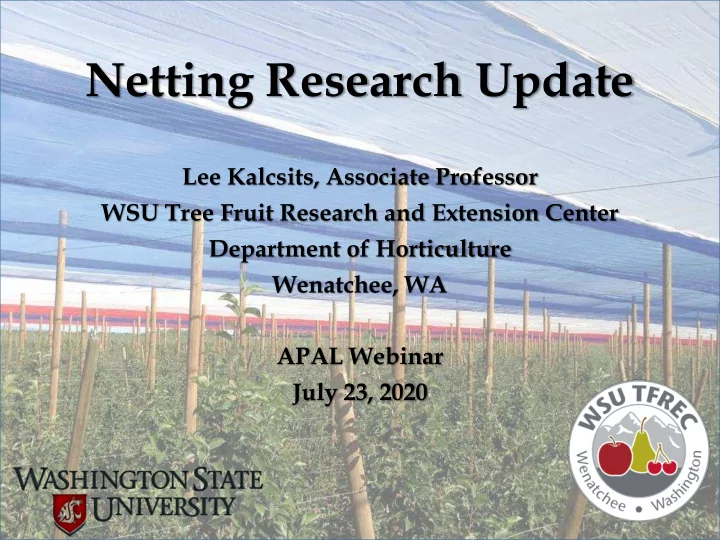
Netting Research Update Lee Kalcsits, Associate Professor WSU Tree Fruit Research and Extension Center Department of Horticulture Wenatchee, WA APAL Webinar July 23, 2020 Example: Protective Netting in Fruit Production Overview Design
Hail/Sunburn Environment Fruit Quality Physiology Design Considerations
1% 3% 80% 10 20 30 40 50 60 70 80 90 Exclusion net Drape net Control Fruit damaged by hail (%) Treatment Photo credit: S. Musacchi
drape net and exclusion net respectively (Schmidt, 2014)
(Racsko and Schrader, 2012) (Racsko and Schrader, 2012)
losses in Washington State
Days per year above 95°F
5 50 100 200 PNW = 25 -> 60 NE = 2 -> 30 MW = 3 -> 46 SA = 7 -> 52 AUS = 11 -> 54
Hail/Sunburn Environment Fruit Quality Physiology Design Considerations
Light Intensity (umol m-2 s-1) Wind Speed (km h-1) Control 1804 a 6.03 a Blue 1404 b 3.76 b Pearl 1459 b 3.96 b Red 1355 b 3.64 b
Table 1. Mean light intensity and wind speed for Blue, Pearl and Red netting compared to an uncovered control (84 days). Letters indicate significant difference determined by Tukey’s HSD test. 0.5 1 1.5 2
2.5 3 3.5 4 4.5 5
10-May 29-Jun 18-Aug 7-Oct
Wnid Speed (km h-1) Control Pearl Blue Red
Light Scattering
Hail/Sunburn Environment Fruit Quality Physiology Design Considerations
Red Blue Pearl Control
High Grade Reduced-Grade Cull
2015 2016 Control 231 a 366 a Pearl 274 c 394 b Blue 252 b 388 b Red 260 bc 386 b Average fruit size (g) for fruit harvested from under pearl, blue and pearl netting compared to an uncovered control
SSC (°Brix) Control 15.0 a Pearl 14.7 ab Blue 14.5 b Red 14.5 b
accounted for, there are more sugars per fruit netting compared to the uncovered control.
was better in 2015 compared to 2016. Uncovered trees had slightly better color in 2015 compared to netted trees.
2015 2016 Control 2.77 a 2.30 a Netted 2.52 b 2.25 a Fruit red color development in Honeycrisp apple in 2015 and 2016 under netting compared to an uncovered control. 2 = 50% red color. Fruit red color development and soluble sugars content (Brix) in Honeycrisp apple under pearl, blue and red netting compared to an uncovered control. 2 = 50% red color.
Hail/Sunburn Environment Fruit Quality Physiology Design Considerations
2 4 6 8 10 12 14
Control Netting
Shoot Growth (Inches)
0.1 0.2 0.3 0.4 0.5 0.6 Quantum Yield of Photosystem II (P) Honeycrisp 5 10 15 20 25 Net CO2 Exchange (µmol m-2 s-
1)
Honeycrisp
5 10 15 28-Jul 29-Jul 30-Jul 31-Jul 1-Aug Cummulative evaporation (mm d-1) Date
Control
100 200 300 400 500 Tree Water Use (mL H2O hr-1)
Time of Day
Netting Control
Hail/Sunburn Environment Fruit Quality Physiology Design Considerations
where wind damage is a higher risk
west side of the tree that is exposed to damaging solar radiation in the afternoon
Hail Protection Reduced Sunburn Increased Canopy Infill Reduced water-use Improve sizing and quality Slight reductions in color development Costs Labor to deploy and retract Disease pressure?? Positives Negatives
Kalcsits Lab Crew - 2018
Back Row (L to R): Lee Kalcsits, Ryan Mullin, Jack Gavin, Giverson Mupambi, Chloe Smythman, Hector Camargo-Alvarez Front row (L to R): Erica Casagrande Biasuz, Brenda Castaneda, Michelle Reid, Katie Mullin, Sumyya Waliullah, Nadia Valverdi, Raquel Gomez