Neural network applications ALVINN (Pomerleau, mid 1990s) - - PowerPoint PPT Presentation

neural network applications alvinn pomerleau mid 1990s
SMART_READER_LITE
LIVE PREVIEW

Neural network applications ALVINN (Pomerleau, mid 1990s) - - PowerPoint PPT Presentation

Neural network applications ALVINN (Pomerleau, mid 1990s) Autonomous Land Vehicle in Neural Network To date: Sharp Straight Sharp Left Ahead Right Neural networks: what are they 30 Output Units Backpropagation: efficient


slide-1
SLIDE 1

Neural network applications

To date:

  • Neural networks: what are they
  • Backpropagation: efficient gradient computation
  • Advanced training: (scaled) conjugate gradient
  • Adaptive architectures: cascade NN w/NDEKF

Today:

  • Neural network applications

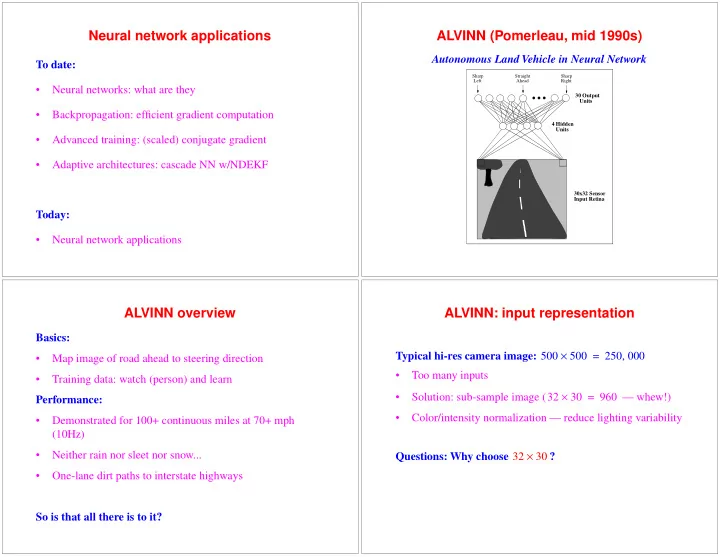
ALVINN (Pomerleau, mid 1990s)

Autonomous Land Vehicle in Neural Network

Sharp Left Sharp Right

4 Hidden Units 30 Output Units 30x32 Sensor Input Retina

Straight Ahead

ALVINN overview

Basics:

  • Map image of road ahead to steering direction
  • Training data: watch (person) and learn

Performance:

  • Demonstrated for 100+ continuous miles at 70+ mph

(10Hz)

  • Neither rain nor sleet nor snow...
  • One-lane dirt paths to interstate highways

So is that all there is to it?

ALVINN: input representation

Typical hi-res camera image:

  • Too many inputs
  • Solution: sub-sample image (

— whew!)

  • Color/intensity normalization — reduce lighting variability

Questions: Why choose ? 500 500 × 250 000 , = 32 30 × 960 = 32 30 ×

slide-2
SLIDE 2

ALVINN: input image example #1 ALVINN: input image example #2 ALVINN: output representation

Output representation: two choices

  • Single linear output
  • Multiple outputs: Gaussian fit

Questions:

  • Why choose particular output representation?

Gaussian output representation example

  • 1
  • 0.5

0.5 1 0.2 0.4 0.6 0.8 1

  • 1
  • 0.5

0.5 1 0.2 0.4 0.6 0.8 1

  • 1
  • 0.5

0.5 1 0.1 0.2 0.3 0.4 0.5 0.6 0.7

  • 1
  • 0.5

0.5 1 0.2 0.4 0.6 0.8 1

slide-3
SLIDE 3

ALVINN: neural network architecture

Tried everything from one to 70 hidden units Four to five hidden units worked best Questions:

  • Why no direct input/output connections?
  • Why did larger networks not do better?

ALVINN: training data

Problem: Person drives too well!

  • Neural network does not learn error recovery

Solution: create synthetic data from real data

ALVINN: synthetic images

Problem: What’s the correct steering direction?

  • Pure pursuit model of how people driving

ALVINN: spurrious features

Examples of problem data:

  • Oil slicks, shadows
  • Other cars
slide-4
SLIDE 4

Removing spurrious features

Solution #1: Add Gaussian noise to image (problems?) Solution #2: Model spurrious features (problems?) Solution #3: Use neural network’s internal model

  • “Structured noise”
  • Learns to ignore peripheral features

ALVINN: other issues

  • Balance data (left/right/straight samples)

(why?)

  • Training on-line (

vs. batch)

  • Hidden unit weights: a closer look

Hidden Unit 1 Hidden Unit 2 Hidden Unit 3 Hidden Unit 4 Hidden Unit 5 Epoch 50

ALVINN: conclusions

  • ALVINN represented a huge step forward in

autonomous driving (mid 1990s)

  • Probably most well-known NN application
  • Extensively tested at high speeds in real traffic
  • Next step: learning from ALVINN

RALPH: learning from ALVINN

Rapid Lateral Position Handler:

  • Understanding ALVINN let to RALPH
  • Took several years of analysis
  • Easy to understand technique

Question:

  • Which is better approach?
slide-5
SLIDE 5

RALPH: basic algorithm

For a given image:

  • Trapezoidal subsampling of image
  • Hypothesize a road curvature
  • Horizontally

shift pixels to correspond to curvature hypothesis

  • Vertically

add pixel intensities

  • Compute measure of curvature hypothesis correctness

Trapezoidal subsampling

Key insight: don’t look at whole image

  • Function of speed
  • Camera orientation w/respect to road (perspective)
  • No spurrious feature problem

Trapezoidal subsampling: example #1

Why do trapezoidal subsampling?

Trapezoidal subsampling: example #2

Note how key features line up to indicate curvature...

slide-6
SLIDE 6

RALPH: basic algorithm

For a given image:

  • Trapezoidal subsampling of image
  • Curvature hypothesis
  • Horizontally

shift pixels to correspond to curvature hypothesis

  • Vertically

add pixel intensities

  • Compute measure of curvature hypothesis correctness

RALPH: curvature hypothesis

  • Curvature hypothesis
  • Horizontally

shift pixels to correspond to curvature hypothesis

RALPH: basic algorithm

For a given image:

  • Trapezoidal subsampling of image
  • Hypothesize a road curvature
  • Horizontally

shift pixels to correspond to curvature hypothesis

  • Vertically

add pixel intensities

  • Compute measure of curvature hypothesis correctness

RALPH: curvature hypothesis evaluation

  • Vertically

add pixel intensities

  • Compute measure of curvature hypothesis correctness
slide-7
SLIDE 7

RALPH performance

“No Hands across America”

  • Washington, D.C. to San Diego (2,850 miles)
  • 98.1% autonomous (2,796 miles)
  • 70 mph top speed (officially)
  • 110 mph top speed (unofficially)

Lines are useful, but RALPH doesn’t need them... Failure modes...

ALVINN vs. RALPH

Which is better?

Neural network applications

Road following

  • ALVINN: Road following
  • RALPH: learning from neural networks

Face detection Robot control

Face detection (Kanade, late 1990s)

Basics:

  • Map

image to (face/non-face) Performance:

  • Face detection results: 85%-90%, few false detects
  • 1.5Hz - 3.5Hz on PII/450 (

) 20 20 × 1 ± 320 240 ×

slide-8
SLIDE 8

Face detection

Outline:

  • Which part of image to look at?
  • Image pre-processing
  • Specialized neural network architecture
  • Training data
  • Overlap detection
  • Committee of experts: multiple neural networks
  • Results

Image preprocessing

Oval mask for ignoring background pixels: Original window: Best fi t linear function: Lighting corrected window: (linear function subtracted) Histogram equalized window:

Face detection

Outline:

  • Which part of image to look at?
  • Image pre-processing
  • Specialized neural network architecture
  • Training data
  • Overlap detection
  • Committee of experts: multiple neural networks
  • Results

Specialized neural network architecture

20 by 20 pixels Neural network Output Histogram equalize Hidden units Receptive fields Network Input

slide-9
SLIDE 9

Face detection

Outline:

  • Which part of image to look at?
  • Image pre-processing
  • Specialized neural network architecture
  • Training data
  • Overlap detection
  • Committee of experts: multiple neural networks
  • Results

NN training data: face examples Generating non-face examples NN training data: nonface examples

slide-10
SLIDE 10

Basic NN detection results

Missed Detect False Type System faces rate detects Single network, no heuristics 1) Network 1 (2 copies of hidden units (52 total), 2905 connections) 45 91.1% 945 2) Network 2 (3 copies of hidden units (78 total), 4357 connections) 38 92.5% 862 3) Network 3 (2 copies of hidden units (52 total), 2905 connections) 46 90.9% 738 4) Network 4 (3 copies of hidden units (78 total), 4357 connections) 40 92.1% 819 Single 5) Network 1 threshold(2,1)

  • verlap elimination

48 90.5% 570

Face detection

Outline:

  • Which part of image to look at?
  • Image pre-processing
  • Specialized neural network architecture
  • Training data
  • Overlap detection
  • Committee of experts: multiple neural networks
  • Results

Overlap detection

detections overlaid centers of detections Input image pyramid, Overlapping detections "Output" pyramid: False detect in x and y, not in scale Centroids (in position and scale) Face locations and scales represented by centroids Final detection result centroid of detections extended across scale

  • verlapping detection

Spreading out detections Collapse clusters to Potential face locations Final result after removing Final result A B Computations on output pyramid C D E Input image pyramid

✁ ✂ ✂ ✄ ✄ ☎ ✆ ✆ ✝ ✝ ✞ ✟ ✟ ✠ ✠ ✡ ☛ ☞ ✌ ✍ ✎ ✎ ✏ ✑ ✒ ✒ ✓ ✓ ✔ ✕ ✕ ✖ ✗ ✗ ✘ ✙ ✚ ✛ ✛ ✜ ✢ ✣ ✤

NN results w/overlap detection

Missed Detect False Type System faces rate detects Single network, no heuristics 1) Network 1 (2 copies of hidden units (52 total), 2905 connections) 45 91.1% 945 2) Network 2 (3 copies of hidden units (78 total), 4357 connections) 38 92.5% 862 3) Network 3 (2 copies of hidden units (52 total), 2905 connections) 46 90.9% 738 4) Network 4 (3 copies of hidden units (78 total), 4357 connections) 40 92.1% 819 Single network, with heuristics 5) Network 1

threshold(2,1)

  • verlap elimination

48 90.5% 570 6) Network 2

threshold(2,1)

  • verlap elimination

42 91.7% 506 7) Network 3

threshold(2,1)

  • verlap elimination

49 90.3% 440 8) Network 4

threshold(2,1)

  • verlap elimination

42 91.7% 484

slide-11
SLIDE 11

Face detection

Outline:

  • Which part of image to look at?
  • Image pre-processing
  • Specialized neural network architecture
  • Training data
  • Overlap detection
  • Committee of experts: multiple neural networks
  • Results

Committee of experts

✦ ✦✧ ★ ★✩ ✪ ✪✫ ✬ ✬✭ ✮ ✮✯ ✰ ✰✱ ✲✳ ✴ ✴✵ ✶ ✶ ✶ ✶✷ ✷ ✸ ✸✹ ✹ ✺✻ ✼✽ ✾✿ ❀❁ ❂❃ ❄ ❄❅ ❅ ❆ ❆ ❆ ❆❇ ❇ ❈ ❈ ❈ ❈❉ ❉ ❊ ❊❋
❍ ■ ■❏ ❑ ❑ ❑ ❑▲ ▲ ▼ ▼◆❖ ❖P P ◗❘ ❙❚ ❯ ❯❱ ❲ ❲ ❲ ❲❳ ❳ ❨ ❨ ❨ ❨❩ ❩ ❬❭❪❫ ❴❵

AND Network 2’s detections (in an image pyramid) Result of AND (false detections eliminated) False detect Network 1’s detections (in an image pyramid) False detects

NN results w/multiple networks

4357 connections) Single network, with heuristics 5) Network 1

threshold(2,1)

  • verlap elimination

48 90.5% 570 6) Network 2

threshold(2,1)

  • verlap elimination

42 91.7% 506 7) Network 3

threshold(2,1)

  • verlap elimination

49 90.3% 440 8) Network 4

threshold(2,1)

  • verlap elimination

42 91.7% 484 Arbitrating among two networks 9) Networks 1 and 2

AND(0) 68 86.6% 79 10) Networks 1 and 2

AND(0)

threshold(2,3)

  • verlap elimination

112 77.9% 2 11) Networks 1 and 2

threshold(2,2)

  • verlap

elimination

AND(2) 70 86.2% 23 12) Networks 1 and 2

thresh(2,2)

  • verlap elim

OR(2)

thresh(2,1)

  • verlap elimination

49 90.3% 185 Arbitrating among three networks 13) Networks 1, 2, 3

voting(0)

  • verlap

elimination 59 88.4% 99 14) Networks 1, 2, 3

network arbitration (5 hidden units)

thresh(2,1)

  • verlap elimination

79 84.4% 16 15) Networks 1, 2, 3

network arbitration (10 hidden units)

thresh(2,1)

  • verlap elimination

83 83.6% 10 16) Networks 1, 2, 3

network arbitration (perceptron)

thresh(2,1)

  • verlap elimination

84 83.4% 12

Face detection

Outline:

  • Which part of image to look at?
  • Image pre-processing
  • Specialized neural network architecture
  • Training data
  • Overlap detection
  • Committee of experts: multiple neural networks
  • Results
slide-12
SLIDE 12

Sample detection results Sample detection results

D: 1/1/1 B: 4/2/0 E: 8/8/0 C: 4/3/0

Sample detection results

D: 2/2/0 A: 15/15/0 C: 14/12/0 B: 9/9/1 F: 1/1/0 E: 1/1/0

Sample detection results

K: 5/4/1 F: 1/1/0 J: 1/1/0 I: 1/1/0 L: 1/1/0 H: 7/5/0 G: 1/1/0 N: 1/1/0 M: 1/1/0

slide-13
SLIDE 13

Sample detection results

E: 1/1/0 C: 3/1/2 A: 2/2/0 D: 1/1/0 B: 1/1/0 J: 0/0/0 K: 1/1/0 F: 1/1/0 G: 1/1/1 H: 1/1/0 I: 1/1/1

Sample detection results

N: 2/2/0 M: 1/1/0 J: 0/0/0 P: 1/1/0 O: 1/1/0 K: 1/1/0 L: 14/13/0 Q: 3/3/0 H: 1/1/0 I: 1/1/1 R: 1/1/0

Face detection: concluding thoughts

NN worked as well as anything at the time... ...since then statistical frequency modeling has surpassed accuracy (Schneiderman, 2001) Comparison (over same test set):

  • 95.8%

vs. 86.0% detection

  • 65

vs. 31 false detections

  • slower

vs. faster Commercial system at Superbowl 2001 (Tampa)

Neural network applications

Road following

  • ALVINN: Road following
  • RALPH: learning from neural networks

Face detection Robot control

slide-14
SLIDE 14

Robot control

Analytic model: (why important?) What’s missing?

  • Friction
  • Link flexibility
  • Unmodeled dynamics (inertia tensors, masses, etc.)

Bottom line: analytic model will not be 100% τ M Θ ( )Θ ˙˙ V Θ Θ ˙ , ( ) G Θ ( ) + + =

Robot control

Analytic model: (why important?) What’s missing?

  • Friction
  • Link flexibility
  • Unmodeled dynamics (inertia tensors, masses, etc.)

Bottom line: analytic model will not be 100% τ M Θ ( )Θ ˙˙ V Θ Θ ˙ , ( ) G Θ ( ) + + =

Use NN to model robot dynamics

Is this a good idea? NN Θ Θ ˙ Θ ˙˙ τ

Better idea: complement analytic model

Why is this better? Dynamic Θ Θ ˙ Θ ˙˙ τ' model NN δτ model τ τ' δτ + =

slide-15
SLIDE 15

Neural network applications

Road following

  • ALVINN: Road following
  • RALPH: learning from neural networks

Face detection Robot control Other applications? Why didn’t we use it for horizon tracking?