New cryptographic goals Data privacy is not the only important - - PowerPoint PPT Presentation

new cryptographic goals
SMART_READER_LITE
LIVE PREVIEW

New cryptographic goals Data privacy is not the only important - - PowerPoint PPT Presentation

New cryptographic goals Data privacy is not the only important cryptographic goal CS 4803 It is also important that a receiver is assured Computer and Network Security that the data it receives has come from the sender and has not been


slide-1
SLIDE 1

CS 4803 Computer and Network Security

Alexandra (Sasha) Boldyreva Message authentication codes (MACs)

1

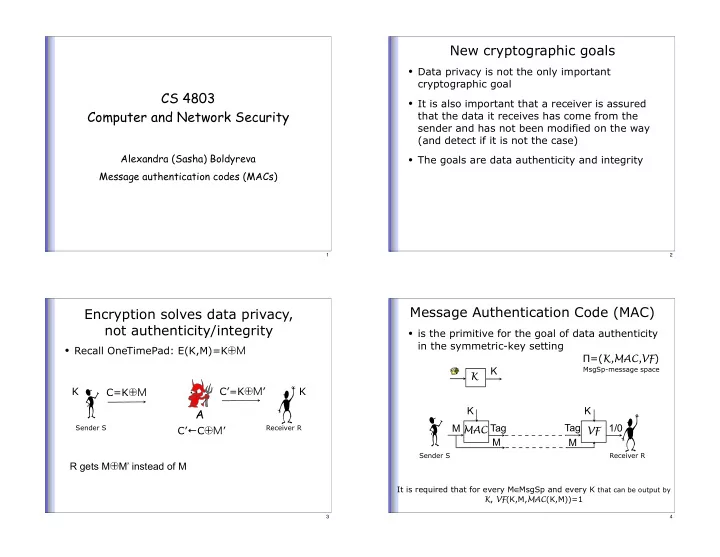
New cryptographic goals

  • Data privacy is not the only important

cryptographic goal

  • It is also important that a receiver is assured

that the data it receives has come from the sender and has not been modified on the way (and detect if it is not the case)

  • The goals are data authenticity and integrity

2

Encryption solves data privacy, not authenticity/integrity

  • Recall OneTimePad: E(K,M)=K⊕M

Sender S

A

Receiver R

C=K⊕M K K C’C⊕M’ C’=K⊕M’ R gets M⊕M’ instead of M

3

Message Authentication Code (MAC)

  • is the primitive for the goal of data authenticity

in the symmetric-key setting

Sender S

K K MAC K Tag M

Receiver R

VF K 1/0 M Tag =(K,MAC,VF)

It is required that for every M∈MsgSp and every K that can be output by K, VF(K,M,MAC(K,M))=1

MsgSp-message space

M

4

slide-2
SLIDE 2

Message Authentication Code (MAC)

  • If the key-generation algorithm simply picks a

random string from some KeySp, then KeySp describes K

  • If the MAC algorithm is deterministic, then the

verification algorithm VF does not have to be defined as it simply re-computes the MAC by invoking the MAC algorithm on the given message M and accepts iff the result is equal to its input TAG.

5

Towards a security definition for MACs

  • We imagine that an adversary can see some

number of message plus tag pairs

  • As usual, it is necessary but not sufficient to

require that no adversary can compute the secret key

  • Right now we will not be concerned with replay

attacks

  • We don’t want an adversary to be able to

compute a new message and a tag such that the receiver accepts (outputs 1).

6

Security definition for MACs

A

Fix =(K,MAC,VF) Run K to get K For an adversary A consider an experiment Exp-uf-cma(,A)

MAC (K,) VF(K,,)

M,Tag The uf-cma advantage of A is defined as the probability of A

  • utputting M, Tag, s.t. Tag is valid (VF(K,M,Tag)=1) and M is new

(was not queried to the MAC oracle)

7

Examples

M[1]

EK

C[1] M[2]

EK

C[2] M[m]

EK

C[m] MAC(K,M): Let E:{0,1}k{0,1}n{0,1}n be a block cipher. 1=({0,1}k,MAC,Vf): Tag=

⊕ ⊕ ⊕

Is 1 secure (uf-cma)?

8

slide-3
SLIDE 3

Note

  • We broke the MAC scheme without breaking the

underlying block cipher (it can be secure PRF).

  • The weaknesses were in the scheme, not the

tools

9

CBC-MAC

M[1]

EK

C[1] M[2]

EK

C[2] M[m]

EK

C[m] Let E:{0,1}k{0,1}n{0,1}n be a block cipher. CBC-MAC=({0,1}k,MAC): 0n ⊕ ⊕ ⊕

  • Theorem. If E is a PRF then CBC-MAC is uf-cma.

MsgSp={0,1}nm for some m1. MAC returns MAC(K,M):

10

Can we use a hash function as a building block?

  • SHA1: {0,1}< {0,1}160
  • Collision-resistant: hard to find M,M’ s.t. SHA1(M)=SHA1(M’)
  • Is it a good idea to use SHA1 as a MAC?
  • What about:
  • MACK(M)=SHA1(M||K)?
  • MACK(M)=SHA1(K||M)?
  • MACK(M)=SHA1(K||M||K)?
  • Cannot prove security for these constructions.
  • Secure construction: HMAC
  • HMACK(M)=SHA1(K⊕c||SHA1(K⊕d||M)), where c,d are some

constants

264

11

Can we get it all?

  • We know how to achieve data privacy (IND-CPA security)

and data authenticity/integrity (UF-CMA security) separately.

  • Can we achieve the both goals at the same time (can we

send messages securely s.t. a sender is assured in their authenticity/integrity)?

  • Can we use the existing primitives: encryption schemes

and MACs?

12

slide-4
SLIDE 4

Composite schemes

  • Fix a symmetric encryption scheme and a

message authentication code

  • There are several ways to use them together
  • 1. Encrypt-and-MAC
  • 2. MAC-then-Encrypt
  • 3. Encrypt-then-MAC
  • If the components are secure, are the

composite schemes secure (provide privacy and integrity)?

13

Integrity of encryption

  • We did not define a notion of integrity of encryption

schemes (we did it for MACs)

  • But one can define a similar notion for encryption
  • Informally, no efficient adversary should be able to

construct a ciphertext that the receiver will assume valid

14

K Ke

$

← Ke Km

$

← Km

Encrypt-and-MAC

  • Fix a symmetric encryption scheme

and a MAC

  • Consider a symmetric encryption scheme

SE = (Ke,E,D)

MAC = (Km,T ,V )

EaM = (K ,E,D)

  • Theorem1. There exist an IND-CPA SE and UF-CMA MAC

s.t. EaM constructed as above is NOT IND-CPA secure.

15

K Ke

$

← Ke Km

$

← Km

MAC-then-Encrypt

  • Fix a symmetric encryption scheme

and a MAC

  • Consider a symmetric encryption scheme

SE = (Ke,E,D)

MAC = (Km,T ,V ) MtE = (K ,E,D)

  • Theorem2. There exist an IND-CPA SE and UF-CMA MAC

s.t. MtE constructed as above is NOT IND-CCA secure.

16

slide-5
SLIDE 5

K Ke

$

← Ke Km

$

← Km

Encrypt-then-MAC !

  • Fix a symmetric encryption scheme

and a MAC

  • Consider a symmetric encryption scheme

SE = (Ke,E,D)

MAC = (Km,T ,V )

EtM = (K ,E,D)

  • Theorem3. For every IND-CPA SE and UF-CMA

deterministic MAC, EtM constructed as above provably provides privacy (IND-CPA, IND-CCA) and integrity

17

  • It’s possible to construct a secure symmetric encryption scheme that

provably provides privacy and integrity without using a generic composition.

  • (&⊕ )

(&⊕ ) *(&⊕ ) +,-'.(& ⊕ ) ,(& ⊕ )&⊕ !"#$ ⋅ ( *(&⊕ ) +,-'.(& ⊕ ) ,(& ⊕ ) /01 "%2 34%5678, τ 549: ;&<'= ;&<*= ;&<,- ' = ;&<, = 3<'= 3<* = 3<,- ' = 3<,=

...

>? @0$ ( A925% ) >? >? >? >? >?

... ...

⊕ ⊕ ⊕ ⊕ ⊕ ⊕ ⊕ ⊕ ⊕ ⊕ 34%5678,&B&;<'=&⊕ ;<*=&⊕ C ⊕ ;<,-'=&⊕ 3<,=DE&⊕ @0$ (&B&>?+!.

18