New existence bounds for decoding transition with Q-LDPC codes: - - PowerPoint PPT Presentation

new existence bounds for decoding transition with q ldpc
SMART_READER_LITE
LIVE PREVIEW

New existence bounds for decoding transition with Q-LDPC codes: - - PowerPoint PPT Presentation

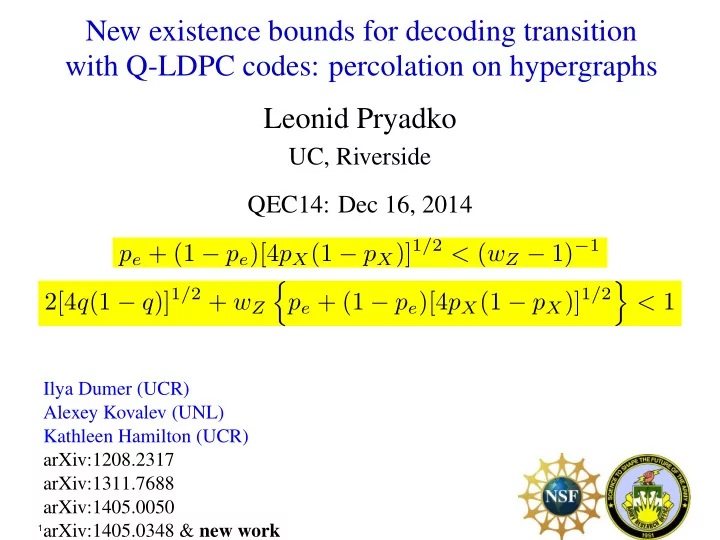
New existence bounds for decoding transition with Q-LDPC codes: percolation on hypergraphs Leonid Pryadko UC, Riverside QEC14: Dec 16, 2014 p e + (1 p e )[4 p X (1 p X )] 1 / 2 < ( w Z 1) 1 2[4 q (1 q )] 1 / 2 + w Z p


slide-1
SLIDE 1

1

2[4q(1 − q)]1/2 + wZ

  • pe + (1 − pe)[4pX(1 − pX)]1/2

< 1

Leonid Pryadko New existence bounds for decoding transition with Q-LDPC codes: percolation on hypergraphs

UC, Riverside QEC14: Dec 16, 2014

Ilya Dumer (UCR) Alexey Kovalev (UNL) Kathleen Hamilton (UCR) arXiv:1208.2317 arXiv:1311.7688 arXiv:1405.0050 arXiv:1405.0348 & new work

pe + (1 − pe)[4pX(1 − pX)]1/2 < (wZ − 1)−1

slide-2
SLIDE 2

1

Leonid Pryadko New existence bounds for decoding transition with Q-LDPC codes: percolation on hypergraphs

UC, Riverside QEC14: Dec 16, 2014

  • Introduction: SAW-based bound for the surface codes
  • Old bound for Q-LDPC codes with log distance
  • New bounds: count irreducible undetectable operators
  • Conclusions and open problems

Ilya Dumer (UCR) Alexey Kovalev (UNL) Kathleen Hamilton (UCR) arXiv:1208.2317 arXiv:1311.7688 arXiv:1405.0050 arXiv:1405.0348 & new work

slide-3
SLIDE 3

2

Decoding threshold

Decoding threshold pc: Consider an infinite family of error correcting codes. With probability p for independent errors per (qu)bit, at p < pc, a large enough code can correct all errors with success probability P → 1, but not at p > pc Example: code family with finite relative distance δ = d/n. A code can detect any error involving w < d (qu)bits, and distinguish between any two errors involving w < d/2 qubits

  • each. For such a family, pc ≥ δ/2.

In practice, this does not quite work since such codes have stablizer generators of weight ∼ n: measuring syndrome is hard All known code families with finite-weight stabilizer generators have distance scaling logarithmically or as a sublinear power of n.

Finite-rate: Tillich & Z´ emor 2009 Andriyanova et al. 2012 . . . Zero-rate codes: toric (Kitaev) color (Bombin et al.) . . .

slide-4
SLIDE 4

3

Surface codes

Family of codes invented by Alexey Kitaev (orig: toric codes) Stabilizer generators: plaquette A = ZZZZ and vertex B+ = XXXX operators (this is a CSS code).

toric code [[98, 2, 7]]

slide-5
SLIDE 5

3

Surface codes

Family of codes invented by Alexey Kitaev (orig: toric codes) Stabilizer generators: plaquette A = ZZZZ and vertex B+ = XXXX operators (this is a CSS code). Detectable errors: have open X chains along dual lattice or open Z chains on the original lattice

toric code [[98, 2, 7]]

slide-6
SLIDE 6

3

Surface codes

Family of codes invented by Alexey Kitaev (orig: toric codes) Stabilizer generators: plaquette A = ZZZZ and vertex B+ = XXXX operators (this is a CSS code). Detectable errors: have open X chains along dual lattice or open Z chains on the original lattice

toric code [[98, 2, 7]]

slide-7
SLIDE 7

3

Surface codes

Family of codes invented by Alexey Kitaev (orig: toric codes) Stabilizer generators: plaquette A = ZZZZ and vertex B+ = XXXX operators (this is a CSS code). Detectable errors: have open X chains along dual lattice or open Z chains on the original lattice

toric code [[98, 2, 7]]

Undetectable error: only closed chains Trivial undetectable error: topologically trivial loops Bad undetectable error: topologically non-trivial loop ⇒ Code distance d = L ∝ √n. [[n = 2L2, k = 2, d = L]]

slide-8
SLIDE 8

4

Surface codes: finite decoding threshold

toric code [[98, 2, 7]]

Distance scales as d ∝ n1/2, meaning zero relative distance δ ∝ n−1/2, n → ∞. Is there a finite decoding threshold? Yes! [Dennis, Kitaev, Landahl & Preskill, 2002]

  • Counting topologically non-trivial chains
  • Mapping to the Ising model with bond disorder
slide-9
SLIDE 9

4

Surface codes: finite decoding threshold

toric code [[98, 2, 7]]

Distance scales as d ∝ n1/2, meaning zero relative distance δ ∝ n−1/2, n → ∞. Is there a finite decoding threshold? Yes! [Dennis, Kitaev, Landahl & Preskill, 2002]

  • Counting topologically non-trivial chains
  • Mapping to the Ising model with bond disorder
  • Counting topologically non-trivial chains
  • Mapping to the Ising model with bond disorder

Erasures: unrecoverable chain len. ℓ ≥ d: Qℓ ≤ n pℓ#(SAWℓ) ≤ n (3p)ℓ Uncorrectable error: such a chain more than half-filled with errors. Probability:

Pℓ ≤ n #(SAWℓ)

  • m≥⌊ℓ/2⌋

m

  • pm(1 − p)ℓ−m

Pℓ ≤ n 3ℓ × 2ℓ[p(1 − p)]ℓ/2

Neither happens at sufficiently small p!

slide-10
SLIDE 10

5

General (h, w)-limited Q-LDPC codes

Example: hypergraph product code constructed from [7, 3, 4] cyclic code. Column weights ≤ h = 3, row weights ≤ w = 6. GX =             ↓ ↓ ↓ 1 1 1 . . . 1 . . . 1 1 1 . . . 1 . . . ← 1 1 1 . . . 1 . . . ← 1 1 1 . . . 1 . . . ← 1 1 1 . . . . . . ← 1 1 1 . . . . . . ← 1 1 . . . . . . ←            

Observation: for small p, errors can be separated into clusters which affect different subsets of generators. Here, each qubit has up to z ≡ h(w − 1) neighbors. Formation of large clusters can be viewed as percolation on a graph with vertex degrees bounded by z.

slide-11
SLIDE 11

6

Threshold theorem and sparse-graph codes (cont’d)

  • Start with a small per-qubit error probability p ≪ 1.
  • Connect errors affecting common gen-
  • erators. For small p and a sparse code

these form small disconnected clusters

slide-12
SLIDE 12

6

Threshold theorem and sparse-graph codes (cont’d)

  • Start with a small per-qubit error probability p ≪ 1.
  • Connect errors affecting common gen-
  • erators. For small p and a sparse code

these form small disconnected clusters

  • Key observation: disconnected clusters

can be detected independently; they do not affect each other’s syndromes. This implies that errors formed by clusters

  • f weight w < d are all detectable
slide-13
SLIDE 13

6

Threshold theorem and sparse-graph codes (cont’d)

  • Start with a small per-qubit error probability p ≪ 1.
  • Connect errors affecting common gen-
  • erators. For small p and a sparse code

these form small disconnected clusters

  • Below percolation limit pc, probability to have a cluster of

large weight w is exponentially small with w.

  • Key observation: disconnected clusters

can be detected independently; they do not affect each other’s syndromes. This implies that errors formed by clusters

  • f weight w < d are all detectable
  • Maximum cluster size grows logarithmically with n (for small

enough p this is also true for confusing half-filled clusters) Conclusion: as long as d ∝ nα, α > 0 (or even logarithmic), a sparse-graph code can correct errors at finite p. [Kovalev & LPP, ’13]

slide-14
SLIDE 14

7

Percolation-based threshold for quantum LDPC codes

Actual value of the threshold for erasures: pe ≥ (z − 1)−1 for (h, w)-limited code. For depolarizing channel: pd ≥ [2e(z − 1)]−2 (assuming power-law distance). Here z ≡ h(w − 1). Trouble: This threshold is much weaker than what we have for the toric codes (h = 2, w = 4), even though both thresholds are related to percolation. Reason: This approximates code as a qubit-connectivity graph. Any structure associated with the action of generators is ignored

slide-15
SLIDE 15

8

Irreducible cluster counting algorithm

Algorithm for CSS code (X errors) Definition 1 For a given stabilizer code, an undetectable

  • perator is called irreducible if it cannot be decomposed as a

product of two disjoint undetectable Pauli operators.

  • Order the stabilizer generators; pick a starting bit (n choices)
  • At each recursion step, deal with topmost ”unhappy” stabilizer

generator and pick a bit among unselected points in its support (up to w − 1 choices)

  • Recursion stops when syndrome is zero (an undetectable oper-

ator is found), or when there are no more positions for a given generator (have to go back).

  • After m recursion steps, return all irreducible undetectable op-

erators of weight up to m. Complexity N m = n (w − 1)m−1. This gives upper bound for the number Nm of irreducible logical

  • perators at m ≥ d.
slide-16
SLIDE 16

9

Toric code example

(a) (b)

Z Z Z Z X X X X 1 2 3 4

Reducible cluster will be returned or not, depending on the order in which the numbered qubits are encountered

slide-17
SLIDE 17

10

Minimum-energy decoding

Let P(E) be some error probability, energy ε = − ln P(E).

  • For an (unknown) error E, let E′ be the minimum-energy error

with the same syndrome ⇒ E′E† is undetectable.

  • Decompose E′E† =

j Jj into irreducible operators Jj.

  • Error found correctly if ε(JjE) > ε(E) for all Jj that are non-

trivial logical operators (Jj not in stabilizer) Decoding is asymptotically correct at n → ∞ if the probability for a ”bad” error for any irreducible J ∈ C(S) \ S vanishes. Let ε(E) correspond to uniform uncorrelated errors. Then for a given J, probability Pm of bad error only depends on m ≡ wgt J. Example: Erasures with probability pe ⇒ Pm = pm

e .

Total probability to fail: Pfail ≤

  • m≥d

PmN m ≤ n[(w − 1)pe]d 1 − (w − 1)pe

slide-18
SLIDE 18

11

Improved cluster counting

For toric code, w = 4, and this bound is the same as simple-minded walk counting (Nm ∼ n 3m−1) Power-law scaling of Nm for different codes — exponents can be used for improved bounds, just like SAW exponent in the case of the toric code [ζ6 ≈ 4.76, ζ7 ≈ 5.74, ζ8 ≈ 5.79 and ζ9 ≈ 6.78]

slide-19
SLIDE 19

12

Combination of erasures and independent X/Z errors

Combined erasures (probability pe) and X errors (probability p). Probability of E: a erasures and b X errors in a cluster of size m: PE = m

a

  • pa

e(1 − pe)m−a m−a b

  • pb(1 − p)m−a−b.

Probability of JE (invert bits outside of the erasure): PJE = m

a

  • pa

e(1 − pe)m−a m−a b

  • (1 − p)bpm−a−b.

Bad errors: PE ≤ PJE, which gives m − a − 2b > 0. Upper bound for bad error probability in a cluster of size m: Pm =

  • pe + (1 − pe)[4p(1 − p)]1/2m.

With code distance scaling as a power law d ≥ Anα, α > 0, minimum-energy decoding asymptotically successful if pe + (1 − pe)[4p(1 − p)]1/2 ≤ (w − 1)−1.

slide-20
SLIDE 20

13

Fault-tolerant case

With syndrome errors, use aux 3D code with CSS-like generators (analog of 3D line matching): P =

  • Im ⊗ Hr×n, Rm×(m−1) ⊗ Ir
  • Degeneracy generator: Q =
  • [RT ](m−1)×m ⊗ In

Im−1 ⊗ [HT ]n×r Im ⊗ Gr′×n,

  • Repetition code check matrix:

[RT ](m−1)×m ≡      1 1 1 1 ... ... 1 1     

For combination of uncorrelated erasures (pe), depolarizing (p), and syndrome errors, with distance d ≥ D ln n, we get 4[q(1 − q)]1/2 + wY ≤ e−1/D, Y ≡ pe + (1 − pe) 2p 3 + 2 p 3(1 − p) 1/2 Bound the number of clusters of size m, with mq qubit errors: N m,mq ≤ m

mq

  • wmq2m−mq
slide-21
SLIDE 21

14

Summary

  • Yet percolation on a graph (like the old bound) can be also used:

– With large variations of w, e.g., pe ≥ 1/λmax(A) [Hamilton & LPP, 2014] – With correlated errors [in progress] Not clear if something similar can be done in the present case. Need to come up with MF theory for percolation on hypergraphs

  • New analytic lower bound for the thresholds with minimum-energy decoder

– Same accuracy as counting SAWs for the toric code – Simple expressions for uncorrelated errors – Phenomenological syndrome errors included on equal footing – Way better than the old percolation-based bound A good postdoc is needed to work on this, LDPC codes & related stat-mech!

  • This corresponds to a bound on percolation of (binary) cycles on hypergraphs
  • Erasure threshold, e.g., pe ≥ (w − 1)−1 for CSS codes, also gives bounds:

– for code rate, using 1 − R ≥ 2pe ⇒ R < 1 − 2/(w − 1) – for codes with transverse logical ops in m th level of Clifford chierarcy, pe ≤ 1/w [Yoshida & Pastawski (2014)]

slide-22
SLIDE 22

15