
SLIDE 1
New Haven Public Schools Reopening Plan
- Dr. Iline Tracey, Superintendent
July 21, 2020
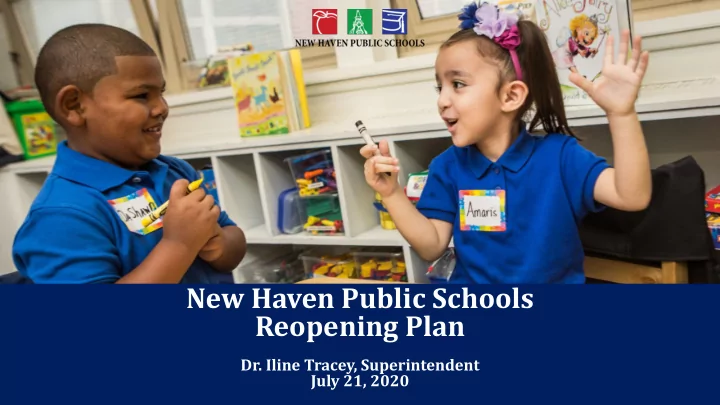
New Haven Public Schools Reopening Plan Dr. Iline Tracey, - - PowerPoint PPT Presentation
New Haven Public Schools Reopening Plan Dr. Iline Tracey, Superintendent July 21, 2020 Agenda Topic Presenter Overview of the Work Dr. Iline Tracey Operations Attorney Michael Pinto Health Dr. Jennifer Vazquez and Ms. Sue Peters
New Haven Public Schools Reopening Plan
July 21, 2020
Topic Presenter Overview of the Work
Operations Attorney Michael Pinto Health
Cleaning the Building
Transportation
Arrival
Classroom Spacing
Food Service
Meal Distribution
Dismissal
Social Emotional Supports
Instructional Models
Professional Learning
Distance Learning
Special Education
English Learners
Disengaged Youth
Afterschool Programs
Athletics
Funding Reopening
Community Support
Agenda
Tiger Team
Facilities Wellness Instruction Technology
Goals
Essential Covid-19 Safety
students and staff to reduce virus transmission
maximized to ensure safety
will be taught and reinforced Covid-19 Safety Enhancements
teachers
in high interaction Areas – including reception desks and food serving lines
distributed throughout each building
District in multiple languages
Keeping Staff and Students Safe
Cleaning/Disinfection Protocol and Schedule
consistent teams to minimize cross-contamination of student groups
with no sharing of materials
Implementing Enhanced Safety
building to identify additional learning spaces
gymnasium, and outdoor spaces to classroom use where needed
to school opening on new protocols
communication with families to clearly identify expectations and enhance safety
Maximizing Building Flexibility
Health Subcommittee Recommendations for Reopening Schools
12
Goal: To present health focused recommendations, protocols and resources to facilitate the planning and preparation for reopening schools safely and to reduce the spread of infectious illness.
Response Plan-Transmission Levels
13
New Haven Health Department and the Board of Education will monitor trends and determine response level LEVEL 1- No Community Transmission= No reported cases in the community LEVEL 2- Moderate Community Transmission=Multiple cases in the community *We are in LEVEL 2 LEVEL 3- Substantial Transmission-Increased spread in towns and public places-Extended School dismissals would be considered
Health Care Recommendations-Planning
14
Based on CT Plan, CDC, AAP and other State and national recommendations Highlights: Planning
hybrid) and transportation needs;
19 amongst students/staff
students
15
Health Recommendations
picking up child) Parent-staff meetings should be conducted by phone or other electronic means;
through the day as “handwashing breaks” and when required (before/after eating, sharing any materials, before/,
avoid sharing materials
the building. All students/staff must apply sanitizer to hands when they enter building;
Health Recommendations-Events/Gatherings
16
distancing of at least 6 feet between people if events are held. Limit group size to the smallest extent possible
geographic area (e.g., community, town, city, county).
performances, school-wide parent meetings, and spirit nights, as possible
that minimizes the risk of transmission of COVID-19 to players, families, coaches, and communities
Nursing and School Based Health Clinics
17
Remove chairs not in use.
students and families;
telehealth visit (encourage allowing families to keep chromebooks at home to facilitate telehealth)
Students with Special Health Care Needs
18
adequate privacy and PPE for procedures. Staff providing care and the students will be provided with appropriate PPE, as indicated (masks, shields, gowns)
provided with appropriate PPE
Staff providing personal care to students- Cloth/Disposable mask and face shield
Health Care Recommendations-PPE
19
provided a disposable mask either before entering the bus or school. * State working on list of specific medical reasons that would allow students/staff not to wear masks. In these cases, provide face shields if applicable.
Student/staff-low risk factors-Cloth or *non medical disposable masks (*can be worn for several days with proper storage) Students/staff with high risk (medical issues, immune suppressed) N95 masks (not with one way valve) or surgical mask with face shield Health Professionals-SBHC staff /nurses: ASTM level 3, N95, surgical
Health Care Recommendations-Mitigation of Risk
20
–information will be sent to school nurse for follow up
before returning to school;
Health Care Recommendations-Response
21
Procedures for response to case of COVID-19
Planning moving forward
Cleaning removes germs, dirt and impurities from surface or objects.
Prevention(CDC) recommends cleaning “frequently touched” surfaces and commonly shared items at le least d dai aily ly and when visibly soiled
proper cleaning protocol.
appropriately
the cleaning and when it was completed.
copy will be filed at the facilities department
Disinfecting kills germs on surfaces or objects.
dirty surfaces. By killing germs on a surface after cleaning, it lowers the risk of spreading infection.
health standards or requirements. This process works by either cleaning or disinfecting surfaces or
surfaces will be the key focus of building services personnel during a pandemic. The Centers for Disease Control and Prevention (CDC) recommends cleaning frequently touched surfaces and commonly shared items at least daily and when visibly soiled.
Cleani eaning ng
Di Disinf nfec ecting ng
COVID-19 DEEP CLEANING & DISINFECTION
Fa Fall 2 2020 Daily ily Cleani eaning & ng & Disinfec fecti tion P
REOPEN 2020 – COVID-19 ENHANCED CLEANING PROTOCOLS
CLEANING & DISINFECTION CHECKLIST
27
Student expectation / PPE
all times while on the school bus.
before boarding the school bus.
for each bus to distribute in the event a student mask is not being available. Driver requirements / PPE
loading and unloading the vehicle.
distancing guidelines as directed.
safety practices as directed and guidelines change.
PPE expectations and requirements
Social Distancing Load/Unload
guidelines.
guidelines.
in a front to rear order.
Social Distancing on the School Bus
Signage and Student Guidance
remind riders of requirements while riding the school bus as well as guidance for minimizing the risk of spreading infection.
29
First Student has researched and is recommending a student and bus safe product effective at disinfecting surfaces common to school buses called ZOONO-Z71.
Zoono Z71™ Microbe Shield Surface Monthly Disinfectant
(metal/glass/vinyl/plastic/fabric)
forming an antimicrobial shield
School Bus Disinfection recommendation
School Bus Disinfection recommendation
31
School Bus Disinfection Protocol
Arrival
34
Stay home if you feel ill.Students must stay home if they are feeling sick, have any symptoms consistent with COVID-19, or have had close contact with a person diagnosed with COVID-19.
Morning health check by parents required.In order to prevent transmission among the school population, parents are instructed to screen students before leaving for school. Check to ensure temperature is below 100.0 degrees Fahrenheit and observe for symptoms associated with COVID 19 outlined by public health officials. Limited Entry Arrival procedures will limit unnecessary entrance of parents and guardians into the building.
Face coverings or masks required.Students must wear face coverings or masks that completely cover the nose and mouth while inside the school and on the bus, with exceptions
be responsible for providing students with face coverings or masks. Schools will have backup disposable masks available for students who forget them.
Social distancing required.Students must maintain social distancing to the greatest extent possible. Students are expected to practice social distancing when entering and exiting the building, in classrooms, and moving throughout the school. Sharing of school
Frequent hand washing or hand sanitizing expected.Students must engage in frequent hand washing or sanitizing upon arrival, before and after meals, after bathroom use, and after coughing
Kid Kid 6 feet 3 feet 3 feet If you use a common footprint across all classrooms for the teacher space – say 75 ft2 – you can then deduct that from the total room area of the classroom and divide by the above to get the number of students that will fit.
@6 ft @ 3ft Diameter of kid 1.5 1.5 Additional distance 3.0 1.5 x2 (in all directions) 6.0 3.0 Total diameter 7.5 4.5 Radius 3.8 2.3 Radius squared 14.1 5.1 x 3.14159 44.2 15.9
6ft Social Distancing
CLASSROOM SPACING
Breakfast Meals for students attending school Pre K - 8
staff dropped off to classrooms
Food service distributed
Hallways High Schools
Lunch Meals for students attending school Pre K – 8
some schools had School Staff pick up meals from kitchen that were on a cart in insulated bags, Food service staff delivered to classrooms where time was allowed
come to kitchen serving line to pick up meal that is boxed to eat in the cafeteria maintaining social distancing guidelines or take back to the classroom
guide them through serving line
between food service staff and students
a manual tally for accountability
LOW TRANSMISSION - OPEN FOR SCHOOL WEEK (5 DAYS)
High Schools
students come to kitchen serving line to pick up meal that is boxed to eat in the cafeteria maintaining social distancing guidelines or take back to the classroom or other space
place between food service staff and students
staff will use a manual tally for accountability *Curbside Pickup Meals will be available for students not attending school
Principal and Food Service will designate a location for student/parent pick up of meals
LOW TRANSMISSION - OPEN FOR SCHOOL WEEK (5 DAYS)
Breakfast Meals for students attending school
PreK - 8
staff dropped off to classrooms
Food service distributed
Hallways High Schools
Lunch Meals for students attending school
PreK – 8
schools had School Staff pick up meals from kitchen that were on a cart in insulated bags, Food service staff delivered to classrooms where time was allowed
kitchen serving line to pick up meal that is boxed to eat in the cafeteria maintaining social distancing or take back to classroom
them through serving line
service staff and students
manual tally for accountability
MODERATE TRANSMISSION - OPEN FOR SCHOOL WEEK (4 DAYS)
High Schools
lines, students come to kitchen serving line to pick up meal that is boxed to eat in the cafeteria maintaining social distancing or take back to classroom or other space
markers on floor to guide them through serving line
in place between food service staff and students
food staff will use a manual tally for accountability *Curbside Pickup Meals will be available for students not attending school Principal and Food Service will designate a location for student/parent pick up of meals MODERATE TRANSMISSION - OPEN FOR SCHOOL WEEK (4 DAYS)
Schools Closed Only No Contact Pick-Up “Grab & Go Meals Distribution” We anticipate a similar program as used during the spring/summer 2020 shutdown period (Days, Times, Sites To Be Determined)
HIGH TRANSMISSION - SCHOOLS CLOSED
Dismissal
44
School Principals will develop their dismissal plan to best suit their building Limited Entry for Parents Dismissal procedures will limit unnecessary entrance of parents and guardians into the building.
Dismissal routines have to be flexible.
Social Emotional Learning Supports
As we prepare to reopen schools we must put the social well being of our students as our highest priority. We must first support the physical, cognitive, language, social, ethical, and psychological needs of our students and adults as they adjust to the new normal. This work will be carried out through multiple platforms, keeping in mind the needs of our students, parents/guardians, and educators. Schools will be provided with varying activities to address the social emotional well being of our school
community oriented activities recognizing that there will be varying needs amongst students, staff, and families.
Schools
Goal: To reestablish a sense of community and build on climate and culture if each school.
(meet-the-teacher opportunities).
circles/conversations/SEL activities.
Students
4 8
Goal: To provide guidelines in order to support the psychological and emotional well-being of our students create a sense of belonging and normalcy as we return back to school.
monitoring, connection to outside agencies)
Educators
Goal: To assess the well being of staff and provide resources and support regarding SEL
anxiety.
brain breaks, optimistic closure, and norms
Families
Goal: To provide guidelines between the district and school communications with parents, guardians, and community partners regarding physical and emotional wellness during the transition back to school. Communication between administrators and families should:
parents, guardians, and community partners.
Thermometer Distribution https://www.newhavenct.gov/gov/depts/health/thermometer_distribution.htm?fbclid=IwAR17r9DoPWOtE_lFWLy- shUDC89Nj6EMhw2RpR4-YEa5_0fTPK62UK6AcmA CLIFFOR BEERS WARMLINE https://www.cliffordbeers.org/reach-out-new-haven CT TEMPORARY RENTAL HOUSING ASSISTANCE https://files.constantcontact.com/79121f78701/6fe36234-ddbb-4ff5-8235-e77c8556ea53.pdf
Fall 2020 Instructional Models
52
development
staffing and resources
Preferred New Haven Plan
Professional Learning: June 2020
55
Professional Learning: June 2020
56
Professional Learning: Summer 2020
57
Professional Learning: Academic Year 2020 – 2021
58
Leaders Description
LINCspring
All central office leaders, school leaders, teachers, and paraprofessionals will have access to over 150 hours of virtual professional development through LINCspring, which includes access to LINCspring Essentials, Remote Learning and Google Classroom Libraries.
Teachers
Peer to peer training will occur throughout the year as teachers collaborate in professional learning communities and present exemplary practices to teachers across the district.
Curriculum Supervisors
Curriculum Supervisors will provide on-going support through workshop facilitation and curriculum revisions to all teachers in the district.
Distance Learning
60
Our Goals NHPS’s Distance Learning platform will be engaging, responsive and instructionally sound to ensure students continue to learn and grow their interests.
Every student, whether enrolled in-person or learning remotely, will have access to online resources curated by teachers on a wide range of engaging topics over time. Every student, will have access to Google Classroom, where they will link to synchronous and asynchronous learning activities with teachers and classmates. Teachers will convene whole groups and small groups online to differentiate content and instruction in order to respond to where students are on the continuum of learning for each subject area, given the time away from school in the spring.
Distance Learning
61
Design Elements
Google Classroom and Google Suite Apps, to delivery instruction.
workshops presented by amazing volunteer teacher, supervisors and community members.
LINCspring to design sophisticated online lessons that merge video, whiteboards, flipped curriculum, online reading and more, so that students engage with content in varying and differentiated ways.
students are and using holistic, performance based assessments to instruct.
ideas.
will capture student’s growth over time and can be shared with parents.
and asynchronous technology.
Distance Learning
62
Teacher and Parent Design Elements
Coaches.
expectations for synchronous versus asynchronous modes of instruction by grade level and content.
and community.
support your child succeed in distance learning.
Students with Disabilities
64
plan(IEP)
academic, social/emotional/behavioral, and vocational needs of students
Service Delivery
65
ensure implementation of IEP/goals and objectives
skills and concepts
safety of students and staff
Continuum of Services
66
disabilities to significant intellectual delays (resource, self-contained, vocational)
modifications and accommodations as outlined by IEP( wearing masks, social distancing in resource rooms, classrooms, blended learning experiences within the context of the academic day, to the extent possible-limiting number of cross interactions amongst students)
support-(behavioral analysts, physical therapists, et cetera) -utilizing additional staffing in order to maintain social distancing
may not be possible; requiring more routine health checks with nursing and additional PPE
Recommendation for In Person Instruction
67
containers, cubies or spaces-avoid sharing materials
possible
visual cuing (speech and hearing impairments, preschool)
visual cues, and other developmentally appropriate strategies
care needs
Recommendation for In Person Instruction
68
requiring additional staff training and PPE
when there is agreement with families
speech, et. Cetera)
an option(speech, social work, school psychology, school counseling) for protection for students and staff
Distance Learning
69
general education curriculum providing modifications and accommodations
71
English learners will be provided with a standards based instructional program that addresses their linguistic, academic, and social emotional needs in order to access grade level curriculum. The following supports/considerations must be taken into account:
determine individual students needs
language proficiency and prior schooling must be considered at all times
speaking, listening, reading, and writing
content
engagement and access to the grade level curriculum and technology resources
English Learners
72
English Learners
Provide ELs their supplemental instruction program in addition to their general education program of mainstream, grade- level, and content-area instruction Notify schools of the current list of ELs and provide instructors to meet their needs ELs will continue to receive the language instructional services, such as bilingual education, ESL, Sheltered Instruction, and
Comply with the requirement that eligible students in bilingual mandated districts are offered bilingual education programs Review yearly opening schools protocols to ensure that we can maintain a high-level of programming that is mandated while maintaining social distancing Students will receive required bilingual education services Establish systems for ongoing collaboration between bilingual and TESOL teachers Review systems and protocols that foster collaboration between bilingual and TESOL teachers and make adjustments when necessary Teachers will have a better understanding
needs of students Develop and maintain ongoing communication with families of ELs regarding remote learning and returning to their school Develop a communication plan for families Students will be reacclimated with the learning environment with reduced anxiety Task/Objective Action Steps Intended outcomes/Evidence
Engaging Family of Vulnerable Students
74
engagement as a mechanism to reduce students at risk for disengagement and has trained school and district administrators and staff on the framework. In addition, NHPS has adopted the CSDE definition
partnership among families, educators and community partners to promote children’s learning and development from birth through college and career.
Engaging Family of Vulnerable Students
75
disengagement including identification of students who are at-risk of disengagement, homeless students, students in foster care, undocumented students, students with history of exclusion from class and school--contributing to chronic absenteeism
Restorative Practices; Implement Care Coordination to intensively support families to help our most vulnerable youth transition back to school in the fall:
student retention workers, drop-out prevention workers to shift and incorporate restorative practices;
Address Root Causes for Disengagement
76
help with family needs that may contribute to the obstacles facing disengaged youth.
students may be bringing into the schools. Within these spaces staff (Restorative Specialists) can meet with students individually to have a private conversation or in groups as needed. Larger schools with large numbers of disengaged youth will need support in locating multiple or adequate size spacesdesigned to promote positive affect.
78
Afterschool Programming
that will maintain proper social distancing in-person and remote learning options will be available
providers, families, school leaders and students to assure that students and family needs are front and center of programming
80 This document has been developed with guidance from the Ct State Department of Education, the Connecticut Interscholastic Athletic Conference ( CIAC) , the National Federation of High Schools ( NFHS), input from the Southern Connecticut Conference ( SCC) member schools, and the New Haven Public Schools Athletic Department This plan is to help you understand the procedures that are in place to allow athletes, coaches, officials, and fans to safely return to Connecticut high school athletic play. Many of the procedures are based off of the document released by the CIAC “The CT Interscholastic Conference Resocialization
Registration Every athlete participating in a sport must register for that sport prior to the season start up. An athlete cannot participate in a sport unless the registration is complete and their physical is up to date. Student Athlete Physicals Due to the uncertainty and difficulty of scheduling a physical, the CIAC, in consultation with the Medical Society, has extended the policy for student physicals from a 13 month validation to 15 month. The student athlete physical must be valid throughout the entire athletic season. If the extension of two additional months does not cover the entire season, that child will be required to receive an updated physical from their physician or medical walk in clinic. Health As with any illness, student athletes are not allowed to report to practices or contests until cleared by a physician if any of the following symptoms appear:
Return to Play Plan 2020-2021
81 If the student athlete or any individual in their household has tested positive for COVID-19; is experiencing symptoms of COVID-19; or has experienced symptoms of COVID-19 in the preceding 14 days, including, but not limited to, fever or chills, cough, shortness of breath or difficulty breathing, fatigue, muscle or body aches, headache, new loss of taste or smell, sore throat, congestion or runny nose, nausea or vomiting, and/or diarrhea, or if the student athlete or any individual in their household has recently had close contact with a person infected with COVID-19. Start Dates The CIAC currently lists the following start dates for fall sports : Football - August 17 All other fall sports - August 27 The CIAC will inform us on any changes or revisions to start dates. We will inform parents should any revisions occur. Face Coverings The face covering is intended to reduce the risk of spreading the virus. Face coverings should be worn by coaches, officials, game personnel, and spectators. Athletes should also wear a face covering with the following exceptions recommended by the CIAC, in collaboration with the Connecticut State Medical Society, Sports Medicine Committee:
swimming), such as when sitting on the bench, during chalk talk, interacting with an athletic trainer, etc.
and have no tint. 4. Coaches, officials and other contest personnel should always wear cloth face coverings.
Return to Play Plan 2020-2021
82
Personal Items Every participant must supply their own Personal protective mask. Every participant will be required to supply their own personal water bottle. The water bottle must have their name on it. Only the owner may handle the water bottle (no manager, etc).
Team water bottles will not be available and student athletes cannot share their water bottle. The water bottle may be refilled by a water jug supplied by the coach. Student athletes cannot refill the water jug. Each personal water bottle must be brought home every night to be cleaned and refilled. It is the responsibility of the student athlete to take all personal sport equipment, including school issued equipment, home every day. Sport Schedules The current fall sport schedules can be found at the CIAC web site http://ciacsports.com/site/?page_id=105. Or on Arbiter Live -https://www.arbiterlive.com/Teams?entityId=4072 The CIAC has discussed the possibility of allowing leagues to adjust schedules to reduce travel time (regionalizing schedules). Should any changes take place they will be updated on the above sites. Transportation The New Haven Athletics department will continue to offer transportation to and from away contests with the following modifications prescribed by the State Department of Education for transportation:
The CIAC will work with school districts and leagues to consider options that would reduce transportation costs. Options may include, but are not limited to, regional play, reduced game scheduled, weekend jamborees, sub-varsity jamborees, parent transportation, etc.
Return to Play Plan 2020-2021
83 Locker room use Student athletes are not allowed to store equipment, shower, or congregate in locker rooms. Students can use a locker room to change into sport gear in monitored groups which will allow proper social distancing. . Masks must be worn while changing. All personal items must be carried out once the student has
Return to Play Plan 2020-2021
Funding
85
million.
million for rental of portable classrooms if social distancing can’t be achieved in the building.
expenses, after required allocation to non-public schools.
State aid or the General Find.
(EH&S) and ability to shift to online learning on short notice.
Funding
86
Operations 7/20 meeting materials):
professional development $1.4 million.
teacher/classroom tech and be able to have robust distance learning $5.5 million.
disengaged youth $0.3 million.
than $100K.
Funding
87
million.
development, $1.4 million.
for sick students and prior expenditures $1.4 million.
Funding
88
accessing FEMA funds; nevertheless, will be seeking reimbursement for costs incurred after March 13.
disasters; balance gets absorbed locally.
CARES holdback and the amount allocated to governors.
Family and Community Support
90
Families play a critical role in supporting the new culture of health and safety that each of our schools will
following:
whenever possible, communicating concerns with teachers and school leaders