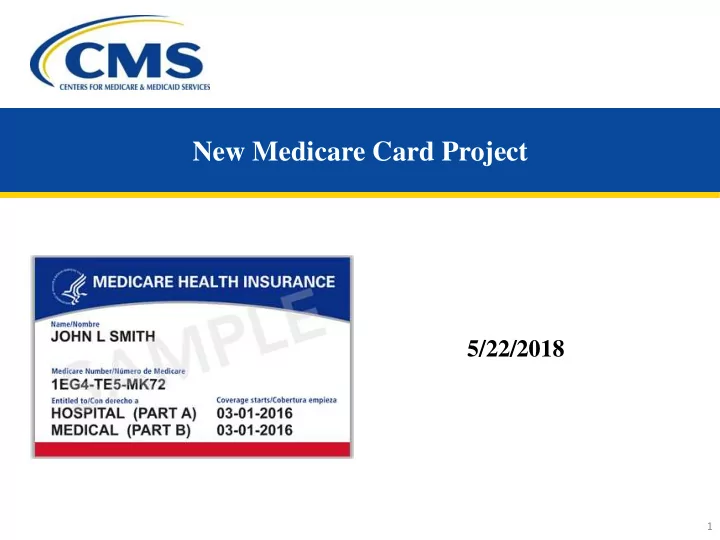
New Medicare Card Project 5/22/2018 INFORMATION NOT RELEASABLE TO - - PowerPoint PPT Presentation

new medicare card project
SMART_READER_LITE
LIVE PREVIEW

New Medicare Card Project 5/22/2018 INFORMATION NOT RELEASABLE TO - - PowerPoint PPT Presentation

New Medicare Card Project 5/22/2018 INFORMATION NOT RELEASABLE TO THE PUBLIC UNLESS AUTHORIZED BY LAW: This information has not been publicly disclosed and may be privileged and confidential. It is for internal government use only and must not be


slide-1
SLIDE 1

INFORMATION NOT RELEASABLE TO THE PUBLIC UNLESS AUTHORIZED BY LAW: This information has not been publicly disclosed and may be privileged and confidential. It is for internal government use only and must not be disseminated, distributed, or copied to persons not authorized to receive the information. Unauthorized disclosure may result in prosecution to the full extent of the law.

1

5/22/2018

New Medicare Card Project

slide-2
SLIDE 2

2

  • The Health Insurance Claim Number (HICN) is a Medicare beneficiary’s

identification number, used for processing claims and for determining eligibility for services across multiple entities (e.g., Social Security Administration (SSA), Railroad Retirement Board (RRB), States, Medicare providers, and health plans)

  • The Medicare Access and CHIP Reauthorization Act (MACRA) of 2015

mandates the removal of the Social Security Number (SSN)-based HICN from Medicare cards to address current risk of beneficiary medicalidentity theft

  • The legislation requires that CMS mail out new Medicare cards with a new

Medicare Beneficiary Identifier (MBI) by April 2019

Background

2

slide-3
SLIDE 3

The SSN Removal solution must provide the following capabilities: 1. Generate Medicare Beneficiary Identifiers (MBI) for all beneficiaries: Includes existing (currentlyactive, deceased, or archived) and new beneficiaries 2. Issue new, redesigned Medicare cards: New cards containing the MBI to existing and new beneficiaries 3. Modify systems and business processes: Required updatesto accommodate receipt, transmission, display, and processing of the MBI CMS will use an MBI generatorto:

  • Assign 150 million MBIs in the initial enumeration (60 million active and 90

million deceased/archived) and generate a unique MBI for each new Medicare beneficiary

  • Generate a new unique MBI for a Medicare beneficiary whose identityhas

been compromised

Solution Concept for the New Medicare Cards

3

slide-4
SLIDE 4

The Medicare Beneficiary Identifier (MBI) will have the following characteristics:

  • The same number of characters as the current HICN (11), but will be visibly

distinguishable from the HICN

  • Contain uppercase alphabetic and numeric characters throughout the 11-digit

identifier

  • Occupy the same field as the HICN on transactions
  • Be unique to each beneficiary (e.g., husband and wife will have their
  • wn MBI)
  • Be easy to read and limit the possibility of letters being interpreted as

numbers (e.g., alphabetic characters are upper case only and will exclude S, L, O, I, B, Z)

  • Not contain any embedded intelligence or special characters
  • Not contain inappropriate combinations of numbers or strings that may be
  • ffensive

CMS anticipates that the MBI will not be changed for an individual unless the MBI is compromised or other limited circumstances still undergoing review

New Medicare Number Characteristics

4

slide-5
SLIDE 5

MBI Generation and Transition Period

5

slide-6
SLIDE 6
  • The transition period will run from April 2018 through December 31, 2019
  • CMS will complete its system and process updates to be ready to accept

and return the MBI on April 1,2018

  • All stakeholders who submit or receive transactions containing the HICN must

modify their processes and systems to be ready to submit or exchange the MBI by April 1, 2018. Stakeholders may submit either the MBI or HICN during the transition period

  • CMS will accept, use for processing, and return to stakeholders eitherthe

MBI or HICN, whichever is submitted on the claim, during the transition period

  • CMS will actively monitor use of HICNs and MBIs during the transition period

to ensure that everyone is ready to use MBIs only by January 1, 2020

Using the New Medicare Number – During Transition

6

slide-7
SLIDE 7
  • CMS is making systems changes so that when a provider checks a beneficiary’s

eligibility, the CMS HIPAA Eligibility Transaction System (HETS) will return a message on the response indicating that CMS mailed that particular beneficiary’s new Medicare card

  • Beginning October 2018 through the end of the transition period, when a valid

and active HICN is submitted on Medicare fee-for-service claims both the HICN and the MBI will be returned on the remittanceadvice

  • The MBI will be in the same place you currently get the “changed HICN”:

835 Loop 2100, Segment NM1 (Corrected Patient/Insured Name), Field NM109 (Identification Code)

  • Use of HICN and MBI for the same person with Medicare on the same batch of

claims

  • During the transition period, we’ll process all claims with either the HICN
  • r MBI, even when both are in the same batch

Using the New Medicare Number – During Transition (2)

7

slide-8
SLIDE 8
  • Medicaid and supplemental insurers
  • We will give State Medicaid Agencies and supplemental insurers the MBIs for

Medicaid-eligible people who also have Medicare before we mail the new Medicare cards. During the transition period, we’ll process and transmit Medicare crossover claims with either the HICN or MBI

  • Railroad Retirement Board (RRB) beneficiaries
  • The RRB will continue to send cards with the RRB logo, but you can’t tell from

looking at the MBI if beneficiaries are eligible for Medicare because they’re railroad retirees

  • Beginning in April 2018, we’ll return a message on the eligibility transaction

response for a RRB patient. The message will say, "Railroad Retirement Medicare Beneficiary.

  • 271 Loop 2110C, Segment MSG
  • Medicare Providers must program their systems to identify RRB beneficiaries so

they know to send those claims to the Specialty Medicare Administrative Contractor (SMAC)

Using the New Medicare Number – During Transition (3)

8

slide-9
SLIDE 9
  • Private payers
  • For non-Medicare business, private payers won’t have to use the MBI.

We’ll continue to use supplemental insurer’s unique numbers to identify customers, but after the transition period, supplemental insurers must use the MBI for any Medicare transactions where they would have used the HICN

  • In addition, CMS is working to develop capabilities where providers will be

able to access a beneficiary’s MBI through a secure look up tool at the point of service

  • In instances in which a beneficiary does not have a new Medicare card at

the point of care, we believe this look up tool will give providers a mechanism to access a beneficiary’s MBI securely without disrupting workflow

Using the New Medicare Number – During Transition (4)

9

slide-10
SLIDE 10
  • Beneficiaries, providers, and plans will no longer use the HICN for internal and

most external purposes.

  • However, once the transition period is over, you’ll still be able to use the HICN

in these situations: Medicare plan exceptions:

  • Appeals – You can use either the HICN or the MBI for claims appeals and

related forms

  • Adjustments – You can use the HICN indefinitely for some systems (Drug Data

Processing, Risk Adjustment Processing, and Encounter Data), Coordination of Benefits and for all records, not just adjustments

  • Reports – We will use the HICN on these reports until further notice:
  • Incoming to us (quality reporting, Disproportionate Share Hospital data

requests, etc.)

  • Outgoing from us (Provider Statistical & Reimbursement Report,

Accountable Care Organization reports, etc.)

New Medicare Number Exceptions After the Transition Period

10

slide-11
SLIDE 11

Fee-for-Service claim exceptions:

  • Appeals - You can use either the HICN or the MBI for claims appeals and related forms
  • Span-date claims - You can use the HICN for 11X-Inpatient Hospital, 32X-Home

Health, and 41X-Religious Non-Medical Health Care Institution claims if the “From Date” is before the end of the transition period (12/31/2019).

  • You can submit claims received between April 1, 2018 and December 31, 2019

using the HICN or the MBI.

  • If a patient starts getting services in an inpatient hospital, home health, or religious

non-medical health care institution before December 31, 2019, but stops getting those services after December 31, 2019, you may submit a claim using either the HICN or the MBI, even if you submit it after December 31, 2019. Other Exceptions:

  • Incoming premium payments - People with Medicare who don't get SSA or RRB benefits

and submit premium payments should use the MBI on incoming premium

  • remittances. But, we'll accept the HICN on incoming premium remittances after the

transition period. (Part A premiums, Part B premiums, Part D income related monthly adjustment amounts, etc.)

New Medicare Number Exceptions After the Transition Period (continued)

11

slide-12
SLIDE 12

What Providers and Pharmacies Need to Know to Get Ready for the New MBI

1. Subscribe to the weekly MLN Connects newsletter for updates and new information 2. Verify your patients’ addresses:

  • If the address you have on file is different than the address you get in

electronic eligibility transaction responses, encourage your patients to correct their address in Medicare's records at SSA using ssa.gov/myaccount (this may require coordination between your billing and office staff)

  • Remind people with Medicare that Medicare will never contact them and

request personal information. They should protect their new Medicare number like a credit card and only share it with trusted providers

12

slide-13
SLIDE 13

What Providers and Pharmacies Need to Know to Get Ready for the New MBI (continued)

3. Get ready to use the new MBI Format:

  • Ask your billing and office staff if your system can accept the 11 digit

alpha numeric MBI

  • If you use vendors to bill Medicare, ask them about their MBI practice

management system changes and make sure they are ready for the change

  • Encourage practices and health care facilities to visit our website at

https://www.cms.gov/newcard 4. Make sure you can access the new provider portal to obtain a patient’s MBI:

  • You’ll be able to look up your Medicare patient’s new Medicare number

through your Medicare Administrative Contractor’s (MAC’s) secure web portal starting in June 2018.

13

slide-14
SLIDE 14

What Providers and Pharmacies Need to Know to Get Ready for the New MBI (continued)

Patient History

  • Throughout the transition period, a provider can submit a claim or other transactions, such as

eligibility requests, using either the HICN or the MBI. This means a provider could submit a claim or other transactions using a Medicare patient’s HICN and be paid or receive eligibility information, even if their Medicare patient already received a new card with a MBI.

  • CMS will actively monitor the transition to the new Medicare number to confirm that people

with Medicare continue to get uninterrupted access to care. This transition period will allow time for pharmacies to ensure that they can process the new MBI in their systems. E1 Transactions for Pharmacies

  • Both the Part D and A/B E1 transactions will return the MBI. Pharmacies may submit the

HICN or MBI until the end of the transition period.

  • Pharmacies can explore whether the National Council for Prescription Drug Programs batch

E1 transaction, offered through the Part D Transaction Facilitator would useful method for pharmacies to obtain the MBI for Part B and Part D drug services. For more information visit either the RelayHealth or the NCPDP website (http://medifacd.mckesson.com or www.NCPDP.org).

14

slide-15
SLIDE 15

New Medicare Cards

6

New Medicare Card New Railroad Retirement Board Card

slide-16
SLIDE 16

Outreach and Education

  • CMS will provide outreach and

education to: − Approximately 60 million beneficiaries, their families, advocacy groups, and caregivers − Health Plans − The provider community (1.5M providers) − All Provider Letter and Fact Sheet − Quarterly Open Door Forums − States and Territories − Other business partners, including vendors

  • CMS will conduct intensive

education and outreach to all Medicare beneficiaries, their families, caregivers, and advocates to help prepare for thischange from September 2017 through April 2019

  • Once they receive their new cards,

beneficiaries will be instructed to safely and securely destroy their

  • ld Medicare cards and keep the

new Medicare number confidential

  • CMS is also working to develop

a secure way for beneficiaries to be able to access their new Medicare number when needed

16

slide-17
SLIDE 17

Outreach and Education Resources

A Flyer to Distribute

  • Resources to help you communicate with people with Medicare are available
  • n our website https://www.cms.gov/newcard to print and/or order

A Poster for Providers’ Offices Tear-offs for Patients Conference Cards for Beneficiaries A Full Timeline for Your Records

8

slide-18
SLIDE 18

Key Points to Reinforce with Patients

  • Understand that mailing everyone a new card will take some time. Your

card might arrive at a different time than your friend’s or neighbor’s.

  • Make sure your mailing address is up-to-date. If your address needs to

be corrected, contact Social Security at ssa.gov/myaccount or 1-800- 772-1213. TTY: 1-800-325-0778.

  • Beware of anyone who contacts you about your new Medicare card. We

will never ask you to give us personal or private information to get your new Medicare number and card.

10

slide-19
SLIDE 19

Key Points to Know

1. Providers need to be ready by April 1, 2018 (systems and business processes) 2. There will be a 21- month transition period from April 1, 2018 – December 31, 2019 3. Providers will have 3 ways to get the new MBI: a. Patient presents the card at time of service b. Provider receives it through the remittance advice c. Provider obtains it through the a secure web portal with the MAC 4. Providers have resources you can use when you talk to people with Medicare about the new Medicare cards: https://www.cms.gov/Medicare/New-Medicare-Card/Partners-and- Employers/Partners-and-employers.html

11

slide-20
SLIDE 20

Final Thoughts

  • Thank you for participating today.
  • For the most updated information on the New Medicare Card please go

to https://www.cms.gov/newcard

  • Please submit any additional comments or questions to the New

Medicare Card team mailbox: NewMedicareCardSSNRemoval@cms.hhs.gov

  • Problems and concerns may also be reported to the Provider

Ombudsman for the New Medicare Card at NMCProviderquestions@cms.hhs.gov .

12