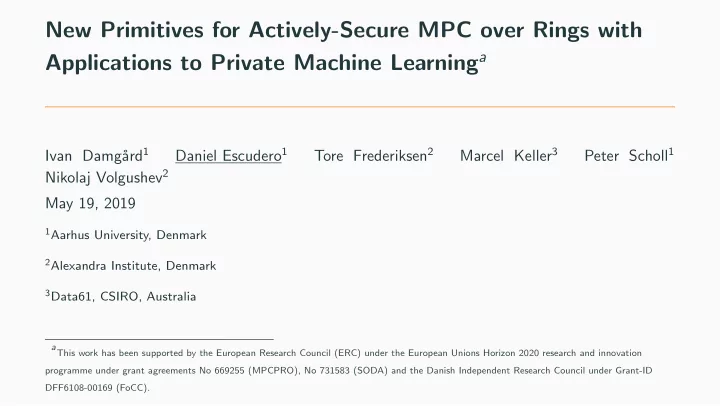
SLIDE 1 New Primitives for Actively-Secure MPC over Rings with Applications to Private Machine Learninga
Ivan Damg˚ ard1 Daniel Escudero1 Tore Frederiksen2 Marcel Keller3 Peter Scholl1 Nikolaj Volgushev2 May 19, 2019
1Aarhus University, Denmark 2Alexandra Institute, Denmark 3Data61, CSIRO, Australia aThis work has been supported by the European Research Council (ERC) under the European Unions Horizon 2020 research and innovation programme under grant agreements No 669255 (MPCPRO), No 731583 (SODA) and the Danish Independent Research Council under Grant-ID DFF6108-00169 (FoCC).
SLIDE 2
Introduction
SLIDE 3
MPC
Trusted Party Alice Bob Charlie Dave
1
SLIDE 4
MPC
Trusted Party Alice Bob Charlie Dave x1 x2 x3 x4
1
SLIDE 5
MPC
Trusted Party Alice Bob Charlie Dave x1 x2 x3 x4 z z z z
1
SLIDE 6
MPC
Trusted Party Alice Bob Charlie Dave
1
SLIDE 7 Many different approaches to MPC
Circuits over F2
- Garbled Circuits
- BMR
- GMW
- · · ·
Circuits over Fp
- BGW
- BeDOZa
- SPDZ
- MASCOT
- · · ·
Circuits over Z2k (dishonest majority and active security)
- SPDZ2k, Cramer et al. CRYPTO’18.
2
SLIDE 8
Benefits of Z2k
(Already conjectured in SPDZ2k)
3
SLIDE 9 Benefits of Z2k
(Already conjectured in SPDZ2k)
- Computation modulo 264 or 232 can be done natively in hardware.
3
SLIDE 10 Benefits of Z2k
(Already conjectured in SPDZ2k)
- Computation modulo 264 or 232 can be done natively in hardware.
- Easier compilation of pre-existing programs to MPC programs.
3
SLIDE 11 Benefits of Z2k
(Already conjectured in SPDZ2k)
- Computation modulo 264 or 232 can be done natively in hardware.
- Easier compilation of pre-existing programs to MPC programs.
- Computation modulo powers of 2 should be “more compatible” with computation
modulo 2.
3
SLIDE 12 Our Contribution
New sub-protocols for SPDZ2k We expand SPDZ2k with a series of sub-protocols to enhance the potential range
- f applications.
- Arithmetic-Binary share conversions
- Random-bit generation
- Bit-decomposition
- Secure truncation, comparison and equality check.
4
SLIDE 13 SPDZ2k implementation We implement the SPDZ2k protocol in Java, as part of the FRamework for Effi- cient Secure COmputation (FRESCO).
- Our implementation contains several optimizations that can be of
independent interest.
- In the microbenchmarks we observe several improvements with respect to
- ther protocols over fields.
5
SLIDE 14 Applications to Secure Machine Learning We illustrate the benefits of our techniques by performing certain ML tasks in SPDZ2k and observe several improvements with respect to other protocols over
- fields. We consider:
- Secure evaluation of Decision Trees
- Secure evaluation of Support Vector Machines
6
SLIDE 15
SPDZ2k
SLIDE 16 SPDZ2k in a nutshell
Additive Authenticated Secret-Sharing over Z2k x ∈ Z2k is shared, denoted by [x]2k, if
- Each Pi has xi, αi, mi ∈ Z2k+s
- xi ≡k+s x′ with x′ ≡k x
- αi ≡k+s α, where α ∈ Z2s is a random global key
- mi ≡k+s α · x′.
x ≡ y mod 2ℓ is abbreviated by x ≡ℓ y
7
SLIDE 17 Secure computation with preprocessing
Input phase [xi]2k = (xi − ri)
+[ri]2k where xi are the inputs and (ri, [ri]2k) is preprocessed. Addition gates [x + y]2k = [x]2k + [y]2k Multiplication gates [x · y]2k = [c]2k + (x − a)
·[b]2k + (y − b)
·[a]2k + (x − a)
(y − b)
where ([a]2k, [b]2k, [c]2k) is preprocessed with c = a · b.
8
SLIDE 18
Primitives for MPC Modulo 2k
SLIDE 19
Z2 Triple [·]2k → [·]2 [·]2 → [·]2k Random Bit Z2k Triple · → [·]2 TinyOT Triple TruncP BitDec EQZ MSB, LTZ BitLT Carry SVM Decision Trees 9
SLIDE 20
Z2 Triple [·]2k → [·]2 [·]2 → [·]2k Random Bit Z2k Triple · → [·]2 TinyOT Triple TruncP BitDec EQZ MSB, LTZ BitLT Carry SVM Decision Trees 10
SLIDE 21 Generating Random Bits [b]2k (Intuition)
Ideal Protocol
- 1. Sample [r]2k at random and let [a]2k = [r2]2k.
- 2. Open a. Let c be some square root of a.
- 3. Compute [d]2k = c−1[r]2k.
- Now d is a random square root of 1, so d ∈R {−1, +1}.
- 4. Output [b]2k, where b = (d + 1)/2.
11
SLIDE 22 Generating Random Bits [b]2k (Intuition)
Ideal Protocol
- 1. Sample [r]2k at random and let [a]2k = [r2]2k.
- 2. Open a. Let c be some square root of a.
- 3. Compute [d]2k = c−1[r]2k.
- Now d is a random square root of 1, so d ∈R {−1, +1}.
- 4. Output [b]2k, where b = (d + 1)/2.
11
SLIDE 23 Generating Random Bits [b]2k (Intuition)
Actual Protocol
- 1. Sample [r]2k+2 at random, where r is odd, and let [a]2k+2 = [r2]2k+2.
- 2. Open a. Let c be some square root of a.
- 3. Compute [d]2k+2 = c−1[r]2k+2
- Now d is a random square root of 1 mod 2k+2, so
d ∈R {−1, +1, −1 + 2k+1, +1 + 2k+1}.
- 4. Output [b]2k, where b ≡k (d + 1)/2.
12
SLIDE 24 Share Conversions
[b]2k → [b]2 Local reduction modulo 2.a
aIn fact, it is reduction modulo 2s+1 for the extra s “MAC” bits.
[b]2 → [b]2k
- 1. Sample a random bit [r]2k (r ∈ Z2)
- 2. Convert [r]2k to [r]2.
- 3. Open [c] = [b]2 ⊕ [r]2
- 4. Output [b]2k = [r]2k + [c]2k − 2[r]2k[c]2k
13
SLIDE 25 Bit Decomposition: [x]2k → ([x0]2k, . . . , [xk−1]2k)
- 1. Sample random bits [r0]2k, . . . , [rk−1]2k and let [r]2k = k−1
i=0 2i[ri]2k.
- 2. Compute [a]2k = [x]2k − [r]2k and open a.
- 3. Convert ([r0]2k, . . . , [rk−1]2k) to ([r0]2, . . . , [rk−1]2).
- 4. Compute the binary circuit
([x0]2, . . . , [xk−1]2) = ADD ((a0, . . . , ak−1), ([r0]2, . . . , [rk−1]2)) .
- 5. Convert the result ([x0]2, . . . , [xk−1]2) to ([x0]2k, . . . , [xk−1]2k).
14
SLIDE 26
Implementation and Benchmarks
SLIDE 27 Online Phase - Micro Operations
Throughput in elements per second for the online phase of micro operations over 1 Gbps network. The factor columns express the runtime improvement factor of SPDZ2k
k = 32 k = 64 SPDZ2k (σ = 26) SPDZ (σ = 26) Factor SPDZ2k (σ = 57) SPDZ (σ = 57) Factor Multiplication 687041 141346 4.9x 522258 114071 4.6x Equality 15334 3213 4.8x 6902 1282 5.4x Comparison 9153 1769 5.2x 4514 756 6.0x
15
SLIDE 28 Online Phase for SVMs Evaluation
Online phase benchmarking of SVM evaluation over 1 Gbps network. The factor columns express the runtime improvement factor of SPDZ2k over SPDZ in FRESCO. Times are in milliseconds per sample.
k = 32, σ = 26 k = 64, σ = 57 Dataset
Batch Size SPDZ2k SPDZ Factor SPDZ2k SPDZ Factor CIFAR 10, 2048 1 82 ms 214 ms 2.6x 99 ms 255 ms 2.6x MIT 67, 2048 1 379 ms 1318 ms 3.5x 499 ms 1582 ms 3.2x ALOI 463, 128 1 242 ms 857 ms 3.5x 362 ms 1312 ms 3.6x CIFAR 10, 2048 5 39 ms 168 ms 4.3x 57 ms 209 ms 3.7x MIT 67, 2048 5 225 ms 1101 ms 4.9x 294 ms 1428 ms 4.9x ALOI 463, 128 5 162 ms 741 ms 4.6x 244 ms 1220 ms 5.0x
16
SLIDE 29 Online Phase for Decision Trees Evaluation
Online phase benchmarking of evaluation of decision trees over 1 Gbps network. The factor columns express the runtime improvement factor of SPDZ2k over SPDZ in
- FRESCO. Times are in milliseconds per sample.
k = 32, σ = 26 k = 64, σ = 57 Dataset Depth, Num. Features Batch Size SPDZ2k SPDZ Factor SPDZ2k SPDZ Factor Hill Valley 3, 100 1 21 ms 24 ms 1.2x 26 ms 34 ms 1.3x Spambase 6, 57 1 48 ms 104 ms 2.2x 56 ms 128 ms 2.3x Diabetes 9, 8 1 80 ms 215 ms 2.7x 122 ms 443 ms 3.6x Hill Valley 3, 100 5 6 ms 10 ms 1.7x 7 ms 15 ms 2.1x Spambase 6, 57 5 14 ms 40 ms 2.9x 17 ms 68 ms 4.0x Diabetes 9, 8 5 41 ms 185 ms 4.5x 78 ms 376 ms 4.8x
17
SLIDE 30
Triple Generation Throughput
500 1000 1500 SPDZ2k (k = 32, σ= 26) SPDZ2k (k = 64, σ = 57) Mascot (128 bit field) Overdrive (k = 64 (128 bit field), σ = 57) Overdrive (k = 32 (64 bit field), σ = 40) 1 2 3 4 Number of threads 500 1000 1500 2000 2500 3000 3500 Throughput [per second]
(a) WAN (50 Mbps, 100 ms latency)
1 2 3 4 Number of threads 5000 10000 15000 20000 25000 30000 35000 Throughput [per second]
(b) LAN (1 Gbps, 0.1 ms latency)
1 2 3 4 Number of threads 5000 10000 15000 20000 25000 30000 35000 Throughput [per second]
(c) LAN (10 Gbps, 0.1 ms latency)
18
SLIDE 31 Conclusions
- We implemented the SPDZ2k protocol along with practical primitives for MPC
mod 2k.
- We saw up to a 5-fold improvement in computation for various tasks, and up to a
85-fold reduction in online communication costs for secure comparison, as compared to the field setting. Future Work
- Close the gap for the preprocessing.
- Expand the range of applications for computation modulo 2k.
19
SLIDE 32
Thank you!
19