Newcastle Neuro-oncology Team Audit of Outcome of Glioblastoma - - PowerPoint PPT Presentation

newcastle neuro oncology team audit of
SMART_READER_LITE
LIVE PREVIEW

Newcastle Neuro-oncology Team Audit of Outcome of Glioblastoma - - PowerPoint PPT Presentation

Newcastle Neuro-oncology Team Audit of Outcome of Glioblastoma Multiforme Chemoradiotherapy Treatment Jennifer Wright Neurosurgery SSC Audit Team Jennifer Wright, Rachel Tresman, Cyril Dubois, Surash Surash, Joanne Lewis The Stupp Trial -


slide-1
SLIDE 1

Jennifer Wright Neurosurgery SSC Audit Team Jennifer Wright, Rachel Tresman, Cyril Dubois, Surash Surash, Joanne Lewis
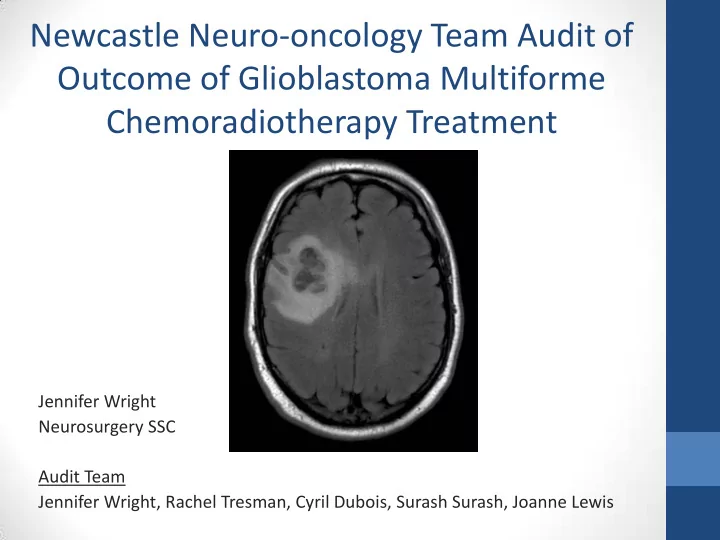
Newcastle Neuro-oncology Team Audit of Outcome of Glioblastoma Multiforme Chemoradiotherapy Treatment

slide-2
SLIDE 2

The Stupp Trial - 2005

  • Phase III EORTC clinical trial of 573 patients from 85 centres
  • Compared radiotherapy alone with radiotherapy PLUS

concurrent and adjuvant temozolomide

  • 287 randomised to temozolomide
  • Concurrent phase: 75mg/m2 delivered daily during the 6 weeks of

standard dose radiotherapy

  • Adjuvant phase: a further 6 cycles of temozolomide – 150-200mg/m2

alone (5 days during each 28 day cycle)

slide-3
SLIDE 3

Statistically significant survival benefit with temozolomide

Radiotherapy

  • nly

Radiotherapy + temozolomide Mean survival 12.1 months 14.6 months 2 year survival 10.4% 26.5%

The Stupp Trial - Results

slide-4
SLIDE 4

Newcastle Audit Aims

  • To determine whether Stupp results were reproducible in

GBM patients treated at RVI and Northern Centre for Cancer Care (NCCC)

  • Further subset analysis – prognosis of debulking vs

biopsy

  • Many prognostic factors – extent of surgery is one
  • Literature suggests a prognostic benefit to removing >98% of the

tumour bulk

slide-5
SLIDE 5

Cohort

  • Data collected from patients diagnosed from December 2009

to December 2013

  • All patients with GBM (grade 4) confirmed by histology aged

18 and over were included

  • Exclusions:
  • Avastin trial
  • Patients who weren’t treatment naive
  • Patients who did not commence Stupp protocol
  • Usually due to early/aggressive progression
  • N=67
  • Age range 19-70 years, median age 54.85 years
slide-6
SLIDE 6

Results

  • Stupp vs. Newcastle
  • Biopsy vs. Debulking
  • Not statistically significant due to small number of

patients in biopsy group (p=0.881)

Biopsy (n=11) Debulking (n=56) Median age at diagnosis 54.5 years 55.2 years Median survival 14.7 months 18.7 months Stupp RVI Median age at diagnosis 56 years 54.85 years Median OS 14.6 months 16.7 months 2 year survival 26.2% ?

slide-7
SLIDE 7

Kaplan-Meier curve

Survival in months Cumulative survival Biopsy Debulk

slide-8
SLIDE 8

Adjuvant chemotherapy

  • RVI: 65.7% patients treated at the NCCC completed the 6

cycles of adjuvant temozolomide

  • Stupp trial: 47% completed 6 cycles of adjuvant temozomolide
  • RVI: 4.5% (3/67) did not complete concurrent temozolomide -

all received 0 cycles of adjuvant chemotherapy

  • Stupp trial: 13% did not complete concurrent temozolomide

Number of cycles completed Number of patients (n=67) 8 1 2 2 3 3 4 4 2 5 4 6 44

slide-9
SLIDE 9

Reasons for non-completion

Reason RVI Number of patients (n=23) and (%) Progression 12 (52.2%) Myelosuppression 4 (17.4%) Pseudoprogression 3 (13%) Isolated thrombocytopaenia 1 (4.3%) Depression 1 (4.3%) Infection 1 (4.3%) ‘not coping’ 1 (4.3%)

  • RVI: 52.2% of patients failing to complete 6 cycles did so due

to progression, 26% due to toxicities

  • Stupp trial: 39% due to progression, 8% due to toxicities, 4%

‘patient decision’

slide-10
SLIDE 10

Conclusions

  • Stupp protocol considered standard since 2005
  • Newcastle cohort overall survival 16.7 months
  • Remains unclear whether extent of surgery impacts on

prognosis significantly

  • Our results not statistically significant: literature review of post-

Stupp data reveals similar findings elsewhere

  • 65.7% patients completed 6 cycles adjuvant TMZ
  • Main reasons for non completion are progression (52.2%) and

toxicity (26%)

slide-11
SLIDE 11

Questions? Thank you for listening! Jennifer Wright Neurosurgery SSC

slide-12
SLIDE 12

References

  • Krex, D.; Klink, B.; Hartmann, C.; Von Deimling, A.; Pietsch, T.; Simon, M.;

Sabel, M.; Steinbach, J. P. et al. (2007). "Long-term survival with glioblastoma multiforme". Brain 130 (10): 2596–606.

  • R Endersby and S J Baker.(2008) “PTEN signaling in brain:

neuropathology and tumorigenesis”. Oncogene 27, 5416–5430

  • Lacroix, Michel; Abi-Said, Dima; Fourney, Daryl R.; Gokaslan, Ziya L.; Shi,

Weiming; Demonte, Franco; Lang, Frederick F.; McCutcheon, Ian E. et al. (2001). "A multivariate analysis of 416 patients with glioblastoma multiforme: Prognosis, extent of resection, and survival". Journal of Neurosurgery 95 (2): 190–8

  • Walker, Michael D.; Alexander, Eben; Hunt, William E.; MacCarty, Collin

S.; Mahaley, M. Stephen; Mealey, John; Norrell, Horace A.; Owens, Guy et al. (1978). "Evaluation of BCNU and/or radiotherapy in the treatment

  • f anaplastic gliomas". Journal of Neurosurgery 49 (3): 333–43
  • Stupp, Roger; Mason, Warren P.; Van Den Bent, Martin J.; Weller,

Michael; Fisher, Barbara; Taphoorn, Martin J.B.; Belanger, Karl; Brandes, Alba A. et al. (2005). "Radiotherapy plus Concomitant and Adjuvant Temozolomide for Glioblastoma". New England Journal of Medicine352 (10): 987–96.