Newtonian Telescope Design for Stand-off Laser Induced Breakdown - PowerPoint PPT Presentation
Newtonian Telescope Design for Stand-off Laser Induced Breakdown Spectroscopy Mechatronics project presentation What is LIBS? LIBS stands for Laser Induced Breakdown Spectroscopy LIBS focuses a laser onto a sample which results in
Newtonian Telescope Design for Stand-off Laser Induced Breakdown Spectroscopy Mechatronics project presentation
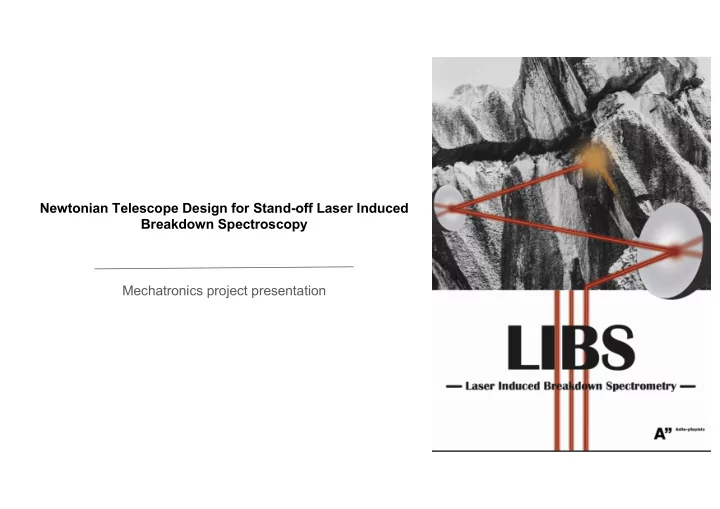
What is LIBS? ● LIBS stands for Laser Induced Breakdown Spectroscopy ● LIBS focuses a laser onto a sample which results in ablation (plasma forming) ● Light is gathered from the plasma and analyzed ● Stand-off LIBS means that the range to the sample varies. ● Most common applications: ○ Detecting explosive materials from a distance (Military) ○ Testing element compositions of samples in Mars Rover (Research) ○ Mapping out elements in mine walls in mining operations (Commercial)
What is LIBS?
Research goals and initial prototype ● The goal was to improve the initial prototype: ○ To gather enough light for a high quality spectroscopy analyze. ○ The device should function properly in the range of 3 - 10 meters. ○ The wavelength gathered for the spectrometer should include the ranges of 200 - 950 nm. ○ The laser beam focused onto the sample should be on the same optical axis as the light gathering optical components, to prevent complexity of the light path. ○ Minimizing the area of the components on the breadboard. ○ Enlarging the lenses for the laser beam to enable less power from the laser.
Our solution ● Modified Newtonian telescope that uses primary concave mirror and 45 degree secondary mirror to collect the light. ● Laser is steered to the same optical axis in front of the telescope ● The stepper motors that focus the laser and the fibre optic are outside the telescope and the optical axis
Prototyping ● 3D-printing as main manufacturing method ○ + Allows very free design ○ + Relatively fast, cheap and easy ○ - Poor tolerances compared to machining ● Laser cutting for specific parts ○ + Good tolerances ○ + Strong and stiff ○ + Very fast ○ - Only flat geometry
Quantel Q-smart 450 Optical components pulsed Nd:YAG laser system 0.5” negative lens For the laser path 2” gold plated 45 degree mirror for the laser path
Tests ● The expanding and focusing lenses functionalities were tested with a laser pointer. ● The best focus was tested by moving the expanding lens, as well as the target sample.
Results Main findings: - Newtonian telescope is the optimal setup for this 3D printed components for the modified Newtonian telescope application - Setup can be built using 3D printed parts - the light gathering area of the primary mirror is 5.9x the original prototypes Usable mirror area in blue
Thank you Questions?
Recommend
More recommend
Explore More Topics
Stay informed with curated content and fresh updates.