NIA CFD Futures Conference Hampton, VA; August 2012 2 10 1 10 4 - - PowerPoint PPT Presentation

nia cfd futures conference
SMART_READER_LITE
LIVE PREVIEW

NIA CFD Futures Conference Hampton, VA; August 2012 2 10 1 10 4 - - PowerPoint PPT Presentation

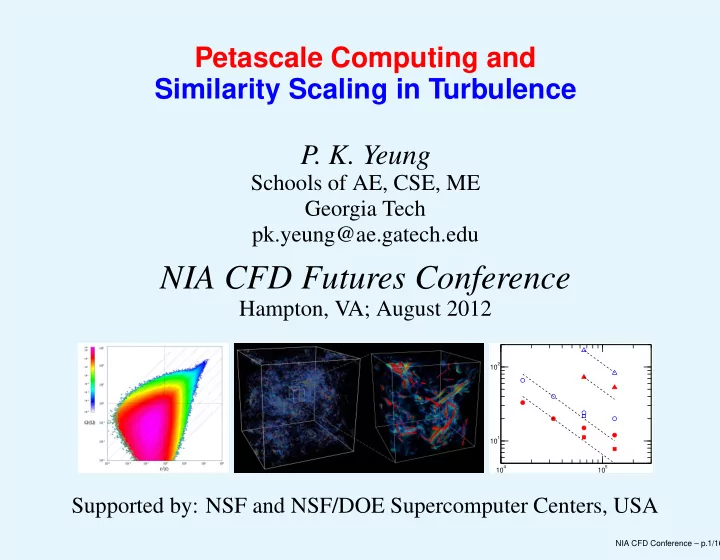
Petascale Computing and Similarity Scaling in Turbulence P. K. Yeung Schools of AE, CSE, ME Georgia Tech pk.yeung@ae.gatech.edu NIA CFD Futures Conference Hampton, VA; August 2012 2 10 1 10 4 5 10 10 Supported by: NSF and NSF/DOE


slide-1
SLIDE 1

Petascale Computing and Similarity Scaling in Turbulence

  • P. K. Yeung

Schools of AE, CSE, ME Georgia Tech pk.yeung@ae.gatech.edu

NIA CFD Futures Conference

Hampton, VA; August 2012

10

4

10

5

10

1

10

2

Supported by: NSF and NSF/DOE Supercomputer Centers, USA

NIA CFD Conference – p.1/16

slide-2
SLIDE 2

Petascale and Beyond: Some Remarks

The “supercomputer arms race”: Earth Simulator (Japan) was No. 1 in 2002 at 40 Teraflops. In 2011: the same speed did not make it into top 500. Massive parallelism has been dominant trend but, because of communication and memory cache issues, most actual user codes at only a few percent of theoretical peak multi-cored processors for on-node shared memory Path to Exascale may require new modes of programming Tremendous demand for resources: both CPU hours and storage Advanced Cyberinfrastructure having a transformative impact on research in turbulence and other fields of science and engineering

NIA CFD Conference – p.2/16

slide-3
SLIDE 3

Direct Numerical Simulations (DNS)

For science discovery: instantaneous flow fields (at all scales) via equations expressing fundamental conservation laws Navier-Stokes equations with constant density (∇·u=0):

∂u/∂t + u · ∇u = −∇(p/ρ) + ν∇2u + f

Fourier pseudo-spectral methods (for accuracy and efficiency) in our work: homogeneous turbulence (no boundaries) local isotropy: results relevant to high-Re turbulent flows Wide range of scales =

⇒ computationally intensive

Tremendous detail, surpassing most laboratory experiments fundamental understanding, “thought experiments” help advance modeling (both input and output)

NIA CFD Conference – p.3/16

slide-4
SLIDE 4

NSF: Petascale Turbulence Benchmark

(One of a few for acceptance testing of 11-PF Blue Waters)

“A 122883 simulation of fully developed homogeneous turbulence in a periodic domain for 1 eddy turnover time at a value of Rλ of O(2000).” “The model problem should be solved using a dealiased, pseudospectral algorithm, a fourth-order explicit Runge-Kutta time-stepping scheme, 64-bit floating point (or similar) arithmetic, and a time-step of 0.0001 eddy turnaround times.” “Full resolution snapshots of the three-dimensional vorticity, velocity and pressure fields should be saved to disk every 0.02 eddy turnaround

  • times. The target wall-clock time is 40 hours.”

(PRAC grant from NSF, working with BW Project Team)

NIA CFD Conference – p.4/16

slide-5
SLIDE 5

2D Domain Decomposition

Partition a cube along two directions, into “pencils” of data PENCIL Up to N2 cores for N3 grid MPI: 2-D processor grid, M1(rows) × M2(cols) 3D FFT from physical space to wavenumber space: (Starting with pencils in x) Transform in x Transpose to pencils in z Transform in z Transpose to pencils in y Transform in y Transposes by message-passing, collective communication

NIA CFD Conference – p.5/16

slide-6
SLIDE 6

Factors Affecting Performance

Much more than the number of operations... Domain decomposition: the “processor grid geometry” Load balancing: are all CPU cores equally busy? Software libraries, compiler optimizations Computation: cache size and memory bandwidth, per core Communication: bandwidth and latency, per MPI task Memory copies due to non-contiguous messages I/O: filesystem speed and capacity; control of traffic jams Environmental variables, network topology Practice: job turnaround, scheduler policies, and CPU-hour economics

NIA CFD Conference – p.6/16

slide-7
SLIDE 7

Current Petascale Implementations

Pure MPI: performance dominated by collective communication usually 85-90% strong scaling every doubling of core count Hybrid MPI + OpenMP (multithreaded) shared memory on node, distributed across nodes less communication overhead, may scale better than pure MPI at large problem size and large core count memory affinity issues (system-dependent) Co-Array Fortran (Partitioned Global Address Space language) remote-memory addressing in place of MPI communication key routines by Cray expert (R.A. Fiedler) on Blue Waters project, significantly faster on Cray XK6 (using 131072 cores)

NIA CFD Conference – p.7/16

slide-8
SLIDE 8

DNS Code: Parallel Performance

Largest tests on 2+ Petaflop Cray XK6 (Jaguarpf at ORNL)

40963 (circles) and 81923 (triangles), 4th-order RK

10

4

10

5

10

1

10

2

# cores # cores

  • CPU/step, MPI-OpenMP

CPU/step, MPI + CAF pure MPI, best processor grid, stride-1 arithmetic dealiasing: can skip some (high k) modes in Fourier space better scaling when scalars added (blue, more work/core)

NIA CFD Conference – p.8/16

slide-9
SLIDE 9

Future Optimization Strategies

Advanced MPI: one-sided communication let sending task write directly onto memory in receiving task Overlap between computation and communication not a new idea, but tricky to do, and little hardware support not too effective if there is not much to overlap Serialized-threads: let some OpenMP threads communicate, while others compute GPUs and accelerators: speed up computation and capable of v. large thread counts but need to copy data between GPU and CPU Or, shall we change the numerical method? (Consider the degree of need for communication)

NIA CFD Conference – p.9/16

slide-10
SLIDE 10

Turbulence: Uses of High-End HPC

A wider range of scales (in space and/or time) higher Reynolds number (always!) mixing high Schmidt number (Sc = ν/D): smaller scales very low Sc: small time steps (fast molecular diffusion) Improved accuracy at the small scales fine-scale intermittency, thin reaction zones Longer simulations for better sampling or temporal evolution amount of data is also a challenge More complex physics, coupled with other phenomena e.g. stratification, rotation, MHD More complex boundary conditions channel, boundary layer, mixing layer etc (still canonical)

NIA CFD Conference – p.10/16

slide-11
SLIDE 11

Extreme Events and Intermittency

Dissipation: ǫ = 2νsijsij (strain rates squared) Enstrophy: Ω = (ν)ωiωi (rotation rates squared) Same mean values in homogeneous turbulence, but moments and PDFs can be different Both represent small scales, but most data sources suggest enstrophy is more intermittent, contrary to expectation at high Reynolds no. (Nelkin 1999) Strong dissipation/straining can pull flame surfaces apart, while strong rotation leads to preferential particle concentration in multiphase flows Difficulties in resolution and sampling, — inherent nature of infrequent but extreme events

NIA CFD Conference – p.11/16

slide-12
SLIDE 12

3D Visualization

[TACC visualization staff] 20483, Rλ ≈ 650: intense enstrophy (red) has worm-like structure, while dissipation (blue) is more diffuse

NIA CFD Conference – p.12/16

slide-13
SLIDE 13

PDFs of Dissipation and Enstrophy

From Yeung et al. J. Fluid Mech. 2012 (Vol. 700; Focus on Fluids) Highest Re, and best-resolved at moderate Re (both 40963)

ǫ/ǫ, Ω/Ω ǫ Ω ǫ Ω Rλ 240 Rλ 1000

PDF High Re: most intense events in both found to scale similarly Higher-order moments also become closer

NIA CFD Conference – p.13/16

slide-14
SLIDE 14

JPDF of Dissipation and Enstrophy

Do intense ǫ and intense Ω tend to occur together?

Rλ 240 Rλ 1000 ǫ/ǫ ǫ/ǫ Ω/Ω

Yes, for most-intense fluctuations, at Rλ 1000 (and 650) (contours in first quadrant, logarithmic intervals)

NIA CFD Conference – p.14/16

slide-15
SLIDE 15

Database and Data Management

Three 40963 simulations have been performed, aimed at: Lagrangian statistics at highest Re feasible Improved resolution of smallest scales Higher Schmidt number for turbulent mixing (A fourth is planned, for mixing at very low Schmidt number) Several hundred Terabytes of data, mostly restart files that can be analyzed to answer various physical questions how best to keep/organize data, at national centers how best to share data with other researchers (and/or work with them to extract statistics they need) Cyber challenges: e.g. data management are non-trivial

NIA CFD Conference – p.15/16

slide-16
SLIDE 16

Concluding Remarks

Successful extreme-scale DNS will require:

Deep engagement with top HPC experts and vendors’ staff Communication, memory, and data; rather than raw speed Insights about the science: what will be most useful to compute, that cannot be obtained otherwise? Competition for hours, in high demand by other disciplines

Q.: Will we be ready for Exascale in 2018?

NIA CFD Conference – p.16/16