Nia Kurniawan S.Si., MP. D.Sc Biology Department Faculty of - - PowerPoint PPT Presentation

nia kurniawan s si mp d sc
SMART_READER_LITE
LIVE PREVIEW

Nia Kurniawan S.Si., MP. D.Sc Biology Department Faculty of - - PowerPoint PPT Presentation

FROGS FARMING IN RESPONDING TO THE INCREASING DEMAND OF FROZEN FROGLEGS FROM THE EUROPEAN UNION Nia Kurniawan S.Si., MP. D.Sc Biology Department Faculty of Mathematic and Natural Sciences Brawijaya University Presented at Webinar


slide-1
SLIDE 1

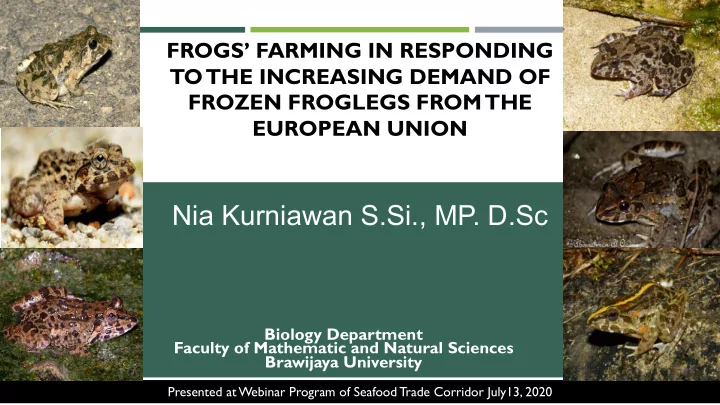
FROGS’ FARMING IN RESPONDING TO THE INCREASING DEMAND OF FROZEN FROGLEGS FROM THE EUROPEAN UNION

Presented at Webinar Program of Seafood Trade Corridor July13, 2020

Nia Kurniawan S.Si., MP. D.Sc

Biology Department Faculty of Mathematic and Natural Sciences Brawijaya University

slide-2
SLIDE 2

Background

Frog harvesting is now becoming amphibians threats factor beside destruction and habitat degradation, environmental contaminants, and infectious disease (Iskandar, 2018) In many countries in Asia, Africa, and Latin America frogs are collected for subsistence or local consumption (Altherr et al, 2011).

slide-3
SLIDE 3

BACKGROUND

In Southeast Asia, Fejervarya cancrivora and Limnoncectes macrodon are highly exploited frogs species for consumption purpose.

Frogs’s legs exports from Indonesia in 1969-2002 (Kusrini & Alford, 2006)

Indonesia is one of major exportir country

  • f frogs’ legs (Schmuck, 2000; Kusrini &

Alford, 2006).

slide-4
SLIDE 4

¡ Export Number of Froglegs in Indonesia (1999 –

2002): 3,831 ton (US$ 11.593 – 15.324 million)

¡ Comprises L. macrodon, F. limnocharis, F. cancrivora,

  • R. catesbiana – mostly belonged to F.

cancrivora, with destination of 36 juridictions

¡ Europe was the major importer of Indonesian

frogs’ legs (83.2% of the total exported)

Background

Destinations of exported frogs’ legs from Indonesia

slide-5
SLIDE 5

¡ F.cancrivora is medium frogs, a narrow head ¡ The sides of the head have small glandular

  • warts. Parts of the flanks have glandular folds

and the lower part has glandular warts.

¡ Almost-full webbed membrane on hind limbs ¡ Habitat in rice fields and mangrove forest ¡ Tolerant to high salinity

Natural History

Morphology Reproduction and behaviour

¡ Reproduction season in April-August ¡ Preference on rice fields irrigation channels as

reproduction spot

¡ 500-1000 produced eggs from mature female ¡ Hatched eggs will grow to be juvenile frogs in

45 days

¡ Noctural, prey insects and crabs which suitable

to its mouth

Mortality factors

¡ Mortality level when tadpoles stage in the farm is around 10%, on metamorphosis 35 % ¡ Low immune system of frogs on rice fields (effect of herbicide & pesticide), predators ¡ Highest level of eggs production is in rainy season
slide-6
SLIDE 6

Areas of Research

  • It means an exploitation of this species from the field

Mostly, F.cancrivora exported from Indonesia are catched from the wild

  • Artificial reproduction of F.cancrivora using mina padi system
  • Spreading young frogs in the rice fields

Thus, to fulfill the market demand while maintaining the population of this frog is important

slide-7
SLIDE 7

¡

A mode of ecological farming, is fundamental in realizing sustainable development in agriculture (Fang et al., 2019).

¡

Introducing frogs in the fields could reduce the populations of rice leaf rollers, stem borers, and planthoppers effectively due to frog predation, and could control rice sheath blight indirectly through reducing insects that transmit disease pathogens (Teng et al, 2015)

¡

Introducing frogs in the paddy fields not only showed a potential of pest and disease control but also improved soil fertility and rice growth (Teng et al, 2015)

Variation of tiller number of rice seedlings within the rice growing season.

Integrated rice-frog farming

slide-8
SLIDE 8

RESEARCH CONCEPT

Research concept

slide-9
SLIDE 9

FROGS METAMORPHOSIS

R.leptoglossa

slide-10
SLIDE 10

Hormone injecting Keep the frog inside dark room Sperm collection Insemination Incubation Giving food of hatchling frog

Frogs artificial reproduction methods

slide-11
SLIDE 11

TADPOLES RANCHING

Gosner stage 42 days Small aquarium Release subadult frogs

slide-12
SLIDE 12

Floor plan illustrating the installations to ranching frogs

Floor plan illustrating the installations of the greenhouses (tadpole greenhouse and fattening greenhouse)

  • f the commercial frog pond in Brazil
slide-13
SLIDE 13

ENVIRONMENT MONITORING

¡ T

  • prevent the possible poisonous effects of agro-chemicals
  • n frog growth, no any herbicides, pesticides, and chemical

fertilizers were applied within the rice growing seasons

¡ Measure of abiotic factor peridiodically.

slide-14
SLIDE 14

Challenging of frog farmings in Indonesia

slide-15
SLIDE 15

PROBLEMS

¡ Decreasing frogs population caused by exploitation as food ¡ Increasing demand market of frogs' legs ¡ The decline in amphibians leads to an increase in mosquito

population

¡ Lack of knowledge about integrated fish / frog rice farming

slide-16
SLIDE 16

MINA PADI SYSTEM/INTEGRATED FISH FARMING

¡ Mina paddy system is one method to increase the

production of agricultural crops by raising fish in the rice fields when growing season.

¡ The system can increase soil quality and reduce

pest diseases in rice plants

¡ In several parts of Indonesia, Mina paddy was used

by farmers community

MINA PADDY SYSTEM/ INTEGRATED FISH FARMING

slide-17
SLIDE 17

Modifications integrated rice-frog farming model in Indonesia

Irrigation channels Fish net Paddy fields Rice fields dikes Space for ranching frogs

slide-18
SLIDE 18

IMPORTANT THINGS FACTOR OF FROGS FARMING

¡ Artificial Feeding. Feeding is the critical process in culturing frogs successfully. Poorly fed

frogs are susceptible to disease and frequently resort to cannibalism

¡ Pond Design. Ponds should be deep enough to protect the adult frogs and tadpoles from

extremely hot or cold temperatures

¡ Water Quality and Quantity. An abundant supply of high quality water must be readily

available to the frogs throughout the growing season

¡ Diseases The most common disease of frogs, red-leg disease, is due to a bacterial infection

(Aeromonas), often resulting from overcrowded conditions

(Helfrich et al., 2009)

slide-19
SLIDE 19

FUTURE PERSPECTIVE OF FROGS FARMINGS IN INDONESIA

¡ Paddy fields in Indonesia are 8,087,393 ha

(BPS, 2020). Its potential for the development

  • f sustainable agricultural models

¡ Frog breeding is a relatively recent alternative

for an agro industrial

¡ Reduced harvest from the wild ¡ New conservation strategy on highly

exploited frogs

¡ Increase the frog population that plays an

important role to against rice plant pests

¡ Increase income of farmers community

slide-20
SLIDE 20

Thank Y

  • u