
SLIDE 1
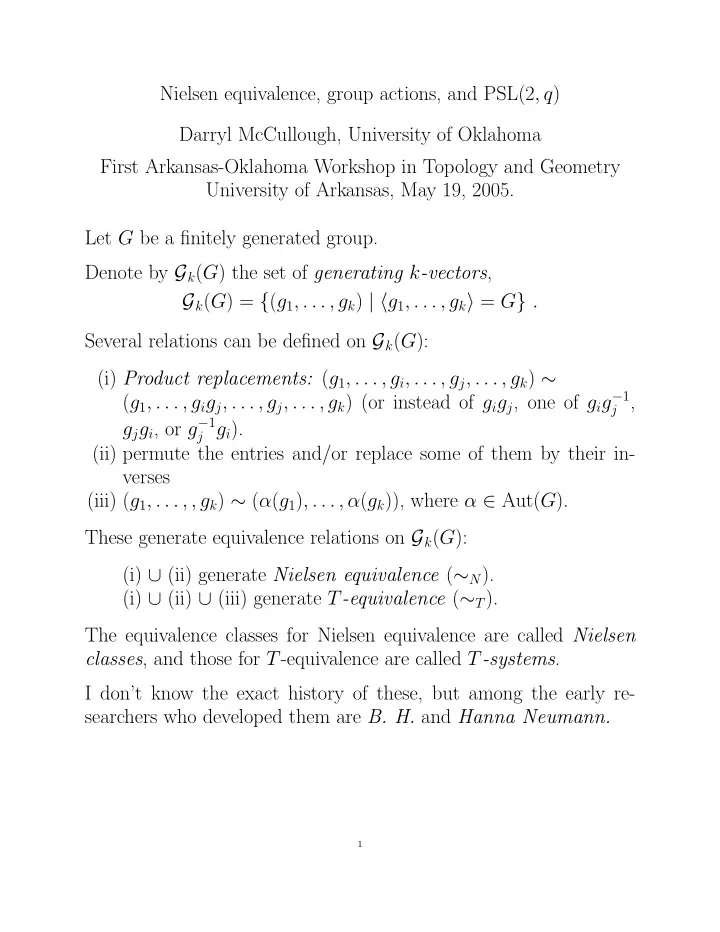
Nielsen equivalence, group actions, and PSL(2, q) Darryl McCullough, University of Oklahoma First Arkansas-Oklahoma Workshop in Topology and Geometry University of Arkansas, May 19, 2005. Let G be a finitely generated group. Denote by Gk(G) the set of generating k-vectors, Gk(G) = {(g1, . . . , gk) | g1, . . . , gk = G} . Several relations can be defined on Gk(G): (i) Product replacements: (g1, . . . , gi, . . . , gj, . . . , gk) ∼ (g1, . . . , gigj, . . . , gj, . . . , gk) (or instead of gigj, one of gig−1
j ,
gjgi, or g−1
j gi).
(ii) permute the entries and/or replace some of them by their in- verses (iii) (g1, . . . , , gk) ∼ (α(g1), . . . , α(gk)), where α ∈ Aut(G). These generate equivalence relations on Gk(G): (i) ∪ (ii) generate Nielsen equivalence (∼N). (i) ∪ (ii) ∪ (iii) generate T-equivalence (∼T). The equivalence classes for Nielsen equivalence are called Nielsen classes, and those for T-equivalence are called T-systems. I don’t know the exact history of these, but among the early re- searchers who developed them are B. H. and Hanna Neumann.
1