No Discha charge Z Zone D Designa nation: n: Raritan Bay, Sandy - - PowerPoint PPT Presentation

no discha charge z zone d designa nation n raritan bay
SMART_READER_LITE
LIVE PREVIEW

No Discha charge Z Zone D Designa nation: n: Raritan Bay, Sandy - - PowerPoint PPT Presentation

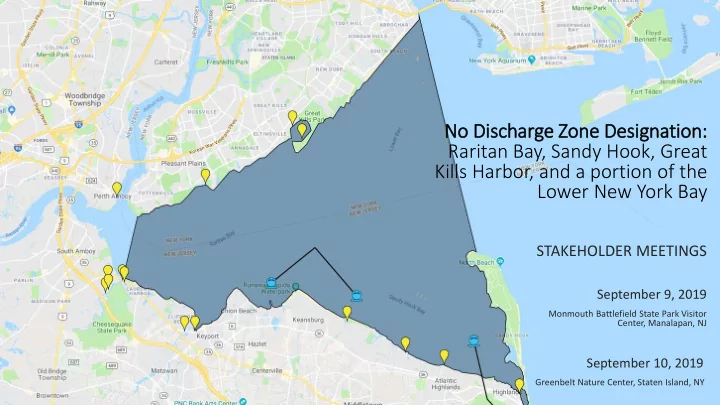
No Discha charge Z Zone D Designa nation: n: Raritan Bay, Sandy Hook, Great Kills Harbor, and a portion of the Lower New York Bay STAKEHOLDER MEETINGS September 9, 2019 Monmouth Battlefield State Park Visitor Center, Manalapan, NJ


slide-1
SLIDE 1

No Discha charge Z Zone D Designa nation: n: Raritan Bay, Sandy Hook, Great Kills Harbor, and a portion of the Lower New York Bay

STAKEHOLDER MEETINGS

September 9, 2019

Monmouth Battlefield State Park Visitor Center, Manalapan, NJ

September 10, 2019

Greenbelt Nature Center, Staten Island, NY

slide-2
SLIDE 2
slide-3
SLIDE 3

Ne New Y Yor

  • rk-New

ew J Jersey ey Harbor & E & Estuary P Program

The New York – New Jersey Harbor & Estuary Program (HEP) is one of the Nation’s 28 Estuaries of National Significance. HEP was created by the U.S. Environmental Protection Agency (EPA) at the request of the governors of New York and New Jersey in 1988 under the Clean Water Act as an

  • ngoing effort to develop and implement a consensus

driven plan to protect, conserve and restore the Estuary. The Harbor Estuary is the biggest public resource in the nation's largest and most densely developed metropolitan area. Managing this public resource and its many services and uses is the shared responsibility of many partners that work together to implement the Action Agenda that advances progress towards five (5) long-term goals.

slide-4
SLIDE 4

Microbial pathogens from sewage wastes pose direct threats to human health and limit shellfishing and recreational uses. While wastes discharged by vessels to surface water are often treated by marine sanitation devices, they still pose some risk and contain chemical additives, such as chlorine. No Discharge Zone (NDZ) designations are a key component of larger strategies for protecting navigable waters and educating the public about water

  • quality. HEP will work with the two

states, EPA and other partners to advance establishment of a no discharge zone in the Bay.

WQ-A-3: NO DISCHARGE ZONES

Help establish a No Discharge Zone for vessel waste in Raritan Bay.

Reference: NY/NJ Harbor & Estuary Program 2017-2022 Action Agenda

slide-5
SLIDE 5

Stakeholder Engagement Meetings

Goal

  • To seek input from stakeholders and gain

more information on the possible effects of the designation on the communities surrounding the Raritan Bay and others who use the bay for business and recreation.

  • No Discharge Zone Presentation (~45

minutes)

  • Open Discussion (~60 minutes)
  • Closing Remarks (~15 minutes)

Agenda Please note, the decision to pursue an NDZ designation will not be made today; rather, we are seeking an exchange of views and information to help inform the eventual decision.

slide-6
SLIDE 6

Clean Water Act (CWA), Section 312:

No Discharge Zone (NDZ)

  • An NDZ is a designated body of water within which the discharge of

both treated and untreated boat sewage is prohibited.

  • Boaters must dispose of their sewage at specially designated pump-
  • ut stations or via a mobile pumpout.
  • Federal Law prohibits the discharge of untreated boat sewage within

all navigable waters of the U.S., which include territorial seas within three (3) miles offshore.

slide-7
SLIDE 7

Clean Water Act (CWA), Section 312:

No Discharge Zone (NDZ)

Why?

  • Discharges of sewage from boats can contain harmful levels of

pathogens, nutrients, and chemicals (e.g., formaldehyde, phenols, and chlorine).

  • Negative impacts on water quality pose a risk to public health and

impair marine life.

slide-8
SLIDE 8

Clean Water Act (CWA), Section 312:

No Discharge Zone (NDZ)

A State can seek to establish an NDZ for any of the following three (3)

  • bjectives:
  • 1. Section 312 (f)(3): Protecting aquatic habitats where pumpout

facilities are available – most common;

  • 2. Section 312 (f)(4)(A): Protecting special aquatic habitats or species;

and

  • 3. Section 312 (f)(4)(B): Protecting drinking water intake zones to

protect human health.

slide-9
SLIDE 9

Clean Water Act (CWA), Section 312(f): No Discharge Zone (NDZ)

  • The State determines that the

protection and enhancement

  • f the quality of the water

requires greater environmental protection than current Federal regulations; and

  • EPA determines that adequate

facilities for the safe and sanitary removal, and treatment of sewage from all vessels are reasonably available.

slide-10
SLIDE 10

Clean Water Act (CWA), Section 312(f):

No Discharge Zone (NDZ)

  • State must submit to EPA a petition to have the waterbody of concern

designated as a NDZ.

  • In the case of the Raritan Bay, both New Jersey and New York state would

need to initiate the process.

  • EPA reviews the petition submitted by the State.
  • Public Notice of NDZ in Federal Register:
  • Tentative decision
  • Public Comment period
  • Final Decision
  • EPA issues a finding that adequate pumpout facilities for such waters

are reasonably available.

slide-11
SLIDE 11

Water Quality:

Reduce the sources of pollution so that the waters of the Harbor Estuary will meet the fishable/swimmable goal of the Clean Water Act, where attainable.

  • HEP’s 2015 Raritan Bay Conference focused attention on the

need to continue water quality improvements to the Bay, and benefits of sustaining and expanding its beneficial uses.

  • Current and potential uses to benefit from improved water

quality:

  • Fishing: Recreational and Commerical
  • Shellfishing: Commercial
  • Secondary Contact Recreation (e.g., motor boating, sailing,

kayaking, and associated use of marinas)

  • Boating: Commercial
  • Primary Contact Recreation (e.g., swimming)
  • Aesthetic/Scenic (including prime real estate value)
  • Tourism
  • Education
slide-12
SLIDE 12

Indicators at a Glance

Reference: NY/NJ Harbor & Estuary Program State of the Estuary Report 2018

slide-13
SLIDE 13

Water Quality

Reference: NY/NJ Harbor & Estuary Program State of the Estuary Report 2018

  • Water quality improvement is the Harbor

Estuary’s biggest success story!

  • Dissolved oxygen levels in the water, critical for

fish survival, are increasing.

  • Pathogenic contamination has also decreased
  • ver the long-term, but bacterial contamination

emanating from combined sewage overflow (CSO) and stormwater is sporadically high in many places and regularly high in a few parts of the Harbor Estuary, which restricts swimming and the desirability of other on-water recreation.

  • There is less garbage floating in the water and

along the shoreline than there was 20 years ago.

  • Average annual nitrogen concentrations in all the

specific waterways are trending down significantly in both the long and short term analysis.

  • Coming Soon: Harbor-wide Water Quality

Monitoring Report for the Harbor Estuary to be published in 2020
slide-14
SLIDE 14

Water Quality:

Combined Sewer System Improvements in New York

  • No NYC CSOs discharge directly to Raritan Bay, some CSO outfalls to Lower

NY Bay adjacent to the proposed NDZ (Tier 3 Outfall @ Owls Head)

  • NYC efforts to control CSOs date back to 1972
  • 1992 - NYSDEC-NYCDEP Consent Order to control CSO discharges, major

updates to Order in 2005, 2012, 2015

  • NYC DEP commitments: $4.1B for ongoing CSO Grey/Green Infrastructure,

$4.4B for Long Term Control Plan (LTCP) projects through 2050

  • CSO control projects combine hydraulic relief, storage, and disinfection
  • Lower NY Bay CSOs will be covered by the "Open Waters" LTCP due March

2020

slide-15
SLIDE 15

Current NYS Waters with Approved NDZs

  • Lake Champlain (1976)
  • Lake George (1976)
  • Hudson River, water intake zones

(1995)

  • Mamaroneck Harbor (1997)
  • Peconic Waters, East Hampton (1999)
  • Huntington-Northport Bay Complex

(2000)

  • Port Jefferson Complex (2001)
  • Peconic Estuary (2002)
  • Hudson River Estuary (2003)
  • Hempstead Harbor (2008)
  • Oyster Bay/Cold Spring Harbor (2008)
  • South Shore Estuary Reserve (2009)
  • New York State Canal System (2010)
  • Long Island Sound (2011)
  • Jamaica Bay (2011)
  • Lake Ontario (2011)
  • Lake Erie (2014)
  • Seneca/Cayuga Lakes (2015)
slide-16
SLIDE 16

Water Quality:

Combined Sewer System Improvements in New Jersey

  • No Combined Sewer Outfalls within the proposed No Discharge Zone
  • 98% of the CSO outfalls have solids and floatable controls such

as netting

  • Removes over 600 tons of material / year
  • Eliminated 64 CSO outfalls
  • 25 Individual CSO water discharge permits were issued on March 12,

2015, effective July 1, 2015.

  • An ambitious schedule with cascading permit requirements.

Integrated, incremental improvements in water quality

  • Updated mapping with CSO coordinates
  • Enhanced operation and maintenance
  • Asset Management
  • Development and implementation of Long Term Control Plan
  • Long Term Control Plan (LTCP) is due June 1, 2020.
  • Based on ambient data there has been significant improvement
  • f water quality in Raritan Bay and Sandy Hook Bay
slide-17
SLIDE 17

CSO Interactive Map https://www.nj.gov/dep/dwq/cso.htm

slide-18
SLIDE 18

Current NJ Waters with Approved NDZs

  • Manasquan River (1998)
  • Shark River (1998)
  • Navesink River (1999)
  • Shrewsbury River (2000)
  • Barnegat Bay (2003)
slide-19
SLIDE 19

Proposed B ed Bounda ndaries es: Raritan and Sandy Hook Bays and their tributaries, Great Kills Harbor, and the East and South Shores of Staten Island

Marina Pumpout Mobile Pumpout

Legen end

slide-20
SLIDE 20

Raritan NDZ Timeline/History of NEI Report

2015

  • June: Raritan NDZ Quality Assurance Project Plan (QAPP) completed by New England

Interstate Water Pollution Control Commision (NEIWPCC)

  • July: Data acquisition for NDZ petition. Data used spanned 2008 to 2015

2016

  • June: NEIWPCC NDZ petition report finalized and submitted to States as a "working

draft" for consideration/modification

2018

  • November: Raritan NDZ outreach effort added to HEP's 2017-2022 Action Agenda

(WQ-A-3)

slide-21
SLIDE 21

NEIWPCC Raritan NDZ Report - Methods

  • Main function of the report is to establish the ratio of vessels in the

subject waters to available pump-out facilities

  • Primary estimate of vessel numbers and sizes:
  • New York State Office of Parks, Recreation and Historic Preservation’s

Recreational Boating Report

  • Marine Trades Association’s 2008 study of Recreational Boating in New Jersey
  • USGC reports (commercial vessels, both states)
  • Vessels with MSDs estimated based on length using USEPA guidance,

MSD Type not factored in estimate

  • Pump-out availability determined by CVAP funding records and phone

calls to local marinas/commercial operators

slide-22
SLIDE 22

NEIWPCC Raritan NDZ Report - Findings

  • Total est. recreational vessels/fishing

charters with MSDs in Raritan Bay = 5840

  • Total est. commercial vessels with MSDs in

Raritan Bay = 297 (arrivals)

  • Most commercial vessels operating in

Raritan Bay have existing pump-outs at their home ports – not factored into ratio

slide-23
SLIDE 23

Available Pumpouts

  • As of June 2015, the

estimated pumpout-to- recreational vessel ratio is 1:390

  • EPA recommends a ratio of

1:300-600

slide-24
SLIDE 24

Marine Sanitation Devices (MSDs)

  • MSDs are designed to keep

untreated sewage out of the water.

  • Every boat with an installed toilet

must have it connected to an

  • perable U.S. Coast Guard approved

MSD.

  • Most boats have one of three basic

types of MSDs.

MSD Type I MSD Type II MSD Type III

slide-25
SLIDE 25

Types of Marine Sanitation Devices (MSDs)

Type I

Flow-through treatment devices that commonly use maceration and disinfection for the treatment of sewage May be installed

  • nly on vessels less

than or equal to 65 feet in length Must produce an effluent with:

  • No visible floating solids
  • A fecal coliform bacterial count

not greater than 1000 per 100 milliliters

Type II

Flow-through treatment devices that may employ biological treatment and disinfection (some Type II MSDs may use maceration and disinfection) May be installed on vessels of any length Must produce an effluent with:

  • A fecal coliform bacterial count

not greater than 200 per 100 milliliters

  • No more than 150 milligrams
  • f total suspended solids per

liter

Type III

Typically a holding tank where sewage is stored until it can be discharged shore-side or at sea (beyond three miles from shore) May be installed on vessels of any length No performance standard; must "be designed to prevent the

  • verboard discharge of treated
  • r untreated sewage or any

waste derived from sewage."

slide-26
SLIDE 26

How does a vessel operator comply with an NDZ?

  • The regulations allow for four methods of securing an MSD Type I or

II while in an NDZ, including:

  • Closing the seacock and removing the handle;
  • Padlocking the seacock in the closed position;
  • Using a non-releasable wire-tie to hold the seacock in the closed position; or
  • Locking the door to the space enclosing the toilets with a padlock or

door handle key lock.

  • For MSD Type III devices, the following options are available:
  • Closing valves leading to overboard discharge and removing the handle;
  • Padlocking any valves leading to overboard discharge in the closed position;
  • r
  • Holding overboard discharge valves closed using a non-releasable wire-tie
slide-27
SLIDE 27

ND NDZ Z APPL APPLIES T TO AL ALL V VESSE SELS: S:

Commerical, Transportaion, and Recreational

slide-28
SLIDE 28

Enforcement

  • U.S. Coast Guard inspects vessels for compliance with

NDZ; may include review of inspection records, holding tank limits, and review of any sewage logs.

  • Enforcement is allowed by any police officer or peace
  • fficer, including State police, Conservation Officers,

Park Police, Navigation Inspectors, and local police

  • fficers, Harbor Masters, and Bay Constables.
  • Enforcement privilege is shared with the U.S. Coast

Guard and the State(s).

slide-29
SLIDE 29

Stakeholder Feedback Process

January-April 2019: Research Stakeholders with high possible impacts May-August 2019: Conduct Online Survey July-August 2019: Conduct Interviews with key stakeholders September 2019: Public Outreach Meetings held in both states December 2019: Data analysis and prepare a final report on stakeholder feedback

slide-30
SLIDE 30

Stakeholder Feedback Process:

Pre-analysis of Online Survey

  • 20 unique home port zip codes were

given, and the most responses are from 10308 (Great Kills), 10309 (Pleasant Plains), 07716 (Atlantic Highlands), 07701 (Red Bank)

  • Recreational vessels vary in size, from

22 ft to 34 ft length and a draft between 2 ft and 5 ft

  • 80% primarily motorized recreation
  • Primarily active May through October
  • Commerical vessels largely used for

transportation which vessels ranging from 20 ft to 150 ft length, and draft of 2ft to 7 ft.

  • Active yearlong
slide-31
SLIDE 31

Stakeholder Feedback Process:

Pre-analysis of Online Survey

  • Marina's boat slips range between 50 and 200, with

most close or at capacity.

  • Majority of marinas have onshore pumpout facilities

and claim 5 minutes or less for boaters to use the pumpouts through the recreational season (May- October).

  • 40% participants stated they do not have an MSD
  • 23% use a stationary pumpout and indicated that their

with main issue with accessing a pumpout or toilet dump facility was that the facility was closed.

  • 58% participants are familiar with an NDZ
slide-32
SLIDE 32

Stakeholder Feedback Process: Pre-analysis of Interviews

  • Commercial/Transportation industry did not

believe an NDZ would hinder on current

  • perations
  • An interviewee suggested the States work with

the commercial boaters and tugs to set a future date of the NDZ designation to enable

  • perators to plan and implement upgrades to

comply with the designation.

  • Existing mobile pumpouts seem to be at

capacity and there is concern as to the awareness for recreational boaters of where to access pumpouts (stationary or mobile).

slide-33
SLIDE 33

Qu Ques esti tions/Commen ents ts

Are there new pumpouts, planned pumpouts, or have any been lost? How would a prohibition on discharging treated vessel sewage affect tug boat and commercial vessel industries? How would the designation of an NDZ affect local communities? Any other information, concerns,

  • r suggestions?
slide-34
SLIDE 34

Next Steps

  • HEP will analyze stakeholder feedback and prepare a report for

NJDEP/NYSDEC and EPA.

  • If the NJDEP/NYSDEC decide to proceed with the designation…
  • Update the NEI Report, specifically at population and pumpout ratios
  • Upon receipt of the petition to designate Raritan Bay an NDZ, EPA Region 2

will publish it for public comment.

  • EPA will review and respond to public comments.
  • Within 90 days, EPA will determine if adequate pumpouts are available and, if

so, designate Raritan Bay an NDZ.

slide-35
SLIDE 35

Links

Online Survey:

surveymonkey.com/r/NDZ raritan Map: http://bit.ly/NYNJ-NDZ Presentation & More: https://www.hudsonriver.

  • rg/article/no-discharge-

zone