No No Le Learn rning Gather data 1 Write Analyze report - - PowerPoint PPT Presentation

no no le learn rning
SMART_READER_LITE
LIVE PREVIEW

No No Le Learn rning Gather data 1 Write Analyze report - - PowerPoint PPT Presentation

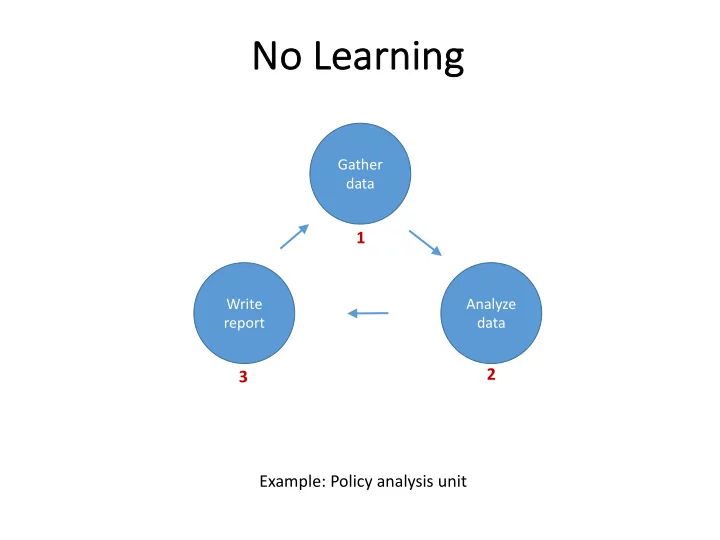
No No Le Learn rning Gather data 1 Write Analyze report data 2 3 Example: Policy analysis unit Si Single-Loop Loop Le Learn rning Gather data Quality Analyze control data Write draft report Definition: The ability to


slide-1
SLIDE 1

No No Le Learn rning

Gather data Write report Analyze data

Example: Policy analysis unit 1 2 3
slide-2
SLIDE 2

Si Single-Loop Loop Le Learn rning

Gather data Write draft report Quality control

Definition: The ability to detect and correct error in relation to a given set of

  • perating assumptions

Analyze data

slide-3
SLIDE 3

Doubl uble-Loop Loop Le Learn rning

Gather data Write draft report Quality control

Definition: The ability to learn from doing, question operating assumptions, and improve organizational strategy, structure, and systems

Analyze data Organizational learning

slide-4
SLIDE 4

Con Content of

  • f Organization
  • nal

Le Learn rning

  • Hard elements
  • 1. Strategy – goal setting, how to achieve goals
  • 2. Structure – legal, managerial
  • 3. Systems – finance, HR, ICT, asset control, quality,

communication

  • Soft elements
  • 4. Staff
  • 5. Skills – hard and soft
  • 6. Shared values – basis for goals setting and teamwork
  • 7. Style – internal culture
slide-5
SLIDE 5

Or Organizational Learning g Capacities

  • Sensing
  • Dialogue with internal and external stakeholders
  • Identifying gaps between performance and expectations
  • Identifying and prioritizing problems
  • Identifying areas of potential expansion / necessary contraction
  • Identifying alternative sources of revenue
  • Identifying potential partnerships
  • Seizing
  • Mobilization of people and resources
  • Design of solutions appropriate to local context
  • Organizational experiments on small-scale
  • Catalyzing of collaboration and active participation
  • Securing of resources
  • Transforming
  • Alteration of organizational culture
  • Creation of shared values
  • Legitimizing of experimentation
  • Embracing of innovation
  • Scaling up of change initiated through sensing and seizing