Noether theorems in a general setting. Reducible graded Lagrangians - - PDF document

noether theorems in a general setting reducible graded
SMART_READER_LITE
LIVE PREVIEW

Noether theorems in a general setting. Reducible graded Lagrangians - - PDF document

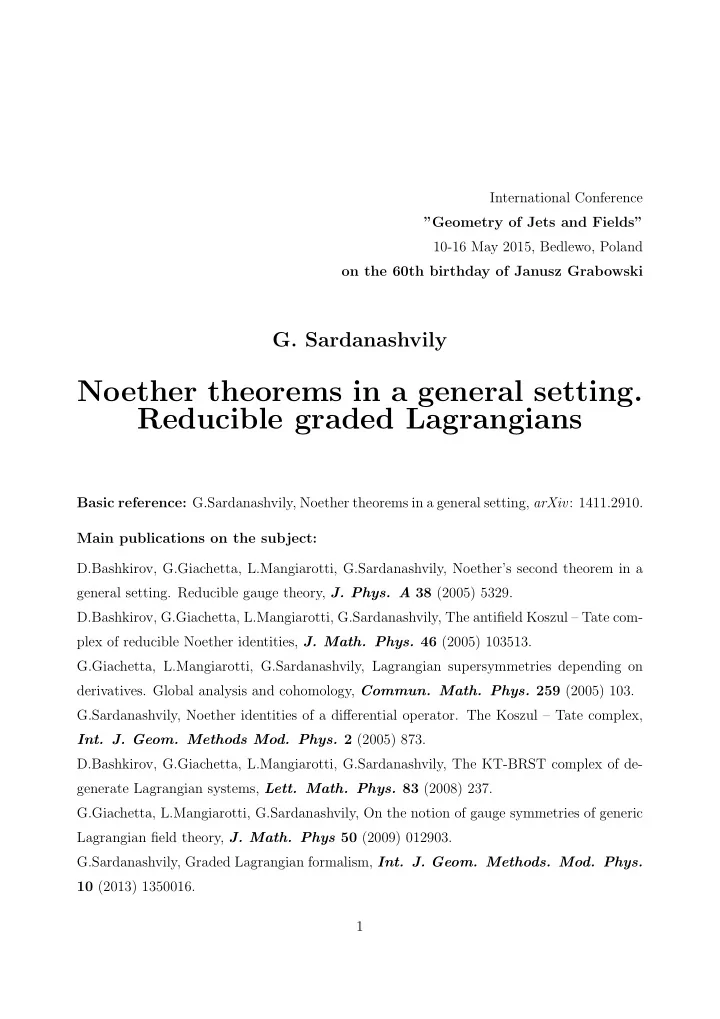
International Conference Geometry of Jets and Fields 10-16 May 2015, Bedlewo, Poland on the 60th birthday of Janusz Grabowski G. Sardanashvily Noether theorems in a general setting. Reducible graded Lagrangians Basic reference:


slide-1
SLIDE 1

International Conference ”Geometry of Jets and Fields” 10-16 May 2015, Bedlewo, Poland

  • n the 60th birthday of Janusz Grabowski
  • G. Sardanashvily

Noether theorems in a general setting. Reducible graded Lagrangians

Basic reference: G.Sardanashvily, Noether theorems in a general setting, arXiv: 1411.2910. Main publications on the subject: D.Bashkirov, G.Giachetta, L.Mangiarotti, G.Sardanashvily, Noether’s second theorem in a general setting. Reducible gauge theory, J. Phys. A 38 (2005) 5329. D.Bashkirov, G.Giachetta, L.Mangiarotti, G.Sardanashvily, The antifield Koszul – Tate com- plex of reducible Noether identities, J. Math. Phys. 46 (2005) 103513. G.Giachetta, L.Mangiarotti, G.Sardanashvily, Lagrangian supersymmetries depending on

  • derivatives. Global analysis and cohomology, Commun. Math. Phys. 259 (2005) 103.

G.Sardanashvily, Noether identities of a differential operator. The Koszul – Tate complex,

  • Int. J. Geom. Methods Mod. Phys. 2 (2005) 873.

D.Bashkirov, G.Giachetta, L.Mangiarotti, G.Sardanashvily, The KT-BRST complex of de- generate Lagrangian systems, Lett. Math. Phys. 83 (2008) 237. G.Giachetta, L.Mangiarotti, G.Sardanashvily, On the notion of gauge symmetries of generic Lagrangian field theory, J. Math. Phys 50 (2009) 012903. G.Sardanashvily, Graded Lagrangian formalism, Int. J. Geom. Methods. Mod. Phys. 10 (2013) 1350016. 1

slide-2
SLIDE 2

Main Theses

Here we are not concerned with the rich history of Noether theorems, and refer for this subject to a brilliant book: Y. Kosmann-Schwarzbach, The Noether Theorems. Invariance and the Conservation Laws in the Twentieth Century (Springer, 2011).

  • Second Noether theorems are formulated in a general case of reducible

degenerate Grassmann-graded Lagrangian theory of even and odd variables

  • n graded bundles.
  • Such Lagrangian theory is characterized by a hierarchy of non-trivial

Noether and higher-stage Noether identities which are described as elements

  • f homology groups of some chain complex.
  • If a certain homology regularity condition holds, one can associate to

a reducible degenerate Lagrangian the exact Koszul – Tate chain complex possessing the boundary operator whose nilpotentness is equivalent to all complete non-trivial Noether and higher-stage Noether identities.

  • Second Noether theorems associate to the above-mentioned Koszul –

Tate complex a certain cochain sequence whose ascent operator consists of the gauge and higher-order gauge symmetries of a Lagrangian system.

  • If gauge symmetries are algebraically closed, this operator is extended

to the nilpotent BRST operator which brings the above mentioned cochain sequence into the BRST complex and thus provides a BRST extension of an

  • riginal Lagrangian system.

2

slide-3
SLIDE 3

Problems

  • A key problem is that any Euler – Lagrange operator satisfies Noether

identities, which therefore must be separated into the trivial and non-trivial

  • nes.
  • These Noether identities can obey first-stage Noether identities, which

in turn are subject to the second-stage ones, and so on. Thus, there is a hierarchy of Noether identities and higher-stage Noether identities which also must be separated into the trivial and non-trivial ones

  • This hierarchy of Noether and higher-stage Noether identities is de-

scribed in the framework of a Grassmann-graded homology complex. There- fore Lagrangian theory of Grassmann-graded even and odd variables should be considered from the beginning.

3

slide-4
SLIDE 4

Graded Lagrangian formalism

Lagrangian theory of even variables on a smooth manifold X, dim X = n > 1, conventionally is formulated in terms of fibre bundles and jet mani-

  • folds. However, different geometric models of odd variables either on graded

manifolds or supermanifolds are discussed. Both graded manifolds and super- manifolds are phrased in terms of sheaves of graded commutative algebras. Graded manifolds are characterized by sheaves on smooth manifolds, while supermanifolds are constructed by gluing of sheaves on supervector spaces.

  • We follow the Serre – Swan theorem extended to graded manifolds.

It states that, if a graded commutative C∞(X)-ring is generated by a pro- jective C∞(X)-module of finite rank, it is isomorphic to a ring of graded functions on a graded manifold whose body is X. Since higher-stage Noether identities of a Lagrangian system on a manifold X form graded C∞(X)- modules, we describe odd variables in terms of graded manifolds.

  • A graded manifold is characterized by a body manifold Z and a structure

sheaf A of Grassmann algebras on Z. Its sections form a graded commuta- tive structure C∞(Z)-ring A of graded functions on (Z, A). The differential calculus on a graded manifold is the Chevalley – Eilenberg differential calculus over its structure ring. By virtue of Batchelor’s theorem, there is a vector bundle E → Z such that a structure ring of (Z, A) is isomorphic to a ring AE of sections of an exterior bundle ∧E∗ of the dual E∗ of E. This isomorphism is not canonical, but usually is fixed from the beginning. Therefore, we restrict our consideration to graded manifolds (Z, AE), called the simple graded manifolds, modelled over vector bundles E → Z.

4

slide-5
SLIDE 5
  • A common configuration space of even and odd variables is defined as

a graded bundle (Y, AF) which is a simple graded manifold modelled over a vector bundle F → Y whose body is Y . Its graded r-order jet manifold (JrY, Ar = AJrF) is introduced as a simple graded manifold modelled over a vector bundle JrF → JrY . This definition of graded jet manifolds is compatible with the conventional one of jets of fibre bundles.

  • Lagrangian theory on a fibre bundle Y adequately is phrased in terms
  • f the variational bicomplex of exterior forms on the infinite order jet

manifold J∞Y of Y . This technique is extended to Lagrangian theory on graded manifolds in terms of the Grassmann-graded variational bicomplex S∗

∞[F; Y ] of graded exterior forms on a graded infinite order jet manifold

(J∞Y, AJ∞F) which is the inverse limit of graded manifolds (JrY, Ar).

  • Lagrangians L and the Euler – Lagrange operator δL are defined

as the elements and the coboundary operator of this graded bicomplex. Its cohomology provides the global variational formula dL = δL − dHΞL, ΞL ∈ Sn−1

∞ [F; Y ], ,

(1) where ΞL is a global Lepage equivalent of a graded Lagrangian L.

  • Given a graded Lagrangian system (S∗

∞[F; Y ], L), by its infinitesimal

transformations are meant contact graded derivations ϑ of a graded com- mutative ring S0

∞[F; Y ]. Every graded derivation ϑ yields a Lie derivative

Lϑ of a graded algebra S∗

∞[F; Y ]. It is the infinite order jet prolongation

ϑ = J∞υ of its restriction υ to a graded commutative ring S0[F; Y ].

5

slide-6
SLIDE 6

Noether identities

We follow the general analysis of Noether identities (NI) and higher-stage NI of differential operators on fibre bundles when trivial and non-trivial NI are represented by boundaries and cycles of a chain complex.

  • One can associate to any graded Lagrangian system (S∗

∞[F; Y ], L) the

chain complex (2) whose one-boundaries vanish on the shell δL = 0. Let us consider the density-dual V F = V ∗F ⊗

F n

∧ T ∗X → F, of the vertical tangent bundle V F → F, and let us enlarge an original algebra S∗

∞[F; Y ] with the

generating basis (sA) to P∗

∞[V F; Y ] with the generating basis (sA, sA), [sA] =

[A] + 1. Following the terminology of BRST theory, we call its elements sA the antifields of antifield number Ant[sA] = 1. An algebra P∗

∞[V F; Y ] is

endowed with the nilpotent right graded derivation δ =

∂ AEA, where EA = δAL are the variational derivatives. Then we have a chain complex 0←Im δ

δ

← − P0,n

∞ [V F; Y ]1 δ

← − P0,n

∞ [V F; Y ]2

(2)

  • f graded densities of antifield number ≤ 2.

Its one-boundaries δΦ, Φ ∈ P0,n

∞ [V F; Y ]2, by very definition, vanish on-shell.

Any one-cycle Φ of the complex (2) is a differential operator on a bundle V F such that its kernel contains the graded Euler – Lagrange operator δL, i.e., δΦ = 0,

  • 0≤|Λ|

ΦA,ΛdΛEAω = 0, (3) where dΛ are total derivatives relative to a multi-index Λ = λ1 · · · λk. Refer- eing to a notion of NI of a differential operator, we say that the one-cycles Φ define the Noether identities (3) of an Euler – Lagrange operator δL.

6

slide-7
SLIDE 7
  • One-chains Φ are necessarily NI if they are boundaries. Therefore, these

NI are called trivial. Accordingly, non-trivial NI modulo trivial ones are associated to elements of the first homology H1(δ) of the complex (2). A Lagrangian L is called degenerate if there are non-trivial NI.

  • Non-trivial NI can obey first-stage NI. To describe them, let us assume

that a module H1(δ) is finitely generated. Namely, there exists a graded projective C∞(X)-module C(0) ⊂ H1(δ) of finite rank possessing a local basis {∆rω} such that any element Φ ∈ H1(δ) factorizes as Φ =

  • 0≤|Ξ|

Φr,ΞdΞ∆rω, Φr,Ξ ∈ S0

∞[F; Y ],

(4) through elements ∆rω of C(0). Thus, all non-trivial NI (3) result from the NI δ∆r =

  • 0≤|Λ|

∆A,Λ

r

dΛEA = 0, (5) called the complete NI. Then the complex (2) can be extended to the chain complex (6) with a boundary operator whose nilpotency is equivalent to the complete NI (5). By virtue of Serre – Swan theorem, a graded module C(0) is isomorphic to that of sections of the density-dual E0 of some graded vector bundle E0 → X. Let us enlarge P∗

∞[V F; Y ] to an algebra

P

∗ ∞{0} = P∗ ∞[V F × X E0; Y ] with a generating basis (sA, sA, cr) where cr are

antifields such that [cr] = [∆r] + 1 and Ant[cr] = 2. This algebra admits a derivation δ0 = δ+

∂ r∆r which is nilpotent iff the complete NI (5) hold. Then δ0 is a boundary operator of a chain complex 0←Im δ

δ

← P0,n

∞ [V F; Y ]1 δ0

← P

0,n ∞ {0}2 δ0

← P

0,n ∞ {0}3

(6)

  • f graded densities of antifield number ≤ 3. One can show that its homology

H1(δ0) vanishes, i.e., the complex (6) is one-exact.

7

slide-8
SLIDE 8
  • Let us consider the second homology H2(δ0) of the complex (6). Its

two-cycles define the first-stage NI δ0Φ = 0,

  • 0≤|Λ|

Gr,ΛdΛ∆rω = −δH. (7) Conversely, let the equality (7) hold. Then it is a cycle condition. The first-stage NI (7) are trivial either if the two-cycle Φ is a δ0-boundary or its summand G vanishes on-shell. Therefore, non-trivial first-stage NI fails to exhaust the second homology H2(δ0) of the complex (6) in general. One can show that non-trivial first-stage NI modulo trivial ones are identified with elements of H2(δ0) iff any δ-cycle φ ∈ P

0,n ∞ {0}2 is a δ0-boundary.

A degenerate Lagrangian is called reducible if it admits non- trivial first-stage NI.

  • Non-trivial first-stage NI can obey second stage NI, and so on. Iter-

ating the arguments, we say that a degenerate graded Lagrangian system (S∗

∞[F; Y ], L) is called N-stage reducible if it admits finitely generated

non-trivial N-stage NI, but no non-trivial (N + 1)-stage ones. It is charac- terized as follows. (i) There are graded vector bundles E0, . . . , EN over X, and P∗

∞[V F; Y ] is

enlarged to an algebra P

∗ ∞{N} = P∗ ∞[V F × X E0 × X · · · × X EN; Y ]

(8) with a local generating basis (sA, sA, cr, cr1, . . . , crN) where crk are k-stage antifields of antifield number Ant[crk] = k + 2.

8

slide-9
SLIDE 9

(ii) The algebra (8) is provided with a nilpotent right graded derivation δKT = δN = δ +

  • 0≤|Λ|

∂ r∆A,Λ

r

sΛA +

  • 1≤k≤N

∂ rk∆rk, (9) ∆rkω =

  • 0≤|Λ|

∆rk−1,Λ

rk

cΛrk−1ω + (10)

  • 0≤|Σ|,|Ξ|

(h(rk−2,Σ)(A,Ξ)

rk

cΣrk−2sΞA + ...)ω ∈ P

0,n ∞ {k − 1}k+1,

  • f antifield number -1. The index k = −1 here stands for sA. The nilpotent

derivation δKT (9) is called the Koszul – Tate operator. (iii) With this derivation, a module P

0,n ∞ {N}≤N+3 of densities of antifield

number ≤ (N + 3) is split into the exact Koszul – Tate chain complex 0←Im δ

δ

← − P0,n

∞ [V F; Y ]1 δ0

← − P

0,n ∞ {0}2 δ1

← − P

0,n ∞ {1}3 · · ·

(11)

δN−1

← − P

0,n ∞ {N − 1}N+1 δKT

← − P

0,n ∞ {N}N+2 δKT

← − P

0,n ∞ {N}N+3

which satisfies the following homology regularity condition. Any δk<N-cycle φ ∈ P

0,n ∞ {k}k+3 ⊂ P 0,n ∞ {k + 1}k+3 is a δk+1-boundary.

(iv) The nilpotentness of the Koszul – Tate operator (9) is equivalent to complete non-trivial NI (5) and complete non-trivial (k ≤ N)-stage NI

  • 0≤|Λ|

∆rk−1,Λ

rk

dΛ(

  • 0≤|Σ|

∆rk−2,Σ

rk−1 cΣrk−2) = −δ(

  • 0≤|Σ|,|Ξ|

h(rk−2,Σ)(A,Ξ)

rk

cΣrk−2sΞA). (12)

  • It may happen that a graded Lagrangian system possesses non-trivial

NI of any stage. However, we restrict our consideration to N-reducible La- grangians for a finite integer N. In this case, the Koszul – Tate operator (9) and the gauge operator (16) below contain finite terms.

9

slide-10
SLIDE 10

Inverse second Noether theorem

Different variants of the inverse second Noether theorem have been sug- gested in order to relate reducible NI and gauge symmetries.

[G.Barnich, F.Brandt, M.Henneaux, Local BRST cohomology in gauge theories, Phys. Rep. 338 (2000) 439. R.Fulp, T.Lada, J. Stasheff, Noether variational Theorem II and the BV formalism, Rend.

  • Circ. Mat. Palermo (2) Suppl. No. 71 (2003) 115.]

The inverse second Noether theorem (Theorem 1), that we formu- late in homology terms, associates to the Koszul – Tate complex (11)

  • f non-trivial NI the cochain sequence (15) with the ascent oper-

ator u (16) whose components are gauge and higher-stage gauge symmetries of a Lagrangian system. Given an algebra P

∗ ∞{N} (8), let us consider the algebras

P ∗

∞{N} = P ∗ ∞[F × X E0 × X · · · × X EN; Y ],

(13) possessing the generating basis (sA, cr, cr1, . . . , crN), [crk] = [crk] + 1, and P∗

∞{N} = P∗ ∞[V F × X E0 × X · · · × X EN × X E0 × X · · · × X EN; Y ]

(14) with the generating basis (sA, sA, cr, cr1, . . . , crN, cr, cr1, . . . , crN). Their ele- ments crk are called the k-stage ghosts of ghost number gh[crk] = k +1 and antifield number Ant[crk] = −(k + 1). The Koszul – Tate operator δKT (9) naturally is extended to a graded derivation of an algebra P∗

∞{N}.

10

slide-11
SLIDE 11

Theorem 1. Given the Koszul – Tate complex (11), a module of graded densities P 0,n

∞ {N} is decomposed into a cochain sequence

0 → S0,n

∞ [F; Y ] u

− → P 0,n

∞ {N}1 u

− → P 0,n

∞ {N}2 u

− → · · · (15) graded in ghost number. Its ascent operator u = u + u(1) + · · · + u(N) = uA ∂ ∂sA + ur ∂ ∂cr + · · · + urN−1 ∂ ∂crN−1 , (16) is an odd graded derivation of ghost number 1 where u = uA ∂ ∂sA, uA =

  • 0≤|Λ|

cr

Λη(∆A r )Λ,

(17)

δ(cr∆r) δsA EAω = uAEAω = dHσ0, (18) is a gauge variational symmetry of a graded Lagrangian L and the derivations u(k) = urk−1 ∂ ∂crk−1 =

  • 0≤|Λ|

crk

Λ η(∆rk−1 rk )Λ

∂ ∂crk−1 , k = 1, . . . , N, (19) are higher-stage gauge symmetries which obey the relations

  • 0≤|Ξ|

crk

0≤|Σ|

h(rk−2,Σ)(A,Ξ)

rk

cΣrk−2dΞEAω + urk−1

0≤|Ξ|

∆rk−2,Ξ

rk−1 cΞrk−2ω = dHσ′

  • k. (20)
  • Since components of the ascent operator u (16) are gauge and higher-stage

gauge symmetries, we agree to call it the gauge operator.

11

slide-12
SLIDE 12

Direct second Noether theorem

The correspondence of gauge and higher-stage gauge symmetries to NI and higher-stage NI in Theorem 1 is unique due to the following direct second Noether theorem. Theorem 2. (i) If u (17) is a gauge symmetry, the variational derivative of the dH-exact density uAEAω (18) with respect to ghosts cr leads to the equality δr(uAEAω) =

  • 0≤|Λ|

(−1)|Λ|dΛ[uAΛ

r EA] =

(21)

  • 0≤|Λ|

(−1)|Λ|dΛ(η(∆A

r )ΛEA) =

  • 0≤|Λ|

(−1)|Λ|η(η(∆A

r ))ΛdΛEA = 0,

which reproduces the complete NI (5). (ii) Given the k-stage gauge symmetry u(k) (19), the variational derivative

  • f the equality (20) with respect to ghosts crk leads to the equality, reproduc-

ing the k-stage NI (12).

  • 12
slide-13
SLIDE 13

Gauge symmetries

  • Treating gauge symmetries of Lagrangian theory, one traditionally is

based on gauge theory of principal connections on principal bundles.

  • This notion of gauge symmetries has been generalized to Lagrangian

theory on an arbitrary fibre bundle Y → X. Gauge symmetry is defined as a differential operator on section of some vector bundle E → X with values in a space of variational symmetries of a Lagrangian L. In particular, this is the case of general covariant transformations as gauge symmetries of gravitation theory.

  • To define gauge symmetries in the framework of graded Lagrangian

formalism, one considers an extension of a simple graded manifold (Y, AF) modelled over a composite bundle F → Y → X to that (E0 ×

X Y, AE ×

X F).

modelled over a fibre bundle F ×

X E, where

E = E1 ⊕

X E0 → E0 → X

is some graded vector bundle over X. In this case, gauge symmetries depend

  • n even and odd ghosts as gauge parameters.
  • A problem is that gauge symmetries need not form an algebra.

Therefore, we replace the notion of the algebra of gauge symmetries with some conditions on the gauge operator. Gauge symmetries are said to be algebraically closed if the gauge operator admits the nilpotent extension (22), called the BRST operator.

13

slide-14
SLIDE 14

BRST operator

In contrast with the Koszul – Tate operator (9), the gauge operator u (15) need not be nilpotent.

  • Let us study its extension to a nilpotent graded derivation

b = u + γ = u +

  • 1≤k≤N+1

γ(k) = u +

  • 1≤k≤N+1

γrk−1 ∂ ∂crk−1 (22) =

  • uA ∂

∂sA + γr ∂ ∂cr

  • +
  • 0≤k≤N−1
  • urk ∂

∂crk + γrk+1 ∂ ∂crk+1

  • f ghost number 1 by means of antifield-free terms γ(k) of higher polynomial

degree in ghosts cri and their jets cri

Λ, 0 ≤ i < k. We call b (22) the BRST

  • perator, where k-stage gauge symmetries are extended to k-stage BRST

transformations acting both on (k − 1)-stage and k-stage ghosts. If a BRST

  • perator exists, the sequence (15) is brought into a BRST complex

0 → S0,n

∞ [F; Y ] b

− → P 0,n

∞ {N}1 b

− → P 0,n

∞ {N}2 b

− → · · · .

  • One can show that the gauge operator (15) admits the BRST extension

(22) only if the gauge symmetry conditions (20) and the higher-stage NI (12) are satisfied off-shell.

  • The Koszul – Tate and BRST complexes provide the BRST extension

LE = L + b

0≤k≤N

crk−1crk−1

  • ω + dHσ,
  • f an original Lagrangian theory by graded ghosts crk and antifields crk.
  • This extension is a preliminary step towards the BV quantization of

reducible degenerate Lagrangian theories.

14

slide-15
SLIDE 15

Main outcomes

  • Gauge theory on principal bundles.
  • Gauge gravitation theory on natural bundles.
  • Chern – Simons topological theory.
  • Topological BF theory
  • SUSY gauge theory on graded manifold.s

References: D.Bashkirov, G.Giachetta, L.Mangiarotti, G.Sardanashvily, Noether’s second theorem in a general setting. Reducible gauge theory, J. Phys. A 38 (2005) 5329. D.Bashkirov, G.Giachetta, L.Mangiarotti, G.Sardanashvily, The KT-BRST complex of de- generate Lagrangian systems, Lett. Math. Phys. 83 (2008) 237. G.Giachetta, L.Mangiarotti, G.Sardanashvily, Advanced Classical Field Theory (World Scientific, 2009). G.Sardanashvily, W.Wachowski, SUSY gauge theory on graded manifolds, arXiv: 1406.6318. G.Sardanashvily, Noether theorems in a general setting, arXiv: 1411.2910. 15