Nomenclature Communications is the process of transmitting - - PDF document

nomenclature
SMART_READER_LITE
LIVE PREVIEW

Nomenclature Communications is the process of transmitting - - PDF document

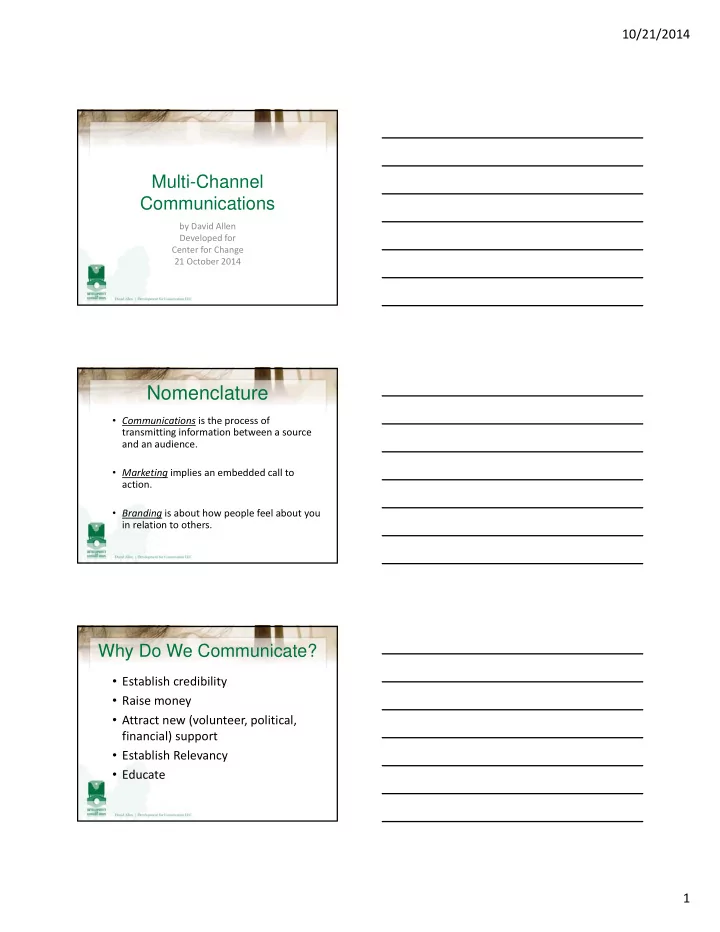
10/21/2014 Multi-Channel Communications by David Allen Developed for Center for Change 21 October 2014 Nomenclature Communications is the process of transmitting information between a source and an audience. Marketing implies an embedded


slide-1
SLIDE 1

10/21/2014 1

Multi-Channel Communications

by David Allen Developed for Center for Change 21 October 2014

Nomenclature

  • Communications is the process of

transmitting information between a source and an audience.

  • Marketing implies an embedded call to

action.

  • Branding is about how people feel about you

in relation to others.

Why Do We Communicate?

  • Establish credibility
  • Raise money
  • Attract new (volunteer, political,

financial) support

  • Establish Relevancy
  • Educate
slide-2
SLIDE 2

10/21/2014 2

With Whom Do We Communicate?

  • Board Members, former Board

Members

  • Major donors
  • Members
  • Former members
  • Volunteers who are not members
  • People who visit
  • General public

What are Channels?

  • Electronic – Website (!), email, e‐news, blog
  • News – Dailies, Weeklies, LTE
  • Broadcast – Radio, TV, Community Cable
  • Print – Newsletter, saturation mail, flyers
  • Video – You‐tube, Vimeo,
  • Social – Facebook, Flickr, Linked‐In, Instagram
  • Telephone – News, Asks, Thank Yous
  • Face‐time – Real‐time networking!

Conversation Starters

It is a mistake to replace paper communications with electronic communications.

slide-3
SLIDE 3

10/21/2014 3

Conversation Starters

Communicating what you believe is more powerful than communicating what you do.

Conversation Starters

Two of the most important words in communications are authenticity and relevance

Conversation Starters

First person is always more effective than third person. Stories are always more effective than descriptions.

slide-4
SLIDE 4

10/21/2014 4

Conversation Starters

An important aspect of mobile phones (the third screen) is that they remove the barrier between message and

  • action. This trend will continue.

Conversation Starters

The purpose of Social Media is to foster user interaction. If you can’t get people talking, you can’t succeed.

Conversation Starters

Grammatically correct is not as important as it used to be. Correct speling is not as important as it used to be

slide-5
SLIDE 5

10/21/2014 5

Conversation Starters

Repetition aids comprehension.

Conversation Starters

If you want to communicate powerfully with younger donors, use paper. If you want to communicate powerfully with younger people, use video.

Conversation Starters

We cannot trust ourselves when it comes to questions about what works (and what doesn’t) in communications.

slide-6
SLIDE 6

10/21/2014 6

Conversation Starters

The purpose of all electronic communication should be to drive traffic to the website.

Conversation Starters

Close‐up photographs of people and animals are always more effective than pictures of landscapes.*

* Unless you spend money on reproduction like the National Geographic or The Nature Conservancy

Services

Assessment, Planning, Training, Coaching

You can raise more money for your organization – I can help.

fundraisinghelp@sbcglobal.net

608/239‐5006

slide-7
SLIDE 7

DAVID ALLEN

I am a non‐profit organizational development consultant. I work with organization boards to help their members learn how to be better leaders and advocates. My background includes 30 years working in membership fundraising, major donor development, communications, and marketing. I worked for about half that time for Nature Conservancy (TNC) chapters in Oregon, Texas, and Wisconsin. In addition to my duties for the individual chapters, I served TNC as an internal fundraising consultant and major donor development trainer. In 2000, served as the vice‐president of

  • perations for the Wisconsin‐based,

international conservation organization Sand County Foundation, a position I held through mid‐2009. Gathering Waters Conservancy, a land trust service agency based in Wisconsin, called me in 2002 to ask whether I would be interested in teaching a seminar for Wisconsin land trusts on major donor development. From 2002, then, through 2009, I consulted on a nights and weekends basis with just a few clients each year. In March of 2009, I launched my consulting business full‐time using the name Development for Conservation. Also in 2009, I partnered with Peter McKeever and Nancy Moore to form Conservation Consulting Group. Together we help land trusts prepare for accreditation by providing assessment, planning, and leadership coaching services. I consider myself a strategic thinker, problem solver, facilitator, educator, and program developer who brings a particular passion for conservation and the environment. Practice Competencies Fundraising Organizational Development

  • Development Audit
  • Strategy Development
  • Staff/Board Training and Development
  • Practice & Process Assessment
  • Major Gift Coaching
  • Problem Solving Facilitation
  • Capital Campaigns
  • Marketing
slide-8
SLIDE 8

David Allen Development for Conservation

fundraisinghelp@sbcglobal.net 608‐239‐5006 608 West Dean Avenue Monona, WI 53716