SLIDE 1
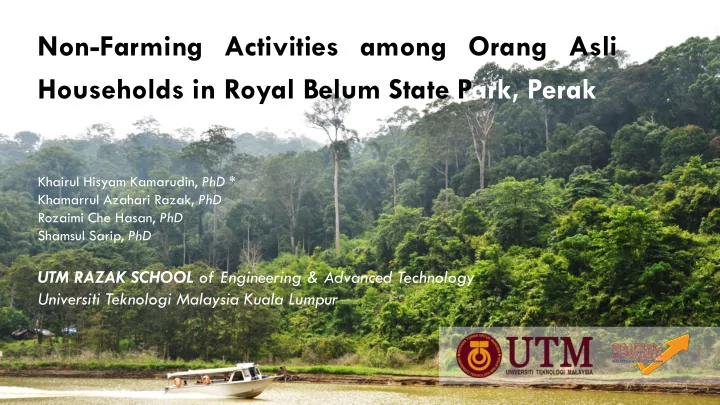
Non-Farming Activities among Orang Asli Households in Royal Belum State Park, Perak
Khairul Hisyam Kamarudin, PhD * Khamarrul Azahari Razak, PhD Rozaimi Che Hasan, PhD Shamsul Sarip, PhD
UTM RAZAK SCHOOL of Engineering & Advanced Technology Universiti Teknologi Malaysia Kuala Lumpur
SLIDE 2
Outline of presentation:
Introduction Role of RNF in Rural & Community Development Study Approach Results & Discussions Issues & Challenges of RNF – some examples Conclusion
SLIDE 3 Introduction
Rural transformation in Malaysia can be
in the multi-dimensional changes towards the diversification of rural activities with increases in non- farming activities, the broadening of farm or land-based activities and the introduction
quality and local specialty products. Federal government agencies began to seek out alternatives in developing the countryside and rural communities, specifically to identify more profitable economic activities as it became obvious that the agricultural sector alone did not hold the key to rural development.
SLIDE 4 Introduction
One of the main strategies of this search was to find ways of encouraging the diversification
- f rural economic activities brought an
interest in rural non-farming (RNF) sector as a tool to revitalize the countryside and rural communities. The emergence of non-farming (NF) or non-agricultural economic activities in rural areas is not an entirely new phenomenon. Unfortunately, as of now, there is very limited research in Malaysia to identify their roles and contribution to rural livelihoods. This study aim to examine the roles and contribution of non-farming (NF) activities in rural livelihoods and how they are linked to the rural economy.
SLIDE 5 The Role of RNF in Rural & Community Development
Migration to the cities has eroded the vitality of rural communities traditional economic systems that usually involve farming and forest-related activities, are falling into disuse + the quality
- f the environment deteriorates
thus affecting the income and employment opportunities in rural communities.
SLIDE 6
NF enterprises in Africa (Reardon, 1997) indicated that the RNF sector has employed more than one member of a typical rural household and the income shares from RNF enterprises contributed between 22 to 93% to the local economic performance. Islam (1997) reported that RNF capable to generate between 20 to 50% of total local employment, resulting in households earning more from RNF activities than from farm wage labour.
SLIDE 7 Absorbing surplus labour in rural areas Assisting farm-based households in spreading risks Offering more remunerative activities to supplement or replace income from agricultural activities Offering potential income during the agricultural off- season Providing a means to cope
sector fails or becoming unviable
Contribution
Gordon and Craig (2001)
1 2 3 4 5
SLIDE 8 linkage between NF development with the local community provision of widespread benefits to all segments
especially the underprivileged active engagement with the local community in the development and management
RNF – a development concept
Source: Ngah et al. (2016); Kamarudin (2015a & 2013) and Wood (2005)
SLIDE 9 Materials & Methods
- Household surveys and interviews (9-11 Sept 2015).
- A total of 15 respondents (seven respondents from Sungai
Kejar and eight from Sungai Tiang) have agreed to participate in the survey by answering a questionnaire- guided interview.
- SPSS software was used to aid data processing and
analyses.
- A simple frequency and comparative statistical analysis
was adopted to differentiate the variation in the contribution of non-agricultural activities to the rural livelihood in different localities.
- Cross-tabulation analysis used to examine the relationships
between different variables such as the respondents’ main reasons for participating in non-farm activities.
1
1 2 2
Legend:
SLIDE 10 Results
Information Frequency (n=15) Percentage (%) Number of respondents
7 8 47 53 Gender Male (head of household) Female 15 100 Marital status Married Widower 13 2 87 13 Education level No formal education Adult school (sekolah dewasa) for 3 months 9 6 60 40
Profile of respondents
SLIDE 11 7% 20% 13% 20% 13% 20% 7% 0% 5% 10% 15% 20% 25% <17 y.o 18-24 25-30 31-34 35-40 41-50 >51 y.o
Age distribution
SLIDE 12 Information Frequency (n=15) Percentage (%) Involvement in non-farm activity Yes No 15 100 Involvement as a full-time job Yes No 13 2 87 13 Involvement as a part-time job Yes No 2 13 13 87 Involvement as a seasonal job Yes No 9 6 60 40 Location of non-farm activities Inside Royal Belum Outside Royal Belum 15 100 Types of NF activity Sandalwood / Kayu gaharu (full-time every month) Honey gatherer (madu Tualang) (seasonal) Honey gatherer (madu Kelulut) (part-time every month) Fishing (part-time every month) 13 15 13 13 87 100 87 87 Frequency of activity per month Every week Not related 13 2 87 13 Involvement of family members in NF Yes No 1 14 7 93
Status of respondents’ involvement in RNF activities
SLIDE 13 87% 27% 93% 27% 40% 27% 0% 10% 20% 30% 40% 50% 60% 70% 80% 90% 100% As main income As supporting income No other
More flexibility Marketable product Inherit and good at the job Respondents’ main reasons for participating in RNF activities
SLIDE 14
Frequency Percentage (%) Valid Not related 1 6.7 <RM10/day 3 20.0 RM15/day 7 46.7 RM30/day 4 26.7 Total 15 100.0 Average income from RNF activity (n=15) Note: National poverty line (average) – RM950 (poor) and RM600 (hard core poor) RM15 x 30 days = RM450
SLIDE 15 60% 20% 13% 7% 0% 0% 73% 27% 0% 10% 20% 30% 40% 50% 60% 70% 80% 90% 100% Is increasing No change Is decreasing Not sure Resource availability Market price
Perceptions on prospect of RNF activities – market price and resources availability (n=15)
SLIDE 16
38% 0% 32% 22% 0% 8% 0% 5% 10% 15% 20% 25% 30% 35% 40% Resource depletion Competition (outside product) Illegal poachers Seasonality Instability in market price High cost/capital issue
Issue and challenges related to RNF activities (n=15)
SLIDE 17 Family dispute? Merajuk? Or….. Just a small sign of….. ……contest for resources (land, spatial, food, comfort)?
Akta Orang Asli 1954 (Akta 134) ……………….. Enakmen Perbadanan Taman Negeri Perak 2001…………………..
SLIDE 18
Unsustainable practice in extracting wild kelulut honey observed in Royal Belum State Park during field study Not a BIG Q: By Orang Asli? By illegal poachers? By locals from outside RBSP? BIG Q: State of natural resources conservation? Long term sustainability/survivability of a species?
SLIDE 19
The Way Forward
RNF activities played a significant role in shaping the livelihoods of Orang Asli households in Royal Belum State Park. The community’s involvement in RNF activities undoubtedly generated local jobs and income. However, the current data showed that the level of household income is far from satisfactory and it is not able to bring them out of poverty. Respondents agreed that the price for RNF products has increased over the years + also admitted that local resources harvested as RNF products have also decreased in tandem with the market price hike - sandalwood, rattan, wild honey and other products. It is recommended by this study that new forms of RNF and RNF-related activities, such as community- based tourism should be introduced in the near future to reduce the community’s dependency on the exploitation of the natural resources, hence reducing the pressure on the valuable resources of Royal Belum State Park solving the issue of energy/power + telecommunication.
SLIDE 20 Thank you!
KHAIRUL HISYAM KAMARUDIN, PHD
Lecturer/Researcher in Planning (Rural Development & Sustainable Tourism) UTM Razak School of Engineering & Advanced Technology UTM Kuala Lumpur Email: khkamarudin@gmail.com Website: http://khairulhkamarudin.wordpress.com