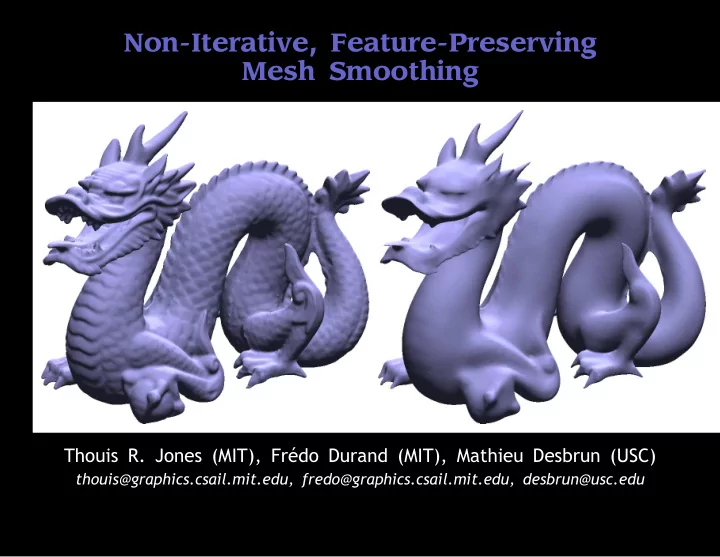
Non-Iterative, Feature-Preserving Mesh Smoothing Thouis R. Jones - - PowerPoint PPT Presentation

non iterative feature preserving mesh smoothing
SMART_READER_LITE
LIVE PREVIEW

Non-Iterative, Feature-Preserving Mesh Smoothing Thouis R. Jones - - PowerPoint PPT Presentation

Non-Iterative, Feature-Preserving Mesh Smoothing Thouis R. Jones (MIT), Frdo Durand (MIT), Mathieu Desbrun (USC) thouis@graphics.csail.mit.edu, fredo@graphics.csail.mit.edu, desbrun@usc.edu Why Smooth? 3D scanners are noisy... Jones, Durand,


slide-1
SLIDE 1

Non-Iterative, Feature-Preserving Mesh Smoothing

Thouis R. Jones (MIT), Frédo Durand (MIT), Mathieu Desbrun (USC)

thouis@graphics.csail.mit.edu, fredo@graphics.csail.mit.edu, desbrun@usc.edu

slide-2
SLIDE 2

Why Smooth?

3D scanners are noisy...

Jones, Durand, Desbrun

slide-3
SLIDE 3

Why Smooth?

3D scanners are noisy... and have dropouts...

Jones, Durand, Desbrun

slide-4
SLIDE 4

Why Smooth?

3D scanners are noisy... and have dropouts... and usually require multiple scans.

Jones, Durand, Desbrun

slide-5
SLIDE 5

Goals

Fast smoothing of meshes Robust

  • Geometrically: preserve features
  • Topologically: no connectivity information

Simple to implement

Jones, Durand, Desbrun

slide-6
SLIDE 6

Goals

Fast smoothing of meshes polygon soups Robust

  • Geometrically: preserve features
  • Topologically: no connectivity information

Simple to implement

Jones, Durand, Desbrun

slide-7
SLIDE 7

Previous Work on Smoothing

Fast Mesh Smoothing

  • Taubin 1995; Desbrun et al. 1999

Feature Preserving

  • Clarenz et al.

2000; Desbrun et al. 2000; Meyer et al. 2002; Zhang and Fiume 2002; Bajaj and Xu 2003 Diffusion on Normal Field

  • Taubin 2001; Belyaev and Ohtake 2001; Ohtake

et al. 2002; Tasdizen et al. 2002 Wiener Filtering of Meshes

  • Peng et al. 2001; Alexa 2002; Pauly and Gross

2001 (points)

Jones, Durand, Desbrun

slide-8
SLIDE 8

Approach

We cast feature-preserving filtering as a robust estimation problem on vertex positions. Extend Bilateral Filter to 3D.

  • Smith and Brady 1997; Tomasi and Manduchi

1998 Use first-order predictors based on facets of model. Single pass.

Jones, Durand, Desbrun

slide-9
SLIDE 9

Non-Robust Estimation

Least Squares Error Norm

1 2 3 4 y –2 –1 1 2 x

Outliers have unlimited influence on estimate.

Jones, Durand, Desbrun

slide-10
SLIDE 10

Robust Estimation

Robust Error Norm

0.05 0.1 0.15 0.2 0.25 0.3 y –2 –1 1 2 x

Outliers have bounded influence on estimate.

Jones, Durand, Desbrun

slide-11
SLIDE 11

Gaussian Filter (Non-robust) I′

s =

  • p

image

  • I(p)

spatial

  • f(s − p)

I f I′

Jones, Durand, Desbrun

slide-12
SLIDE 12

Bilateral Filter (Robust) I′

s = 1

ks

  • p

image

  • I(p)

spatial

  • f(s − p)

influence

  • g(Is − Ip)

I f g fg I′

Jones, Durand, Desbrun

slide-13
SLIDE 13

Bilateral Filter (Robust) I′

s = 1

ks

  • p

image

  • I(p)

spatial

  • f(s − p)

influence

  • g(Is − Ip)

I f g fg I′

Jones, Durand, Desbrun

slide-14
SLIDE 14

Bilateral Filter (Robust) I′

s = 1

ks

  • p

image

  • I(p)

spatial

  • f(s − p)

influence

  • g(Is − Ip)

I f g fg I′

Jones, Durand, Desbrun

slide-15
SLIDE 15

Bilateral Filter (Robust) I′

s = 1

ks

  • p

image

  • I(p)

spatial

  • f(s − p)

influence

  • g(Is − Ip)

I f g fg I′

Jones, Durand, Desbrun

slide-16
SLIDE 16

Bilateral Filter (Robust) I′

s = 1

ks

  • p

image

  • I(p)

spatial

  • f(s − p)

influence

  • g(Is − Ip)

I f g fg I′

Jones, Durand, Desbrun

slide-17
SLIDE 17

Bilateral Filter (Robust) I′

s = 1

ks

  • p

image

  • I(p)

spatial

  • f(s − p)

influence

  • g(Is − Ip)

I f g fg I′

Jones, Durand, Desbrun

slide-18
SLIDE 18

Bilateral Filter (Robust) I′

s = 1

ks

  • p

image

  • I(p)

spatial

  • f(s − p)

influence

  • g(Is − Ip)

ks =

  • p

f(s − p) g(Is − Ip)

Jones, Durand, Desbrun

slide-19
SLIDE 19

Bilateral Filter

Left: Jones and Jones 2003 Right: Bilaterally filtered.

Jones, Durand, Desbrun

slide-20
SLIDE 20

Extending the Bilateral Filter to Meshes

How to separate location and signal in a 3D model?

  • Forming

local frames requires a connected mesh. Instead, use first-order predictors based on facets:

p q Π ( ) p

q

No connectivity required between facets.

Jones, Durand, Desbrun

slide-21
SLIDE 21

Bilateral Filter for Meshes

Estimate p′, the new position for a vertex p

p′ = 1 k(p)

  • q∈S

prediction

Πq(p)

spatial

  • f(||cq − p||)

influence

  • g(||Πq(p) − p||)

area

  • aq

Jones, Durand, Desbrun

slide-22
SLIDE 22

Bilateral Filter for Meshes

Estimate p′, the new position for a vertex p

p′ = 1 k(p)

  • q∈S

prediction

Πq(p)

spatial

  • f(||cq − p||)

influence

  • g(||Πq(p) − p||)

area

  • aq

Jones, Durand, Desbrun

slide-23
SLIDE 23

Bilateral Filter for Meshes

Estimate p′, the new position for a vertex p

p′ = 1 k(p)

  • q∈S

prediction

Πq(p)

spatial

  • f(||cq − p||)

influence

  • g(||Πq(p) − p||)

area

  • aq

Jones, Durand, Desbrun

slide-24
SLIDE 24

Bilateral Filter for Meshes

Estimate p′, the new position for a vertex p

p′ = 1 k(p)

  • q∈S

prediction

Πq(p)

spatial

  • f(||cq − p||)

influence

  • g(||Πq(p) − p||)

area

  • aq

Jones, Durand, Desbrun

slide-25
SLIDE 25

Why we expect it to work

Predictions across corners are ``outliers''.

Jones, Durand, Desbrun

slide-26
SLIDE 26

Dealing with Noise

Noise has a nonlinear effect on predictions. We must mollify (pre-smooth) normals.

Jones, Durand, Desbrun

slide-27
SLIDE 27

Dealing with Noise

Noise has a nonlinear effect on predictions. We must mollify (pre-smooth) normals.

Jones, Durand, Desbrun

slide-28
SLIDE 28

Dealing with Noise

Noise has a nonlinear effect on predictions. We must mollify (pre-smooth) normals.

Jones, Durand, Desbrun

slide-29
SLIDE 29

Dealing with Noise

Noise has a nonlinear effect on predictions. We must mollify (pre-smooth) normals.

Jones, Durand, Desbrun

slide-30
SLIDE 30

Dealing with Noise

Noise has a nonlinear effect on predictions. We must mollify (pre-smooth) normals.

Jones, Durand, Desbrun

slide-31
SLIDE 31

Implementation

3K vertices / second (typical), 1.4 GHz Athlon. Gaussians for f and g. Optimizations

  • Cutoff at twice spatial filter radius.
  • Binning for spatially coherent computation.

Data and non-optimized code available online.

Jones, Durand, Desbrun

slide-32
SLIDE 32

Results - Smoothing Original Desbrun 1999 Our result

Jones, Durand, Desbrun

slide-33
SLIDE 33

Results - Effect of g Original Without g Our result

Jones, Durand, Desbrun

slide-34
SLIDE 34

Results - Effect of Mollification Original Without mollification Our result

Jones, Durand, Desbrun

slide-35
SLIDE 35

Results - Connectivity 50% Original Smoothed All predictors

Jones, Durand, Desbrun

slide-36
SLIDE 36

Results - Varying width of f and g Original Narrow spatial and influence

Jones, Durand, Desbrun

slide-37
SLIDE 37

Results - Varying width of f and g Original Narrow spatial and wide influence

Jones, Durand, Desbrun

slide-38
SLIDE 38

Results - Varying width of f and g Original Wide spatial and influence

Jones, Durand, Desbrun

slide-39
SLIDE 39

Normalization factor k as ``Confidence''

Normalization term k(p) is sum of weights, and is a measure of confidence in the estimation at p. p′ = 1 k(p)

  • q∈S

Πq(p) f(||cq − p||) g(||Πq(p) − p||) aq k(p) =

  • q∈S

f(||cq − p||) g(||Πq(p) − p||) aq

Jones, Durand, Desbrun

slide-40
SLIDE 40

Results - k as Confidence Low High

Jones, Durand, Desbrun

slide-41
SLIDE 41

Results - k as Confidence Low High

Jones, Durand, Desbrun

slide-42
SLIDE 42

Results - vs Wiener Filtering Original

Jones, Durand, Desbrun

slide-43
SLIDE 43

Results - vs Wiener Filtering (Low Noise) Peng et al. 2001 Our result

Jones, Durand, Desbrun

slide-44
SLIDE 44

Results - vs Wiener Filtering (High Noise) Peng et al. 2001 Our result

Jones, Durand, Desbrun

slide-45
SLIDE 45

Results - vs Anisotropic Diffusion Original

Jones, Durand, Desbrun

slide-46
SLIDE 46

Results - vs Anisotropic Diffusion Clarenz et al. 2000 Our result

Jones, Durand, Desbrun

slide-47
SLIDE 47

Similar Methods

Bilateral Mesh Denoising, Fleishman et al. 2003 (next talk)

  • Iterative
  • Local frame
  • No mollification
  • Different predictor

Trilateral Filter, Cloudhury and Tumblin 2003 (EGSR)

  • Images and Meshes
  • Mollify normals, then vertices
  • Different predictor

Jones, Durand, Desbrun

slide-48
SLIDE 48

Future Work

Extend to other types of data (point models, volume data). Using k to steer further processing. Iterative application.

Jones, Durand, Desbrun

slide-49
SLIDE 49

Conclusions

Fast, feature preserving filter. Simple to implement. Applicable to polygon soups. Take-home message:

  • Robust estimation for smoothing.
  • Points across features are outliers.
  • First-order

predictors remove connectivity requirements.

Jones, Durand, Desbrun

slide-50
SLIDE 50

Acknowledgements

SIGGRAPH reviewers, Caltech SigDraft and MIT pre-reviewers. Udo Diewald, Martin Rumpf, Jianbo Peng, Denis Zorin, and Jean-Yves Bouguet, and Stanford 3D Scanning Repository for models. Peter Shirley and Michael Cohen for comments on this presentation. We would like to thank the NSF (CCR-0133983, DMS-0221666, DMS-0221669, EEC-9529152, EIA-9802220).

Jones, Durand, Desbrun