Non-linear diffusive shock acceleration and the SNR paradigm for - - PowerPoint PPT Presentation

non linear diffusive shock acceleration and the snr
SMART_READER_LITE
LIVE PREVIEW

Non-linear diffusive shock acceleration and the SNR paradigm for - - PowerPoint PPT Presentation

Non-linear diffusive shock acceleration and the SNR paradigm for Galactic CRs Damiano Caprioli In collaboration with Pasquale Blasi, Elena Amato INAF / Oss. Astrofisico di Arcetri, Firenze (Italy) The SNR paradigm for galactic CRs SNe


slide-1
SLIDE 1

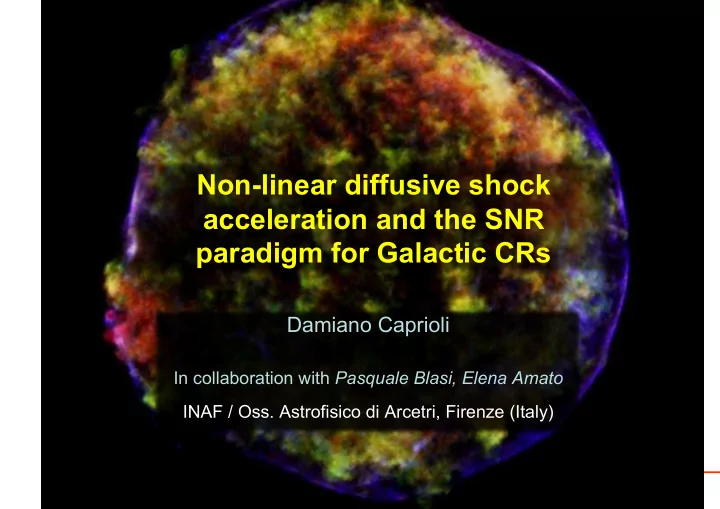
Non-linear diffusive shock acceleration and the SNR paradigm for Galactic CRs

Damiano Caprioli

In collaboration with Pasquale Blasi, Elena Amato INAF / Oss. Astrofisico di Arcetri, Firenze (Italy)

slide-2
SLIDE 2

The SNR paradigm for galactic CRs

SNe may account for Galactic CR energetics Diffusive Shock Acceleration provides power

law spectra (E-2) with the correct index

G1.9+0.3

Are CRs passive spectators of the shock dynamics? What is the maximum energy achievable in SNRs? How are particles released in the Galaxy?

2

Need for a Non-Linear theory of DSA

slide-3
SLIDE 3

CR pressure around the shock: the

upstream fluid is slowed down and becomes more compressible

“Standard” calculations leads to very efficient acceleration (Rtot~10-100) The spectra of the accelerated particles is concave (and even as flat as E-1.2)

At odds with multi-wavelength observations!

CR-modified shocks

r = 4

Subshock Precursor

Velocity Profile

Rtot > 4

3

slide-4
SLIDE 4

Magnetic Field Amplification

The width of the rims requires

Bds 70-500 µG >> B0

Völk, Berezhko & Ksenofontov 2005 Parizot et al. 2006

SNR Bds (µG) PB,ds(%) Cas A 250-390 3.2-3.6 Kepler 210-340 2.3-2.5 Tycho 240-530 1.8-3.1 SN1006 90-110 4.0-4.2 RCW 86 75-145 1.5-3.8

Cas A Kepler SN 1006 RCW 86 The downstream magnetic pressure is at most 2 - 4% of the bulk pressure

4

B2 8 > nkT B > 6µG n1/2 T 104K

  • But upstream PB very likely

dominates over Pgas, since:

slide-5
SLIDE 5

The dynamical feedback of MFA

Three-fluid model with Alfvén waves excited by streaming instability In young SNRs: W 1-100

DC, Blasi, Amato,Vietri 2008

The magnetic turbulence feedback cannot be neglected and provides a smoothening of the precursor

5

Unmagnetized

Ratio between magnetic and plasma pressure upstream

W = P

B,ups

P

gas,ups

slide-6
SLIDE 6

Magnetic feedback on the spectra

DC, Blasi, Amato, Vietri 2009

U0=5900 km/s; SNR age=1000yr

6

slide-7
SLIDE 7

Turbulent (Alfvèn) Heating

7 Often explained as due to non-linear Landau damping of the magnetic

turbulence and invoked in order to reduce the precursor, but it:

Is expected to be relevant only if Vsh< 4000 (T/105 K)1/2 km/s

Völk & McKenzie 1981; Ptuskin & Zirakasvhili 2005

Cannot be too efficient, otherwise no MFA!! =damp/ growth< 1

B0=10 µG; Age=1000 yr; T0=105 K DC, Blasi, Amato, Vietri 2009

May lead to a too large downstream temperature and too large thermal emissivity, see RX J1713.7-3946)

slide-8
SLIDE 8

MONTE CARLO: account for CR anisotropy

Jones, Ellison 1991; Ellison et al. 1990;1995; Vladimirov, Ellison, Bykov 2006

FULLY NUMERICAL: time-dependent

Kang, Jones 1997;2005;2008; Berezhko, Völk 1997;2004;2007; Zirakashvili, Aharonian

2009; Ptuskin, Zirakashvili, Seo 2010

SEMI-ANALYTICAL: versatile, computationally extremely fast

Malkov 1997; Blasi 2002; 2004; Amato, Blasi 2005; 2006, DC et al. 2009; 2010b

All methods require an a priori description of:

Particle transport (diffusion and convection) Magnetic field amplification Injection into the acceleration process Particle escape from the source

For reviews on NLDSA see e.g. :

Drury 1983; Blandford,Heicler 1987; Jones, Ellison 1991; Malkov, Drury 2002

Kinetic approaches to NLDSA

8

slide-9
SLIDE 9

Why semi-analytical?

The developed formalism is a very powerful tool since it:

is very fast (a run takes 10”-1’ on a laptop) has virtually no dynamical range limitation on Pmax, M0, … allows to scan a wide range of environmental parameters allows the inclusion of nuclei

Applications to SNR shocks:

Hydro + Multi-wavelength analysis of

single SNRs

Test the SNR paradigm for the origin

  • f galactic CRs

9

Tycho

slide-10
SLIDE 10

A semi-analytic approach

Solution of the stationary diffusion-convection equation

With momentum boundary pmax (Amato & Blasi 2005; 2006; Blasi, Amato & DC 2007) With escape boundary x0 (DC, Amato & Blasi 2010b)

10

Momentum conservation CR pressure CR transport equation Injection

slide-11
SLIDE 11

Vs Numerical and Monte Carlo approaches

11

DC, Kang, Vladimirov, Jones 2010 Spectra at the shock Escape flux Fluid velocity Anisotropy at the FEB

slide-12
SLIDE 12

The velocity of the scattering centres naturally enters the transport equation It strongly affects the CR spectrum: Resonant streaming instability (Skilling 1975)

UPSTREAM: countergoing Alfvèn waves excited by CRs DOWNSTREAM: isotropy? Reflection + transmission? Other instabilities? In the background field or in the amplified field?

Evidences of magnetic field amplification suggest:

Scattering centre velocity

12

How does vW depend on the nature of the turbulence?

˜ u (x) = u(x) + vW

vw = vA = B 4 (0.01÷ 0.1)u Rsub = u1 + vw1 u2 + vw2 Rtot = u0 + vw0 u2 + vw2

slide-13
SLIDE 13

From accelerated particles to CRs

Ejecta dominated stage

The magnetic turbulence and Pmax

increase with time

Sedov-Taylor stage

Vsh, Pmax and B decrease, and so

does the SNR confining power

Particles with momentum close to

Pmax(t) escape the system

For constant Fesc(t) and Rsh t2/5 i.e.

the adiabatic self-similar solution:

13

Blasi, Amato, DC 2007 DC, Amato, Blasi, 2010a

The released spectrum is the convolution over time of 3 contributions: Escape from upstream+ Leakage from downstream + Relic advected CRs

slide-14
SLIDE 14

A snapshot from a benchmark SNR

14 CSM density = 0.01 part/cm-3 CSM temperature = 106 K Diffusion in the amplified

magnetic field

Chemical abundances tuned to

fit the observed ones (Hörandel

2003; Blümer et al. 2009)

Nuclei are as relevant as protons for the shock dynamics!

DC, Blasi, Amato astroph:/1007.1925

slide-15
SLIDE 15

Account for propagation in the Galaxy + spallation (at lower energies)

CRs at Earth

15

DC, Blasi, Amato astroph:/1007.1925

Earth(E) = SNNSNR(E) esc(E) 4RGal

2

esc(E) =15Myr 1 Z E 10GeV

  • 0.55

; SN = 3 100yr

slide-16
SLIDE 16

Open issues about SNR paradigm

What is the contribution by Type I/II SNe?

Role of pre-SN stages (winds, hot bubbles, chemical composition…)

What is the nature of magnetic turbulence in modified shocks?

Are they resonant and/or non-resonant modes? (Bell 2004) Velocity of the scattering centres CR spectrum Details of the magnetic feedback SNR hydrodynamics

How does injection of heavy nuclei work?

C,O in molecular form, Fe in grain form…

How is the diffusion around a SNR (Bohm-like or Galactic like)?

Relevant for predicting the spectrum illuminating Molecular Clouds 16