Non-Recursive In-Place FFT Algorithm Idea: "Unwind the in-place - - PowerPoint PPT Presentation

non recursive in place fft algorithm idea unwind the in
SMART_READER_LITE
LIVE PREVIEW

Non-Recursive In-Place FFT Algorithm Idea: "Unwind the in-place - - PowerPoint PPT Presentation

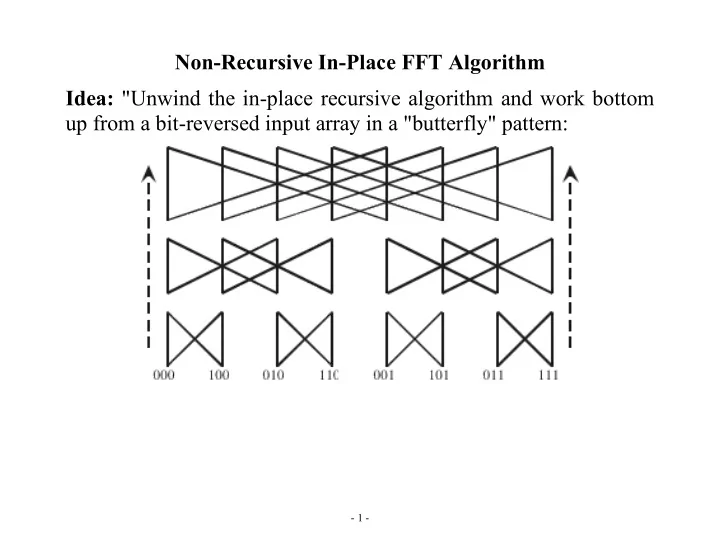
Non-Recursive In-Place FFT Algorithm Idea: "Unwind the in-place recursive algorithm and work bottom up from a bit-reversed input array in a "butterfly" pattern: - 1 - (non-recursive in-place FFT algorithm continued) Non-recursive


slide-1
SLIDE 1
  • 1 -

Non-Recursive In-Place FFT Algorithm Idea: "Unwind the in-place recursive algorithm and work bottom up from a bit-reversed input array in a "butterfly" pattern:

slide-2
SLIDE 2
  • 2 -

(non-recursive in-place FFT algorithm continued)

Non-recursive algorithm: The outer loop indexes the levels from bottom to top, the second loop indexes the butterflies along a given level, and the inner loop indexes the points on a given butterfly: input an array A[0]...A[n–1], n a power of 2 r := a principal nth root of unity BITREVERSE(A) for m := 0 to log2(n)–1 do for j := 0 to n–2m+1 by 2m+1 do for k := 0 to 2m–1 do begin temp := r

n/ 2m+1

( )

( )

k

  • A[ j + k + 2m]

A[j+k+2m] := A[j+k] – temp A[j+k] := A[j+k] + temp end

Note: The limit of n–2m+1 on the second loop can simply be replaced by n–1 since the next value of j will exceed n–1.

slide-3
SLIDE 3
  • 3 -

Simplified Non-Recursive In-Place FFT Algorithm

Idea: Accumulate powers of 2 as the algorithm progresses. Also, simplify the inner loop by making k start at j instead of 0. input an array A[0]...A[n–1], n a power of 2 r := a principal nth root of unity BITREVERSE(A) m := 1 while m≤n do begin m := 2m w := rn/(2m) for j := 0 to n–1 by 2m do begin v := 1 for k := j to j+m–1 do begin h := k + m temp := v • A[h] A[h] := A[k] – temp A[k] := A[k] + temp v := v • w end end end

slide-4
SLIDE 4
  • 4 -

(simplified non-recursive in-place FFT continued)

Further simplifications that can be made:

  • Pre-compute powers of r, etc. which are constant independent
  • f the input.
  • Replace the two inner loops by a single loop from 0 to n–1.

The constant associated with the O(nlog(n)) time: Counting just the (complex) arithmetic operations involving elements of A, gives a total of:

  • n

2 log2(n) multiplications

  • n

2 log2(n) additions

  • n

2 log2(n) subtractions

slide-5
SLIDE 5
  • 5 -

An Example Using the Simplified Algorithm

Consider the input 1,2,3,4 (recall that the principal 4th roots of unity for the complex numbers are 1, 1, –1, 1):