Notes on Error Propagation in Linear Systems CS3220 Summer 2008 - - - PDF document

notes on error propagation in linear systems
SMART_READER_LITE
LIVE PREVIEW

Notes on Error Propagation in Linear Systems CS3220 Summer 2008 - - - PDF document

Notes on Error Propagation in Linear Systems CS3220 Summer 2008 - Jonathan Kaldor Up to this point, we have talked about solving n n linear systems Ax = b where A is of full rank. We have talked about, in passing, difficult systems to


slide-1
SLIDE 1

Notes on Error Propagation in Linear Systems

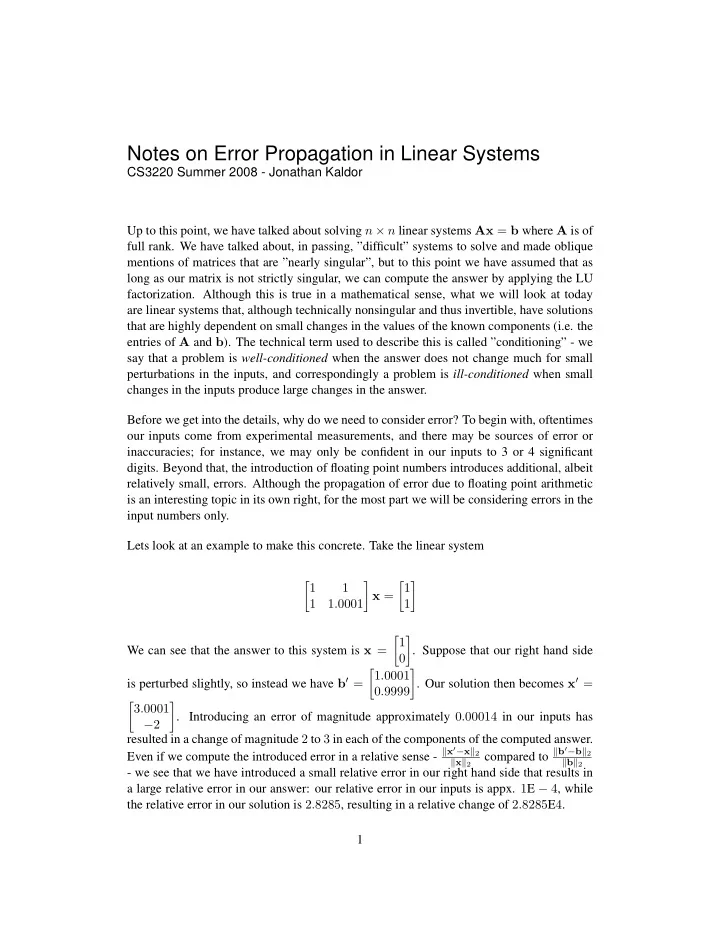
CS3220 Summer 2008 - Jonathan Kaldor Up to this point, we have talked about solving n × n linear systems Ax = b where A is of full rank. We have talked about, in passing, ”difficult” systems to solve and made oblique mentions of matrices that are ”nearly singular”, but to this point we have assumed that as long as our matrix is not strictly singular, we can compute the answer by applying the LU

  • factorization. Although this is true in a mathematical sense, what we will look at today

are linear systems that, although technically nonsingular and thus invertible, have solutions that are highly dependent on small changes in the values of the known components (i.e. the entries of A and b). The technical term used to describe this is called ”conditioning” - we say that a problem is well-conditioned when the answer does not change much for small perturbations in the inputs, and correspondingly a problem is ill-conditioned when small changes in the inputs produce large changes in the answer. Before we get into the details, why do we need to consider error? To begin with, oftentimes

  • ur inputs come from experimental measurements, and there may be sources of error or

inaccuracies; for instance, we may only be confident in our inputs to 3 or 4 significant

  • digits. Beyond that, the introduction of floating point numbers introduces additional, albeit

relatively small, errors. Although the propagation of error due to floating point arithmetic is an interesting topic in its own right, for the most part we will be considering errors in the input numbers only. Lets look at an example to make this concrete. Take the linear system 1 1 1 1.0001

  • x =

1 1

  • We can see that the answer to this system is x =

1

  • . Suppose that our right hand side

is perturbed slightly, so instead we have b′ = 1.0001 0.9999

  • . Our solution then becomes x′ =

3.0001 −2

  • . Introducing an error of magnitude approximately 0.00014 in our inputs has

resulted in a change of magnitude 2 to 3 in each of the components of the computed answer. Even if we compute the introduced error in a relative sense - x′−x2

x2

compared to b′−b2

b2

  • we see that we have introduced a small relative error in our right hand side that results in

a large relative error in our answer: our relative error in our inputs is appx. 1E − 4, while the relative error in our solution is 2.8285, resulting in a relative change of 2.8285E4. 1

slide-2
SLIDE 2

CS3220 - Notes on Error Propagation in Linear Systems 2 Why is this the case? Observe that although our matrix is technically nonsingular, it is pretty close to a singular matrix, namely 1 1 1 1

  • . We can confirm this by looking at the

SVD of our matrix. The singular values are σ1 = 2.00005, σ2 = 0.00005. Although our matrix is not singular, we can see that one of the singular values is very close to 0, and so we are very close to a rank-deficient matrix. Another way of looking at this is to look at the value we are computing: x = A−1b. Again using the SVD, we get x = VΣ−1UT b, which can also be expressed as x =

n

  • i=1

uT

i b

σi vi.

When we have a small singular value σi, we are dividing by a small number, and so a small change in uT

i b is magnified.

One note: we also learned in linear algebra that for singular matrices A, det(A) = 0. Unfortunately, this is not a reliable predictor of ill-conditioned matrices; there are numerous examples of matrices that are nearly singular with perfectly reasonable determinants, and similarly matrices that have very small determinants but are perfectly well behaved. For an instance of the latter, consider aI for any small choice of a: det(aI) = a, but the matrix aI does not magnify the relative error in our solution. What we would like to do is bound the maximum error we will see in our outputs relative to the error in the inputs. For the moment, only consider errors in our right hand side b. Later

  • n we will discuss errors in our matrix A as well.

Suppose we have a RHS vector b, and a perturbed RHS b + δb. Let x = A−1b; that is, x is the exact solution to our original system. We can then write A(x + δx) = b + δb that is, x + δx is the solution to the perturbed system. Expanding the left hand side leads to Ax + Aδx = b + δb Aδx = δb δx = A−1δb since Ax = b. Since we are interested in bounding the magnitude of the error, we now take the norms of both sides. As we saw before, we have many choices for what norm to use, and each norm will give different answers. In this case, though, it doesn’t particularly matter which norm we choose, since we are interested in the magnitude of the changes, and

slide-3
SLIDE 3

CS3220 - Notes on Error Propagation in Linear Systems 3 anyways, vector norm a can be bounded by vector norm b and constants c1, c2 such that c1vb ≤ va ≤ c2vb. So, in short, it doesn’t matter which norm we use as long as we use the same norm everywhere (for both vectors and matrices) Taking the norms of both sides gives us δx = A−1δb ≤ A−1δb where the second statement is true by the definition of the matrix norm induced by the vector norm. This tells us the absolute value of the change, but we would like to bound the relative error. To do that, we can also use the following inequality: b = Ax ≤ Ax We can combine these two inequalities as follows: δx ≤ A−1δb δx b ≤ A−1δb b δx Ax ≤ A−1δb b δx x ≤ AA−1δb b δx x ≤ κ(A)δb b where κ(A) = AA−1 is called the condition number of the matrix A. If A is singular, then we define κ(A) = ∞. Note the following properties of the condition number:

  • 1. κ(A) = κ(A−1)
slide-4
SLIDE 4

CS3220 - Notes on Error Propagation in Linear Systems 4

  • 2. κ(A) ≥ 1
  • 3. κ(cA) = κ(A) for any c = 0
  • 4. If we are using the 2-norm for our analysis, then κ2(A) = σ1

σn .

  • 5. κ2(Q) = 1 if Q is orthogonal

So from above, the condition number bounds the maximum amount of magnification in the relative error of the input that is propagated to the solution. As it turns out, this is a tight bound (within the constraints of our floating point system) – we can choose b and e to achieve this maximum error growth. As an example of getting close to this maximal error growth, recall our example from above: the change in relative growth was 2.8285E4. Computing the condition number of the matrix gives us 4.0002E4, so already we are quite close to the maximal growth, and if we had chosen our RHS and perturbation a bit more carefully (the numbers were chosen more for ease of computation) we could have achieved a growth of 4.0002E4 in our relative error. Using this, we can now see why some of the systems we have discussed are ”difficult” to solve. In particular, take the normal equations method for solving the least squares

  • problem. In that, we end up with a system AT Ax = AT b. Take the SVD of the matrix

A = UΣVT . Then AT A = VΣ2VT . Using the 2-norm for our analysis, then we get κ(AT A) = σ2

1

σ2

n =

  • σ1

σn

2 . Forming the normal equations squares the condition number of the matrix, and thus squares the maximum amount of magnification in error, meaning that we have less confidence in our solution for a given level of input error. Similarly, take the Vandermonde matrix of size 12×12, consisting of xi = i

/12 (that is, the

12 points are evenly spaced from 0 to 1). We said that Vandermonde systems are difficult to solve for high degree polynomials; in this case, the condition number is 3.306E9. The system magnifies errors greatly, and so any small amount of uncertainty or perturbation in

  • ur initial inputs will cause us to potentially lose much of the certainty in our computed

answer. Finally, we have only talked about errors in the right hand side of the equation Ax = b. Suppose instead that we have some errors in A – we then have (A+E)(x+δx) = b+δb. As it turns out, a careful analysis using calculus on matrices leads to the conclusion that the error is still bounded by the condition number of the matrix A: δx x = κ(A) δb b + E A

  • This means that whether we have uncertainty / errors in our data matrix or our right hand

side, we can still bound the maximum amount of error we will have in our solution.

slide-5
SLIDE 5

CS3220 - Notes on Error Propagation in Linear Systems 5 Some caveats: this is measuring the relative error of the vector as a whole (using the vector norm), and not at the level of individual components of the vector. We can also end up with poorly conditioned systems that are the result of bad scaling: consider 1 ǫ

  • x =

1 ǫ

  • The matrix is ill-conditioned for small ǫ, but if we scale the second equation (both sides) by

1 ǫ, we end up with a perfectly conditioned system.

Sources

Gene H. Golub and Charles F. Van Loan. Matrix Computations, Third Edition. Section 2.7 (pages 80-85). The Johns Hopkins University Press, 1996. Michael T. Heath. Scientific Computing: An Introductory Survey, Second Edition. Section 2.3 (pages 52-62) and Section 2.4.10 (pages 83-84). McGraw-Hill, 2002. Cleve B. Moler. Numerical Computing with MATLAB. Section 2.9 (pages 66-72). Society for Industrial and Applied Mathematics, 2004. Steve Marschner. CS322 Notes: Condition Numbers. CS322, Spring 2007. http://www.cs.cornell.edu/courses/cs322/2007sp/notes/condition.pdf.