1 | Energy Efficiency and Renewable Energy eere.energy.gov
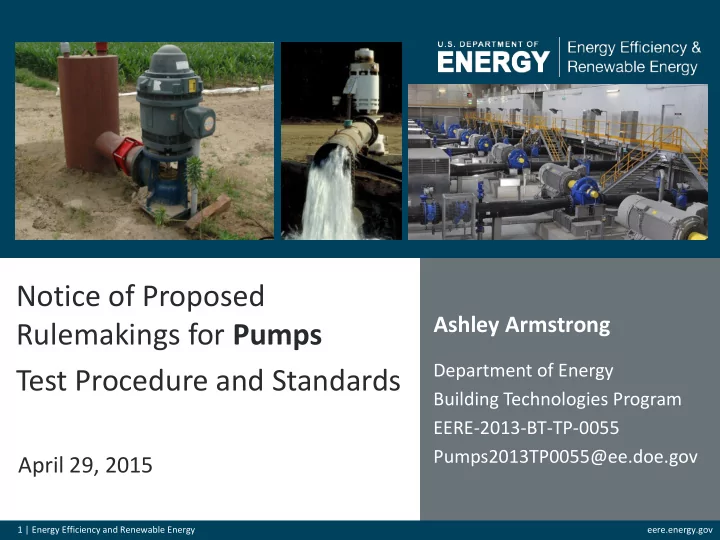
Notice of Proposed Ashley Armstrong Rulemakings for Pumps - - PowerPoint PPT Presentation
Notice of Proposed Ashley Armstrong Rulemakings for Pumps Department of Energy Test Procedure and Standards Building Technologies Program EERE-2013-BT-TP-0055 Pumps2013TP0055@ee.doe.gov April 29, 2015 1 | Energy Efficiency and Renewable
2
Welcome
- Introductions (around the room)
- Role of the Facilitator
- Ground Rules
– Speak one at a time. – Say your name for the record – there will be a complete transcript of this meeting. – Be concise – share the ‘air-time’. – Keep the focus here – cell phones on silent; limit sidebar conversations. – Webinar participants turn phone on mute; “raise your hand” to be recognized to speak.
- Housekeeping Items
- Agenda Review
- Opening Remarks
3
Agenda – Morning (TP)
1) 9:00 AM Introductions & Stakeholder Opening Statements 2) 9:30 AM Regulatory History & Scope 3) 10:00 AM Metric 4) 10:30 AM Test Procedure: Determination of Pump Performance 5) 11:00 AM Break 6) 11:15 AM Test Procedure: Determination of Driver Efficiency 7) 11:45 AM Test Procedure: Calculation & Testing Based Methods 8) 12:30 PM Test Procedure: Sampling Plan 9) 12:45 PM Test Procedure: Burden 10) 1:00 PM Lunch
4
Agenda – Afternoon (ECS)
1) 2:00 PM Welcome, Introductions, Opening Statements 2) 2:10 PM Overview, Scope, Market and Technology Assessment, Screening Analysis 3) 2:30 PM Engineering Analysis 4) 3:00 PM Energy Use, Markup Analysis, Life-Cycle Cost and Payback Period Analysis 5) 3:40 PM Break 6) 3:50 PM Shipments, National Impact Analysis 7) 4:20 PM Manufacturer Impact Analysis 8) 4:35 PM Utility Impact Analysis, Employment Impact Analysis, Emissions Analysis, Regulatory Impact Analysis 9) 4:45 PM Closing Remarks
5
Public Meeting Slides Topics – Morning (TP)
1 Introductions & Stakeholder Opening Statements 2 Regulatory History & Scope 3 Metric 4 Test Procedure: Determination of Pump Performance 5 Break 6 Test Procedure: Determination of Driver Efficiency 7 Test Procedure: Calculation & Testing Based Methods Test Procedure: Sampling Plan Test Procedure: Burden Lunch Break 8 9 10
6
Public Meeting Slide Topics – Afternoon (ECS)
1 Overview 2 Market & Technology; Screening 3 Engineering 4 Markups Analysis; Energy Use 5 Life-Cycle Cost & Payback Period Analysis 6 Shipments; National Impact Analysis 7 MIA; NOPR Analyses; Closing Remarks 8 Proposed Standards; Labeling and Certification; Closing Remarks
7
Listening Via the Webcast
- DOE is broadcasting this meeting live over the Internet.
- DOE is providing the webcast to accommodate stakeholders
who are unable to attend the public meeting in person.
- The web broadcast allows stakeholders to listen in and view
the slides.
- All stakeholders are encouraged to submit written comments
after the public meeting.
8
Purpose of the Public Meeting
- Present DOE’s proposed test procedure and energy conservation
standards for pumps.
– Morning = Test Procedure Notice of Proposed Rulemaking (NOPR) – Afternoon = Energy Conservation Standards NOPR
- Discuss next steps in the rulemakings.
- Invite comment on:
– the test procedure NOPR; – the energy conservation standard NOPR; and – any additional issues raised by interested parties.
9
Opening Remarks
Meeting participants are invited to provide opening remarks or statements at this time.
10
- DOE welcomes comments, data, and information concerning
its proposed test procedure and energy conservation standards for pumps. Whether invited by an issue box or not, comments are welcome on any part of DOE’s analysis.
- Issue boxes are not included for the energy conservation
standard section of this presentation, as the analysis was discussed with the Working Group and directly supports their Recommendations.
Issues for Discussion
Issue Box: Issue boxes in the test procedure section of this presentation correspond to the list of issues published at the end of the NOPR document. These issues will be numbered corresponding to the numbers presented in section V.E of the pumps test procedure NOPR.
11
How to Submit Written Comments
In all correspondence, please refer to these pumps rulemakings by: Postal: Courier
- Ms. Brenda Edwards
U.S. Department of Energy U.S. Department of Energy Building Technologies Program, Building Technologies Program, Suite 600 Mailstop EE-2J 950 L’Enfant Plaza, SW 1000 Independence Avenue, SW Washington, DC 20024 Washington, DC 20585-0121 Tel: 202 586-2945
Title Pumps Test Procedure Pumps Energy Conservation Standard Docket Number: EERE-2013-BT-TP-0055 EERE-2011-BT-STD-0031 Regulation Identification Number (RIN): 1904-AD50 1904-AC54 Email: Pumps2013TP0055@ee.doe.gov Pumps2011STD0031@ee.doe.gov Comments Due: June 15, 2015, 11:59 PM ET June 1, 2015, 11:59 PM ET
12
Public Meeting Slides Topics – Morning (TP)
1 Introductions & Stakeholder Opening Statements 2 Regulatory History & Scope 3 Metric 4 Test Procedure: Determination of Pump Performance 5 Break 6 Test Procedure: Determination of Driver Efficiency 7 Test Procedure: Calculation & Testing Based Methods Test Procedure: Sampling Plan Test Procedure: Burden Lunch Break 8 9 10
13
Statutory Authority
- The Energy Policy and Conservation Act (EPCA) of 1975
established an energy conservation program for certain commercial and industrial equipment.
– This program includes pumps as covered equipment. (42 U.S.C. 6311(1)(A)) – EPCA authorizes DOE to issue standards, test procedures, and labeling requirements for covered equipment. (42 U.S.C. 6295(r), 42 U.S.C. 6315(a), 42 U.S.C. 6316(a)(1))
- Manufacturers must use the test procedure as the basis for:
– Certifying to DOE that their equipment complies with applicable energy conservation standards adopted under EPCA. (42 U.S.C. 6295(s) and 6316(a)(1)), and – Making representations about the energy consumption of the equipment. (42 U.S.C. 6314(d))
14
Regulatory History: Pumps
- There are currently no Federal energy conservations standards or
test procedures for pumps.
- On June 13, 2011, DOE issued a Request for Information (RFI) to
gather information related to pumps. 76 FR 34192.
- On February 1, 2013, DOE published a Framework document
discussing potential methodologies for considering new energy conservation standards and a new test procedure for pumps. 78 FR 7304.
- On July 23, 2013, DOE issued a notice of intent to form a Working
Group under the Appliance Standards Rulemaking Federal Advisory Committee (ASRAC) to negotiate energy conservation standards for pumps (Commercial and Industrial Pumps [Pumps] Working Group). 78 FR 44036.
15
Pumps Working Group Membership
Member Affiliation Lucas Adin U.S. Department of Energy Tom Eckman Northwest Power and Conservation Council (ASRAC Member) Robert Barbour TACO, Inc. Charles Cappelino ITT Industrial Process Greg Case Pump Design, Development and Diagnostics Gary Fernstrom Pacific Gas & Electric Company, San Diego Gas & Electric Company, Southern California Edison, and Southern California Gas Company Mark Handzel Xylem Corporation Albert Huber Patterson Pump Company Joanna Mauer Appliance Standards Awareness Project Doug Potts American Water Charles Powers Flowserve Corporation, Industrial Pumps Howard Richardson Regal Beloit Steve Rosenstock Edison Electric Institute Louis Starr Northwest Energy Efficiency Alliance Greg Towsley Grundfos USA Meg Waltner Natural Resources Defense Council
- The members of the Pumps Working Group were selected to
ensure a broad and balanced representation of stakeholder interests.
16
Regulatory History: Pumps Working Group
- Between December 2013 and June 2014, DOE held seven open meetings
and two webinars to discuss scope, metrics, test procedures, and standard levels for pumps.
– Details of the negotiation sessions and related materials can be found in the docket for the Working Group (http://www.regulations.gov/#!docketDetail;D=EERE-2013-BT-NOC-0039).
- The Pumps Working Group concluded on June 19, 2014, producing 14
recommendations for DOE related to pump energy conservation standards and the pump test procedure (Working Group Recommendations).
– ASRAC voted unanimously to approve the Working Group Recommendations during a July 7, 2014 webinar.
- DOE’s proposed pumps test procedure reflects the Working Group
Recommendations.
– Additional details are discussed in this presentation.
- DOE’s proposed energy conservation standards directly reflect the Working
Group Recommendations.
17
Pumps Test Procedure Rulemaking
- NOPR issued by DOE on March 13, 2015
– NOPR published in the Federal Register on April 1, 2015 (80 FR 17586) – NOPR Public Meeting today, April 29, 2015
- Comments on NOPR from interested parties accepted until June 15, 2015.
– DOE reviews and considers all written and oral comments
- Transcript records oral comments from today’s public meeting
- Written comments
- Final Rule is expected to be issued by December 2015.
NOPR
Final Rule
18
Scope of Covered Equipment
- “Pump” is listed as a type of covered
equipment under EPCA, but is not defined.
- Defining “pump” characterizes the
- verall scope of coverage for pumps that
can be considered in current and future rulemakings.
- The proposed energy conservation
standards and test procedure are limited to an identical and more narrow range of equipment.
“Pump” as Covered Equipment Pumps Subject to Standards and TP in these Rulemakings Issue 1: DOE requests comment on its proposal to match the scopes of the pump test procedure and energy conservation standard rulemakings, as recommended by the Working Group.
Pumps Working Group Recommendation # 4 and 6-8
19
Pump Configurations
Bare Pump Bare Pump + Driver Bare Pump + Driver + Controls
- Pump means equipment that is designed to move liquids (which
may include entrained gases, free solids, and totally dissolved solids) by physical or mechanical action, and includes a bare pump and, if included by the manufacturer at the time of sale, mechanical equipment, driver, and controls.
Proposed Definition of Pump
Bare Pump Pumps Working Group Recommendation # 1 (with slight modification) Driver Bare Pump Driver Control Bare Pump
20
- DOE is also proposing definitions related to the components
that comprise a pump, as recommended by the Working Group:
– Bare pump means a pump excluding mechanical equipment, driver, and controls. – Mechanical equipment means any component of a pump that transfers energy from a driver to the bare pump. – Driver means the machine providing mechanical input to drive a bare pump directly or through the use of mechanical equipment. Examples include, but are not limited to, an electric motor, internal combustion engine, or gas/steam turbine. – Control means any device that can be used to operate the driver.
Examples include, but are not limited to, continuous or non- continuous speed controls, schedule-based controls, on/off switches, and float switches.
Proposed Definitions of Pumps Components
Pumps Working Group Recommendation # 2 (with slight modification)
Issue 2: DOE requests comment on the proposed definitions for ‘‘pump,’’ ‘‘bare pump,’’ ‘‘mechanical equipment,’’ ‘‘driver,’’ and ‘‘control.’’
21
Proposed Pump-Specific Definition of a Basic Model
- DOE proposes the following pump-specific definition for basic model:
– Basic model means all units of a given type of covered equipment (or class thereof) manufactured by one manufacturer, having the same primary energy source, and having essentially identical electrical, physical, and functional (or hydraulic) characteristics that affect energy consumption, energy efficiency, water consumption, or water efficiency; except that:
- RSV* and VTS** pump models for which the bare pump differs in the number of stages
must be considered a single basic model, and
- pump models for which the bare pump differs in impeller diameter, or impeller trim, may
be considered a single basic model or separate basic models.
- The certified ratings for a given pump basic model will be based on the
specified numbers of stages required for testing under the test procedure and
- n that model’s full impeller diameter.
– Variations in motor sizing as a result of different impeller trims would not be a basis for differentiating basic models.
Pumps Working Group Recommendations # 7, 14 * RSV = Radially split, multi-stage, vertical, in-line diffuser casing pump ** VTS = Vertical turbine submersible pump
22
Proposed Definition of Full Impeller
- DOE proposes a definition of full impeller that would:
– apply to all pump models, including custom pumps and those that are
- nly distributed in commerce with trimmed impellers, and
– allow manufacturers the flexibility to rate a model with a trimmed impeller as less consumptive than at full impeller, if desired.
- Full impeller diameter means [either]:
(1) the maximum diameter impeller used with a given pump basic model distributed in commerce or (2) the maximum diameter impeller referenced in the manufacturer’s literature for that pump basic model,
whichever is larger.
Issue 7: DOE requests comment on the proposed definition for ‘‘full impeller.’’
Pumps Working Group Recommendations # 7 (with slight modification)
23
Basic Model for Pumps Sold with Motors
- Manufacturers often pair a given bare pump with several different motors of
varying performance characteristics.
- To rate these pump and motor combinations, manufacturers may:
– rate each pairing of a bare pump at full impeller with a motor as a unique basic model, OR – group multiple motor pairings with the same bare pump at full impeller into a single basic model.
Pump and Motor Combinations Driver Performance Energy Rating Multiple Basic Models Single Basic Model Highest Efficiency Highest Efficiency Lowest Efficiency Middle Efficiency Middle Efficiency Lowest Efficiency Lowest Efficiency
Driver A Bare Pump Driver B Bare Pump Driver C Bare Pump
24
Requests for Comment
Issue 6: DOE requests comment on DOE’s proposal to allow manufacturers the option of rating pumps with trimmed impellers as a single basic model or separate basic models, provided the rating for each pump model is based on the maximum impeller diameter available within that basic model. Issue 8: DOE requests comment on the proposal to require that all pump models be rated in a full impeller configuration only.
25
Pump Categories
ESCC
Rotodynamic Pumps Rotodynamic Pumps Subject to TP and Standards
Radial-Split Horizontal
Positive Displacement
Vertical Turbine Dedicated- Purpose Pool Axial Split Multi-Stage
Double Suction
Immersible Circulator Mixed/Axial ESFM VTS RSV IL
Pumps
Pumps Working Group Recommendations #5A, 5B, 6
- DOE proposes that the test procedure and energy conservation standards
are applicable to certain categories of rotodynamic pumps.
ESCC
26
Rotodynamic Pumps Subject to Proposed TP and Standards
Equipment Class Acronym HI Nomenclature (A) End Suction Close-Coupled ESCC OH7 (A) End Suction Frame Mounted ESFM OH0,OH1 (A) In-Line IL OH3, OH4, OH5 (B) Radially Split, Multi-Stage, Vertical, Inline Diffuser Casing RSV VS8 (B) Vertical Turbine Submersible VTS VS0
Note: Pump diagrams provided by HI. Source: (A) 2014 version of ANSI/HI Standard 1.1-1.2, “Rotodynamic (Centrifugal) Pumps For Nomenclature And Definitions” (ANSI/HI 1.1-1.2–2014) or (B) 2008 version of ANSI/HI Standard 2.1-2.2, “Rotodynamic (Vertical) Pumps For Nomenclature And Definitions” (ANSI/HI 2.1-2.2–2008). Pumps Working Group Recommendation #4
27
Proposed Definitions of Pump Classes: Method
- DOE developed proposed definitions for the five pump
equipment classes to accomplish the following:
– Cleary identify the equipment that would be subject to the standards and test procedure.
- DOE referenced HI nomenclature in the definitions as requested by
stakeholders.
– Create mutually exclusive equipment classes, e.g. ESCC versus ESFM. – Make the equipment classes mutually exclusive from other pumps not proposed to be part of this rulemaking, for example:
- ESCC, ESFM, and IL versus circulators;
- ESCC and ESFM versus dedicated-purpose pool pumps; and
- RSV versus immersible pumps.
- DOE also proposed definitions for rotodynamic pump, end
suction pump, and single axis flow pump to support the equipment class definitions.
28
Add’l Proposed Definitions Related to Pump Equipment Classes
- Rotodynamic pump means a pump in which energy is
continuously imparted to the pumped fluid by means of a rotating impeller, propeller, or rotor.
- End suction pump means a single-stage, rotodynamic pump in
which the liquid enters the bare pump in a direction parallel to the impeller shaft and on the side opposite the bare pump’s driver-end. The liquid is discharged through a volute in a plane perpendicular to the shaft.
- Single axis flow pump means a pump in which the liquid inlet of
the bare pump is on the same axis as the liquid discharge of the bare pump.
29
Proposed Definitions of Pump Equipment Classes (1)
- End suction close-coupled (ESCC) pump means an end suction pump in which:
(1) the motor shaft also serves as the impeller shaft for the bare pump; (2) the pump requires attachment to a rigid foundation to function as designed and cannot function as designed when supported only by the supply and discharge piping to which it is connected; and (3) the pump does not include a basket strainer.
– Examples include, but are not limited to, pumps complying with ANSI/HI nomenclature OH7, as described in ANSI/HI 1.1–1.2–2014.
- End suction frame mounted (ESFM) pump means an end suction pump where:
(1) the bare pump has its own impeller shaft and bearings and does not rely on the motor shaft to serve as the impeller shaft; (2) the pump requires attachment to a rigid foundation to function as designed and cannot function as designed when supported only by the supply and discharge piping to which it is connected; and (3) the pump does not include a basket strainer.
– Examples include, but are not limited to, pumps complying with ANSI/HI nomenclature OH0 and OH1, as described in ANSI/HI 1.1–1.2–2014.
- In-line (IL) pump means a single-stage, single axis flow, rotodynamic pump in which:
(1) liquid is discharged through a volute in a plane perpendicular to the impeller shaft; and (2) the pump requires attachment to a rigid foundation to function as designed and cannot function as designed when supported only by the supply and discharge piping to which it is connected.
– Examples include, but are not limited to, pumps complying with ANSI/HI nomenclature OH3, OH4, or OH5, as described in ANSI/HI 1.1–1.2–2014.
To exclude circulators To exclude dedicated- purpose pool pumps
30
Proposed Definitions of Pump Equipment Classes (2)
- Radially split, multi-stage, vertical, inline diffuser casing (RSV) pump means
a vertically suspended, multi-stage, single axis flow, rotodynamic pump in which: (1) liquid is discharged in a plane perpendicular to the impeller shaft, (2) each stage (or bowl) consists of an impeller and diffuser, and (3) no external part of such a pump is designed to be submerged in the pumped liquid.
– Examples include, but are not limited to, pumps complying with ANSI/HI nomenclature VS8, as described in ANSI/HI 2.1–2.2–2008.
- Vertical turbine submersible (VTS) pump means a single-stage or multistage
rotodynamic pump that is designed to be operated with the motor and stage(s) (or bowl(s)) fully submerged in the pumped liquid, and in which: (1) each stage of this pump consists of an impeller and diffuser, and (2) liquid enters and exits each stage of the bare pump in a direction parallel to the impeller shaft.
– Examples include, but are not limited to, pumps complying with ANSI/HI nomenclature VS0, as described in ANSI/HI 2.1–2.2–2008.
To exclude immersible
31
Requests for Comment
Issue 10: DOE requests comment on its application of the proposed test procedure to the five listed pump equipment classes. Issue 11: DOE requests comment on the proposed definitions for the five equipment classes. Issue 12: DOE requests comment on whether the references to ANSI/HI nomenclature are (1) necessary as part of the equipment definitions in the regulatory text or (2) likely to cause confusion because of inconsistencies. DOE also seeks comment on whether discussing the ANSI/HI nomenclature in this preamble would provide sufficient reference material for manufacturers when determining the appropriate equipment class for their pump models.
32
Requests for Comment
Issue 13: DOE requests comment on whether it needs to clarify the flow direction to distinguish RSV pumps from other similar pumps when determining test procedure and standards applicability. Issue 14: DOE requests comment on whether any additional language in the RSV definition is necessary to make the exclusion of immersible pumps clearer. Issue 17: DOE is interested in whether any pumps commonly referred to as ESCC, ESFM, or IL do not require attachment to a rigid foundation to function as designed.
33
Circulators and Pool Pumps
- The Pumps Working Group recommended that circulator pumps and
dedicated-purpose pool pumps be addressed as part of separate rulemakings.
- To distinguish between circulator and dedicated-purpose pool pumps, DOE
proposed design-based definitions:
– Circulator means a pump that: (1) is either an end suction pump or a single-stage, single-axis flow, rotodynamic pump; and (2) has a pump housing that only requires the support of the supply and discharge piping to which it is connected (without attachment to a rigid foundation) to function as designed.
- Examples include, but are not limited to, pumps complying with ANSI/HI nomenclature
CP1, CP2, or CP3, as described in ANSI/HI 1.1–1.2– 2014.
– Dedicated-purpose pool pump means an end suction pump designed specifically to circulate water in a pool and that includes an integrated basket strainer.
- If mutually exclusive through design, a size-based
threshold is unnecessary.
Pumps Working Group Recommendations # 5A, 5B
Use of only pipe- mounted support provides clear and unambiguous differentiation from pumps in this rulemaking. Use of integrated basket strainer as design feature differentiating from pumps in this rulemaking. Issue 16: DOE also requests comment on the proposed definitions for circulators and dedicated-purpose pool pumps.
34
Axial/Mixed Flow and Positive Displacement Pumps
Issue 18: DOE requests comment on its initial determination that axial/mixed flow and PD pumps are implicitly excluded from this rulemaking based on the proposed definitions and scope parameters. In cases where commenters suggest a more explicit exclusion be used, DOE requests comment on the appropriate changes to the proposed definitions or criteria that would be needed to appropriately differentiate axial/mixed flow and/or PD pumps from the specific rotodynamic pump equipment classes proposed for coverage in this NOPR.
- The Pumps Working Group recommended excluding axial/mixed flow
and positive displacement pumps from the current rulemakings.
- DOE believes that the proposed definitions and scope parameters
implicitly exclude these pump types.
Pumps Working Group Recommendation #6
35
Definition of Clean Water Pump
- DOE proposed to limit the
scope of the test procedure and energy conservation standards to clean water pumps, defined as follows:
– Clean water pump means a pump that is designed for use in pumping water with a maximum non-absorbent free solid content
- f 0.25 kilograms per cubic meter,
and with a maximum dissolved solid content of 50 kilograms per cubic meter, provided that the total gas content of the water does not exceed the saturation volume, and disregarding any additives necessary to prevent the water from freezing at a minimum of -10 °C.
Pumps
Clean Water Pumps
Wastewater
Chemical Process (ASME B73.1) Hydrocarbon (API 610)
Fire Sump
Solids Handling
Slurry
Sanitary (3A 02-11)
Self- Priming Prime- Assist Sealless Nuclear Facility MIL- SPEC
Clean Water Pumps In Rulemaking
Pumps Working Group Recommendation #8
Issue 19: DOE requests comment on the proposed definition for ‘‘clean water pump.’’
Fire Pump
36
Requests for Comment
Issue 21: DOE requests comment on the proposed definition for ‘‘fire pump,’’ ‘‘self- priming pump,’’ ‘‘prime-assisted pump,’’ and ‘‘sealless pump.’’ Issue 22: Regarding the proposed definition of a self-priming pump, DOE notes that such pumps typically include a liquid reservoir above or in front of the impeller to allow recirculating water within the pump during the priming cycle. DOE requests comment on any other specific design features that enable the pump to operate without manual re- priming, and whether such specificity is needed in the definition for clarity. Issue 23: DOE requests comment on the proposed specifications and criteria to determine if a pump is designed to meet a specific Military Specification and if any Military Specifications other than MIL–P–17639F should be referenced. Issue 24: DOE requests comment on excluding the following pumps from the test procedure: Fire pumps, self-priming pumps, prime-assist pumps, sealless pumps, pumps designed to be used in a nuclear facility, and pumps meeting the design and construction requirements set forth in Military Specification MIL–P–17639F.
37
Proposed Pump Parameters
- DOE proposes to further limit the test procedure and energy
conservation standards to:
– pumps with the following performance and design characteristics: – And pumps designed to operate with the following styles of motors:
Pumps Working Group Recommendation #7 (with modification)
Parameter Criteria Shaft Power at the Best Efficiency Point, BEP*, at Full Impeller Diameter for the Number of Stages Required for Testing to the Standard 1–200 hp BEP Flow Rate at Full Impeller Diameter ≥25 gpm Head at BEP at Full Impeller Diameter ≤459 feet Design Temperature
- 10 to 120 °C
Bowl Diameter for VTS Pumps (HI VS0) ≤6 inches
Style of Motor Nominal Speed of Rotation for Rating (at 60 Hz) 2-Pole Induction Motor 3,600 rpm 4-Pole Induction Motor 1,800 rpm Non-Induction Motor Designed to Operate Between 2,880 and 4,320 rpm 3,600 rpm Non-Induction Motor Designed to Operate Between 1,440 and 2,160 rpm 1,800 rpm
38
Proposed Definition of Bowl Diameter
Issue 25: DOE requests comment on the listed design characteristics (i.e., power, flow, head, design temperature, design speed, and bowl diameter) as limitations on the scope of pumps to which the proposed test procedure would apply. Issue 26: DOE requests comment on the proposed definition for ‘‘bowl diameter’’ as it would apply to VTS pumps.
- To ensure consistent application of the design criteria related to bowl
diameter, DOE proposes to define bowl diameter as follows:
– Bowl diameter means the maximum dimension of an imaginary straight line passing through and in the plane of the circular shape of the intermediate bowl or chamber of the bare pump that is perpendicular to the pump shaft and that intersects the circular shape of the intermediate bowl or chamber
- f the bare pump at both of its ends, where the intermediate bowl or
chamber is as defined in ANSI/HI 2.1–2.2–2008.
39
- The proposed test procedure and energy conservation standards would
apply to pumps in three main configurations:
- However, the appropriate and applicable test method(s) will depend on the
style of driver and control with which the pump is being rated:
Pump Configurations
Non-Electric Driver Single-Phase Induction Motor Covered Poly-Phase Electric Motor Non-Covered Poly-Phase Electric Motor Submersible Motor Continuous Control Non-Continuous Control Controls Other than Continuous or Non-Continuous
Driver
Bare Pump Bare Pump + Driver Bare Pump + Driver + Controls
Bare Pump Driver Bare Pump Driver Control Bare Pump Control
40
- DOE is primarily concerned with controls that reduce pump power input at a
given flow rate, specifically continuous and non-continuous controls:
Proposed Control Category Definitions
- Continuous control means a control that
adjusts the speed of the pump driver continuously over the driver operating speed range in response to incremental changes in the required pump flow, head, or power
- utput.
- Non-continuous control means a control that
adjusts the speed of a driver to one of a discrete number of non-continuous preset
- perating speeds, and does not respond to
incremental reductions in the required pump flow, head, or power output. “Control” as Part of Covered Equipment Controls that Reduce Energy Consumption
On/Off Switch Float Switch Schedule-Based VFD ECM Multi-Speed Motor
Continuous Controls
Non-Continuous Controls
Issue 3: DOE requests comment on the proposed definitions for ‘‘continuous control’’ and ‘‘non-continuous control.’’
41
Rated As Test Method Applicable Pump Configurations Bare Pump Calculation
- Based
Only Pump + Motor Testing- Based Only Testing- Based or Calculation
- Based
Pump + Motor + Controls Testing- Based Only Testing- Based or Calculation
- Based
Rating Covered Pump Configurations
Covered Poly-Phase Electric Motor
Bare Pump
Non-Electric Driver
Bare Pump
Single-Phase Induction Motor
Bare Pump Bare Pump
Covered Poly-Phase Electric Motor Non-Continuous Control
Bare Pump
Covered Poly-Phase Electric Motor Continuous Control
Bare Pump
Submersible Motor Continuous Control
Bare Pump
Submersible Motor Non-Continuous Control
Bare Pump
Non-Covered Poly-Phase Electric Motor Continuous or Non-Continuous Control
Bare Pump
Submersible Motor
Bare Pump
Non-Covered Poly-Phase Electric Motor
Bare Pump
Non-Covered Poly-Phase Electric Motor Controls Other than Continuous or Non-Continuous
Bare Pump
Pumps Working Group Recommendation #3 (Non-Electric Drivers)
Covered Poly-Phase Electric Motor Controls Other than Continuous or Non-Continuous
Bare Pump
Submersible Motor Controls Other than Continuous or Non-Continuous
Bare Pump
42
Requests for Comment
Issue 27: DOE requests comment on its proposal to test pumps sold with non-electric drivers as bare pumps. Issue 28: DOE requests comment on its proposal that any pump distributed in commerce with a single-phase induction motor be tested and rated in the bare pump configuration, using the calculation method. Issue 29: DOE requests comment from interested parties on any
- ther categories of electric motors, except submersible motors,
that: (1) are used with pumps considered in this rulemaking and (2) typically have efficiencies lower than the default nominal full- load efficiency for NEMA Design A, NEMA Design B, or IEC Design N motors.
43
Public Meeting Slides Topics – Morning (TP)
1 Introductions & Stakeholder Opening Statements 2 Regulatory History & Scope 3 Metric 4 Test Procedure: Determination of Pump Performance 5 Break 6 Test Procedure: Determination of Driver Efficiency 7 Test Procedure: Calculation & Testing Based Methods Test Procedure: Sampling Plan Test Procedure: Burden Lunch Break 8 9 10
44
Proposed Rating Metric
Pump Energy Index Constant Load Pump Energy Index (PEICL) Variable Load Pump Energy Index (PEIVL) Ratio Pump Energy Rating * * PER Load Profile i = 75, 100, and 110%
- f BEP Flow
i = 25, 50, 75, and 100%
- f BEP Flow
PERSTD PERCL for Minimally Compliant Pump of the Same Equipment Class Serving the Same Hydraulic Load Applicable Pump Configurations Pumps Sold without Continuous
- r Non-Continuous Controls
Pumps Sold with Continuous or Non-Continuous Controls
*Where: wi = weight at each load point i Pin
i = power input to the “pump” at the driver, inclusive of the controls if present, (hp)
i = Percentage of flow at the Best Efficiency Point (BEP) of the pump 𝑸𝑭𝑱𝑫𝑴 =
𝑄𝐹𝑆𝐷𝑀 𝑄𝐹𝑆𝑇𝑈𝐸
𝑸𝑭𝑱𝑾𝑴 =
𝑄𝐹𝑆𝑊𝑀 𝑄𝐹𝑆𝑇𝑈𝐸
𝑸𝑭𝑺𝑫𝑴 = 𝜕𝑗 𝑄𝑗𝑜𝑗
𝑗
𝑸𝑭𝑺𝑾𝑴 = 𝜕𝑗 𝑄𝑗𝑜𝑗
𝑗
Pumps Working Group Recommendation #11
45
Metric Rated As Test Method Applicable Pump Configurations
PEICL
Bare Pump Calculation- Based Only Pump + Motor Testing- Based Only Testing- Based or Calculation- Based
PEIVL
Pump + Motor + Controls Testing- Based Only Testing- Based or Calculation- Based
Proposed Rating Metric Based on Pump Configuration
Covered Poly-Phase Electric Motor
Bare Pump
Non-Electric Driver
Bare Pump
Single-Phase Induction Motor
Bare Pump Bare Pump
Covered Poly-Phase Electric Motor Non-Continuous Control
Bare Pump
Covered Poly-Phase Electric Motor Continuous Control
Bare Pump
Submersible Motor Continuous Control
Bare Pump
Submersible Motor Non-Continuous Control
Bare Pump
Non-Covered Poly-Phase Electric Motor Continuous or Non-Continuous Control
Bare Pump
Submersible Motor
Bare Pump
Non-Covered Poly-Phase Electric Motor
Bare Pump
Non-Covered Poly-Phase Electric Motor Controls Other than Continuous or Non-Continuous
Bare Pump
Covered Poly-Phase Electric Motor Controls Other than Continuous or Non-Continuous
Bare Pump
Submersible Motor Controls Other than Continuous or Non-Continuous
Bare Pump
46
Issue 30: DOE requests comment on the proposed load points and weighting for PEICL for bare pumps and pumps sold with motors and PEIVL for pumps inclusive of motors and continuous or non-continuous controls. Issue 31: DOE requests comments on the proposed PEICL and PEIVL metric architecture.
Requests for Comment
47
Determining PEI
- The PEI represents the performance of the pump, motor, and
controls, if present.
Metric Rated As Test Method Bare Pump Performance Motor Performance Controls Performance
PEICL
Bare Pump
Calculation
- Based
Only Tested Minimally Compliant Motor Efficiency with Assumed Part-Load Losses N/A
Pump + Motor
Testing- Based Only Tested N/A Testing- Based or Calculation
- Based
Tested Nominal Motor Efficiency with Assumed Part-Load Losses N/A
PEIVL
Pump + Motor + Controls
Testing- Based Only Tested Testing- Based or Calculation
- Based
Tested Nominal Motor Efficiency Assumed System Curve and Assumed Part-Load Losses of Motor + Controls
48
Determining PEICL for an Uncontrolled Pump
𝑄𝐹𝐽𝐷𝑀 =
𝑄𝐹𝑆𝐷𝑀 𝑄𝐹𝑆𝑇𝑈𝐸
=
𝜕75% 𝑄𝑗𝑜75% +𝜕100% 𝑄𝑗𝑜100% +𝜕110% 𝑄𝑗𝑜110% 𝑄𝐹𝑆𝑇𝑈𝐸
=
1 3∗ 𝑄75%+𝑀75% +1 3∗ 𝑄100%+𝑀100% +1 3∗ 𝑄110%+𝑀110%
𝑄𝐹𝑆𝑇𝑈𝐸
Testing-Based Approach Calculation-Based Approach
- Tested driver input power (𝑄𝑗𝑜100%) is
measured directly – Pi values are the tested input power to the driver (motor) at each load point i.
- i = 75%, 100%, and 110% of flow
rate at BEP of the bare pump
- Equal weighting
– Reflects the performance of both the bare pump and the motor.
- Bare Pump Performance
– Pi values are the tested shaft input power to the pump (speed x torque) at each load point i.
- i = 75%, 100%, and 110% of flow rate at BEP of the
bare pump
- Equal weighting
- Motor Performance (Losses)
– Li is either:
- (A) the part-load losses of a motor that is paired with
the pump for pumps sold with motors or
- (B) the part-load losses of an open or enclosed motor
that is minimally compliant with DOE’s motor regulations (10 CFR 431.25) for NEMA Design A, Design B, IEC Design N Electric Motors except for submersible motors, sized based on shaft input power
- f the pump evaluated at 120% of BEP flow
- No Controls
- No Controls
49
PERSTD: Minimally Compliant Pump
- PERSTD is equivalent to PERCL for a minimally compliant pump
– Based on the tested characteristics and hydraulic load of the pump being rated. – Assumes a pump curve shape for the minimally compliant pump and always assumes no controls. – Motor losses are that of a minimally compliant open or enclosed motor for the appropriate pump equipment class, horsepower configuration, and speed. – The minimally compliant pump efficiency is calculated for each pump equipment class based on a function of flow and speed of the pump being rated.
𝑄𝐹𝑆𝑇𝑈𝐸 = 𝜕75% 𝑄𝐼𝑧𝑒𝑠𝑝,75% 0.95 ∗ 𝜃𝑞𝑣𝑛𝑞,𝑇𝑈𝐸 + 𝑀75% + 𝜕100% 𝑄𝐼𝑧𝑒𝑠𝑝,100%𝑄 𝜃𝑞𝑣𝑛𝑞,𝑇𝑈𝐸 + 𝑀100% + 𝜕110% 𝑄
1.10%
0.985 ∗ 𝜃𝑞𝑣𝑛𝑞,𝑇𝑈𝐸 + 𝑀110%
Where: Ns = the specific speed at 60 Hz, Q = the flow rate of the pump at BEP in GPM, C = the C-value of the surface, which is set based
- n the speed of rotation of the pump, and
the pump equipment class 𝜃𝑞𝑣𝑛𝑞,𝑇𝑈𝐸 = −0.85 ∗ ln 𝑅100% 2 − 0.38 ∗ ln 𝑂𝑡 ∗ ln 𝑅100% − 11.48 ∗ ln 𝑂𝑡 2 + 17.80 ∗ ln 𝑅100% + 179.80 ∗ ln 𝑂𝑡 − (𝐷 + 555.6)
50
Determining PEIVL for a Controlled Pump
𝑄𝐹𝐽𝑊𝑀 = 𝑄𝐹𝑆𝑊𝑀 𝑄𝐹𝑆𝑇𝑈𝐸
= 𝜕25% 𝑄𝑗𝑜25% + 𝜕50% 𝑄𝑗𝑜50% + 𝜕75% 𝑄𝑗𝑜75% + 𝜕100% 𝑄𝑗𝑜100% 𝑄𝐹𝑆𝑇𝑈𝐸 = 1 4 𝑄
25% + 𝑀25% + 1
4 𝑄𝑗𝑜50% + 𝑀50% + 1 4 𝑄𝑗𝑜75% + 𝑀75% + 1 4 𝑄𝑗𝑜100% + 𝑀100% 𝑄𝐹𝑆𝑇𝑈𝐸
Testing-Based Approach Calculation-Based Approach
- Tested driver input power (𝑄𝑗𝑜100%) is measured
directly – Pi values are the tested input power to the driver (control) at each load point i.
- i = 25%, 50%, 75%, and 100% of flow rate at
BEP of the bare pump
- Equal weighting
– Reflects the performance of the bare pump, motor, and control.
- Pump Performance
– Pin values are the input electrical power to the drive a load point i.
- i = 25%, 50%, 75%, and 100% of flow rate at BEP of
the pump
- Equal weighting
- Motor Performance (Losses)
– Li is the part-load losses of motor and control that are paired with the pump
- Controls Performance
– Benefit is captured in the calculation of bare shaft input power. – Accounts for drive efficiency in tested driver input power.
- Controls Performance
– Benefit is captured in the calculation of bare shaft input power. – Accounts for drive efficiency in calculated losses
51
Request for Comment
Issue 32: DOE requests comment on its proposal to base the default motor horsepower for the minimally compliant pump on that of the pump being evaluated. That is, the motor horsepower for the minimally compliant pump would be based on the calculated pump shaft input power of the pump when evaluated at 120 percent of BEP flow for bare pumps and the horsepower of the motor with which that pump is sold for pumps sold with motors (with or without continuous or non-continuous controls).
52
Public Meeting Slides Topics – Morning (TP)
1 Introductions & Stakeholder Opening Statements 2 Regulatory History & Scope 3 Metric 4 Test Procedure: Determination of Pump Performance 5 Break 6 Test Procedure: Determination of Driver Efficiency 7 Test Procedure: Calculation & Testing Based Methods Test Procedure: Sampling Plan Test Procedure: Burden Lunch Break 8 9 10
53
Determination of Pump Performance
- To determine PEICL or PEIVL, as applicable, the input power to the pump at
the specified load points is required.
- The proposed test procedure requires physically measuring either:
– the bare pump (for calculation-based methods), or – the entire pump, inclusive of any motor, continuous control, or non-continuous control (for testing-based methods).
- DOE’s test procedure, as proposed, requires instructions for how to
physically measure the performance of bare pumps, pumps with motors, and pumps with motors and continuous or non-continuous controls in a standardized and consistent manner.
54
Referenced Industry Standards
- Consistent with Working Group Recommendations, DOE
proposes to incorporate by reference the Hydraulic Institute (HI) Standard 40.6–2014, “Methods for Rotodynamic Pump Efficiency Testing,” as part of DOE’s test procedure for measuring the energy consumption of pumps, with a few minor modifications.
Pumps Working Group Recommendation # 10 (with slight modifications)
Issue 33: DOE requests comment on using HI 40.6– 2014 as the basis of the DOE test procedure for pumps.
Proposed Minor Modifications Include: Exclude sections not relevant to DOE’s regulatory framework Section 40.6.5.3 and appendix B (reporting) & section A.7 (high temperature testing) Specify data collection interval Collect data every 5 seconds Specify allowable integration
- f data for stabilization
Dampening devices cannot integrate over time periods ≥5 seconds Improve test repeatability Pumps speed, power supply characteristics, number of stages for multi-stage pumps, determination of pump shaft input power, electrical measurement equipment, pumps with BEP at run-out, calculations and rounding
55
Pump Speed
- HI 40.6–2014 does not clearly specify nominal rating speeds for tested pump models.
- DOE proposes that all test data be adjusted (in accordance with section 40.6.6.1.1) to
the following nominal speed prior to use in subsequent calculations:
- Consistent with HI 40.6–2014, DOE proposes that the tested speed must be
maintained within 20 percent of the nominal speed, and the speed of rotation recorded at each test point may not vary more than ±1 percent to ensure accurate and reliable results.
Pump Configuration Pump Design Speed of Rotation Style of Motor Nominal Speed
- f Rotation for
Rating Bare Pump 2,880 and 4,320 rpm N/A 3,600 rpm 1,440 and 2,160 rpm 1,800 rpm Pump + Motor OR Pump + Motor + Control N/A 2-Pole Induction Motor 3,600 rpm N/A 4-Pole Induction Motor 1,800 rpm N/A Non-Induction Motor Designed to Operate Between 2,880 and 4,320 rpm 3,600 rpm N/A Non-Induction Motor Designed to Operate Between 1,440 and 2,160 rpm 1,800 rpm
56
Requests for Comment
Issue 37: DOE requests comment on its proposal to require data collected at the pump speed measured during testing to be normalized to the nominal speeds of 1,800 and 3,600 rpm. Issue 38: DOE requests comment on its proposal to adopt the requirements in HI 40.6–2014 regarding the deviation of tested speed from nominal speed and the variation of speed during the test. Specifically, DOE is interested if maintaining the tested speed within ±1 percent of the nominal speed is feasible and whether this approach would produce more accurate and repeatable test results.
57
Power Supply Characteristics
- To determine the appropriate power supply characteristics for testing pumps with
motors and pumps with both motors and continuous or non-continuous controls, DOE examined applicable test methods for electric motors and VSD systems.
- DOE proposes to establish these power supply requirements in the DOE pump test
procedure for measurement of electric input power to the motor or controls.
Test Procedure Applicable Equipment Voltage Requirement Frequency Requirement Total Harmonic Distortion Impedance IEEE Standard 112– 2004 Electric Motors Maintained Within ±0.5% and “Voltage Unbalance” ≤0.5% Maintained Within ±0.5% <5% N/A AHRI 1210–2011 Variable Speed Drives N/A ≤1% CSA C838–2013 Variable Speed Drives <5% >1% and ≤3%
Issue 39: DOE requests comment on the proposed voltage, frequency, voltage unbalance, total harmonic distortion, and impedance requirements that are required when performing a wire-to-water pump test or when testing a bare pump with a calibrated motor. Specifically, DOE requests comments on whether these tolerances can be achieved in typical pump test labs, or whether specialized power supplies or power conditioning equipment would be required.
58
Measurement Equipment for Testing of Controlled Pumps
- When measuring input power to the pump for pumps sold with a motor and
continuous or non-continuous controls, the equipment specified in section C.4.3.1, “electric power input to the motor,” of HI 40.6–2014 may not be sufficient.
- CSA C838–2013 and AHRI 1210–2011 require that electrical measurements
for determining variable speed drive efficiency be taken using equipment:
– capable of measuring current, voltage, and real power up to at least the 40th harmonic of fundamental supply source frequency and – having an accuracy level of ±0.2 percent of full scale when measured at the fundamental supply source frequency.
- DOE proposes that the electrical measurement equipment specified in AHRI
1210–2011 and CSA C838–2013 be required for the purposes of measuring input power to a pump sold with a motor and continuous or non-continuous controls.
Issue 43: DOE requests comment on the type and accuracy of required measurement equipment, especially the equipment required for electrical power measurements for pumps sold with motors having continuous or non-continuous controls.
59
Pump Shaft Input Power at Load Points
- The test protocol in HI 40.6–2014 requires that test data be collected at 40, 60, 75,
90, 100, 110, and 120 percent of the expected BEP flow.*
– HI 40.6–2014 does not specify how to determine relevant parameters at the specific load points (i.e., 75, 100, or 110 percent of the actual BEP flow for PERCL and PERSTD).
- DOE proposes that the pump shaft input power at the specific load points of 75, 100,
and 110 percent of expected BEP flow be determined by regressing the pump shaft input power with respect to flow for the measured data at the load points between 60 and 110 percent of expected BEP flow.
10 20 30 40 50 60 50 100 150 Pump Shaft Input Power (hp) Percent of BEP Flow Rate Load points above 60% of expected BEP flow Load points below 60% of expected BEP flow Linear (Load points above 60% of expected BEP flow)
Issue 41: DOE requests comment on its proposal to use a linear regression of the pump shaft input power with respect to flow rate at all the tested flow points greater than or equal to 60 percent of expected BEP flow to determine the pump shaft input power at the specific load points of 75, 100, and 110 percent of BEP flow. DOE is especially interested in any pump models for which such an approach would yield inaccurate measurements.
* For pumps with BEP at run-out data shall be collected at 40, 50, 60, 70, 80, 90, and 100% of expected BEP flow
60
Public Meeting Slides Topics – Morning (TP)
1 Introductions & Stakeholder Opening Statements 2 Regulatory History & Scope 3 Metric 4 Test Procedure: Determination of Pump Performance 5 Break 6 Test Procedure: Determination of Driver Efficiency 7 Test Procedure: Calculation & Testing Based Methods Test Procedure: Sampling Plan Test Procedure: Burden Lunch Break 8 9 10
61
Public Meeting Slides Topics – Morning (TP)
1 Introductions & Stakeholder Opening Statements 2 Regulatory History & Scope 3 Metric 4 Test Procedure: Determination of Pump Performance 5 Break 6 Test Procedure: Determination of Driver Efficiency 7 Test Procedure: Calculation & Testing Based Methods Test Procedure: Sampling Plan Test Procedure: Burden Lunch Break 8 9 10
62
Determining of Motor Efficiency
Nominal Full-Load Motor Efficiency Default Full-Load Motor Efficiency Metric Applicability PERCL or PERVL for pumps + motors and pumps + motors + controls PERCL for Bare Pumps PERSTD for All Pumps Default Nominal Motor Full- Load Efficiency for Pumps Rated with... Covered Poly-Phase Electric Motor Measured Nominal Full-Load Efficiency Determined in Accordance with the DOE Electric Motor Test Procedure Specified at 10 CFR 431.16 and Appendix B to Subpart B
- f Part 431
Nominal Full-Load Motor Efficiency (Standard) for General Purpose, Polyphase, NEMA Design A, NEMA Design B, and IEC Design N Motors Defined at 10 CFR 431.25 Non-Covered Poly- Phase Electric Motor Not Applicable (Only Testing- Based Approach can be Used) Nominal Full-Load Motor Efficiency (Standard) for General Purpose, Polyphase, NEMA Design A, NEMA Design B, and IEC Design N Motors Defined at 10 CFR 431.25 Submersible Motor Default Submersible Motor Full-Load Efficiency Default Submersible Motor Full-Load Efficiency Default Submersible Motor Full-Load Efficiency Default Motor Speed Equivalent to nominal speed of the rated pump Default Motor Horsepower That of the motor with which the pump is being sold Either equivalent to, or the next highest horsepower- rated level greater than, the measured pump shaft input power at 120 percent of BEP flow That of the motor with which the pump is being sold
- Default motor efficiency, or motor losses, are required for determining the PERCL of a
bare pump or the PERSTD for any pump configuration.
63
Default Motor Efficiencies at 10 CFR 431.25
10 CFR 431.25(h)
Motor horsepower Default Nominal Full-Load Motor Efficiency (%) Nominal Full-Load Efficiencies (%) of NEMA Design A, NEMA Design B and IEC Design N Motors (Excluding Fire Pump Electric Motors) at 60 Hz Minimum Efficiency (%) Enclosed Motors Open Motors Number of Poles Number of Poles Number of Poles 4 2 4 2 4 2 1 77.0 77.0
85.5 77.0 85.5 77.0
1.5 84.0 84.0
86.5 84.0 86.5 84.0
2 85.5 85.5
86.5 85.5 86.5 85.5
3 85.5 86.5
89.5 86.5 89.5 85.5
5 86.5 88.5
89.5 88.5 89.5 86.5
7.5 88.5 89.5
91.7 89.5 91.0 88.5
10 89.5 90.2
91.7 90.2 91.7 89.5
15 90.2 91.0
92.4 91.0 93.0 90.2
20 91.0 91.0
93.0 91.0 93.0 91.0
25 91.7 91.7
93.6 91.7 93.6 91.7
30 91.7 91.7
93.6 91.7 94.1 91.7
40 92.4 92.4
94.1 92.4 94.1 92.4
50 93.0 93.0
94.5 93.0 94.5 93.0
60 93.6 93.6
95.0 93.6 95.0 93.6
75 93.6 93.6
95.4 93.6 95.0 93.6
100 93.6 94.1
95.4 94.1 95.4 93.6
125 94.1 95.0
95.4 95.0 95.4 94.1
150 94.1 95.0
95.8 95.0 95.8 94.1
200 95.0 95.4
96.2 95.4 95.8 95.0
250 95.0 95.8
96.2 95.8 95.8 95.0
64
Requests for Comment
Issue 45: DOE requests comment on its proposal to determine the default motor horsepower for rating bare pumps based on the pump shaft input power at 120 percent of BEP flow. DOE is especially interested in any pumps for which the 120 percent of BEP flow load point would not be an appropriate basis to determine the default motor horsepower (e.g., pumps for which the 120 percent of BEP flow load point is a significantly lower horsepower than the BEP flow load point). Issue 46: DOE requests comment on its proposal that would specify the default, minimally compliant nominal full-load motor efficiency based on the applicable minimally allowed nominal full-load motor efficiency specified in DOE’s energy conservation standards for NEMA Design A, NEMA Design B, and IEC Design N motors at 10 CFR 431.25 for all pumps except pumps sold with submersible motors.
65
Default Submersible Motor Full-Load Efficiency
- Submersible motors are not
currently subject to the DOE energy conservation standards for electric motors specified at 10 CFR 431.25.
- DOE proposes to establish a default
table of motor efficiencies for submersible motors to pair with VTS pumps when using the calculation method or calculating the PERSTD.
– DOE determined representative minimum submersible motor efficiencies from literature review and data mining. – DOE specified the submersible motor efficiency based on the number of “bands” below comparable NEMA Design A, NEMA Design B, or IEC Design N motors of the same horsepower.
Motor Horse power (hp) Minimum Observed Full-Load Efficiency (2-poles) (%) Observed Number of “Bands” Below the Full-Load Efficiency in in Table 5 of 10 CFR 431.25(h) Default Number of “Bands” Below the Full-Load Efficiency in in Table 5 of 10 CFR 431.25(h) Default Submersible Motor Full-Load Nominal Efficiency 2-pole 4-pole 1 67 6 11 55 68 1.5 67 11 66 70 2 73 9 68 70 3 75 9 70 75.5 5 76 10 74 75.5 7.5 77 10 15 68 74 10 75 13 70 74 15 72.2 15 72 75.5 20 76.4 13 72 77 25 79 12 74 78.5 30 79.9 12 12 78.5 82.5 40 83 10 80 84 50 83 11 81.5 85.5 60 84 11 82.5 86.5 75 83.8 12 82.5 87.5 100 87 10 14 81.5 85.5 125 86 13 84 85.5 150 86 13 84 86.5 175 88 12 85.5 87.5 200 87 14 86.5 87.5 250 87 14 55 68
66
Issue 47: DOE requests comment on the proposed default minimum full-load motor efficiency values for submersible motors. Issue 48: DOE requests comment on defining the proposed default minimum motor full-load efficiency values for submersible motors relative to the most current minimum efficiency standards levels for regulated electric motors, through the use of “bands.” Issue 49: DOE requests comment on the proposal to allow the use of the default minimum submersible motor full-load efficiency values to rate: (1) VTS bare pumps, (2) pumps sold with submersible motors, and (3) pumps sold with submersible motors and continuous or non-continuous controls as an option instead of wire-to-water testing.
Requests for Comment
67
Part-Load Motor Losses
- When calculating PERSTD or PERCL for all pumps the part-load motor losses at
each load point must be determined:
- DOE proposes to determine part-load motor losses based on a “part-load
loss factor” and the full-load motor losses:
Step Equation Where
- 1. Calculate full-load losses
for the motor.
𝑀𝑔𝑣𝑚𝑚,𝑒𝑓𝑔𝑏𝑣𝑚𝑢 =
𝑁𝑝𝑢𝑝𝑠𝐼𝑄
𝜃𝑛𝑝𝑢𝑝𝑠,𝑔𝑣𝑚𝑚 100
− 𝑁𝑝𝑢𝑝𝑠𝐼𝑄 Lfull,default= default (or nominal) motor losses at full-load (hp), ηmotor,full = the full-load motor efficiency
- 2. Determine the part-load
loss factor (yi) for each rating point, where part- load loss factor at a given point represents the part- load losses at the given load divided by full-load losses.
𝑧𝑗 = −0.4508 × 𝑄𝑗 𝑁𝑝𝑢𝑝𝑠𝐼𝑄
3
+ 1.2399 × 𝑄𝑗 𝑁𝑝𝑢𝑝𝑠𝐼𝑄
2
− 0.4301 × 𝑄𝑗 𝑁𝑝𝑢𝑝𝑠𝐼𝑄 + 0.6410
yi = the part-load loss factor at load point i, Pi = the shaft input power to the bare pump (hp), MotorHP = the motor horsepower (hp) i = percentage of flow at the BEP of the pump.
- 3. Multiply the full-load
losses by each part-load loss factor to obtain part-load losses at each rating point. 𝑀𝑗 = 𝑀𝑔𝑣𝑚𝑚,𝑒𝑓𝑔𝑏𝑣𝑚𝑢 × 𝑧𝑗
Li= default motor losses at rating point i (hp)
𝑄𝑗𝑜
𝑗 = 𝑄𝑗 + 𝑀𝑗
68
Determination of Part-Load Loss Curve
- DOE evaluated motor efficiency data at 25, 50, 75, and 100 percent of full-
load of the motor from multiple sources, including NEMA, the DOE MotorMaster database, and the DOE Motor Challenge.
– DOE considered providing multiple part-load loss curves based on motor size, motor speed, and/or motor type, but ultimately determined that the rating metric is not sensitive to changes in the part-load loss curve based on these factors. – Therefore, DOE proposes to adopt a single curve represented by a cubic polynomial for determining the part-load losses of motors when using the calculation method.
y = -0.4508x3 + 1.2399x2 - 0.4301x + 0.641 y = 1.0275x3 - 1.0686x2 + 0.8818x + 0.1593 0.1 0.2 0.3 0.4 0.5 0.6 0.7 0.8 0.9 1 0.00% 20.00% 40.00% 60.00% 80.00% 100.00% Part-Load Motor Fractional Load Loss Fractional Motor Load NEMA MG-1 part load data Most conservative loss fraction curve Least conservative loss fraction curve
Issue 50: DOE requests comment on the development and use of the motor part- load loss factor curves to describe part-load performance of covered motors and submersible motors including the default motor specified for bare pumps and calculation of PERSTD.
69
Public Meeting Slides Topics – Morning (TP)
1 Introductions & Stakeholder Opening Statements 2 Regulatory History & Scope 3 Metric 4 Test Procedure: Determination of Pump Performance 5 Break 6 Test Procedure: Determination of Driver Efficiency 7 Test Procedure: Calculation & Testing Based Methods Test Procedure: Sampling Plan Test Procedure: Burden Lunch Break 8 9 10
70
Testing Methods: Calculation- and Testing-Based
- DOE considered both testing-based and calculation-based
methods for determining the metric for a given pump configuration.
Test Method Pros Cons
Calculation Based Approach Repeatable; Less Burdensome Assumptions Regarding Change in Motor/Controls Efficiency with Changing Load Required; Decreased Accuracy; Not applicable to ALL pumps Testing Based Approach Accurate; Differentiates Performance
- f Different Motor/Controls
Equipment at Full and Part-Load Burdensome
71
Calculation-Based: A.1 – Bare Pump
- The bare pump PERCL would be measured based on the pump shaft input power at
75, 100, and 110 percent of BEP flow.
Where: ωi = weighting at each rating point (equal weighting or 1/3 in this case), Pi
in = calculated input power to the motor at rating point i (hp),
Pi = the tested shaft input power to the bare pump (hp), Li = default motor losses at each load point i (hp), and i = 75, 100, and 110 percent of BEP flow as determined in accordance with the DOE test procedure. 𝑄𝐹𝐽𝐷𝑀 = 𝑄𝐹𝑆𝐷𝑀 𝑄𝐹𝑆𝑇𝑈𝐸 𝑄𝐹𝑆𝐷𝑀 = 𝜕75% 𝑄75%
𝑗𝑜
+ 𝜕100% 𝑄
100% 𝑗𝑜
+ 𝜕110% 𝑄
110% 𝑗𝑜
= 𝜕75% 𝑄75% + 𝑀75% + 𝜕100% 𝑄
100% + 𝑀100% + 𝜕110% 𝑄 110% + 𝑀110%
standardized motor efficiency and default part-load curve pump performance data from HI 40.6 pump test at rated speed
×
MOTOR
72
Calculation-Based: B.1 – Pump Sold With a Motor
- Procedure is the same as for pumps sold as bare pumps except that motor efficiency,
- r losses, would be that of the motor with which the pump is sold when determining
PERCL, as opposed to the default motor efficiency.
manufacturer motor efficiency at full-load and default loss curve pump performance data from pump test at rated speed
×
Where: ωi = weighting at each rating point (equal weighting or 1/3 in this case), Pi
in = calculated input power to the motor at rating point i (hp),
Pi = the tested shaft input power to the bare pump (hp), Li = default motor losses at each load point i (hp), and i = 75, 100, and 110 percent of BEP flow as determined in accordance with the DOE test procedure. 𝑄𝐹𝑆𝐷𝑀 = 𝜕75% 𝑄75%
𝑗𝑜
+ 𝜕100% 𝑄
100% 𝑗𝑜
+ 𝜕110% 𝑄
110% 𝑗𝑜
= 𝜕75% 𝑄75% + 𝑀75% + 𝜕100% 𝑄
100% + 𝑀100% + 𝜕110% 𝑄 110% + 𝑀110% determined based on nominal full-load efficiency of motor with which pump is being rated
MOTOR
73
Calculation-Based: C.1 – Pump, Motor & Continuous Control
- PEIVL accounts for the power reduction resulting from continuous controls.
Where: ωi = weighting at each rating point (equal weighting or ¼ in this case), Pi
in = measured or calculated input power to the pump at the input
to the continuous or non-continuous controls at rating point i, and Pi = the tested shaft input power to the bare pump (hp), Li = default motor and control losses at each load point i (hp), and i = 25, 50, 75, and 100 percent of BEP flow, as determined in accordance with the proposed DOE test procedure. 𝑄𝐹𝑆𝑊𝑀 = 𝜕25% 𝑄25%
𝑗𝑜
+ 𝜕50% 𝑄50%
𝑗𝑜
+ 𝜕75% 𝑄75%
𝑗𝑜
+ 𝜕100% 𝑄
100% 𝑗𝑜
= 𝜕25% 𝑄25% + 𝑀25% + 𝜕50% 𝑄50% + 𝑀50% + 𝜕75% 𝑄75% + 𝑀75% + 𝜕100% 𝑄
100% + 𝑀100%
manufacturer motor efficiency at full-load MOTOR pump performance data from pump test at rated speed
× ×
default controls performance
Controls
Default loss curve for both motor and controls
74
50 100 150 200 250 300 350 200 400 600 800 1000 1200 1400 Head (ft) Flow Rate (GPM) Original VFD load profile New VFD Load Profile Example Pump Curve
Best Efficiency Point 20% of BEP Head
Realized potential savings
Reference System Curve
- DOE proposes a reference system curve based on the pump affinity laws, but with a
static offset.
– Static head offset is 20% of BEP head. – Given QBEP and HBEP, the system curve becomes: 𝐼 = 0.8 ∗
𝑅 𝑅100% 2
+ 0.2 ∗ H100%
System Curve based on Pump Affinity Laws Reference System Curve with Static Offset
Issue 54: DOE requests comment on the proposed system curve shape to use, as well as whether the curve should go through the origin instead of the statically-loaded offset.
75
Efficiency of Motor and Control
- To determine the representative
part-load losses of the motor and control, DOE analyzed the results of AHRI 1210-2011 testing for five different “motor-drive” combinations and additional, publically-available data.
– DOE primarily considered maximum losses.
- DOE determined that 4 curves
describing combined motor + control efficiency as a function of fractional motor load and motor horsepower were the most accurate representation without being overly burdensome or complex.
– DOE also considered curves as a function of speed, torque, motor size, and other variables. 𝑨𝑗 =
𝑀𝑗(𝑁𝑝𝑢𝑝𝑠+𝐷𝑝𝑜𝑢𝑗𝑜𝑣𝑝𝑣𝑡 𝐷𝑝𝑜𝑢𝑠𝑝𝑚) 𝑀𝑔𝑣𝑚𝑚,𝑒𝑓𝑔𝑏𝑣𝑚𝑢(𝑁𝑝𝑢𝑝𝑠) 𝑨𝑗 = 𝑏 ∗ 𝑄
𝑗
𝑁𝑝𝑢𝑝𝑠𝐼𝑄
2
+ 𝑐 ∗ 𝑄
𝑗
𝑁𝑝𝑢𝑝𝑠𝐼𝑄 + 𝑑
0.00 0.50 1.00 1.50 2.00 2.50 0% 25% 50% 75% 100% zi = (VFD+MOTOR losses)/(Motor FL losses) Motor Load 1-5HP 6-20HP 21-50HP 51+HP ALL HP
- Poly. (1-5HP)
- Poly. (6-20HP)
- Poly. (21-50HP)
- Poly. (51+HP)
Motor Horsepower (hp) Coefficients for Motor and Control Part-Load Loss Factor (zi) a b c ≤5
- 0.4658
1.4965 0.5303 >5 and ≤20
- 1.3198
2.9551 0.1052 >20 and ≤50
- 1.5122
3.0777 0.1847 >50
- 0.8914
2.8846 0.2625
76
Requests for Comment
Issue 55: DOE requests comment on the proposed calculation approach for determining pump shaft input power for pumps sold with motors and continuous controls when rated using the calculation-based method. Issue 56: DOE requests comment on the proposal to adopt four part-load loss factor equations expressed as a function of the load on the motor (i.e., motor brake horsepower) to calculate the losses of a combined motor and continuous controls, where the four curves would correspond to different horsepower ratings of the continuous control. Issue 57: DOE also requests comment on the accuracy of the proposed equation compared to one that accounts for multiple performance variables (speed and torque). Issue 60: DOE requests comment and data from interested parties regarding the extent to which the assumed default part-load loss curve would represent minimum efficiency motor and continuous control combinations.
77
Issue 62: DOE requests comment on its proposal to limit the use of calculations and algorithms in the determination of pump performance to the calculation-based methods proposed in this NOPR.
Test of Bare Pumps and Additional Calculation Approaches
- Under the calculation-based
approach, DOE proposes that testing of bare pump performance is required in all cases.
- DOE is not considering additional
calculations or algorithms at this time.
standardized motor efficiency and default part-load curve pump performance data from HI 40.6 pump test at rated speed × MOTOR manufacturer motor efficiency at full-load MOTOR pump performance data from pump test at rated speed × × default controls performance
Controls
Default loss curve for both motor and controls manufacturer motor efficiency at full-load and default loss curve pump performance data from pump test at rated speed × MOTOR
Issue 61: DOE requests comment on its proposal to require testing of each individual bare pump as the basis for a certified PEICL or PEIVL rating for
- ne or more pump basic models.
78
Application of Calculation-Based Test Methods Based on Pump Configuration
Metric Rated As Test Method Applicable Pump Configurations Calculation-Based Test Method
PEICL
Bare Pump Calculation
- Based
Only A.1: Tested Pump Efficiency of Bare Pump + Default Motor Efficiency + Default Motor Part- Load Loss Curve Pump + Motor Testing- Based Only Not Applicable Testing- Based or Calculation
- Based
B.1: Tested Pump Efficiency of Bare Pump + Motor Nameplate Efficiency for Actual Motor Paired with Pump + Default Motor Part-Load Loss Curve
PEIVL
Pump + Motor + Controls Testing- Based Only Not Applicable Testing- Based or Calculation
- Based
C.1: Tested Pump Efficiency of Bare Pump + Motor Nameplate Efficiency for Actual Motor Paired with Pump (or Default Submersible Motor Efficiency+ Default Motor/Control Part- Load Loss Curve + Refined System Curve
Covered Poly-Phase Electric Motor Bare Pump Non-Electric Driver Bare Pump Single-Phase Induction Motor Bare Pump Bare Pump Covered Poly-Phase Electric Motor Non-Continuous Control Bare Pump Covered Poly-Phase Electric Motor Continuous Control Bare Pump Submersible Motor Continuous Control Bare Pump Submersible Motor Non-Continuous Control Bare Pump Non-Covered Poly-Phase Electric Motor Continuous or Non-Continuous Control Bare Pump Submersible Motor Bare Pump Non-Covered Poly-Phase Electric Motor Bare Pump Non-Covered Poly-Phase Electric Motor Controls Other than Continuous or Non-Continuous Bare Pump Covered Poly-Phase Electric Motor Controls Other than Continuous or Non-Continuous Bare Pump Submersible Motor Controls Other than Continuous or Non-Continuous Bare Pump
79
Testing Methods: Calculation- and Testing-Based
- DOE considered both testing-based and calculation-based
methods for determining the metric for a given pump configuration
Test Method Pros Cons Calculation- Based Approach Repeatable; Less Burdensome Assumptions Regarding Change in Motor/Controls Efficiency with Changing Load Required; Decreased Accuracy Physical Testing- Based Approach Accurate; Differentiates Performance
- f Different Motor/Controls
Equipment at Full and Part-Load Burdensome; Drive Test Data Not Available
80
Testing-Based: B.2 – Pump Sold With a Motor
- For pumps sold with motors, the PEICL can be determined by wire-to-water testing, as
specified in HI 40.6–2014 section 40.6.4.4.
– Test similar to bare pump test, except in this case, the input power to the motor is measured directly at 75, 100, and 110 percent of BEP flow and – The BEP is determined based on overall efficiency
𝑄𝐹𝑆𝐷𝑀 = 𝜕75% 𝑄75%
𝑗𝑜
+ 𝜕100% 𝑄
100% 𝑗𝑜
+ 𝜕110% 𝑄
110% 𝑗𝑜
Where: ωi = weighting at each rating point (equal weighting or 1/3 in this case), Pi
in = measured input power to the motor at rating point i, and
i = 75, 100, and 110 percent of BEP flow as determined in accordance with the DOE test procedure. 𝑄𝐹𝐽𝐷𝑀 = 𝑄𝐹𝑆𝐷𝑀 𝑄𝐹𝑆𝑇𝑈𝐸
PUMP MOTOR 𝜃𝑝𝑤𝑓𝑠𝑏𝑚𝑚 = 𝑄𝐼𝑧𝑒𝑠𝑝 𝑄𝑗
𝑗𝑜
81
Testing-Based: C.2 – Pump, Motor & Control
- For pumps sold with motors and continuous or non-continuous controls, DOE
proposes that the PEIVL may be determined by wire-to-water testing.
– First, determine the BEP of the pump, inclusive of motor and continuous or non-continuous controls, at nominal speed based on overall efficiency. – Then adjust the operating speed of the motor and the head until the head and flow conditions specified by the reference system curve are reached.
Where: ωi = weighting at each rating point (equal weighting or 1/4 in this case), Pi
in = measured input power to the controls at rating point i, and
i = 25, 50, 75, and 100 percent of BEP flow as determined in accordance with the DOE test procedure.
𝑄𝐹𝐽𝑊𝑀 = 𝑄𝐹𝑆𝑊𝑀 𝑄𝐹𝑆𝑇𝑈𝐸 PUMP MOTOR
Controls
𝑄𝐹𝑆𝑊𝑀 = 𝜕25% 𝑄25%
𝑗𝑜
+ 𝜕50% 𝑄50%
𝑗𝑜
+ 𝜕75% 𝑄75%
𝑗𝑜
+ 𝜕100% 𝑄
100% 𝑗𝑜
82
Testing-Based: C.2 – Determining Rated Power
- To ensure accurate and consistent results, DOE is proposing:
– that tested flow points are within 10 percent of the target flow and head load points defined on the reference system curve and – measured input power to the pump (at the controls) is extrapolated to the exact load points specified by the system curve.
20 40 60 80 100 120 20 40 60 80 100 120 % of BEP Head %of BEP Flow Tested Flow Points Rated Flow Points Reference System Curve
QT,j QR,i HR,i HT,j
𝑄𝑆,𝑗 =
𝐼𝑆,𝑗 𝐼𝑈,𝑘 𝑅𝑆,𝑗 𝑅𝑈,𝑘 𝑄𝑈,𝑗
83
- In the case of non-continuous controls, the test procedure is the same as for
pumps sold with motors and continuous controls (C.2), except:
– the measured head must be no lower than 10 percent below the load points specified by the reference system curve and – head values above the reference system curve must be used directly and not corrected.
Test Based: C.2 – Non-Continuous Control
20 40 60 80 100 120 20 40 60 80 100 120 % of BEP Head %of BEP Flow Rated Flow Points Measured Flow Points Reference System Curve Full Speed Half Speed Full Speed Pump Curve Half Speed Pump Curve
84
Issue 64: DOE requests comment on the proposed testing-based method for pumps sold with motors and continuous or non-continuous controls. Issue 65: DOE requests comment on the proposed testing-based method for determining the input power to the pump for pumps sold with motors and non-continuous controls. Issue 66: DOE requests comment on any other type of non-continuous control that may be sold with a pump and for which the proposed test procedure would not apply.
Requests for Comment
85
Application of Testing-Based Test Methods Based on Pump Configuration
Metric Rated As Test Method Applicable Pump Configurations Physical Testing-Based Test Method
PEICL
Bare Pump Calculation
- Based
Only Not Applicable Pump + Motor Testing- Based Only B.2: Tested Wire-to-Water Performance Testing- Based or Calculation
- Based
B.2: Tested Wire-to-Water Performance
PEIVL
Pump + Motor + Controls Testing- Based Only C.2: Tested Wire-to-Water Performance Testing- Based or Calculation
- Based
C.2: Tested Wire-to-Water Performance
Covered Poly-Phase Electric Motor Bare Pump Non-Electric Driver Bare Pump Single-Phase Induction Motor Bare Pump Bare Pump Covered Poly-Phase Electric Motor Non-Continuous Control Bare Pump Covered Poly-Phase Electric Motor Continuous Control Bare Pump Submersible Motor Continuous Control Bare Pump Submersible Motor Non-Continuous Control Bare Pump Non-Covered Poly-Phase Electric Motor Continuous or Non-Continuous Control Bare Pump Submersible Motor Bare Pump Non-Covered Poly-Phase Electric Motor Bare Pump Non-Covered Poly-Phase Electric Motor Controls Other than Continuous or Non-Continuous Bare Pump Covered Poly-Phase Electric Motor Controls Other than Continuous or Non-Continuous Bare Pump Submersible Motor Controls Other than Continuous or Non-Continuous Bare Pump
86
Metric Rated As Test Method Applicable Pump Configurations Calculation-Based Test Method Physical Testing-Based Test Method
PEICL
Bare Pump Calculate Only Bare Pump; Pump Sold with Non- Electric Driver; Pump Sold with Single- Phase Induction Motor A.1: Tested Pump Efficiency of Bare Pump + Default Motor Efficiency + Default Motor Part-Load Loss Curve Not Applicable Pump + Motor Testing Only Pump + Non-Covered Poly-Phase Electric Motor (with or without Controls Other than Continuous or Non-Continuous Controls) Not Applicable B.2: Tested Wire-to- Water Performance Test or Calculate Pump + Covered Poly-Phase Electric Motor (with or without Controls Other than Continuous or Non-Continuous Controls) OR Pump + Submersible Motor (with or without Controls Other than Continuous or Non-Continuous Controls) B.1: Tested Pump Efficiency of Bare Pump + Motor Nameplate Efficiency for Actual Motor Paired with Pump + Default Motor Part-Load Loss Curve B.2: Tested Wire-to- Water Performance
PEIVL
Pump + Motor + Control s Testing Only Pump + Non-Covered Poly-Phase Electric Motor with Continuous or Non- Continuous Controls; Pump + Covered Poly-Phase Electric Motor with Non-Continuous Controls; OR Pump + Submersible Motor with Non- Continuous Controls Not Applicable C.2: Tested Wire-to- Water Performance Test or Calculate Pump + Covered Poly-Phase Electric Motor with Continuous Controls OR Pump + Submersible Motor with Continuous Controls C.1: Tested Pump Efficiency of Bare Pump + Motor Nameplate Efficiency for Actual Motor Paired with Pump + Default Motor/Control Part-Load Loss Curve + Assumed System Curve C.2: Tested Wire-to- Water Performance
Applicable Test Methods Based on Pump Configuration
87
Requests for Comment
Issue 67: DOE requests comment on its proposal to establish (1) calculation- based test methods as the required test method for bare pumps and (2) testing-based methods as the required test method for pumps sold with motors that are not regulated by DOE’s electric motor energy conservation standards, except for submersible motors, or for pumps sold with any motors and with non-continuous controls. Issue 68: DOE also requests comment on the proposal to allow either testing- based methods or calculation-based methods to be used to rate pumps sold with continuous control-equipped motors that are either (1) regulated by DOE’s electric motor standards or (2) submersible motors. Issue 69: DOE requests comment on the level of burden that would accompany any certification requirements related to reporting the test method used by a manufacturer to certify a given pump basic model as compliant with any applicable energy conservation standard DOE may set.
88
Representations of Energy Use and Energy Efficiency
- The DOE test procedure describes methods for determining
PEICL, PERCL, PEIVL, and PERVL.
- DOE does not wish to limit the representations manufacturers
may make regarding other pump performance metrics.
Metric Permitted Representations PEI Full Impeller Only (at Specified Number of Stages) PER Full Impeller Only (at Specified Number of Stages) Pump Efficiency, Overall Efficiency, Bowl Efficiency Multiple Impeller Trims, Operating Speeds, and Number of Stages for a Given Pump Pump Input Power, Hydraulic Output Power, and/or Brake Horsepower Multiple Impeller Trims, Operating Speeds, and Number of Stages for a Given Pump Non-Energy = Head, Flow (Especially BEP Flow), Specific Speed Multiple Impeller Trims, Operating Speeds, and Number of Stages for a Given Pump
89
Public Meeting Slides Topics – Morning (TP)
1 Introductions & Stakeholder Opening Statements 2 Regulatory History & Scope 3 Metric 4 Test Procedure: Determination of Pump Performance 5 Break 6 Test Procedure: Determination of Driver Efficiency 7 Test Procedure: Calculation & Testing Based Methods Test Procedure: Sampling Plan Test Procedure: Burden Lunch Break 8 9 10
90
Sampling Plans for Pumps
- DOE provides sampling plans in subpart B to 10 CFR part 429 for all covered
equipment.
- The purpose of these sampling plans is to provide uniform statistical
methods for determining compliance with prescribed energy conservation standards and when making representations of energy consumption and energy efficiency for each covered equipment type on labels and in other locations such as marketing materials.
- DOE proposes to adopt the same statistical sampling procedures that are
applicable to many other types of commercial and industrial equipment in a new section (10 CFR 429.59).
– DOE proposes to apply the minimum requirement of two tested units to certify a basic model as compliant. – DOE proposes to determine compliance in an enforcement matter based on the arithmetic mean of a sample not to exceed four units.
91
Determining Sample Size
- Manufacturers must determine the certified rating based on the testing of a
randomly selected sample of sufficient size such that:
– The PEICL or PEIVL shall be greater than or equal to the higher of:
(A) The mean of the sample:
x = 1 n xi
n i=1
where x is the sample mean; n is the number of samples; and xi is the maximum of the ith sample; Or, (B) The upper 95 percent confidence limit (UCL) of the true mean divided by 1.10:
UCL = x + t0.95 s n
where s is the sample standard deviation; n is the number of samples; and t0.95 is the t statistic for a 95 percent one-tailed confidence interval with n-1 degrees of freedom.
- To pass, the certified rating determined based on the above method must be less
than the standard (1.0). Issue 70: DOE requests comment on the proposed sampling plan for certification of commercial and industrial pump models.
92
Public Meeting Slides Topics – Morning (TP)
1 Introductions & Stakeholder Opening Statements 2 Regulatory History & Scope 3 Metric 4 Test Procedure: Determination of Pump Performance 5 Break 6 Test Procedure: Determination of Driver Efficiency 7 Test Procedure: Calculation & Testing Based Methods Test Procedure: Sampling Plan Test Procedure: Burden Lunch Break
8
9 10
93
Review Under the Regulatory Flexibility Act
Initial Regulatory Flexibility Analyses Key Assumptions Key Findings Identification of small businesses
- NAICS 333911, “Pump and Pumping Equipment
Manufacturing,” and SBA standard ≤500 employees (13 CFR part 121) are applicable to this industry 25 domestic small businesses Assessing number of basic models
- In most cases manufacturers could use calculation-based
method and, thus, burden is primarily associated with number
- f bare pump models
Average of 41 basic models per company Burden of conducting the test procedure Accounts for:
- capital expenses associated with construction and maintenance
- f a test facilities capable of testing pumps in compliance with
the test procedure and
- recurring burden associated with ongoing testing activities
(testing of 2 units per pump model)
- $61,000-$221,000
per year per small manufacturer
- 0.36-2.55% of
annual sales
- DOE conducted a Regulatory Flexibility Act analysis for the proposed test procedure
rule pursuant to the Regulatory Flexibility Act, as amended. (5 U.S.C 601, et seq.)
Issue 82: DOE requests comment on the assumptions and estimates made in the burden analysis associated with implementing the proposed DOE test procedure.
94
Public Meeting Slides Topics
1 Introductions 2 Stakeholder Opening Statements 3 Regulatory History & Scope 4 Metric 5 Test Procedure: Determination of Pump Performance 6 Test Procedure: Determination of Driver Efficiency 7 Test Procedure: Calculation & Testing Based Methods Test Procedure: Sampling Plan Test Procedure: Burden Lunch Break 8 9 10
95
Public Meeting Slides Topics - Standards
1 Overview 2 Market & Technology; Screening; 3 Engineering; 4 Markups Analysis; Energy Use 5 Life-Cycle Cost & Payback Period Analysis; 6 Shipments; National Impact Analysis; 7 MIA; NOPR Analyses; Closing Remarks 8 Proposed Standards; Labeling and Certification; Closing Remarks
96
Regulatory History: Pumps Working Group
- The Pumps Working Group concluded on June 19, 2014, with 14
recommendations for DOE related to pump energy conservation standards and the pump test procedure (Working Group Recommendations).
- DOE’s proposed energy conservation standards directly reflect
the Working Group Recommendations.
- DOE conducted analysis during the Pumps Working Group to
ensure that the recommended standards also meet the relevant statutory requirements.
97
Statutory Requirements
- Pursuant to EPCA, any new or amended energy conservation standard must be designed
to achieve maximum improvement in energy efficiency that is technologically feasible and economically justified (42 U.S.C. 6295(o)(2)(A) and 6316(a), and must result in a significant conservation of energy (42 U.S.C. 6295(o)(3)(B) and 6316(a).
- EPCA also directs DOE to consider seven factors when setting energy conservation
- standards. (42 U.S.C. 6313(a)(6)(B))
EPCA Factors Corresponding DOE Analyses
- 1. Economic impact on consumers and
manufacturers Life-Cycle Cost Analysis Manufacturer Impact Analysis
- 2. Lifetime operating cost savings compared to
increased cost for the equipment Life-Cycle Cost Analysis
- 3. Total projected energy savings
National Impact Analysis
- 4. Impact on utility or performance
Engineering Analysis Screening Analysis
- 5. Impact of any lessening of competition
Manufacturer Impact Analysis
- 6. Need for national energy conservation
National Impact Analysis
- 7. Other factors the Secretary considers relevant
Emissions Analysis Utility Impact Analysis Employment Impact Analysis
98
Energy Conservation Standards Rulemaking Process
NOPR Framework Final Rule
Emissions Analysis
99
PERSTD: Minimally Compliant Pump
- The actual standard for all equipment classes and efficiency levels considered:
𝑄𝐹𝐽 =
𝑄𝐹𝑆 𝑄𝐹𝑆𝑇𝑈𝐸 ≤ 1.00
- The C-value in PERSTD varies by equipment class and with each efficiency
level/trial standard level.
𝑄𝐹𝑆𝑇𝑈𝐸 = 𝜕75% 𝑄
𝐼𝑧𝑒𝑠𝑝,75%
0.95 ∗ 𝜃𝑞𝑣𝑛𝑞,𝑇𝑈𝐸 + 𝑀75% + 𝜕𝐶𝐹𝑄 𝑄𝐼𝑧𝑒𝑠𝑝,100% 𝜃𝑞𝑣𝑛𝑞,𝑇𝑈𝐸 + 𝑀100% + 𝜕110% 𝑄
𝐼𝑧𝑒𝑠𝑝,110%
0.985 ∗ 𝜃𝑞𝑣𝑛𝑞,𝑇𝑈𝐸 + 𝑀110%
𝜃𝑞𝑣𝑛𝑞,𝑇𝑈𝐸 = −0.85 ∗ ln 𝑅100% 2 − 0.38 ∗ ln 𝑂𝑡 ∗ ln 𝑅100% − 11.48 ∗ ln 𝑂𝑡 2 + 17.80 ∗ ln 𝑅100% + 179.80 ∗ ln 𝑂𝑡 − (𝐷 + 555.6) This value changes with efficiency level to increase the efficiency
- f a minimally-
compliant pump Determined for each pump in the test procedure
100
Public Meeting Slides Topics
1 Overview; 2 Market & Technology; Screening; 3 Engineering; 4 Markups Analysis; Energy Use; 5 Life-Cycle Cost & Payback Period Analysis; 6 Shipments; National Impact Analysis; 7 MIA; NOPR Analyses; Closing Remarks 8 Proposed Standards; Labeling and Certification; Closing Remarks
101
Market and Technology Assessment
Purpose:
- Develop the scope of coverage for this rulemaking
– Equivalent to the scope proposed for the Test Procedure
- Define equipment classes
- Characterize the pump manufacturing industry
- Gather historical shipments and other relevant market data
- Characterize the efficiency distribution of the current market
- Identify existing regulatory and voluntary efficiency programs
- Identify technology options for improving efficiency
Note: A detailed description of methodology and results is contained in chapter 3 of the NOPR technical support document (TSD).
102
Equipment Classes
DOE proposed the following 20 pump equipment classes:
Category Sale Configuration Design Speed (rpm) Designation ESCC bare pump or pump with motor without controls 1800 ESCC.1800.CL 3600 ESCC.3600.CL pump with motor and with controls 1800 ESCC.1800.VL 3600 ESCC.3600.VL ESFM bare pump or pump with motor without controls 1800 ESFM.1800.CL 3600 ESFM.3600.CL pump with motor and with controls 1800 ESFM.1800.VL 3600 ESFM.3600.VL IL bare pump or pump with motor without controls 1800 IL.1800.CL 3600 IL.3600.CL pump with motor and with controls 1800 IL.1800.VL 3600 IL.3600.VL RSV bare pump or pump with motor without controls 1800 RSV.1800.CL 3600 RSV.3600.CL pump with motor and with controls 1800 RSV.1800.VL 3600 RSV.3600.VL VTS bare pump or pump with motor without controls 1800 VTS.1800.CL 3600 VTS.3600.CL pump with motor and with controls 1800 VTS.1800.VL 3600 VTS.3600.VL
103
Technology Assessment
Method: DOE identified technology options for improved energy efficiency from publically available literature, comments and input from stakeholders, and manufacturer interviews. Results: DOE identified the following technology options:
- Improved surface finish on wetted components
- Reduced running clearances
- Reduced mechanical friction in seals
- Reduction of other volumetric losses
- Improved hydraulic design
- Addition of a variable speed drive (VSD)
- Improvement of VSD efficiency
- Reduced VSD standby and off mode power usage
Note: Chapter 3 of the NOPR TSD contains a detailed description of the identified technologies.
104
Screening Analysis
Purpose: Screen out technologies that do not save energy and/or do not meet all of the following four criteria:
- 1. Technological feasibility
- 2. Practicability to manufacture, install and service on a commercial scale at the
time that compliance with any final standards would be required
- 3. Impacts on product utility or available to consumers
- 4. Impact on health and safety
Results: Technology Option
Status Reduced Running Clearances Screened Out Reduction of Other Volumetric Losses Screened Out Improved Surface Finish of Wetted Components Screened Out Reduced Mechanical Friction in Seals Screened Out Addition of a Variable Speed Drive Screened Out Improvement of VSD Efficiency Screened Out Reduced VSD Standby and Off Mode Power Usage Screened Out Hydraulic Redesign Passed to Engineering
Note: Chapter 4 of the NOPR TSD discusses screening and elimination of certain technologies.
105
Public Meeting Slides Topics
1 Overview 2 Market & Technology; Screening; 3 Engineering; 4 Markups Analysis; Energy Use; 5 Life-Cycle Cost & Payback Period Analysis; 6 Shipments; National Impact Analysis; 7 MIA; NOPR Analyses; Closing Remarks 8 Proposed Standards; Labeling and Certification; Closing Remarks
106
Engineering Analysis
Purpose: Establish efficiency levels and determine incremental changes in manufacturer selling price (MSP) at each level. Method:
- Efficiency levels established using a market-distribution
- approach. Levels based on the current market-available
range of efficiency.
- Base-case and incremental MSPs were determined using
confidential market-wide revenues, shipments, and markups data, as well as specific manufacturer input.
Note: Chapter 5 of the NOPR TSD contains a detailed description of the Engineering Analysis.
107
Engineering Analysis: Efficiency Levels
Results: Efficiency Levels and Corresponding C-values
Equipment Class EL0 EL1 EL 2 EL 3 EL 4 EL 5 Baseline 10th Efficiency Percentile 25th Efficiency Percentile 40th Efficiency Percentile 55th Efficiency Percentile 70th Efficiency Percentile/ Max Tech ESCC.1800 134.43 131.63 128.47 126.67 125.07 123.71 ESCC.3600 135.94 134.60 130.42 128.92 127.35 125.29 ESFM.1800 134.99 132.95 128.85 127.04 125.12 123.71 ESFM.3600 136.59 134.98 130.99 129.26 127.77 126.07 IL.1800 135.92 133.95 129.30 127.30 126.00 124.45 IL.3600 141.01 138.86 133.84 131.04 129.38 127.35 RSV.1800 129.63 N/A N/A N/A N/A 124.73 RSV.3600 133.20 N/A N/A N/A N/A 129.10 VTS.1800 137.62 135.93 134.13 130.83 128.92 127.29 VTS.3600 137.62 135.93 134.13 130.83 128.92 127.29
108
Engineering Analysis: Base-Case MSP-Efficiency Relationship
Results: Base-Case MSP-Efficiency Relationship
- DOE found a relationship between manufacturer markup and efficiency.
- DOE determined that improved efficiency does not increase manufacturer
production cost (MPC).
- DOE modeled the average MPC for pumps within scope.
- The base-case MSP for a pump of a given size and efficiency (MSP-Efficiency
Relationship) is found using the Average MPC Model (below, left) and the Markup vs. Efficiency Percentile model (below, right) for each equipment class:
𝑁𝑇𝑄 = 𝑁𝑄𝐷 × 𝑁𝑏𝑠𝑙𝑣𝑞
109
Engineering Analysis: Conversion Costs
Hydraulic redesigns result in significant conversion costs and manufacturers may use increased markups to recover these conversation costs. Method: Bottom-up approach to find industry conversion costs
- 1. Determine the industry-average cost, per model, to redesign pumps of varying
sizes to meet each of the proposed efficiency levels.
- 2. Model the distribution of unique pump models that would require redesign at
each efficiency level.
- 3. For each efficiency level, multiply the number of unique failing models by the
associated cost to redesign and sum to reach an estimate of the total conversion cost for the industry.
Results:
Aggregate Industry Conversion Cost at Each Efficiency Level (Million USD) All Values in Millions
- f Dollars
EL 0 EL 1 EL 2 EL 3 EL 4 EL 5 Baseline 10th Percentile 25th Percentile 40th Percentile 55th Percentile 70th Percentile ESCC/ESFM* $0 $12.4 $49.4 $110.6 $210.4 $344.7 IL $0 $5.1 $20.0 $45.3 $88.2 $144.0 VTS $0 $2.5 $9.3 $19.2 $37.8 $61.3 Total Industry $0 $20.0 $78.7 $175.1 $336.4 $550.0
Note: Chapter 5 of the NOPR TSD contains a detailed description
- f the Conversion Cost Analysis.
110
Engineering Analysis: Standards-Case MSP-Efficiency Relationship
Method: DOE evaluated two standards-case MSP-Efficiency scenarios to represent the uncertainty regarding the potential impacts of standards on prices and profitability.
- 1. Flat Pricing
- Pricing structure not modified to recover conversion costs.
– i.e., Same markup structure as in the base-case
- This scenario is considered a lower bound for revenues.
- 2. Cost Recovery Pricing
- Pricing structure modified to recover conversion costs over the analysis
period.
– i.e., Increased markups, even as MPC remains the same
- This scenario is considered an upper bound for revenues.
- This scenario provides the highest cost to consumers and is used for the LCC
analysis.
Results are incorporated into the LCC and MIA analyses
111
Public Meeting Slides Topics
1 Overview 2 Market & Technology; Screening; 3 Engineering; 4 Markups Analysis; Energy Use; 5 Life-Cycle Cost & Payback Period Analysis; 6 Shipments; National Impact Analysis; 7 MIA; NOPR Analyses; Closing Remarks 8 Proposed Standards; Labeling and Certification; Closing Remarks
112
Markups Analysis
Purpose
- Determine consumer prices based on manufacturer’s selling price for
baseline and higher efficiency equipment
- Characterize pump distribution channels
Method
- Analyze company direct costs, expenses, and profits
– Original Equipment Manufacturers: U.S. Census Bureau, 2007 Manufacturing Industry Series – Distributors: U.S. Census Bureau, 2012 Annual Wholesale Trade Survey, Hardware, Plumbing, and Heating Equipment and Supplies Merchant Wholesalers – Contractors: RSMeans, 2013 Electrical Cost Data – Sales Taxes: The Sales Tax Clearinghouse, 2014
- Calculate baseline and incremental markups
– Baseline markups applied to MSP of baseline level – Incremental markups applied to incremental difference in MSP at each level above baseline; covers only expenses that vary with MSP, or in this case, expense that increase due to an efficiency standard
113
Markups Analysis
Markups Analysis: Overall Markups
Markup
Manufacturer to Distributor to Contractor to End-User (70%) Manufacturer to Distributor to End-User (17%) Manufacturer to OEM to End-User (8%) Manufacturer to End-User (2%) Manufacturer to Contractor to End-User (1%) Other (2%)
Base- line Incr. Base- line Incr. Base- line Incr. Base- line Incr. Base- line Incr. Base- line Incr. OEM
- 1.43
1.38
- Distributor
1.39 1.15 1.39 1.15
- Contractor
1.1 1.1
- 1.1
1.1
- Sales Tax
1.07 1.07 1.07 1.07 1.07 1.07 1.07 1.07 1.07 1.07
- Overall
1.64 1.35 1.49 1.23 1.53 1.48 1.07 1.07 1.18 1.18 1.59 1.34
- NOTE: These markups are applied to the MSP, which already includes the
manufacturer markup.
114
Energy Use Analysis
Purpose
- Determine annual energy use (UEC) of pumps at the considered efficiency
levels to find annual energy costs and savings.
- Annual energy costs are inputs to Life-Cycle Cost and Payback Period
Analysis.
Method
- The annual energy use is calculated as a weighted sum of input power
multiplied by the annual operating hours across all load points.
– where:
- Qi is the flow load point
- Hi is the head at Qi, calculated from the pump curve
- ηi is the pump efficiency calculated from the efficiency curve
- ηmotor,i is the motor efficiency
- OpHouri refers to annual hours of operation at load point i
e LoadProfil , i i motor i i i
OpHour H Q AEU
115
Input Description Duty Point The LCC uses a set of representative units constructed from binning the manufacturer survey data into 9 power bins x 9 flow bins, logarithmically
- spaced. All efficiencies within a bin are assumed available for the representative
- unit. Pump curve, efficiency curve, base price and BEP efficiency are normalized
to the bin average specific speed and flow. Pump Sizing Represented by a “BEP offset:” 𝐺𝑚𝑝𝑥𝐸𝑣𝑢𝑧 = 1 + 𝑦 𝐺𝑚𝑝𝑥𝐶𝐹𝑄 X is chosen from a uniform distribution between -0.25 to 0.10 (to represent pump sizing between 75% and 110% of BEP flow). Annual Hours of Operation Distributions of annual operating hours by application based on a consultant estimate with Pumps Working Group review and modification. Load Profile 4 typical load profiles – flat load [30%], flat/over-sized [30%], variable/over-sized [30%], and variable/under-sized [10%]. Pump Losses Accounted for using efficiency curve calculated for each representative unit. Motor Losses Selected a motor using the default sizing procedure in the TP NOPR (based on power required at 120% BEP flow). For each motor pole and horsepower configuration, used the minimum motor efficiency values under 10 CFR 431.25. Determined part-load motor losses using default method in the TP NOPR. Control Losses Assumed that all users with variable loads were throttling their pumps. VSD users handled in a sub-group analysis.
Energy Use Analysis: Inputs
116
Public Meeting Slides Topics
1 Overview; 2 Market & Technology; Screening; 3 Engineering; 4 Markups Analysis; Energy Use; 5 Life-Cycle Cost & Payback Period Analysis; 6 Shipments; National Impact Analysis; 7 MIA; NOPR Analyses; Closing Remarks 8 Proposed Standards; Labeling and Certification; Closing Remarks
117
Life-Cycle Cost (LCC) and Payback Period (PBP) Analysis
Purpose
- Provide an economic evaluation from the consumer’s perspective.
- Life-Cycle Cost (LCC) is the total consumer cost over the life of the
equipment.
- Payback Period (PBP) is the time required to recover the increased purchase
price of more energy-efficient equipment through reduced operating costs.
Method
- 10,000 pump installations (pump user + pump) for each LCC run.
- Many variables (discount rate, operating hours per year, total lifetime
- perating hours, load profile type) are chosen from distributions.
- User characteristics (including lifetime and operating hours) are the same
for all efficiency levels.
- In the base case, pumps are distributed to users according to the efficiency
distribution in the shipments.
- Pump characteristics change with EL if the user’s base case pump does not
pass the efficiency criteria for that EL.
- If a pump fails, a user purchases the same pump that has been redesigned
to meet the efficiency level in each standards case.
118
LCC and PBP Analysis: Overview
Total Installed Cost Payback Period Lifetime Operating Cost Life-Cycle Cost Energy Consumption Electricity Prices Annual Energy Cost Repair Cost Maintenance Cost Electricity Price Trend Annual Operating Cost Lifetime Discount Rates Customer Price Installation Cost Data Inputs Intermediate Analysis Output Results From Engineering Analysis Distributor Markup Contractor Markup Sales Tax Markup From Markups Analysis Baseline MSP Std-level MSP From Engineering Analysis Price is a function
- f efficiency
From Energy Use Analysis
119
Input Description
Sample Weights Fraction of total sample by pump type, speed, power, flow, sector, and application determined based on databases of pump operation in the field, consultant estimates, and shipment data. Equipment Price In the base case, determined from the MSP (engineering analysis) and distribution channel markups (markups analysis). In each standards case, new MSPs for redesigned pumps are determined by distributing conversion costs (engineering analysis) to each power and flow bin based on percentage of total revenue, and dividing the new revenue requirement by the number of failing pumps. Constant real prices used to project pump equipment prices. (PPI does not show a clear trend after 2009.) Installation Cost Not expected to change with efficiency level, so not included in analysis. Annual Energy Use Provided by the Energy Use Analysis. Electricity Prices Based on average national commercial and industrial electricity prices from the AEO 2014 reference case, with extrapolation after 2040. Maintenance Cost Not expected to change with efficiency level, so not included in analysis. Repair Cost Not expected to change with efficiency level, so not included in analysis. Equipment Lifetime Started with typical service lifetimes in years. Used a distribution of mechanical lifetime in hours to allow a negative correlation between annual operating hours and lifetime in years. Also lifetime variation by pump speed. Discount Rate Used to convert streams of annual operating expenses to the year of purchase (i.e., 2020). For industrial, commercial, and agricultural, estimated using the CAPM model (equity capital) and Damodaran Online (debt financing). For municipal, calculated based on inflation-adjusted interest rates on state and local bonds from 1983 to 2012, issued by the Federal Reserve. Efficiency Distribution Determined by performance data of shipments provided by manufacturers and HI.
LCC and PBP Analysis: Inputs
120
LCC and PBP Analysis: ESCC 3600 Results
Efficiency Level Average Costs (2013$) Average Savings (2013$) Percent of Consumers with Net Cost (%) Simple Payback (years) Installed Cost First Year’s Operating Cost Lifetime Operating Cost LCC Base Case 1,092 1,592 9,823 10,915
- EL 1
1,098 1,588 9,800 10,898 17 1 1.4 EL 2 1,111 1,574 9,713 10,823 92 2 1.0 EL 3 1,141 1,565 9,653 10,794 122 14 1.8 EL 4 1,170 1,551 9,566 10,736 180 14 1.9 EL 5 1,215 1,528 9,422 10,638 278 12 1.9
121
Public Meeting Slides Topics
1 Overview; 2 Market & Technology; Screening; 3 Engineering; 4 Markups Analysis; Energy Use; 5 Life-Cycle Cost & Payback Period Analysis; 6 Shipments; National Impact Analysis; 7 MIA; NOPR Analyses; Closing Remarks 8 Proposed Standards; Labeling and Certification; Closing Remarks
122
Shipments Analysis
Purpose
- To estimate shipments over the 30-year analysis period.
- Shipments are inputs to the National Impact Analysis.
Method
- Use initial shipments estimates for each equipment class from the Hydraulic
Institute and major manufacturers.
- Distribute total shipments into four sectors using estimates from the LCC.
- Project shipments by sector using the application of indicator variables from
AEO 2014 forecasts:
- (1) commercial floor space,
- (2) value of manufacturing shipments (industrial),
- (3) value of agriculture, mining, and construction shipments (ag), and
- (4) population (municipal).
- Disaggregate into equipment class based on 2012 market shares.
- Use same shipments in base case and standards case.
123
Shipments Analysis: Results
124
Purpose
- Determine the projected national energy savings and consumer national net present value.
Method
- Develop annual series of national energy and economic impacts.
- Use the shipments model to estimate the total stock of pumps in service each year.
- Calculate National Energy Savings for 30 years of shipments (2020-2049) as the difference
between standards case cumulative energy use and base case cumulative energy use.
- Calculate NPV for 30 years of shipments (2020-2049) by comparing standards case to base
case in terms of cumulative operating cost savings (energy costs) and cumulative installed cost increases (equipment prices) and applying a discount rate.
National Impact Analysis
Shipments Model National Energy Savings National Economic Impacts LCC Analysis Results and Other Inputs National Energy Savings (Quads) National Net Present Value (NPV) (US$2013, billion)
125
Input Description Total Installed Cost Weighted-average per unit values as a function of efficiency level taken from the LCC analysis. Equipment costs vary with efficiency level. Because installation costs do not vary by efficiency level, they are not included in this analysis. Repair and Maintenance Costs Maintenance and repair costs do not vary as a function of efficiency level, and are not included in this analysis. Annual Energy Use Annual weighted-average per unit values as a function of efficiency level taken from LCC analysis. Additional adjustments made for trimmed impellers and pumps used with VFDs, which may reduce potential energy savings. Base-Case Efficiencies Shipments-weighted efficiencies determined for the compliance year. Based on base-case efficiency distribution from LCC analysis. No projected growth. Standards-Case Projected Efficiencies For each efficiency level analyzed, DOE used a “roll-up” scenario to establish the market shares by efficiency level. No change in efficiency distribution over time. Energy Prices Projected energy prices from EIA AEO 2014 forecasts (to 2040) and extrapolated thereafter. Full-Fuel-Cycle Multiplier to convert site energy to full-fuel-cycle energy. Discount Rate 7 percent and 3 percent real from OMB’s Regulatory Analysis Guideline A-4. Present Year Future expenses are discounted to the year 2015.
National Impact Analysis: Inputs
126
National Impact Analysis: Trial Standard Levels
TSL Formulation Criteria 1 Each equipment class (except RSV) moves up one efficiency level from the current baseline; RSV remains at baseline. 2 Each equipment class (except RSV) moves up two efficiency levels from the current baseline; RSV remains at baseline. 3 Each equipment class (except RSV) moves up three efficiency levels from the current baseline; RSV remains at baseline. 4 Each equipment class (except RSV) moves up four efficiency levels from the current baseline; RSV remains at baseline. 5 Maximum technologically feasible level, maximum NPV and maximum NES. Each equipment class (except RSV) moves up five efficiency levels from the current baseline. RSV moves to max-tech.
127
National Impact Analysis: Trial Standard Levels
Equipment Class Baseline TSL 1 TSL 2 TSL 3 TSL 4 TSL 5 Efficiency Level/C-value ESCC 1800 EL 0 EL 1 EL 2 EL 3 EL 4 EL 5 134.43 131.63 128.47 126.67 125.07 123.71 ESCC 3600 EL 0 EL 1 EL 2 EL 3 EL 4 EL 5 135.94 134.60 130.42 128.92 127.35 125.29 ESFM 1800 EL 0 EL 1 EL 2 EL 3 EL 4 EL 5 134.99 132.95 128.85 127.04 125.12 123.71 ESFM 3600 EL 0 EL 1 EL 2 EL 3 EL 4 EL 5 136.59 134.98 130.99 129.26 127.77 126.07 IL 1800 EL 0 EL 1 EL 2 EL 3 EL 4 EL 5 135.92 133.95 129.30 127.30 126.00 124.45 IL 3600 EL 0 EL 1 EL 2 EL 3 EL 4 EL 5 141.01 138.86 133.84 131.04 129.38 127.35 RSV 1800* EL 0 EL 0 EL 0 EL 0 EL 0 EL 5 129.63 129.63 129.63 129.63 129.63 124.73 RSV 3600* EL 0 EL 0 EL 0 EL 0 EL 0 EL 5 133.20 133.20 133.20 133.20 133.20 129.10 VTS 1800* EL 0 EL 1 EL 2 EL 3 EL 4 EL 5 137.62 135.93 134.13 130.83 128.92 127.29 VTS 3600 EL 0 EL 1 EL 2 EL 3 EL 4 EL 5 137.62 135.93 134.13 130.83 128.92 127.29
*Equipment classes not analyzed due to lack of available data (RSV) or lack of market share (VT-S 1800).
128
National Impact Analysis: National Energy Savings
Equipment Class TSL 1 TSL 2 TSL 3 TSL 4 TSL 5
quads
ESCC 1800
0.017 0.05 0.08 0.12 0.17
ESCC 3600
0.017 0.08 0.12 0.18 0.28
ESFM 1800
0.003 0.06 0.12 0.25 0.37
ESFM 3600
0.002 0.02 0.03 0.05 0.07
IL 1800
0.016 0.05 0.08 0.12 0.17
IL 3600
0.003 0.01 0.02 0.02 0.03
VTS 3600
0.002 0.02 0.11 0.17 0.24
TOTAL
0.059 0.28 0.56 0.91 1.32
Note: Components may not sum to total due to rounding.
Cumulative Full-Fuel-Cycle National Energy Savings
129
National Impact Analysis: Consumer NPV
National Net Present Value
Equipment Class Discount Rate TSL 1 TSL 2 TSL 3 TSL 4 TSL 5
Billion 2013$
ESCC 1800
3% 0.052 0.20 0.29 0.40 0.47 7% 0.018 0.07 0.11 0.14 0.15
ESCC 3600
3% 0.069 0.34 0.46 0.68 1.06 7% 0.028 0.14 0.18 0.26 0.41
ESFM 1800
3% 0.010 0.20 0.44 0.88 1.28 7% 0.003 0.06 0.14 0.27 0.39
ESFM 3600
3% 0.009 0.08 0.14 0.20 0.30 7% 0.003 0.03 0.05 0.07 0.11
IL 1800
3% 0.063 0.18 0.25 0.28 0.34 7% 0.022 0.06 0.08 0.07 0.07
IL 3600
3% 0.011 0.04 0.06 0.08 0.11 7% 0.004 0.01 0.02 0.03 0.04
VTS 3600
3% (0.001) 0.07 0.49 0.71 0.90 7% (0.002) 0.02 0.20 0.28 0.35
TOTAL
3% 0.213 1.11 2.13 3.23 4.47 7% 0.077 0.41 0.77 1.13 1.51
*Numbers in parenthesis indicate negative NPV Note: Components may not sum to total due to rounding.
130
Public Meeting Slides Topics
1 Overview; 2 Market & Technology; Screening; 3 Engineering; 4 Markups Analysis; Energy Use; 5 Life-Cycle Cost & Payback Period Analysis; 6 Shipments; National Impact Analysis; 7 MIA; NOPR Analyses; 8 Proposed Standards; Labeling and Certification; Closing Remarks
131
MIA: Overview
Purpose:
- To assess the impacts of standards on manufacturers
- To identify and estimate impacts on manufacturer subgroups that may be
more severely affected than the industry as a whole
- To examine the direct employment, manufacturing capacity, and cumulative
regulatory impacts on the industry
Methodology:
- Analyze industry cash flow and industry net present value (INPV) using the
Government Regulatory Impact Model (GRIM):
- Interview manufacturers to refine inputs to the GRIM, develop subgroup
analyses, and address qualitative issues
132
MIA: INPV
Units Base Case Trial Standard Level 1 2 3 4 5 INPV (2013$ M) 121.4 111.6 to 121.8 81.9 to 129.7 22.4 to 125.4 (85.0) to 114.1 (228.4) to 94.1 Change in INPV (%)
- (8.0)
to .3 (32.5) to 6.9 (81.6) to 3.3 (170.0) to (6.0) (288.2) to (22.5)
Results:
133
Results:
- DOE identified twenty-five domestic small business
manufacturers of pumps falling into the classes that would be addressed by the proposed standards.
- DOE only identified one small manufacturer that exclusively
produced covered product.
- In aggregate, approximately 24% of product offerings from
small manufacturers were covered by this rule.
- DOE estimates the impacts of a standard on an average small
business manufacturers would be comparable to the impacts on an average large manufacturer.
MIA: Small Business Impacts
134
- LCC Subgroup
– DOE calculated the LCC and PBP for consumers who operate their pumps with variable- frequency drives (VFD) as they will typically have lower energy use and may be disproportionately impacted compared with the general user population.
- Emissions Impact
– Estimates full-fuel-cycle emissions reductions resulting from amended energy conservation standards, including carbon dioxide (CO2), sulfur dioxide (SO2), nitrogen oxides (NOX), nitrous
- xide (N2O), and methane (CH4), mercury (Hg).
– Use AEO 2014 to derive emissions factors applied to annual energy savings from NIA.
- Emissions Monetization
– DOE uses the most current Social Cost of Carbon (SCC) values developed by an interagency process. – DOE also monetizes the NOx emissions reductions resulting from amended standards.
- Utility Impact
– DOE estimates changes in electricity capacity and generation that would result from amended energy conservation standards (as compared to the base case). – Uses cases published from the National Energy Modeling System (NEMS) that incorporate efficiency-related policies to estimate the marginal impacts of reduced energy demand on the utility sector.
- Employment
– Uses the ImSET (Impact of Sector Energy Technologies) model for the evaluation of indirect employment impacts resulting from amended energy conservation standards.
- Regulatory Impact
– DOE modified the NIA spreadsheet to analyze the six non-regulatory alternatives and their impact on purchase price and energy use; presents NES and NPV for these alternatives.
NOPR Analyses
135
Public Meeting Slides Topics
1 Overview; 2 Market & Technology; Screening; 3 Engineering; 4 Markups Analysis; Energy Use; 5 Life-Cycle Cost & Payback Period Analysis; 6 Shipments; National Impact Analysis; 7 MIA; NOPR Analyses; 8 Proposed Standards; Labeling and Certification; Closing Remarks
136
Proposed Standard Levels
Equipment Class Maximum PEI* C-value** ESCC 1800 1.00 128.47 ESCC 3600 1.00 130.42 ESFM 1800 1.00 128.85 ESFM 3600 1.00 130.99 IL 1800 1.00 129.30 IL 3600 1.00 133.84 RSV 1800 1.00 129.63 RSV 3600 1.00 133.20 VTS 1800 1.00 134.13 VTS 3600 1.00 134.13
*Equipment rated at constant load: PEICL; Equipment rated at variable load: PEIVL **C-values shown must be used in the equation for PERSTD when calculating PEICL or PEIVL.
137
Labeling Requirements
- The Pumps Working Group recommended that pumps be labeled based
- n the configuration in which they are sold:
- DOE proposes that these labeling requirements be applied to marketing
materials and pump nameplates.
Bare Pump Bare Pump + Motor Bare Pump + Motor + Controls PEICL PEICL PEIVL Model number Model number Model number Impeller diameter for each unit Impeller diameter for each unit Impeller diameter for each unit
138
Certification Requirements
- The Pumps Working Group recommended specific data be
included in certification reports.
– DOE proposes to require the data recommended by the Working Group, with additions and clarifying modifications.
- The following list summarizes selected key certification data
requirements proposed by DOE:
– Equipment class and rating configuration – Nominal and tested speed in rpm, at the BEP – BEP flow rate and head at nominal operating speed – Pump efficiency at BEP – Nominal motor hp and efficiency – Driver input hp at each load point, corrected to nominal speed – PEICL or PEIVL, and whether PEICL or PEIVL is calculated or tested
NOTE: For the complete list of requirements see Section VI of the NOPR document.
139
Pool Pumps RFI
- The Pumps Working Group recommended that dedicated-purpose pool pumps be
addressed as part of a separate rulemaking.
- On April 28, 2015, DOE issued an RFI for dedicated-purpose pool pumps that
discussed the following topics:
– Review of existing regulatory and voluntary programs – Scope (definitions, parameters, product type, sales configuration) – Test procedure and rating metrics – Data needs for rulemaking analysis
- To clearly distinguish dedicated-purpose pool pumps from the pumps, DOE proposed
the following design-based definition:
– Dedicated-purpose pool pump means an end suction pump designed specifically to circulate water in a pool and that includes an integrated basket strainer.
- The RFI poses whether to treat several types of pumps as dedicated-purpose pool
pumps:
– Inground and aboveground – Inflatable pool (integrated filter systems) – Auxiliary – Spa – Pool cover – Solar-powered and bottom-feeder
Pumps Working Group Recommendation # 5B
140
Closing Remarks
Meeting participants are invited to provide any closing remarks
- r statements at this time.