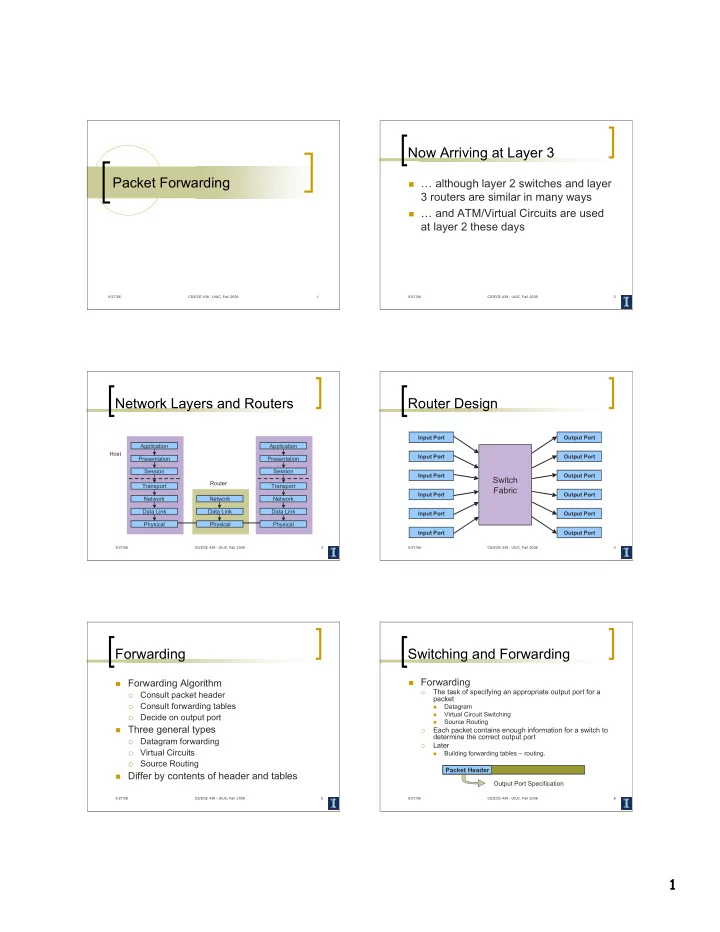
Now Arriving at Layer 3 Packet Forwarding although layer 2 - - PDF document

now arriving at layer 3 packet forwarding
SMART_READER_LITE
LIVE PREVIEW

Now Arriving at Layer 3 Packet Forwarding although layer 2 - - PDF document

Now Arriving at Layer 3 Packet Forwarding although layer 2 switches and layer 3 routers are similar in many ways and ATM/Virtual Circuits are used at layer 2 these days 9/27/06 CS/ECE 438 - UIUC, Fall 2006 1 9/27/06 CS/ECE


slide-1
SLIDE 1

1

9/27/06 CS/ECE 438 - UIUC, Fall 2006 1

Packet Forwarding

9/27/06 CS/ECE 438 - UIUC, Fall 2006 2

Now Arriving at Layer 3

 … although layer 2 switches and layer

3 routers are similar in many ways

 … and ATM/Virtual Circuits are used

at layer 2 these days

9/27/06 CS/ECE 438 - UIUC, Fall 2006 3

Network Layers and Routers

Application Presentation Physical Transport Session Data Link Network Physical Data Link Network Application Presentation Physical Transport Session Data Link Network Host Router

9/27/06 CS/ECE 438 - UIUC, Fall 2006 4

Router Design

Input Port Input Port Input Port Input Port Input Port Input Port Output Port Output Port Output Port Output Port Output Port Output Port

Switch Fabric

9/27/06 CS/ECE 438 - UIUC, Fall 2006 5

Forwarding

 Forwarding Algorithm

Consult packet header

Consult forwarding tables

Decide on output port

 Three general types

Datagram forwarding

Virtual Circuits

Source Routing

 Differ by contents of header and tables

9/27/06 CS/ECE 438 - UIUC, Fall 2006 6

Switching and Forwarding

 Forwarding

The task of specifying an appropriate output port for a packet

Datagram

Virtual Circuit Switching

Source Routing

Each packet contains enough information for a switch to determine the correct output port

Later

Building forwarding tables – routing. Packet Header Output Port Specification

slide-2
SLIDE 2

2

9/27/06 CS/ECE 438 - UIUC, Fall 2006 7

Forwarding with Datagrams

 Connectionless

 Each packet travels independently

 Switch

 Translates global address to output port  Maintains table of translations

 Used in traditional data networks

 i.e., Internet

9/27/06 CS/ECE 438 - UIUC, Fall 2006 8

Forwarding with Datagrams

Host A Host G Host D Host E Host C Host B Host F

α β γ δ

1 2 3 1 2 3 1 2 3 1 2 3

9/27/06 CS/ECE 438 - UIUC, Fall 2006 9

Routing Table

A B C D E F G A B C D E F G A B C D E F G A B C D E F G

α’s Table β’s Table γ’s Table δ’s Table

Each switch maintains a routing table that translates a host name to an output port

β α

A G D E C B F

γ δ

0 1 2 3 0 1 2 3 0 1 2 3 0 1 2 3 1 1 1 1 1 3 3 1 1 2 2 3 3 3 1 2 3 3 3 1 3

9/27/06 CS/ECE 438 - UIUC, Fall 2006 10

Forwarding with Datagrams

A → E DATA E A sends: C → F DATA F C sends: B → E DATA E B sends: F → G DATA G F sends: A → H DATA H A sends:

What happens to the last packet?

β α

A G D E C B F

γ δ

0 1 2 3 0 1 2 3 0 1 2 3 0 1 2 3

9/27/06 CS/ECE 438 - UIUC, Fall 2006 11

Forwarding with Datagrams

 Analogous to following signs  Requires globally unique addresses  Routing is decentralized

 A router follows global routing algorithms  Two packets usually take the same path

but…

 Each router can change its mind at any

time

9/27/06 CS/ECE 438 - UIUC, Fall 2006 12

Traceroute Example

 From HW1 solutions

traceroute www.scott.aq traceroute to www.scott.aq (203.167.246.34), 30 hops max, 40 byte packets 1 uiuc-ewsl-vlan1.gw.uiuc.edu (130.126.160.1) 0.425 ms 0.213 ms 0.319 ms 2 … 13 ae-0-0.bbr1.Washington1.Level3.net (64.159.0.229) 21.946 ms as-2-0.bbr2.Washington1.Level3.net (209.247.10.130) 21.351 ms 21.280 ms

slide-3
SLIDE 3

3

9/27/06 CS/ECE 438 - UIUC, Fall 2006 13

Datagrams

 Advantages

Routes around failures

Can send traffic immediately  Disadvantages

Header requires full unique address

Might not be possible to deliver packet

Successive packets may not follow the same route

Global address to path translations requires significant storage

9/27/06 CS/ECE 438 - UIUC, Fall 2006 14

Forwarding with Virtual Circuits

 Connection oriented

Requires explicit setup and teardown

Packets follow established route  Why support connections in a network?

Useful for service notions

Important for telephony  Switch

Translates virtual circuit ID on incoming link to virtual circuit ID on outgoing link

Circuit Ids can be per-link or per-switch  Used in ATM

9/27/06 CS/ECE 438 - UIUC, Fall 2006 15

Virtual Circuits

 Packet header stores:

 Virtual Circuit ID

 Router stores:

 Table of how to forward packets for each

virtual circuit

 Note: VCID need not be global

 Assign a VCID to a circuit for each link-

link pair

9/27/06 CS/ECE 438 - UIUC, Fall 2006 16

Forwarding with Virtual Circuits

 Set up

A virtual circuit identifier (VCI) is assigned to the circuit for each link it traverses

VCI is locally significant

<incoming port, incoming VCI> uniquely identifies VC  Switch

Maintains a translation table from <incoming port, incoming VCI> to <outgoing port, outgoing VCI>  Permanent Virtual Circuits (PVC)

Long-lived  Switch Virtual Circuits (SVC)

Uses signaling to establish VC

9/27/06 CS/ECE 438 - UIUC, Fall 2006 17

Forwarding with Virtual Circuits

 A simple example setup protocol

Each host and switch maintains per-link local variable for VCI assignment

When setup frame leaves host/switch

Assign outgoing VCI

Increment assignment counter

port and circuit id combination is unique

switches maintain translation table from

incoming port/VCI pair to

  • utgoing port/VCI pair

9/27/06 CS/ECE 438 - UIUC, Fall 2006 18

Forwarding with Virtual Circuits

 Assumptions

 Circuits are simplex  On a duplex link, the same VCI can be used

for two circuits, one in each direction

 The same VCI can be used on different

ports of the same switch

 At setup, the lowest available VCI is used

slide-4
SLIDE 4

4

9/27/06 CS/ECE 438 - UIUC, Fall 2006 19

Forwarding with Virtual Circuits

Host A Host G Host D Host E Host C Host B Host F

α β γ δ

2 3 1 2 1 2 3 1 2 3

Set up circuit: A → E

1 3

Setup Message: Dest = E Host E VCI = ? Setup Message: Dest = E <0,0> → <1,?> Setup Message: Dest = E <3,0> → <2,?> Setup Message: Dest = E <0,0> → <1,?>

9/27/06 CS/ECE 438 - UIUC, Fall 2006 20

Forwarding with Virtual Circuits

Host A Host G Host D Host E Host C Host B Host F

α β γ δ

2 3 1 2 1 2 3 1 2 3

Set up circuit: A → E

1 3

ACK Message: VCI = 0 Host E VCI = 0 ACK Message: VCI = 0 <0,0> → <1,0> ACK Message: VCI = 0 <3,0> → <2,0> ACK Message: VCI = 0 <0,0> → <1,0> Host A VCI = 0

9/27/06 CS/ECE 438 - UIUC, Fall 2006 21

Forwarding with Virtual Circuits

Host A Host G Host D Host E Host C Host B Host F

α β γ δ

2 3 1 2 1 2 3 1 2 3

Set up circuits: A → E C → F G → E

1 3 1 1 2 1

9/27/06 CS/ECE 438 - UIUC, Fall 2006 22

Forwarding with Virtual Circuits

VCI OUT Port OUT VCI IN Port IN VCI OUT Port OUT VCI IN Port IN VCI OUT Port OUT VCI IN Port IN α β δ

Table entries after A→ E connection is set

1 VCI OUT Port OUT VCI IN Port IN 2 3 VCI OUT Port OUT VCI IN Port IN 1 VCI OUT Port OUT VCI IN Port IN

β α

A G D E C B F

γ δ

0 1 2 3 0 1 2 3 0 1 2 3 0 1 2 3

A→E

9/27/06 CS/ECE 438 - UIUC, Fall 2006 23

Forwarding with Virtual Circuits

VCI OUT Port OUT VCI IN Port IN VCI OUT Port OUT VCI IN Port IN VCI OUT Port OUT VCI IN Port IN

Table entries after A→E, C→F, G→E connection is set

VCI OUT Port OUT VCI IN Port IN γ α β δ 1 1 1 3 VCI OUT Port OUT VCI IN Port IN 1 2 1 2 3 2 2 1 3 VCI OUT Port OUT VCI IN Port IN 3 1 1 1 1 2 VCI OUT Port OUT VCI IN Port IN 3 1 VCI OUT Port OUT VCI IN Port IN

9/27/06 CS/ECE 438 - UIUC, Fall 2006 24

Forwarding with Virtual Circuits

Analogous to a game of following a sequence of clues

Advantages

Header (for a data packet) requires only virtual circuit ID

Connection request contains global address

Can reserve resources at setup time

Disadvantages

Typically must wait one RTT for setup

Cannot dynamically avoid failures, must reestablish connection

Global address path information still necessary for connection setup

slide-5
SLIDE 5

5

9/27/06 CS/ECE 438 - UIUC, Fall 2006 25

Forwarding with source routing

 Packet header specifies directions

One direction per switch

Absolute

Port name

Next switch name

Relative

Turn clockwise 3 ports

Switches may delete or rotate directions within packet headers

 No state stored at switch!

9/27/06 CS/ECE 438 - UIUC, Fall 2006 26

Forwarding with Source Routing

What happens to the last packet?

A → E DATA 1 A sends: 2 1 C → F DATA C sends: 3 2 3 B → E DATA B sends: 2 1 F → G DATA F sends: 2 3 A → H DATA A sends: 1 1 2 1 β α

A G D E C B F

γ δ

0 1 2 3 0 1 2 3 0 1 2 3 0 1 2 3

9/27/06 CS/ECE 438 - UIUC, Fall 2006 27

Forwarding with Source Routing

 Analogous to following directions  Advantages

 Simple switches  Fast and cheap

 Disadvantages

 Hosts must know entire topology  Changes must propagate to all hosts  Headers might get large

9/27/06 CS/ECE 438 - UIUC, Fall 2006 28

ATM

 Defined by the ATM Forum

 Formed October 1991  Joint effort of the telephony and data

network industry

 High-Level Overview

 Virtual circuit routing  Fixed length frames (aka cells)  Standard define 3 layers

9/27/06 CS/ECE 438 - UIUC, Fall 2006 29

ATM

ATL Adaptation Layer (AAL)

Convergence sub-layer (CS) supports different application service models

Segmentation and reassembly (SAR)

Supports variable-length frames

ATM Layer

Virtual circuits maintenance

Cell header generation

Flow control

Physical Layer

Transmission convergence (TC)

Error detection, Framing

Physical medium dependent (PMD) sublayer

encoding

ATM AAL CS SAR phys. TC PMD

9/27/06 CS/ECE 438 - UIUC, Fall 2006 30

ATM Details

Where is ATM used?

Common in WANs

Can also be used in LANs

What is ATM built on?

Typically implemented on SONET

Design

Connection establishment

Signaling (Q.2931)

Virtual circuits

Virtual Paths

Bundles of virtual circuits

Share common route

Optimizes forwarding

slide-6
SLIDE 6

6

9/27/06 CS/ECE 438 - UIUC, Fall 2006 31

ATM Cells

 Cell specification

 53-bytes  48-byte payload  1-byte CRC  4-byte header

9/27/06 CS/ECE 438 - UIUC, Fall 2006 32

ATM Rationale

 Why hierarchical connections?

Setup

New virtual circuits can follow existing virtual path routes

Forwarding

Virtual Path Identifier (VPI)

Used between switches

Virtual Circuit Identifier (VCI)

Used for last hop

Routing around failures

Need only change virtual path once for 64K virtual circuits

9/27/06 CS/ECE 438 - UIUC, Fall 2006 33

ATM Rationale

Public Network

Network B Network A

9/27/06 CS/ECE 438 - UIUC, Fall 2006 34

ATM Rationale

 Why fixed-length frames?

 Hardware  Simpler processing for known frame sizes  Parallelization of processing stages  Is there an optimal length?  Small cells

High header-to-data overhead

Large frames must be fragmented

 Large cells

Low utilization for small messages

9/27/06 CS/ECE 438 - UIUC, Fall 2006 35

ATM Rationale

 Why short cells?

Better queueing behavior

Reduced granularity of preemption

High priority cell waits for one cell

Long cell: potentially long wait

Short cell: limited wait

Limits end-to-end jitter (variance in latency)

Shorted store-and-forward delay

Switches typically store whole frame, then forward

Short cells enable first part of a fragmented frame to be sent while the rest is still arriving

9/27/06 CS/ECE 438 - UIUC, Fall 2006 36

ATM Rationale

 Queueing Behavior Example

Consider 4KB vs. 53B cells, 100Mbps Link

Preemption

High priority cell arrives just as switch starts sending low-priority cell

4KB: high-priority cell must wait for 328µs

53B: high priority cell must wait for 4µs

Queueing

Two 4KB frames arrive simultaneously at time 0

4KB: link is idle until all data arrives at time 328µs, 8KB left to send

53B: First 53B is sent at time 4µs. At time 328µs, 4KB left to send

slide-7
SLIDE 7

7

9/27/06 CS/ECE 438 - UIUC, Fall 2006 37

ATM Rationale

Why 53-byte cells?

US wanted 64-bytes

Digital encoding for voice

1 frame = 64Kbps (8-bit samples, 8Khz)

Collect one sample per frame

With 64-byte cells, no need for echo cancellation

Latency – 1 cell = 6msec

Not detectable by humans

Europe wanted 32-byte

Shorter distances, no need for echo cancellation

Compromise – 48-bytes of data!

Problems with 53-byte (48-bytes of data) cells

Not a power of 2!

9/27/06 CS/ECE 438 - UIUC, Fall 2006 38

ATM and LANs

Comments

Switched networks have better performance then shared media

Shared media performance is increasing (100-MBps and Gigabit Ethernet)

ATM in a LAN

ATM doesn’t look like a traditional LAN

Specifically, no native support for broadcast and multicast

Solution

Redesign protocols that require broadcast/multicast

Make ATM behave more like a shared medium

LAN Emulation (LANE)

9/27/06 CS/ECE 438 - UIUC, Fall 2006 39

Structure of LANE

 ATM network can have multiple Emulated

LAN’s (ELAN’s)

Each ELAN corresponds to a single network

 Networks do not have to be geographically

  • riented

Hosts can move between buildings, but remain

  • n the same network

 Access Control Lists (ACL’s) on LANE

servers

Control which hosts can join which ELAN’s

9/27/06 CS/ECE 438 - UIUC, Fall 2006 40

ATM Local Area Network Emulation (LANE)

ATM Switch ATM Switch H LANE/Ethernet Adaptor Card Ethernet Switch H H H H H LANE/Ethernet Adaptor Card Ethernet Switch H H H H

All same color hosts think they are on the same Ethernet

ATM Host

LANE

ATM Host

LANE

ELAN-A ELAN-B

9/27/06 CS/ECE 438 - UIUC, Fall 2006 41

ATM Local Area Network Emulation (LANE)

ATM Switch ATM Switch H LANE/Ethernet Adaptor Card Ethernet Switch H H H H H LANE/Ethernet Adaptor Card Ethernet Switch H H H H

All hosts think they are on the same Ethernet

9/27/06 CS/ECE 438 - UIUC, Fall 2006 42

ATM/LANE Protocol Layers

Higher Layer Protocols (IP, ARP …) Signaling and LANE AAL 5 ATM Physical Higher Layer Protocols (IP, ARP …) Signaling and LANE AAL 5 ATM Physical ATM PHY PHY Ethernet-like Interface Host Host Switch