NRC Briefing on Proposed Rule on Part 35 Medical Events - - PDF document

nrc briefing on proposed rule on part 35 medical events
SMART_READER_LITE
LIVE PREVIEW

NRC Briefing on Proposed Rule on Part 35 Medical Events - - PDF document

NRC Briefing on Proposed Rule on Part 35 Medical Events Definition-Permanent Implant Brachytherapy July 8, 2010 Brian J. Davis, M.D., Ph.D. American Brachytherapy Society Past Chairman (2009-2010) President (2008-2009) Associate


slide-1
SLIDE 1

1

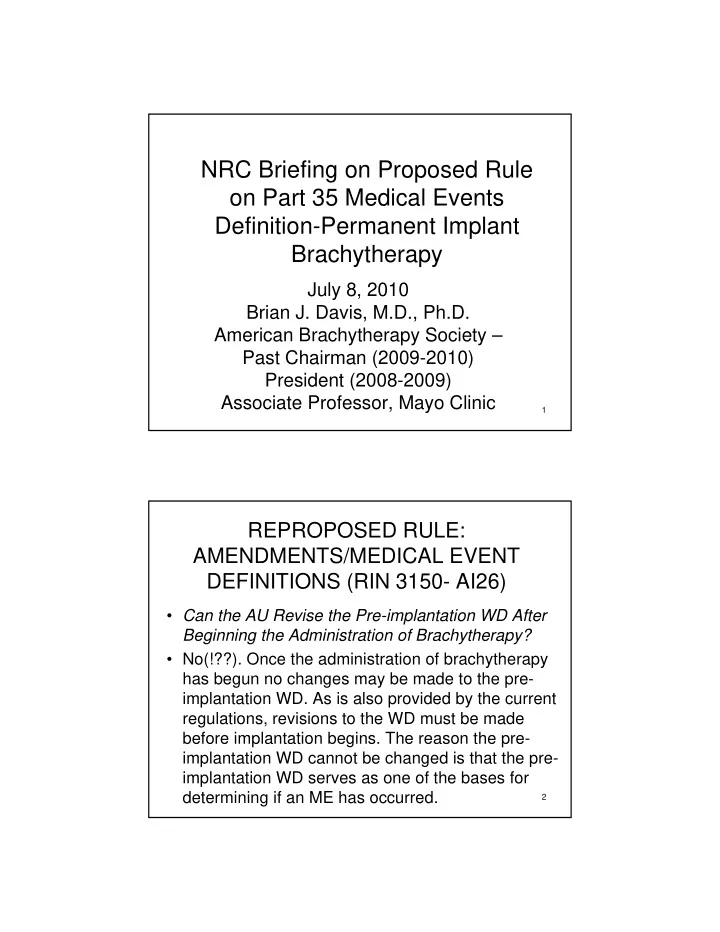
NRC Briefing on Proposed Rule

  • n Part 35 Medical Events

Definition-Permanent Implant Brachytherapy

July 8, 2010 Brian J. Davis, M.D., Ph.D. American Brachytherapy Society – Past Chairman (2009-2010) President (2008-2009) Associate Professor, Mayo Clinic

2

REPROPOSED RULE: AMENDMENTS/MEDICAL EVENT DEFINITIONS (RIN 3150- AI26)

  • Can the AU Revise the Pre-implantation WD After

Beginning the Administration of Brachytherapy?

  • No(!??). Once the administration of brachytherapy

has begun no changes may be made to the pre- implantation WD. As is also provided by the current regulations, revisions to the WD must be made before implantation begins. The reason the pre- implantation WD cannot be changed is that the pre- implantation WD serves as one of the bases for determining if an ME has occurred.

slide-2
SLIDE 2

3

REPROPOSED RULE: AMENDMENTS/MEDICAL EVENT DEFINITIONS (RIN 3150- AI26)

  • However, § 35.40(c) allows for an existing

WD to be revised by an AU prior to beginning the administration in order to account for any changes in the treatment site (such as organ volume and shape) that may have occurred between the time of planning the treatment and the implantation procedure.

4

REPROPOSED RULE: AMENDMENTS/MEDICAL EVENT DEFINITIONS (RIN 3150- AI26)

  • Why is this wrong?

– Volume change after a permanent seed implant is unpredictable, so a dose determination at a single time point may easily vary by more than an arbitrary 20%. – It will result in an over-reporting of ME’s without any justifiable clinical basis. – Excellent long-term results are reported for cases where intended dose prior to an implant varies by more than 20% after an implant.

slide-3
SLIDE 3

5

REPROPOSED RULE: AMENDMENTS/MEDICAL EVENT DEFINITIONS (RIN 3150- AI26)

  • Is delivering a +/- 20% dose in

permanent prostate brachytherapy routinely achievable?

  • Is it necessary?

6

slide-4
SLIDE 4

7

Prostate Volume Changes and Seed Implants

Sohljem, Davis et al., Int J Radiat Oncol Biol Phys 60(3): 2004

8

Sohljem, Davis et al., Int J Radiat Oncol Biol Phys 60(3): 2004

Postimplant to Preimplant Transrectal Ultrasound Volume Ratios

slide-5
SLIDE 5

9

80 100 120 140 160 180 200 220 240 100 200 300 400 500 600

Prostate D90s Using PrePlans Mayo Clinic Experience 1998-04

CP1206912-2

Trend towards a decreased prostate D90 with case number but not significant (P=0.1); standard deviation of D90 decreased from 26.7 Gy to 13.6 Gy and was significant (P=0.0003)

Wilson TM, Davis et al. IJROBP 2004

Implant Number Prostate D90 (Gy)

10

Prostate D90 of 395 Iodine-125 Cases Monotherapy 1998-2003: Mayo Clinic MN

50 100 150 200

CP1187711-1

80- 101- 121- 141- 161- 181- 201- 221- 100 120 140 160 180 200 220 230

No.

0.8% 2.3% 14.0% 40.0% 29.0% 10.0% 3.0% 0.5%

Dose (Gy)

slide-6
SLIDE 6

11

20 40 60 80 100 1 2 3 4 5

Mayo Clinic Experience RRP and Seeds: Matched Pair Study 1998-2003

CP1192621-3

Event free (%) Years after procedure

P=0.367 RRP n=822 Seeds n=274 RRP Brachy

Failure Event – Single PSA > 1.0 ng/ml Above Nadir

12

Conclusions

  • Permanent prostate implants produce

excellent results even with >20% variation from treated to planned dose to the prostate.

  • The ACMUI recommendations are most

consistent with the American Brachytherapy Society guidelines and current practice at the Mayo Clinic.

Slide 12