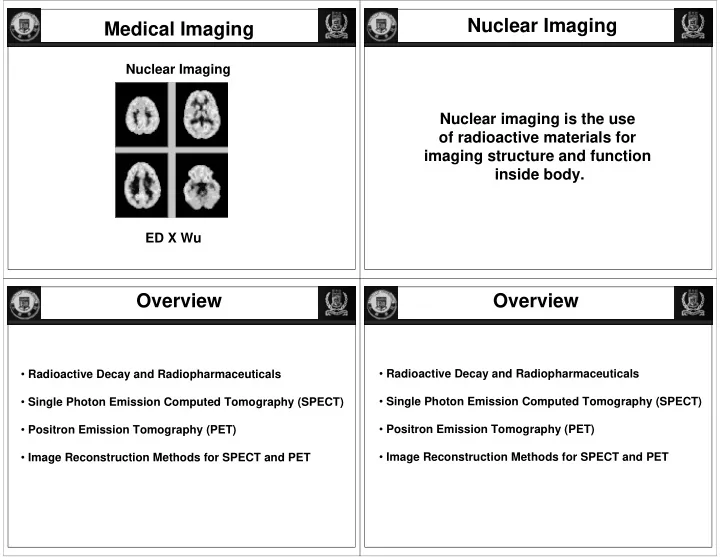
Nuclear Imaging Medical Imaging Medical Imaging Nuclear Imaging - - PowerPoint PPT Presentation

nuclear imaging medical imaging medical imaging
SMART_READER_LITE
LIVE PREVIEW

Nuclear Imaging Medical Imaging Medical Imaging Nuclear Imaging - - PowerPoint PPT Presentation

Nuclear Imaging Medical Imaging Medical Imaging Nuclear Imaging Nuclear Imaging Nuclear imaging is the use of radioactive materials for imaging structure and function inside body. ED X Wu Overview Overview Radioactive Decay and


slide-1
SLIDE 1

Nuclear Imaging Nuclear Imaging ED X Wu

Medical Imaging Medical Imaging Nuclear Imaging

Nuclear imaging is the use

  • f radioactive materials for

imaging structure and function inside body.

Overview

  • Radioactive Decay and Radiopharmaceuticals
  • Single Photon Emission Computed Tomography (SPECT)
  • Positron Emission Tomography (PET)
  • Image Reconstruction Methods for SPECT and PET

Overview

  • Radioactive Decay and Radiopharmaceuticals
  • Single Photon Emission Computed Tomography (SPECT)
  • Positron Emission Tomography (PET)
  • Image Reconstruction Methods for SPECT and PET
slide-2
SLIDE 2

The Atomic Nucleus

+ + + + + + + + + +

Nucleus consist of protons and neutrons: proton neutron Nomenclature:

X

A Z

X

A

  • r

A := mass number (number of protons + neutrons) Z := atomic number (number of protons) Species with same Z but different A are called “isotopes.” E.g.: 64Zn, 66Zn, 67Zn, 68Zn, 70Zn (49%, 28%, 4%, 19%, 0.6%)

Nuclear Shell Model

Analog to atomic shell model the nucleus can be described with a nuclear shell model, in which protons and neutrons occupy various possible energy states.

Stable Nuclei

Nucleus is most stable when a shell is completely filled with protons and neutrons. (Magic numbers Z or N = 2 ,8,20,28,50,82,126) (Super magic numbers Z and N = 2,8,20,28,50,82,126)

line of stability OR electron capture (EC)

More details in:

Introduction to radiological physics and radiation dosimetry By Frank Herbert Attix

Decay Equation and Half-Life

Unit of Radioactivity or Activity (to define # of decays/disintegrations per unit of time): Curie (Ci) & Becquerel (Bq=1/s)

slide-3
SLIDE 3

Decay Equation and Half-Life

β+ , β− decay,

  • r electron capture

possible

N = N0e−λt

N0 := initial number of parent atoms N := parent atoms remaining after time t λ:= decay constant

Half-life (t1/2)? 1 2 = N N0 = e−λT

1/2

=> ln 1 2 ⎛ ⎝ ⎜ ⎞ ⎠ ⎟ = −λT1/2 => T

1/2 = ln2

λ (Half − Life)

Assignment (due in 2 weeks)

1. What is the activity (in both Ci & Bq) contained in ? 2. Radiocarbon dating or carbon dating is routinely used to determine the age of some excavated species that lived in thousands years of ago. Please describe its principle in ~150 words.

Unstable Nuclei (Alpha decay)

Mass Rich Nuclei:

Nucleus emits alpha particle

a

+ +

What is alpha particle?

Unstable Nuclei (Alpha decay)

slide-4
SLIDE 4

Unstable Nuclei (Alpha decay) Unstable Nuclei (Beta- decays)

Neutron Rich Nuclei: Neutron becomes proton under emission

  • f electron

Z increase by 1 (Znew = Zold + 1). A stays the same.

Emax is the max kinetic energy carried by beta-

  • β−-decay

Cs

137 55

Ba +

137 56

β

  • 1

−>

β−-decay

?

Unstable Nuclei (Beta- & Beta+ decays)

In fact, complex reality to conserve energy, momentum and charges!

Unstable Nuclei (Beta+ decays)

Proton Rich Nuclei: Beta+ decay

Z decrease by 1 (Znew = Zold - 1). A stays the same.

slide-5
SLIDE 5

Unstable Nuclei (Beta+ & EC decay)

Proton Rich Nuclei:

Sometimes there are two competing decay processes:

  • Beta+ decay (Z decreases by 1)
  • Capture its own electron

(EC decay) Eb + Neutrino: 1.57 MeV

Unstable Nuclei (Isometric transition)

Nuclei with stable number of protons Z and neutrons N in exited state emit γ rays:

slide-6
SLIDE 6

Tc −>

99m 43

Tc + γ

99 43

Unstable Nuclei (Isometric transition) Overview

  • Radioactive Decay and Radiopharmaceuticals
  • Single Photon Emission Computed Tomography (SPECT)
  • Positron Emission Tomography (PET)
  • Image Reconstruction Methods for SPECT and PET

Single Photon Emission Computed Tomography (SPECT)

99mTC

Anger Camera

slide-7
SLIDE 7

Anger (γ) Camera Anger (γ) Camera

Single Photon Emission Computed Tomography (SPECT) Single Photon Emission Computed Tomography (SPECT)

slide-8
SLIDE 8

Phantom Test

SPECT Measurements SPECT Measurements

α(x,y) vs. µ(x,y)

unknown activity & absorption cross-section

I( ,θ)

g(s,θ) = α(x, y)exp − µ(x, ydl

L1 Lmax

∫ ⎛ ⎝ ⎜ ⎜ ⎞ ⎠ ⎟ ⎟ d

Lmin L max

∫ l

L1 Lmax problem is ill-posed! ⇒different combinations of α and µ can yield same measurement

SPECT Measurement SPECT Measurement

α(x,y) vs. µ(x,y)

unknown activity & absorption cross-section

L1 Lmax scattering can degrade image ⇒use of collimators necessary! However spatial resolution limited to 8-15mm.

slide-9
SLIDE 9

Overview

  • Radioactive Decay and Radiopharmaceuticals
  • Single Photon Emission Computed Tomography (SPECT)
  • Positron Emission Tomography (PET)
  • Image Reconstruction Methods for SPECT and PET
slide-10
SLIDE 10

Overview

  • Positron Emission Tomography (PET)
  • Basic Principles
  • Radioisotope production
  • PET Tracers
  • Clinical Examples

http://www.crump.ucla.edu/lpp

Principles of PET

In unstable nucleus (more protons than neutrons) proton converts to neutron under emission of positron. (Z decrease by 1 , A stays same) Positron travels limited distance in tissue.

Principles of PET

Positron combines with electron of nearby atom and emits two 511 keV X-ray photons that travel in opposite direction.

+/- 0.25 degree

slide-11
SLIDE 11

Principles of PET Principles of PET Principles of PET

slide-12
SLIDE 12

Principles of PET Principles of PET Principles of PET

  • 18-FDG is a glucose analog that is widely used to image glucose metabolism
  • O-15 for study of blood flow or perfusion
  • More recently, PET tracers are employed for molecular and cellular imaging
slide-13
SLIDE 13

Overview

  • Radioactive Decay and Radiopharmaceuticals
  • Single Photon Emission Computed Tomography (SPECT)
  • Positron Emission Tomography (PET)
  • Image Reconstruction Methods for PET and SPECT

CT Transmission Measurement CT Transmission Measurement µ(x,y)

unknown absorption cross-section

X-ray source

( measurable attenuation, shadowgram )

I = Ioexp − µ(x, y)dl

L

∫ ⎛ ⎝ ⎜ ⎞ ⎠ ⎟ g ≡ ln Io I ⎛ ⎝ ⎜ ⎞ ⎠ ⎟ (Signal) g(s,θ) = µ(x, y)dl

L

PET Measurement PET Measurement

α(x,y)

unknown activity cross-section ( measurable coincident)

g(s,θ) = c α (x, y)dl

L

slide-14
SLIDE 14

PE Tomography PE Tomography PE Tomography PE Tomography PE Tomography PE Tomography PE Tomography PE Tomography

slide-15
SLIDE 15

PE Tomography PE Tomography PE Tomography PE Tomography

g(s,θ) = c α (x, y)dl

L

To obtain image from projection data use filtered backprojection algorithm, etc.

Multi-ring PET Some Problems of PET Some Problems of PET

(1) resolution limited to 2-5 mm because of positron mean-free path before annihilation. (2) False Coincidence Events: (a) unrelated photons arrive at same time (<20ns) (~15% of all signals) (b) one or both photons of an annihilation event are scattered (e.g. Compton scattering) (10-30% of signal) (3) Unknown photon absorption profile (2) relatively high radiation dose to patient

slide-16
SLIDE 16

Some Problems of PET Some Problems of PET Some Problems of PET Some Problems of PET Some Problems of PET Some Problems of PET

Anti-scatter collimator Small detectors

2D to 3D PET Configurations 2D to 3D PET Configurations

slide-17
SLIDE 17

Transmission Measurement (as in CT) Transmission Measurement (as in CT)

µ(x,y)

unknown absorption cross-section

X-ray source

( measurable attenuation, shadowgram )

I = Ioexp − µ(x, y)dl

L

∫ ⎛ ⎝ ⎜ ⎞ ⎠ ⎟ g ≡ ln Io I ⎛ ⎝ ⎜ ⎞ ⎠ ⎟ (Signal) g(s,θ) = µ(x, y)dl

L

PET Measurement PET Measurement

α(x,y)

unknown activity cross-section ( measurable coincident)

g(s,θ) = c α (x, y)dl

L

PET vs. SPECT

New Trend

  • CT/PET

Another approach to PET: Time-of-Flight (TOF) ?

  • Electronics requirement?

Or TOF electronics

slide-18
SLIDE 18

Emerging Technology

  • PET/CT scanner
  • PET/MRI scanner

PET/CT scanner PET/CT scanner