
SLIDE 1
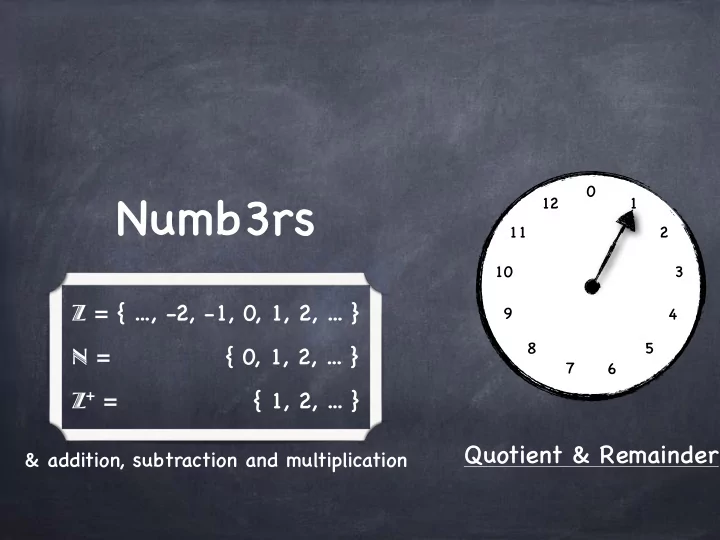
Numb3rs
Quotient & Remainder
1 2 3 4 5 6 7 8 9 10 11 12
Z = { ..., -2, -1, 0, 1, 2, ... } N = { 0, 1, 2, ... } Z+ = { 1, 2, ... }
& addition, subtraction and multiplication
Numb3rs 0 12 1 11 2 10 3 Z = { ..., -2, -1, 0, 1, 2, ... } 9 - - PowerPoint PPT Presentation
Numb3rs 0 12 1 11 2 10 3 Z = { ..., -2, -1, 0, 1, 2, ... } 9 4 8 5 N = { 0, 1, 2, ... } 7 6 Z + = { 1, 2, ... } Quotient & Remainder & addition, subtraction and multiplication Divisibility Definition: For n,d Z , d|n (d
1 2 3 4 5 6 7 8 9 10 11 12
Z = { ..., -2, -1, 0, 1, 2, ... } N = { 0, 1, 2, ... } Z+ = { 1, 2, ... }
& addition, subtraction and multiplication
Definition: For n,d∈Z, d|n (d divides n) if ∃q∈Z n = qd d|n ≡ n is a multiple of d ≡ d is a divisor of n
e.g. Multiples(12) = { …, -24, -12, 0, 12, 24, … }. e.g. Divisors(12) = { ±1, ±2, ±3, ±4, ±6, ±12 }. Divisors(0) = Z [∀d∊Z d|0]. Multiples(0) = {0} [∀n∊Z 0|n ↔ n=0]
12 24
1 2 3 4 6 12
a.k.a. a factor
Proposition: ∀ m,n,n’∈Z if m|n, then m|nn’ Proposition: ∀ m,n,n’∈Z if m|n and m|n’, then m|(n+n’) Proposition: ∀ m,n,n’∈Z if m|n and n|n’, then m|n’ Proposition: ∀ m,n,n’∈Z if mn’|nn’ and n’≠0, then m|n Proposition: ∀ m,n∈Z if m|n and n≠0, then |m| ≤ |n|
n = qm ⇒ nn’ = q’m, where q’=qn’ n = qm & n’ = q’m ⇒ n+n’ = q’’m, where q’’=q+q’ n = qm & n’ = q’n ⇒ n’ = q’’m, where q’’=qq’ nn’ = qmn’ & n’≠0 ⇒ n = qm n = qm & n≠0 ⇒ |n| = |q|⋅|m| where |q| ≥ 1 ⇒ |n| = |m| + (|q|-1)⋅|m| ≥ |m|
Proof of existence
We shall prove it for all n ≥ 0 and m > 0. Then, the other cases can be proven using |n|=q·|m| + r, 0 ≤ r < |m| n ≥ 0, m < 0: n = q·|m|+r = (-q)m + r. 0 ≤ r < |m| n < 0, m > 0: n = -|n| = -(q·m+r) = -(q+1)m + (m-r). 0 ≤ m-r < m n < 0, m < 0: n = -|n| = -(q(-m)+r) = (q+1)m + (|m|-r). 0 ≤ |m|-r < |m| Fix any m>0. We use strong induction on n. Base cases: n ∈ [0,m). Then let q=0 and r=n : n = 0.m + n. Induction step: We shall prove that for all k ≥ m, (induction hypothesis): if ∀n∈Z+ s.t. n<k, ∃q,r s.t n=qm+r & 0 ≤ r < m (to prove): then ∃q*,r* s.t. k = q*⋅m + r* & 0 ≤ r* < m. Consider k’=k-m. 0≤k’<k. By ind. hyp. k’=q’m+r’. Let q*=q’+1, r*=r’. ☐
For any two integers m and n, m≠0, there is a unique quotient q and remainder r (integers), such that n = q⋅m + r, 0 ≤ r < |m|
Assuming r > 0. If r = 0, n = ±qm
Proof of existence
Also known as “Division Algorithm” (when you unroll the inductive argument, you get a (naïve) algorithm)
Proof of uniqueness: Claim: if n = q1⋅m + r1 = q2⋅m + r2, where 0 ≤ r1,r2 < |m|, then q1=q2 and r1=r2
Suppose, q1m + r1 = q2m + r2. W .l.o.g, r1 ≥ r2. So, 0 ≤ (r1-r2) < |m|. Also, (r1-r2) = (q2-q1)m. Now, the only multiple of m in the range [0,|m|) is 0. So r1 = r2. Then (q1-q2)m = 0. Since m≠0, q1=q2.
For any two integers m and n, m≠0, there is a unique quotient q and remainder r (integers), such that n = q⋅m + r, 0 ≤ r < |m|
1 2 3 4 5 6
r
m=7
q
1 2 e.g. n=11 q=1, r=4
For any two integers m and n, m≠0, there is a unique quotient q and remainder r (integers), such that n = q⋅m + r, 0 ≤ r < |m|