
SLIDE 1
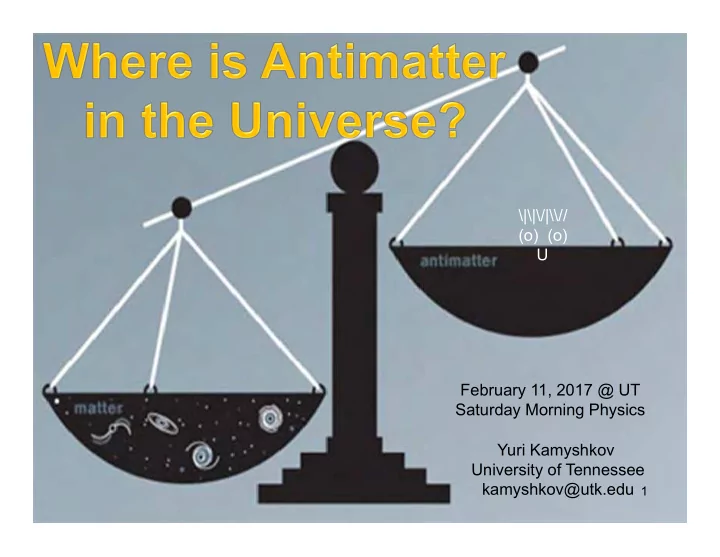
Yuri Kamyshkov University of Tennessee kamyshkov@utk.edu February 11, 2017 @ UT Saturday Morning Physics \|\|\/|\\// (o) (o) U
1
\|\|\/|\\// (o) (o) U February 11, 2017 @ UT Saturday Morning - - PowerPoint PPT Presentation
\|\|\/|\\// (o) (o) U February 11, 2017 @ UT Saturday Morning Physics Yuri Kamyshkov University of Tennessee kamyshkov@utk.edu 1 2 Large Hadron Collider CERN European Centre for Particle Physics Geneva, Switzerland
Yuri Kamyshkov University of Tennessee kamyshkov@utk.edu February 11, 2017 @ UT Saturday Morning Physics \|\|\/|\\// (o) (o) U
1
2
CERN European Centre for Particle Physics Geneva, Switzerland
http://angelsanddemons.cern.ch/
Large Hadron Collider
3
4
5
6
The Low Energy Antiproton Ring (LEAR) at CERN (Geneva, Switzerland)
7
The Antiproton Accumulator (AA) which has been transformed into the Antiproton Decelerator (AD) in 1999
8
1 g of antimatter would produce an explosion equivalent to 40 kt of TNT. At CERN ~ 10,000,000 antiprotons per second can be produced. Over the last 20 years, approximately 10 billionths of a gram of antimatter has been produced at CERN, whose explosive yield is equivalent to that of a firecracker, far less than is needed for it to be the threat depicted in the novel and movie. Antimatter production cost estimate: ~ $62.5 trillion per gram (NASA). 1 g ( ~ 6×10²³ protons) can be produced for ~ 2,000,000,000 years.
9
10
Yin Yang is an active concept: Yin Yang are opposing Yin Yang are rooted together Yin Yang transform each other Yin Yang are balanced Yin-yang is not an actual substance or force, but it is a universal way of describing the interactions and interrelations
Source Wikipedia
5,000 years old concept of Nature
11
“Book of Changes” created ~ 5,000 years ago “by first Chinese Emperor, Fu Hsi”
Heaven Thunder Water Mountain Earth Wind Flame Lake
Kuan
20. Contemplation WIND above, EARTH below The immediate future is difficult, with you feeling 'blown around' and unable to achieve anything. Improvement will come. Be patient, and use this time to
yourself), gain wisdom, and plan. Improvement will come.
Yin is usually characterized as slow, soft, insubstantial, diffuse, cold, wet, and tranquil. It is generally associated with the feminine, birth and generation, and with the night
Concept of is represented by broken line (Yin) : and continuous line (Yang) :
Yang, by contrast, is characterized as hard, fast, solid, dry, focused, hot, and aggressive. It is associated with masculinity and daytime
12
13
Graphics from: http://www.physik.uzh.ch/groups/serra/
14
15
Nobel Prize in Physics 1933
16
in 1932 Carl David Anderson discovered positrons produced in cosmic radiation
Nobel Prize in Physics 1936
17
How positrons would appear in the cosmic rays?
p
Cloud chamber picture of a small cosmic-ray shower of positive and negative electrons in magnetic field
19
Thanks to : http://angelsanddemons.web.cern.ch/
20
21
The Positronium Beam at University College London, a lab used to study the properties of positronium
22
+
23
Further discoveries of antimatter at accelerators: in 1955 (O. Chamberlain, E. Segrè @ LBL) anti-proton in 1956 (B. Cork et al. @ LBL) anti-neutron in 1965 (D. Dorfan et al. @ AGS, Brookhaven) anti-deuteron in 1995 (W. Oelert et al. @ LEAR, CERN) anti-hydrogen atom in 2002 (R. Arsenescu et al. @ NA-52, CERN) anti-3He
proton electron Hydrogen anti-proton positron Ant i-Hydrogen
24
25
26
testing gravity interaction of antimatter
27
https://home.cern/about/updates/2016/12/alpha-observes-light-spectrum-antimatter-first-time
Read more at http://alpha.web.cern.ch/
“One of the main physics results in 2016”
28
Structure of energy levels of anti-hydrogen atom is exactly the same as for normal hydrogen
29
E.g. electron and positron, if brought together, will form for a short while a positronium atom and then will annihilate into 2 or 3 photons Anti-protons annihilate some different
30
Nucleon + anti-nucleon annihilate mostly into
Antiproton annihilation in hydrogen bubble chamber
Pions and muons eventually decay into stable particles: electrons, positrons, photons and neutrinos (~ 60% of energy ultimately is curried away by neutrinos).
e
µ µ
+ + + +
31
32
i.e. why hydrogen atom is stable and there is no 1H (e−p+) → 2 γ ?
If this would happen our matter will not be stable.
―
33
Stability of the matter (at the level observed so far) can be explained as a conservation of the global quantum numbers called “baryon charge” and “lepton charge”. Nucleons (p, n) and other heavy 3-quark particles are called Baryons e, ν, and other particles with similar properties are called Leptons
34
35
Graphics from: http://www.physik.uzh.ch/groups/serra/
matter and anti-matter particles use the same forces for interactions
36
We have learned at accelerators that anti-matter and matter are always produced in equal amount
37
− + − + + −
38
Big Bang is a broadly accepted and well justified theory of the origin and evolution of our
ago from a singular point as a neutral state and underwent an extremely fast exponential expansion called “inflation”. Initial state of the Universe was extremely dense and incredibly hot. Since then the Universe in cooling down.
39
At Big Bang Matter and Anti-matter were produced in equal amounts.
40
41
42
range of visible Universe (from spectrum
Antimatter/Matter ~ 1/10,000, i.e. consistent with antiparticles production by high-energy matter particles in the Earth atmosphere.
(Baryon Asymmetry of Universe)
43
How do we know that there was an Antimatter in Big Bang?
Cosmic Microwave Background Radiation (Relic Radiation) discovered in 1964 by
WMAP CMBR temperature anisotropy. Radiation with T=2.725 K and density of ~ 400 γ per cc
44
Early Universe Present Universe Equal amount of matter and antimatter followed by massive annihilation. Only matter. No antimatter!
CMBR provides an evidence for massive annihilation in Early Universe
45
Generating a Matter-Antimatter Asymmetry
1.
Very early in the Big Bang (t<10−30 s), matter and antimatter were in thermal equilibrium. There was exact balance between matter and antimatter and matter ↔ antimatter transitions took place. 2. At some point, there was a symmetry breaking process that led to a small imbalance between the number of Baryons and Anti-baryons…i.e. a few more Baryons. 3. When the Universe cooled down, all the Anti-baryons annihilated leaving a few Baryons and lots of high-energy annihilation photons.
expansion and are present now as the Cosmic Microwave Background.
In this scenario, the total “apparent” matter-antimatter asymmetry is given by the ratio of Baryons to CMB photons:
10 10 = =
− γ Baryon Antibaryon Baryon
n n n n and
46
As formulated by A. Sakharov, 3 conditions are needed for explanation of Matter-Antimatter asymmetry: (1) Violation of Baryon number (non-stability of matter) e.g. observation
(2) Violation of Time Invariance (or CP-invariance) i.e. rate of M → A not equal A → M (3) Departure from thermal equilibrium
47