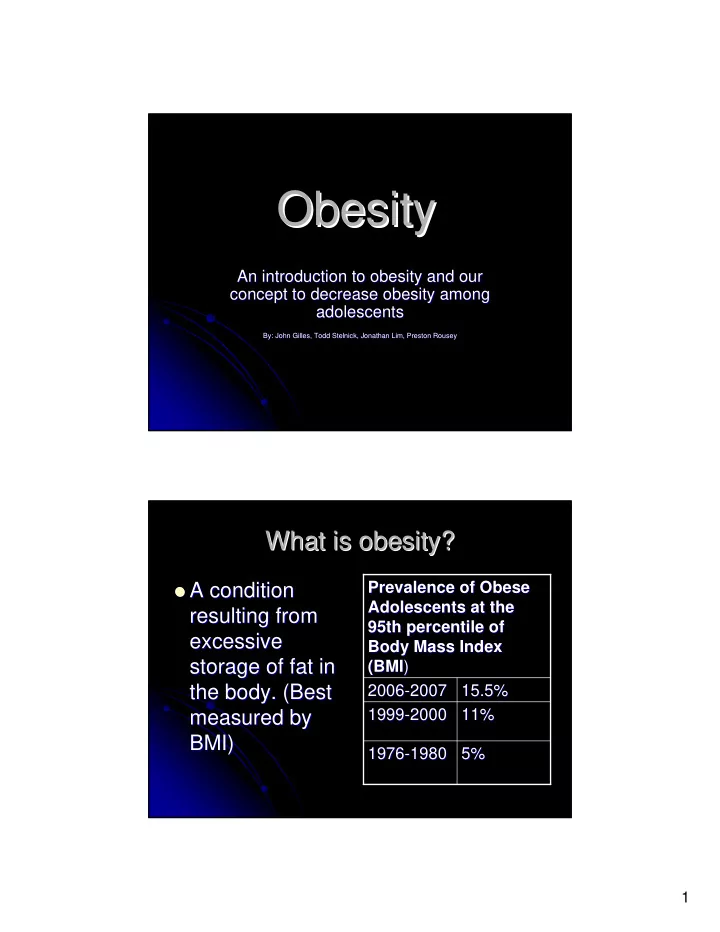
Obesity Obesity An introduction to obesity and our An introduction - - PDF document

obesity obesity
SMART_READER_LITE
LIVE PREVIEW

Obesity Obesity An introduction to obesity and our An introduction - - PDF document

Obesity Obesity An introduction to obesity and our An introduction to obesity and our concept to decrease obesity among concept to decrease obesity among adolescents adolescents By: John Gilles, Todd By: John Gilles, Todd Stelnick


slide-1
SLIDE 1

1

Obesity Obesity

An introduction to obesity and our An introduction to obesity and our concept to decrease obesity among concept to decrease obesity among adolescents adolescents

By: John Gilles, Todd By: John Gilles, Todd Stelnick Stelnick, Jonathan Lim, Preston , Jonathan Lim, Preston Rousey Rousey

What is obesity? What is obesity?

  • A condition

A condition resulting from resulting from excessive excessive storage of fat in storage of fat in the body. (Best the body. (Best measured by measured by BMI) BMI)

5% 5% 1976 1976-

  • 1980

1980 11% 11% 1999 1999-

  • 2000

2000 15.5% 15.5% 2006 2006-

  • 2007

2007 Prevalence of Obese Prevalence of Obese Adolescents at the Adolescents at the 95th percentile of 95th percentile of Body Mass Index Body Mass Index (BMI (BMI) )

slide-2
SLIDE 2

2

What is BMI? What is BMI?

  • BMI (Body Mass Index) is the ratio of weight in

BMI (Body Mass Index) is the ratio of weight in kilograms to square of height in meters. BMI kilograms to square of height in meters. BMI correlates with more accurate measures of body correlates with more accurate measures of body fatness fatness

  • Pediatrics;

Pediatrics;

  • At risk: BMI between 85

At risk: BMI between 85th

th -

  • 95

95th

th percentile for age and

percentile for age and sex sex

  • Overweight/obese: BMI at or above the 95

Overweight/obese: BMI at or above the 95th

th percentile

percentile for age and sex for age and sex

Example Calculation Example Calculation

  • Weight

Weight ÷ ÷ Height Height ÷ ÷ Height x 703 = BMI Height x 703 = BMI

  • 13 year old boy

13 year old boy

  • 146 pounds

146 pounds

  • 64 inch

64 inch

  • 146

146 ÷ ÷ 64 64 ÷ ÷ 64 x 703 = 25 64 x 703 = 25

  • BMI of 25 per growth chart = 95%

BMI of 25 per growth chart = 95%

  • This young man is overweight/obese

This young man is overweight/obese

slide-3
SLIDE 3

3

Overweight & Obesity Overweight & Obesity

  • The prevalence of childhood overweight and

The prevalence of childhood overweight and

  • besity has doubled in the past 20 years
  • besity has doubled in the past 20 years
  • American children are less physically active as

American children are less physically active as a group than were previous generations a group than were previous generations

  • In 1999 16% of high school students were

In 1999 16% of high school students were

  • verweight and nearly 10% were obese
  • verweight and nearly 10% were obese
  • More black and Hispanic female students (23%

More black and Hispanic female students (23% and 18%, respectively) were overweight than and 18%, respectively) were overweight than white female students (12%) white female students (12%)

US Girls 12 US Girls 12-

  • 17 years old

17 years old

*BMI at or above sex *BMI at or above sex-

  • and age

and age-

  • specific 95th percentile

specific 95th percentile

5 10 15 20 1985-1989 1991-1995 1997-2001 2003-2007 Caucasian African-American Caucasian, non-Hispanic African-American, non-Hispanic Mexican

slide-4
SLIDE 4

4

US Boys 12 US Boys 12-

  • 17 years old

17 years old

*BMI at or above sex *BMI at or above sex-

  • and age

and age-

  • specific 95th percentile

specific 95th percentile

2 4 6 8 10 12 14 16 1985-1989 1991-1995 1997-2001 2003-2007 Caucasian African-American Caucasian, non-Hispanic African-American, non-Hispanic Mexican

What are the factors? What are the factors?

  • Lack of physical activity is considered the single biggest facto

Lack of physical activity is considered the single biggest factor in the r in the rising rates of obesity among children and teens rising rates of obesity among children and teens

  • 50% of US young people 12

50% of US young people 12-

  • 21 years old do not participate in vigorous

21 years old do not participate in vigorous physical activity on a regular basis. The time US students spend physical activity on a regular basis. The time US students spend being being active in physical education classes is also decreasing active in physical education classes is also decreasing

  • Only about 50% of schools in the US require physical education i

Only about 50% of schools in the US require physical education in n grades 1 grades 1-

  • 5; 25% of in grad 8; and 5% in grade 12

5; 25% of in grad 8; and 5% in grade 12

  • Women generally are less active than men at all ages

Women generally are less active than men at all ages

  • People with lower incomes and less education are typically not a

People with lower incomes and less education are typically not as s physically active as those with higher incomes and education physically active as those with higher incomes and education

  • African Americans and Hispanics are generally less physically ac

African Americans and Hispanics are generally less physically active than tive than whites whites

  • Diabetes Prevention Program show lifestyle changes

Diabetes Prevention Program show lifestyle changes – – physical activity physical activity – – are more effective than oral diabetes medications at preventing are more effective than oral diabetes medications at preventing or

  • r

delaying the onset of diabetes (58% delaying the onset of diabetes (58% vs vs 31% reduction in risk) 31% reduction in risk)

slide-5
SLIDE 5

5

Dependency on cars discourages Dependency on cars discourages walking walking While there is more opportunity for While there is more opportunity for

  • utdoor activity, schools and
  • utdoor activity, schools and

commercial business may be too commercial business may be too distant to walk to distant to walk to Suburban and Rural Residency Suburban and Rural Residency Prevents women, children, elderly Prevents women, children, elderly from going out for exercise and from going out for exercise and leisure activity leisure activity Increase in crime in some areas Increase in crime in some areas Urban Residency Urban Residency Decrease in daily physical activity Decrease in daily physical activity patterns patterns Increase in the use of elevators, Increase in the use of elevators, escalators, and automatic doors escalators, and automatic doors Public Places Public Places Decrease in physically active and Decrease in physically active and manual labor manual labor Increase in computerization Increase in computerization Work Place Work Place

  • Decrease in manual labor

Decrease in manual labor

  • Decrease in time spent in active

Decrease in time spent in active recreational pursuits recreational pursuits

  • Over

Over-

  • consumption of high

consumption of high-

  • calorie

calorie

  • foods. Eating when not hungry, eating
  • foods. Eating when not hungry, eating

while watching TV or doing homework while watching TV or doing homework

  • Increase in use of modern

Increase in use of modern appliances appliances

  • Increase in TV viewing and computer

Increase in TV viewing and computer and video game use and video game use At Home At Home Decrease in walking or bicycling Decrease in walking or bicycling Rise in car ownership increase in Rise in car ownership increase in short short-

  • distance driving

distance driving Transportation Transportation Impact on Obesity Development Impact on Obesity Development Effect of Modernization Effect of Modernization Location/Type of Activity Location/Type of Activity Greater risk of obesity has been found in children of obese and Greater risk of obesity has been found in children of obese and overweight

  • verweight

parents parents Genetics Genetics

Over Consumption of High Over Consumption of High-

  • calorie

calorie Foods Foods

  • Nutritional content

Nutritional content

  • Portion size

Portion size

slide-6
SLIDE 6

6

Decreased physical activity Decreased physical activity

  • Not as much participation in physical

Not as much participation in physical activities; Walking, Active play, Recess activities; Walking, Active play, Recess

Effects of Overweight Effects of Overweight

  • Hypertension

Hypertension

  • Dyslipidemia

Dyslipidemia (for example, high total cholesterol (for example, high total cholesterol

  • r high levels of triglycerides)
  • r high levels of triglycerides)
  • Type 2 diabetes

Type 2 diabetes

  • Coronary heart disease

Coronary heart disease

  • Stroke

Stroke

  • Gallbladder disease

Gallbladder disease

  • Osteoarthritis

Osteoarthritis

  • Sleep apnea and respiratory problems

Sleep apnea and respiratory problems

  • Some cancers (Endometrial, breast, and colon)

Some cancers (Endometrial, breast, and colon)

slide-7
SLIDE 7

7

  • Today

Today’ ’s children could be the first s children could be the first generation of Americans with a life generation of Americans with a life expectance less than their parents!!! expectance less than their parents!!!

Methods of Weight loss Methods of Weight loss

  • Exercise Regularly

Exercise Regularly

  • Control Portion Sizes

Control Portion Sizes

  • Eat Slower

Eat Slower

  • Eat More Healthy

Eat More Healthy

  • Limit Amount of Sweets Eaten Per Day

Limit Amount of Sweets Eaten Per Day

slide-8
SLIDE 8

8

How to lose Weight How to lose Weight Successfully Successfully if if you are a Teenager you are a Teenager

Unless you are seriously overweight, the most Unless you are seriously overweight, the most effective way to reduce weight is to eat healthily effective way to reduce weight is to eat healthily and exercise regularly. Amazingly, many and exercise regularly. Amazingly, many teenagers don teenagers don’ ’t choose this tried t choose this tried-

  • and

and-

  • tested

tested

  • method. Instead, they prefer
  • method. Instead, they prefer ‘

‘instant solutions instant solutions’ ’ to to their weight concerns their weight concerns – – solutions which typically solutions which typically cause bad health and weight gain. cause bad health and weight gain.

Behavior Change Strategies Behavior Change Strategies

  • Increase awareness of food choices:

Increase awareness of food choices:

  • Moderate food portions

Moderate food portions

‘5 a day 5 a day’ ’ Vegetables and Fruits Vegetables and Fruits

  • Limit activity

Limit activity

  • American Academy of Pediatrics

American Academy of Pediatrics recommends limiting TV viewing to 1 recommends limiting TV viewing to 1-

  • 2

2 hours a day hours a day

slide-9
SLIDE 9

9

Behavior Change Strategies Behavior Change Strategies

  • Increase Physical Activity:

Increase Physical Activity:

  • Provide exercise choices to children

Provide exercise choices to children

  • Encourage age appropriate and creative

Encourage age appropriate and creative exercise exercise

  • Make it FUN!

Make it FUN!

Children Then….

slide-10
SLIDE 10

10

Children Now Children Now…… ……. . Best Practices Best Practices

  • Activ8kids

Activ8kids-

  • Launced in 2005 to fight childhood

Launced in 2005 to fight childhood

  • besity and promote healthy lifestyles among
  • besity and promote healthy lifestyles among

children. children.

  • The goal of Activ8Kids! Is to instill in children

The goal of Activ8Kids! Is to instill in children before the age of eight a daily regimen that before the age of eight a daily regimen that includes: includes:

  • consuming at least 5 fruits and vegetables

consuming at least 5 fruits and vegetables

  • engaging in at least 1 hour of physical activity

engaging in at least 1 hour of physical activity

  • reducing screen time (TV and Video Games)

reducing screen time (TV and Video Games)

slide-11
SLIDE 11

11

We hope everyone agrees we have We hope everyone agrees we have to do something.. to do something..

This is our plan: This is our plan:

1. 1.

We want children and their parents to realize We want children and their parents to realize that Child Obesity that Child Obesity IS IS a major issue. We want to a major issue. We want to show that physical activity and good nutrition is show that physical activity and good nutrition is important for everybody important for everybody

  • 2. We also want to stop the incline of obesity
  • 2. We also want to stop the incline of obesity

among children in the United States. among children in the United States.

  • We want to work from two locations; LA

We want to work from two locations; LA Fitness clubs and High Schools Fitness clubs and High Schools

High Schools High Schools

  • We want to inform adolescent children how important it is to

We want to inform adolescent children how important it is to be physically active and to eat healthy. We also want to be physically active and to eat healthy. We also want to achieve this with organizing special achieve this with organizing special ‘ ‘Get Active Get Active’ ’ Information Information

  • Days. We will go to local high schools in Los Angeles and talk
  • Days. We will go to local high schools in Los Angeles and talk

about child obesity, and show them the same PowerPoint about child obesity, and show them the same PowerPoint presentation we just showed you. To give our presentation we just showed you. To give our ‘ ‘mission mission’ ’ a little a little more value we will invite a professional athlete (think about more value we will invite a professional athlete (think about the Lakers, Dodgers, Kings, Avengers, Sparks, Lady Killers) the Lakers, Dodgers, Kings, Avengers, Sparks, Lady Killers) to talk about these topics with us. They will also talk about to talk about these topics with us. They will also talk about how important physical activity and good nutrition is for their how important physical activity and good nutrition is for their

  • careers. Our goal is to visit the different high schools on a
  • careers. Our goal is to visit the different high schools on a

yearly basis. yearly basis.

  • To make physical education classes more

To make physical education classes more ‘ ‘attractive attractive’ ’ for the for the students, the professional athlete will participate in a weekly students, the professional athlete will participate in a weekly two hour P.E. class two hour P.E. class.

.

slide-12
SLIDE 12

12

What we want High Schools to do What we want High Schools to do

Provide: Provide:

  • Psychosocial education/intervention

Psychosocial education/intervention

  • School nutrition policy

School nutrition policy

  • Quality daily P.E. classes

Quality daily P.E. classes

Costs for our Program Costs for our Program

  • High schools pay $1000 a year

High schools pay $1000 a year

  • LA Fitness develops a special

LA Fitness develops a special ‘ ‘family price family price’ ’ which makes it attractive for parents to take their which makes it attractive for parents to take their children to the gym. children to the gym.

  • The

The ‘ ‘Family Price Family Price’ ’ is an additional price of $10 a is an additional price of $10 a child, per month. child, per month. -

  • $5 will go to LA Fitness and

$5 will go to LA Fitness and $5 will go to our organization. $5 will go to our organization.

  • With this money we will cover our expenditures

With this money we will cover our expenditures for campaigns/ employees/ office rent etc. for campaigns/ employees/ office rent etc.

  • The professional athletes will be paid by their

The professional athletes will be paid by their professional team professional team-

  • so basically they are our

so basically they are our sponsors. sponsors.

slide-13
SLIDE 13

13

Why target high schools? Why target high schools?

  • Prevention is more cost effective than cure

Prevention is more cost effective than cure

  • Children can be reached through schools

Children can be reached through schools

  • Effects of chronic disease accumulate

Effects of chronic disease accumulate

  • ver time; so need long term changes
  • ver time; so need long term changes
  • We need to begin awareness at an early

We need to begin awareness at an early age age

Why target LA Fitness Why target LA Fitness

  • We need to incorporate parents in

We need to incorporate parents in providing strategies and ideas providing strategies and ideas

  • We want parents to

We want parents to ‘ ‘push push’ ’ their children to their children to be healthy and active, but in the same be healthy and active, but in the same time not focus on weight time not focus on weight

  • We want them to care about their

We want them to care about their children's health children's health

slide-14
SLIDE 14

14

What is our goal? What is our goal?

  • We hope adolescents and their parents will see

We hope adolescents and their parents will see how important it is to live healthy and to be how important it is to live healthy and to be physically active. physically active.

  • We hope more adolescents will be physically

We hope more adolescents will be physically active; not only go to the gym, or attend physical active; not only go to the gym, or attend physical education classes. We want them to ride the education classes. We want them to ride the bike more often, or go play basketball instead of bike more often, or go play basketball instead of playing video games or watching TV. playing video games or watching TV.

  • And in the end we hope child obesity will

And in the end we hope child obesity will decrease. decrease.

References References

1.

  • 1. http://www.health.state.ny.us/prevention/obesity/activ8kids/

http://www.health.state.ny.us/prevention/obesity/activ8kids/ 2.

  • 2. Childhood Overweight

Childhood Overweight. . Obesity Fact Sheets Obesity Fact Sheets. . 3.

  • 3. Ebbeling

Ebbeling CB, CB, Pawlak Pawlak DB, Ludwig DS (2002). "Childhood obesity: public DB, Ludwig DS (2002). "Childhood obesity: public-

  • health crisis, common sense cure".

health crisis, common sense cure". Lancet Lancet 360 360 (9331): 473 (9331): 473– –82. 82. doi doi: :10.1016/S0140 10.1016/S0140-

  • 6736(02)09678

6736(02)09678-

  • 2

2. . PMID 12241736 PMID 12241736. .

  • 4. Dietz WH (1998). "Health consequences of obesity in youth: ch
  • 4. Dietz WH (1998). "Health consequences of obesity in youth: childhood

ildhood predictors of adult disease". predictors of adult disease". Pediatrics Pediatrics 101 101 (3 Pt 2): 518 (3 Pt 2): 518– –25.

  • 25. PMID

PMID 12224658 12224658. . 5.

  • 5. Speiser

Speiser PW, Rudolf MC, PW, Rudolf MC, Anhalt Anhalt H, H, et al et al (2005). "Childhood obesity". (2005). "Childhood obesity". J.

  • J. Clin

Clin. . Endocrinol Endocrinol. . Metab Metab. . 90 90 (3): 1871 (3): 1871– –87.

  • 87. doi

doi: :10.1210/jc.2004 10.1210/jc.2004-

  • 1389

1389. . PMID PMID 15598688 15598688. . 6.

  • 6. Kimm

Kimm SY, SY, Obarzanek Obarzanek E (2002). "Childhood obesity: a new pandemic of the E (2002). "Childhood obesity: a new pandemic of the new millennium". new millennium". Pediatrics Pediatrics 110 110 (5): 1003 (5): 1003– –7.

  • 7. PMID 12415042

PMID 12415042. .

  • 7. Miller J,
  • 7. Miller J, Rosenbloom

Rosenbloom A, Silverstein J (2004). "Childhood obesity". A, Silverstein J (2004). "Childhood obesity". J.

  • J. Clin

Clin. . Endocrinol Endocrinol. . Metab Metab. . 89 89 (9): 4211 (9): 4211– –8.

  • 8. doi

doi: :10.1210/jc.2004 10.1210/jc.2004-

  • 0284

0284. . PMID PMID 15356008 15356008 8.

  • 8. Aim for a Healthy Weight: Assess your Risk

Aim for a Healthy Weight: Assess your Risk. National Institutes of Health . National Institutes of Health ( (2007 2007-

  • 07

07-

  • 08

08). ).