Objec&ves Graphs Graph Connec&vity, Traversal BFS & - - PDF document

objec ves
SMART_READER_LITE
LIVE PREVIEW

Objec&ves Graphs Graph Connec&vity, Traversal BFS & - - PDF document

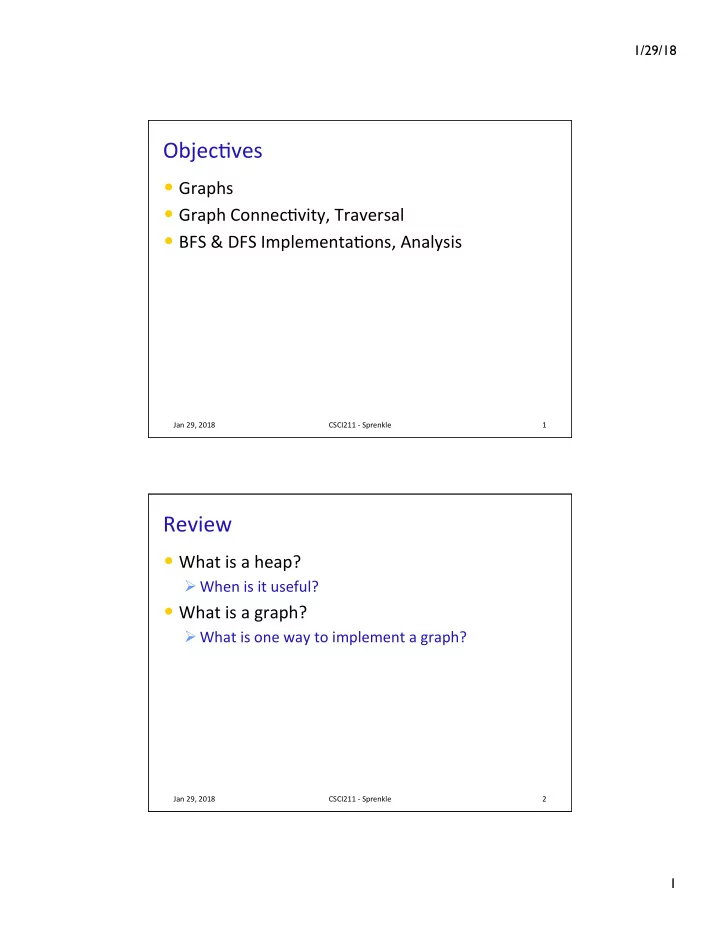
1/29/18 Objec&ves Graphs Graph Connec&vity, Traversal BFS & DFS Implementa&ons, Analysis Jan 29, 2018 CSCI211 - Sprenkle 1 Review What is a heap? When is it useful? What is a graph? What is one way to


slide-1
SLIDE 1

1/29/18 1

Objec&ves

  • Graphs
  • Graph Connec&vity, Traversal
  • BFS & DFS Implementa&ons, Analysis

Jan 29, 2018 1 CSCI211 - Sprenkle

Review

  • What is a heap?

Ø When is it useful?

  • What is a graph?

Ø What is one way to implement a graph?

Jan 29, 2018 CSCI211 - Sprenkle 2

slide-2
SLIDE 2

1/29/18 2

Graph Representa&on: Adjacency Matrix

  • n×n matrix with Auv = 1 if (u, v) is an edge

Ø Two representa&ons of each edge (symmetric matrix) Ø Space? Ø Checking if (u, v) is an edge? Ø Iden&fying all edges?

3

1 2 3 4 5 6 7 8 1 0 1 1 0 0 0 0 0 2 1 0 1 1 1 0 0 0 3 1 1 0 0 1 0 1 1 4 0 1 0 0 1 0 0 0 5 0 1 1 1 0 1 0 0 6 0 0 0 0 1 0 0 0 7 0 0 1 0 0 0 0 1 8 0 0 1 0 0 0 1 0

Jan 29, 2018 CSCI211 - Sprenkle

Graph Representa&on: Adjacency Matrix

  • n×n matrix with Auv = 1 if (u, v) is an edge

Ø Two representa&ons of each edge (symmetric matrix) Ø Space: Θ(n2) Ø Checking if (u, v) is an edge: Θ(1) &me Ø Iden&fying all edges: Θ(n2) &me

4 Jan 29, 2018 CSCI211 - Sprenkle

1 2 3 4 5 6 7 8 1 0 1 1 0 0 0 0 0 2 1 0 1 1 1 0 0 0 3 1 1 0 0 1 0 1 1 4 0 1 0 0 1 0 0 0 5 0 1 1 1 0 1 0 0 6 0 0 0 0 1 0 0 0 7 0 0 1 0 0 0 0 1 8 0 0 1 0 0 0 1 0

slide-3
SLIDE 3

1/29/18 3

Graph Representa&on: Adjacency List

  • Node indexed array of lists

Ø Two representa&ons of each edge Ø Space? Ø Checking if (u, v) is an edge? Ø Iden&fying all edges?

5

1 2 3 2 3 4 2 5 5 6 7 3 8 8 1 3 4 5 1 2 5 8 7 2 3 4 6 5 3 7

node edges

Jan 29, 2018 CSCI211 - Sprenkle

What are the extremes?

Graph Representa&on: Adjacency List

  • Node indexed array of lists

Ø Two representa&ons of each edge Ø Space = 2m + n = O(m + n) Ø Checking if (u, v) is an edge takes O(deg(u)) &me Ø Iden&fying all edges takes Θ(m + n) &me

Jan 29, 2018 CSCI211 - Sprenkle 6

degree = number of neighbors of u

node edges

1 2 3 2 3 4 2 5 5 6 7 3 8 8 1 3 4 5 1 2 5 8 7 2 3 4 6 5 3 7

slide-4
SLIDE 4

1/29/18 4

Paths and Connec&vity

  • Def. A path in an undirected graph G = (V, E) is a

sequence P of nodes v1, v2, …, vk-1, vk

Ø Each consecu&ve pair vi, vi+1 is joined by an edge in E

  • Def. A path is simple if all nodes are dis%nct
  • Def. An undirected graph is connected if ∀ pair
  • f nodes u and v, there is a path between u and v

7

  • Short path
  • Distance

Jan 29, 2018 CSCI211 - Sprenkle

Cycles

  • Def. A cycle is a path v1, v2, …, vk-1, vk in which v1

= vk, k > 3, and the first k-1 nodes are all dis&nct

8

cycle C = 1-2-4-5-3-1

Jan 29, 2018 CSCI211 - Sprenkle

slide-5
SLIDE 5

1/29/18 5

TREES

Jan 29, 2018 CSCI211 - Sprenkle 9

Trees

  • Def. An undirected graph is a tree if it is

connected and does not contain a cycle

  • Simplest connected graph

Ø Dele&ng any edge from a tree will disconnect it

10 Jan 29, 2018 CSCI211 - Sprenkle

slide-6
SLIDE 6

1/29/18 6

Rooted Trees

  • Given a tree T, choose a root node r and orient

each edge away from r

  • Models hierarchical structure

11

a tree

v parent of v child of v root r

Jan 29, 2018 CSCI211 - Sprenkle

Why n-1 edges? the same tree, rooted at 1

Rooted Trees

  • Why n-1 edges?

Ø Each non-root node has an edge to its parent

12 Jan 29, 2018 CSCI211 - Sprenkle

a tree

v parent of v child of v root r

the same tree, rooted at 1

slide-7
SLIDE 7

1/29/18 7

Trees

  • Theorem. Let G be an undirected graph on n
  • nodes. Any two of the following statements

imply the third:

Ø G is connected Ø G does not contain a cycle Ø G has n-1 edges

13 Jan 29, 2018 CSCI211 - Sprenkle

Phylogeny Trees

  • Describe evolu&onary

history of species

Ø mammals and birds share a common ancestor that they do not share with other species Ø all animals are descended from an ancestor not shared with mushrooms, trees, and bacteria

14

animals

Jan 29, 2018 CSCI211 - Sprenkle

slide-8
SLIDE 8

1/29/18 8

GRAPH CONNECTIVITY & TRAVERSAL

Jan 29, 2018 CSCI211 - Sprenkle 15

Connec&vity

  • s-t connec9vity problem. Given nodes

s and t, is there a path between s and t?

  • s-t shortest path problem. Given nodes

s and t, what is the length of the shortest path between s and t?

  • Applica&ons

Ø Facebook Ø Maze traversal Ø Kevin Bacon number Ø Spidering the web Ø Fewest number of hops in a communica&on network

Jan 29, 2018 CSCI211 - Sprenkle 16

slide-9
SLIDE 9

1/29/18 9

Applica&on: Connected Component

  • Find all nodes reachable from s
  • Connected component containing node 1 is { 1,

2, 3, 4, 5, 6, 7, 8 }

Jan 29, 2018 CSCI211 - Sprenkle 17

Applica&on: Flood Fill

  • Given lime green pixel in an image, change color
  • f en&re blob of neighboring lime pixels to blue

Ø Node: pixel Ø Edge: two neighboring lime pixels Ø Blob: connected component of lime pixels

Jan 29, 2018 CSCI211 - Sprenkle 18

recolor lime green blob to blue

slide-10
SLIDE 10

1/29/18 10

Applica&on: Flood Fill

  • Given lime green pixel in an image, change color
  • f en&re blob of neighboring lime pixels to blue

Ø Node: pixel Ø Edge: two neighboring lime pixels Ø Blob: connected component of lime pixels

Jan 29, 2018 CSCI211 - Sprenkle 19

recolor lime green blob to blue

My Facebook Friends

Jan 29, 2018 CSCI211 - Sprenkle 20

HS Extreme Blue

Created with Social Graph

Family Duke Gburg UDel

slide-11
SLIDE 11

1/29/18 11

A General Algorithm

  • R will be the connected component containing s
  • Algorithm is underspecified

Jan 29, 2018 CSCI211 - Sprenkle 21

R will consist of nodes to which s has a path R = {s} while there is an edge (u,v) where u∈R and v∉R add v to R

s u v

R

it's safe to add v

In what order should we consider the edges?

Possible Orders

  • Breadth-first
  • Depth-first

Jan 29, 2018 CSCI211 - Sprenkle 22

slide-12
SLIDE 12

1/29/18 12

Breadth-First Search

  • Intui9on. Explore outward from s in all possible

direc&ons (edges), adding nodes one "layer" at a &me

  • Algorithm

Ø L0 = { s } Ø L1 = all neighbors of L0 Ø L2 = all nodes that have an edge to a node in L1 and do not belong to L0 or L1 Ø Li+1 = all nodes that have an edge to a node in Li and do not belong to an earlier layer

Jan 29, 2018 CSCI211 - Sprenkle 23

s L1 L2 L n-1 L0

Run BFS on This Graph

Jan 29, 2018 CSCI211 - Sprenkle 24

s = 1

slide-13
SLIDE 13

1/29/18 13

Example of Breadth-First Search

Jan 29, 2018 CSCI211 - Sprenkle 25

L0 L1 L2 L3

s = 1 Creates a tree

  • - is a node in the graph that is not in the tree

Breadth-First Search

  • Theorem.

For each i, Li consists of all nodes at distance exactly i from s. There is a path from s to t iff t appears in some layer.

Jan 29, 2018 CSCI211 - Sprenkle 26

s L1 L2 L n-1

  • What does this theorem mean?
  • Can we determine the distance between s and t?
slide-14
SLIDE 14

1/29/18 14

Looking Ahead

  • Monday, 11:59 p.m.: journal - Chapter 2.4, 2.5,

3.1

  • Friday: Problem Set 3 due

Jan 29, 2018 CSCI211 - Sprenkle 27